
- 분류 전체보기 (1053)

- Linguistics (고급 영어학) (10)
- Stylistics (6)
- Etymology & Word Building (15)
- Philosophy Meets Grammar (6)
- Collection of Famous Quotes (22)
- English Mechanism (276)
- The Language Beyond Grammar (274)
- Living English (81)
- Miso’s Life Notes (18)
- My English Journey and Refl.. (16)
- Philosophy (132)
- Video Clip (16)
- Airline English (항공 영어) (47)
- Creative Corner (35)
- Sally & Sia (1)
| 일 | 월 | 화 | 수 | 목 | 금 | 토 |
|---|---|---|---|---|---|---|
| 1 | 2 | 3 | 4 | |||
| 5 | 6 | 7 | 8 | 9 | 10 | 11 |
| 12 | 13 | 14 | 15 | 16 | 17 | 18 |
| 19 | 20 | 21 | 22 | 23 | 24 | 25 |
| 26 | 27 | 28 | 29 | 30 |
- 인도철학 #동양철학 #인문학 #요가 #명상 #힌두교 #불교 #간디 #타고르 #정통6파 #철학공부 #마음공부 #MisoEnglish #인문학영어
- 영어문법
- English for Korean Learners
- EnglishWriting #AcademicWriting #Grammar #EnglishLanguage #EssayWriting #ParagraphStructure #SentenceStructure #BusinessEnglish #EnglishTips #WritingSkills #Linguistics #ESL
- ticketing
- 영어접속사
- 영어회화
- 영문법
- 감성영어
- pnr
- misoenglish
- MisoEnglish#철학입문 #Philosophy #종교철학 #PhilosophyOfReligion #철학공부 #신존재증명 #악의문제 #PhilosophyForBeginners #교육콘텐츠 #철학시리즈
- MisoEnglish#철학입문 #Philosophy #과학철학 #PhilosophyOfScience #철학공부 #포퓨퍼 #쿠hn #과학방법론 #교육콘텐츠 #철학시리즈
- English in English
- 🌿 English with Heart
- Basic English Verbs
- 영어공부
- MisoEnglish#철학입문 #Philosophy #윤리학 #Ethics #도덕철학 #철학공부 #칸트 #공리주의 #교육콘텐츠 #철학시리즈
- English Speaking Practice
- AirlineOpsEnglish
- MisoEnglish#철학입문 #Philosophy #심리철학 #PhilosophyOfMind #철학공부 #의식 #마음 #PhilosophyForBeginners #교육콘텐츠 #철학시리즈
- MisoEnglish#철학입문 #Philosophy #정치철학 #PoliticalPhilosophy #철학공부 #정의론 #자유주의 #PhilosophyForBeginners #교육콘텐츠 #철학시리즈
- 영국사 #영국역사 #세계사 #역사연재 #브리튼에서영국까지
- 동양정치철학 #시리즈완결 #아시아적가치 #동서양비교 #유교 #민주주의 #정치사상 #인문학 #비교철학 #글로벌정치 #문화다양성 #2500년철학사
- MisoEnglish#불교철학 #BuddhismPhilosophy #사성제 #FourNobleTruths #공사상 #Emptiness #명상 #Mindfulness #열반 #EasternWisdom
- everyday English
- MisoEnglish#유교철학 #Confucianism #성리학 #NeoConfucianism #인의예지 #Virtue #맹자 #Mencius #실학 #KoreanScholarship
- MisoEnglish#철학입문 #Philosophy #형이상학 #Metaphysics #철학공부 #존재론 #실재론 #PhilosophyForBeginners #교육콘텐츠 #철학시리즈
- MisoEnglish#한국철학 #KoreanPhilosophy #홍익인간 #Hongik #화랑도 #Hwarang #단군 #Dangun #풍류도 #ThreeKingdoms#동양철학
- MisoEnglish#도교철학 #Taoism #도덕경 #TaoTeChing #무위자연 #WuWei #노자 #Laozi #장자 #YinYang
- Today
- Total
MisoEnglish
Episode 19 — 형용사: 명사를 살아있게 만드는 법 본문
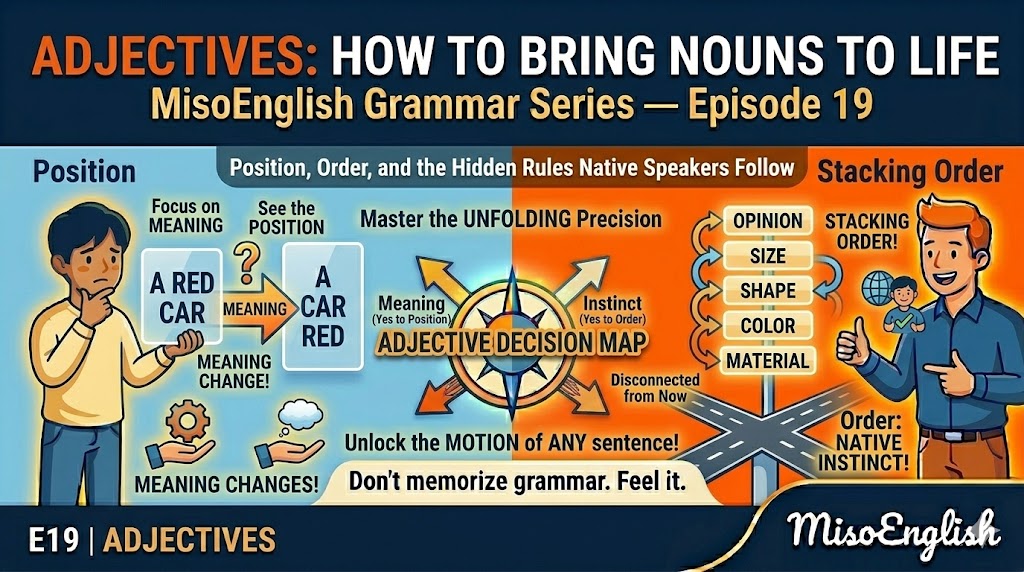
MisoEnglish Grammar Series
Episode 19 — 형용사
명사를 살아있게 만드는 법
"문법을 외우지 말고, 느껴라" Don't memorize grammar. Feel it.
🧭 들어가며 | Introduction
형용사는 명사를 꾸민다. 이건 누구나 안다.
Adjectives modify nouns. Everyone knows that.
하지만 영어의 형용사에는 대부분의 학습자가 모르는 두 가지 중요한 사실이 있다.
But English adjectives have two important facts that most learners don't know.
첫째, 형용사의 위치에 따라 의미가 달라질 수 있다. 둘째, 명사 앞에 형용사를 여러 개 쓸 때는 순서가 있다.
First, the position of an adjective can change its meaning. Second, when multiple adjectives precede a noun, they follow a specific order.
이 두 가지를 느끼는 순간, 영어 묘사가 훨씬 자연스러워진다.
The moment you feel these two things, your English descriptions become far more natural.
1. 형용사의 두 가지 위치 | Two Positions of Adjectives
영어 형용사는 두 가지 위치에 쓰인다.
English adjectives appear in two positions.
① 한정적 용법 — 명사 앞 | Attributive — Before the Noun
명사를 직접 수식할 때. 명사 바로 앞에 위치한다.
Directly modifying the noun. Placed immediately before it.
a beautiful woman 아름다운 여성
the old man 그 나이 든 남자
a red apple 빨간 사과
a hot cup of coffee 뜨거운 커피 한 잔
② 서술적 용법 — 동사 뒤 | Predicative — After the Verb
be동사나 상태 동사 뒤에서 주어의 상태를 설명할 때.
Describing the state of the subject — after be or stative verbs.
She is beautiful. 그녀는 아름답다.
The man looks old. 그 남자는 나이 들어 보인다.
The apple is red. 사과는 빨갛다.
The coffee smells good. 커피 냄새가 좋다.
2. 위치에 따라 의미가 달라지는 형용사 | Adjectives That Change Meaning by Position
일부 형용사는 명사 앞에 오느냐, 뒤에 오느냐에 따라 의미가 완전히 달라진다. 이것이 영어를 흥미롭게 만드는 지점이다.
Some adjectives change meaning completely depending on their position. This is what makes English fascinating.
형용사 한정적 (명사 앞) 서술적 (동사 뒤)
| present | the present situation (현재의 상황) | Everyone present agreed. (참석한 모든 사람) |
| late | the late president (고 대통령, 故) | She was late. (늦었다) |
| certain | a certain person (어떤 특정한 사람) | I'm certain. (확신한다) |
| involved | the involved parties (관련 당사자들) | The costs involved are high. (수반되는 비용) |
| concerned | the concerned parents (걱정하는 부모들) | She is concerned. (걱정한다) |
The late Mr. Kim was a great leader.
고(故) 김 씨는 훌륭한 지도자였다. (late = 故, 작고한)
She was late for work.
그녀는 일에 늦었다. (late = 늦은)
3. 서술적으로만 쓰이는 형용사 | Adjectives Used Only Predicatively
명사 앞에 올 수 없고, 반드시 동사 뒤에만 오는 형용사들이 있다. 주로 a-로 시작하는 형용사들이다.
Some adjectives can only follow a verb — never precede a noun. These are mostly adjectives starting with a-.
She is asleep. ✅ / ~~the asleep baby~~ ❌ → the sleeping baby ✅
He is alive. ✅ / ~~the alive fish~~ ❌ → the living fish ✅
She is alone. ✅ / ~~the alone woman~~ ❌ → the lonely woman ✅
I am afraid. ✅ / ~~the afraid child~~ ❌ → the frightened child ✅
He is aware. ✅ / ~~the aware person~~ ❌
기억법: asleep, alive, alone, afraid, aware, ashamed, alike — a로 시작하면 서술적!
Memory tip: asleep, alive, alone, afraid, aware, ashamed, alike — if it starts with a-, it's predicative only!
4. 형용사 순서 — 숨겨진 규칙 | Adjective Order — The Hidden Rule
명사 앞에 형용사를 여러 개 쓸 때, 영어에는 정해진 순서가 있다. 원어민들은 이 순서를 무의식적으로 따른다.
When multiple adjectives precede a noun, English follows a fixed order. Native speakers follow this instinctively — without thinking.
형용사 순서 | The Order
1. 수량 Quantity       → three, some, a few
2. 의견 Opinion        → beautiful, ugly, strange, wonderful
3. 크기 Size           → big, small, tiny, large
4. 나이 Age            → old, young, new, ancient
5. 모양 Shape          → round, square, flat
6. 색깔 Color          → red, blue, dark
7. 출신 Origin         → Korean, French, Italian
8. 재료 Material       → wooden, cotton, golden
9. 목적 Purpose        → sleeping (bag), running (shoes)
10. 명사 Noun          → bag, shoes, car
기억법 | Memory Aid: Q-O-S-A-S-C-O-M-P Quantity — Opinion — Size — Age — Shape — Color — Origin — Material — Purpose
예문으로 보기 | Examples
a beautiful small old Italian leather bag
아름다운 작은 오래된 이탈리아산 가죽 가방
→ 의견(beautiful) → 크기(small) → 나이(old) → 출신(Italian) → 재료(leather)
three tiny round white Japanese paper lanterns
세 개의 작고 동그란 흰 일본산 종이 등롱
→ 수량(three) → 크기(tiny) → 모양(round) → 색깔(white) → 출신(Japanese) → 재료(paper)
two big old black wooden chairs
크고 오래된 두 개의 검은 나무 의자
→ 수량(two) → 크기(big) → 나이(old) → 색깔(black) → 재료(wooden)
⚠️ 이 순서를 어기면 원어민에게 매우 어색하게 들린다.
Breaking this order sounds very unnatural to native speakers.
~~an Italian beautiful old small leather bag~~ ❌ (매우 어색)
a beautiful small old Italian leather bag ✅
5. 형용사 vs 부사 | Adjective vs Adverb
많은 학습자들이 형용사와 부사를 혼용한다. 간단한 원칙: 형용사는 명사를 수식, 부사는 동사/형용사/다른 부사를 수식.
Many learners mix up adjectives and adverbs. Simple rule: adjectives modify nouns; adverbs modify verbs, adjectives, or other adverbs.
She is a good singer.
그녀는 훌륭한 가수다. (good = 형용사, singer 수식)
She sings well.
그녀는 노래를 잘 한다. (well = 부사, sings 수식)
He is a quick runner.
그는 빠른 달리기 선수다. (quick = 형용사)
He runs quickly.
그는 빠르게 달린다. (quickly = 부사)
⚠️ 흔한 실수 | Common Mistakes
~~She sings good.~~ ❌ → She sings well. ✅
~~He runs quick.~~ ❌ → He runs quickly. ✅
~~I feel badly about it.~~ ❌ → I feel bad about it. ✅
(feel은 상태 동사 → 형용사 bad 사용)
6. 주의해야 할 형용사들 | Tricky Adjectives
-ly로 끝나지만 형용사인 것들 | Adjectives Ending in -ly
부사처럼 보이지만 실제로는 형용사인 단어들.
Words that look like adverbs but are actually adjectives.
friendly 친근한 / lovely 사랑스러운 / lonely 외로운 lively 활기찬 / silly 어리석은 / elderly 나이 든 cowardly 겁쟁이 같은 / likely ~할 것 같은
She is a friendly person. ✅ (형용사)
~~She behaves friendlily.~~ ❌ → She behaves in a friendly way. ✅
📌 이번 편 요약 | Episode Summary
- 한정적 용법 — 명사 앞에서 직접 수식 Attributive — directly before the noun.
- 서술적 용법 — 동사 뒤에서 주어 상태 설명 Predicative — after the verb, describing the subject.
- 위치에 따라 의미가 달라진다 — late, present, certain 등 Position changes meaning — late, present, certain.
- a-로 시작하는 형용사는 서술적으로만 — asleep, alive, alone, afraid a- adjectives are predicative only — asleep, alive, alone, afraid.
- 형용사 순서: 의견→크기→나이→모양→색깔→출신→재료→목적 Adjective order: Opinion→Size→Age→Shape→Color→Origin→Material→Purpose
- 형용사 ≠ 부사 — good(형용사) / well(부사), bad(형용사) / badly(부사) Adjective ≠ adverb — good/well, bad/badly.
🔜 다음 편 예고 | Coming Up Next
Episode 20 — 부사 : 동사와 문장 전체를 조율하는 법 Adverbs: How to Fine-Tune Verbs and Entire Sentences
부사는 단순히 "-게"를 붙이는 게 아니다. 동사, 형용사, 다른 부사, 문장 전체를 조율하는 영어의 정밀한 도구다.
Adverbs aren't just adding "-ly." They fine-tune verbs, adjectives, other adverbs, and even entire sentences.
© MisoEnglish Grammar Series | Level 3 — Episode 19 "문법을 외우지 말고, 느껴라" | "Don't memorize grammar. Feel it."
Adjectives: How to Bring Nouns to Life
Position, Order, and the Hidden Rules Native Speakers Follow
MisoEnglish Grammar Series — Episode 19
"Don't memorize grammar. Feel it."
Introduction
You already know adjectives describe nouns. But English adjectives carry two surprises that most learners never encounter in a textbook.
First: the position of an adjective can change its meaning entirely. Second: when you stack multiple adjectives before a noun, they follow a strict hidden order that native speakers apply instinctively.
Master these two things, and your English descriptions will suddenly sound far more natural.
1. Two Positions of Adjectives
Attributive — before the noun
a beautiful woman the old man a red apple
Predicative — after a verb
She is beautiful.
The man looks old.
The apple is red.
The coffee smells good.
Most adjectives work in both positions. But some behave differently depending on where they sit.
2. Adjectives That Change Meaning by Position
Adjective Before noun After verb
| late | the late president (deceased) | She was late (not on time) |
| present | the present situation (current) | Everyone present agreed (in attendance) |
| certain | a certain person (a specific, unnamed one) | I'm certain (sure) |
| concerned | the concerned parents (worried) | She is concerned (worried) |
The late Mr. Kim was a great leader. (He has passed away.)
She was late for work. (She arrived after the expected time.)
3. Adjectives Used Only After Verbs (Predicative Only)
These adjectives cannot appear before a noun. Most of them start with a-.
She is asleep. ✅ / ~~the asleep baby~~ ❌ → the sleeping baby ✅
He is alive. ✅ / ~~the alive fish~~ ❌ → the living fish ✅
She is alone. ✅ / ~~the alone woman~~ ❌ → the lonely woman ✅
I am afraid. ✅ / ~~the afraid child~~ ❌ → the frightened child ✅
Memory tip: asleep, alive, alone, afraid, aware, ashamed, alike — starts with a-, stays after the verb.
4. Adjective Order — The Hidden Rule
When multiple adjectives precede a noun, English follows a fixed sequence. Native speakers apply this without thinking — but breaking it sounds immediately wrong.
1. Quantity     → three, some, a few
2. Opinion      → beautiful, ugly, strange, wonderful
3. Size         → big, small, tiny, large
4. Age          → old, young, new, ancient
5. Shape        → round, square, flat
6. Color        → red, blue, dark
7. Origin       → Korean, French, Italian
8. Material     → wooden, cotton, golden
9. Purpose      → sleeping (bag), running (shoes)
10. Noun
Memory aid: Q-O-S-A-S-C-O-M-P Quantity — Opinion — Size — Age — Shape — Color — Origin — Material — Purpose
Examples
a beautiful small old Italian leather bag
→ Opinion → Size → Age → Origin → Material
three tiny round white Japanese paper lanterns
→ Quantity → Size → Shape → Color → Origin → Material
two big old black wooden chairs
→ Quantity → Size → Age → Color → Material
~~an Italian beautiful old small leather bag~~ ❌ (sounds completely wrong)
a beautiful small old Italian leather bag ✅
5. Adjective vs. Adverb
Adjectives modify nouns. Adverbs modify verbs, adjectives, or other adverbs.
She is a good singer. (good = adjective, modifies "singer")
She sings well. (well = adverb, modifies "sings")
He is a quick runner. (adjective)
He runs quickly. (adverb)
Common mistakes:
~~She sings good.~~ ❌ → She sings well. ✅
~~He runs quick.~~ ❌ → He runs quickly. ✅
~~I feel badly about it.~~ ❌ → I feel bad about it. ✅
(feel is a stative verb → use adjective "bad")
6. Adjectives That End in -ly
These look like adverbs but are actually adjectives:
friendly / lovely / lonely / lively / silly / elderly / cowardly / likely
She is a friendly person.
✅ ~~She behaves friendlily.~~ ❌ → She behaves in a friendly way. ✅
Episode Summary
- Attributive — before the noun, direct modification.
- Predicative — after the verb, describing the subject's state.
- Position changes meaning — late, present, certain.
- a- adjectives = predicative only — asleep, alive, alone, afraid.
- Adjective order: Opinion→Size→Age→Shape→Color→Origin→Material→Purpose
- Adjective ≠ adverb — good/well, bad/badly, quick/quickly.
Coming Up Next
Episode 20 — Adverbs: How to Fine-Tune Verbs and Entire Sentences
Adverbs do far more than add "-ly" to adjectives. They adjust verbs, other adjectives, entire sentences — and their placement changes emphasis in ways that matter.
© MisoEnglish Grammar Series | Level 3 — Episode 19 "Don't memorize grammar. Feel it."
⚠️ 저작권 안내
본 블로그(MisoEnglish · slowblooms.tistory.com)의 모든 콘텐츠는 저작권법의 보호를 받습니다. 글, 예시 문장, 분석 내용 등 블로그에 게시된 모든 창작물은 저작자의 동의 없이 무단으로 복사, 복제, 배포, 2차 가공하는 행위를 금지합니다. 출처를 밝히지 않은 전재, SNS·커뮤니티·타 블로그 등에의 무단 게시, 상업적 이용은 모두 금지되며, 무단 불펌 적발 시 저작권법에 따라 법적 조치가 취해질 수 있습니다. 콘텐츠 사용 문의는 slowblooms.tistory.com으로 연락 주세요.
© MisoEnglish · slowblooms.tistory.com. All rights reserved.
━━━━━━━━━━━━━━━━━━━━━━━━━━━━━━━━
⚠️ Copyright Notice
All content published on this blog (MisoEnglish · slowblooms.tistory.com) is protected by copyright law. Copying, reproducing, distributing, or adapting any written posts, example sentences, or analyses without the explicit consent of the author is strictly prohibited. Unauthorised reposting on other blogs, social media, online communities, or any public platform — with or without modification — is not permitted, and may result in legal action under applicable copyright law. For content licensing enquiries, please contact us via slowblooms.tistory.com.
© MisoEnglish · slowblooms.tistory.com. All rights reserved.
'English Mechanism' 카테고리의 다른 글
| Episode 21 — 비교급과 최상급: 더하고 빼는 영어의 방식 (1) | 2026.03.01 |
|---|---|
| Episode 20 — 부사: 동사와 문장 전체를 조율하는 법 (0) | 2026.02.28 |
| Episode 18 — 전치사 심화: 규칙이 아니라 이미지로 익혀라 (0) | 2026.02.28 |
| Episode 17 — 전치사 in · on · at: 공간과 시간을 느끼는 법 (0) | 2026.02.28 |
| Episode 16 — 셀 수 있는 명사 vs 셀 수 없는 명사 (0) | 2026.02.28 |


