
- 분류 전체보기 (1053)

- Linguistics (고급 영어학) (10)
- Stylistics (6)
- Etymology & Word Building (15)
- Philosophy Meets Grammar (6)
- Collection of Famous Quotes (22)
- English Mechanism (276)
- The Language Beyond Grammar (274)
- Living English (81)
- Miso’s Life Notes (18)
- My English Journey and Refl.. (16)
- Philosophy (132)
- Video Clip (16)
- Airline English (항공 영어) (47)
- Creative Corner (35)
- Sally & Sia (1)
| 일 | 월 | 화 | 수 | 목 | 금 | 토 |
|---|---|---|---|---|---|---|
| 1 | 2 | 3 | 4 | |||
| 5 | 6 | 7 | 8 | 9 | 10 | 11 |
| 12 | 13 | 14 | 15 | 16 | 17 | 18 |
| 19 | 20 | 21 | 22 | 23 | 24 | 25 |
| 26 | 27 | 28 | 29 | 30 |
- MisoEnglish#한국철학 #KoreanPhilosophy #홍익인간 #Hongik #화랑도 #Hwarang #단군 #Dangun #풍류도 #ThreeKingdoms#동양철학
- English Speaking Practice
- 🌿 English with Heart
- MisoEnglish#철학입문 #Philosophy #종교철학 #PhilosophyOfReligion #철학공부 #신존재증명 #악의문제 #PhilosophyForBeginners #교육콘텐츠 #철학시리즈
- EnglishWriting #AcademicWriting #Grammar #EnglishLanguage #EssayWriting #ParagraphStructure #SentenceStructure #BusinessEnglish #EnglishTips #WritingSkills #Linguistics #ESL
- pnr
- everyday English
- MisoEnglish#철학입문 #Philosophy #과학철학 #PhilosophyOfScience #철학공부 #포퓨퍼 #쿠hn #과학방법론 #교육콘텐츠 #철학시리즈
- English in English
- MisoEnglish#유교철학 #Confucianism #성리학 #NeoConfucianism #인의예지 #Virtue #맹자 #Mencius #실학 #KoreanScholarship
- AirlineOpsEnglish
- 영국사 #영국역사 #세계사 #역사연재 #브리튼에서영국까지
- ticketing
- 인도철학 #동양철학 #인문학 #요가 #명상 #힌두교 #불교 #간디 #타고르 #정통6파 #철학공부 #마음공부 #MisoEnglish #인문학영어
- 영문법
- misoenglish
- MisoEnglish#불교철학 #BuddhismPhilosophy #사성제 #FourNobleTruths #공사상 #Emptiness #명상 #Mindfulness #열반 #EasternWisdom
- Basic English Verbs
- MisoEnglish#철학입문 #Philosophy #윤리학 #Ethics #도덕철학 #철학공부 #칸트 #공리주의 #교육콘텐츠 #철학시리즈
- MisoEnglish#철학입문 #Philosophy #심리철학 #PhilosophyOfMind #철학공부 #의식 #마음 #PhilosophyForBeginners #교육콘텐츠 #철학시리즈
- MisoEnglish#철학입문 #Philosophy #형이상학 #Metaphysics #철학공부 #존재론 #실재론 #PhilosophyForBeginners #교육콘텐츠 #철학시리즈
- 영어접속사
- 감성영어
- MisoEnglish#철학입문 #Philosophy #정치철학 #PoliticalPhilosophy #철학공부 #정의론 #자유주의 #PhilosophyForBeginners #교육콘텐츠 #철학시리즈
- English for Korean Learners
- MisoEnglish#도교철학 #Taoism #도덕경 #TaoTeChing #무위자연 #WuWei #노자 #Laozi #장자 #YinYang
- 영어회화
- 영어공부
- 영어문법
- 동양정치철학 #시리즈완결 #아시아적가치 #동서양비교 #유교 #민주주의 #정치사상 #인문학 #비교철학 #글로벌정치 #문화다양성 #2500년철학사
- Today
- Total
MisoEnglish
Episode 17 — 전치사 in · on · at: 공간과 시간을 느끼는 법 본문
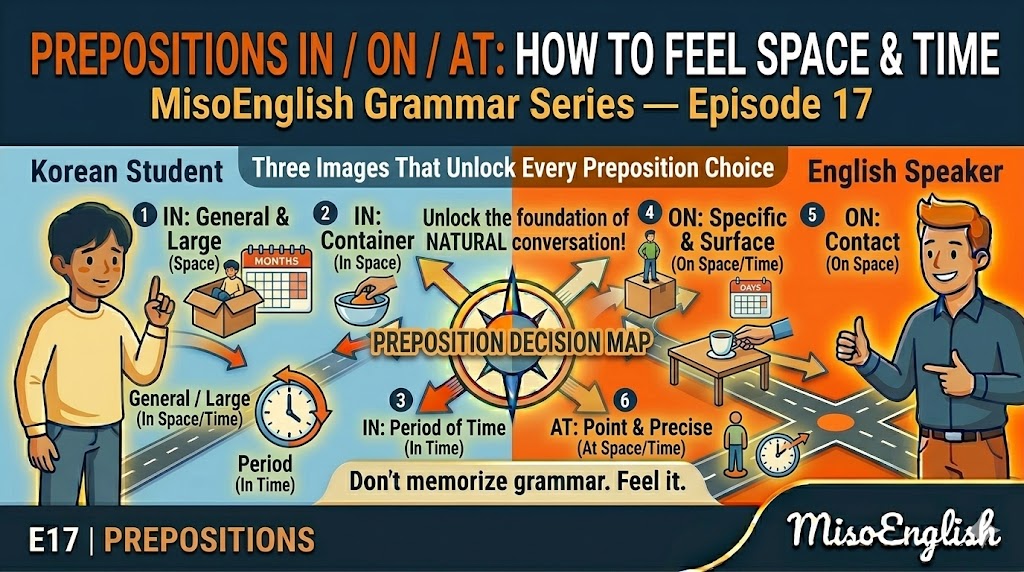
MisoEnglish Grammar Series
Episode 17 — 전치사 in · on · at
공간과 시간을 느끼는 법
"문법을 외우지 말고, 느껴라" Don't memorize grammar. Feel it.
🧭 들어가며 | Introduction
전치사는 외우는 게 아니다.
Prepositions aren't memorized.
in, on, at — 이 세 개는 영어에서 가장 자주 쓰이는 전치사다. 그런데 많은 학습자들이 이것을 경우의 수 목록으로 외우려 한다.
in, on, at — the three most common prepositions in English. But many learners try to memorize them as a list of cases.
그게 가장 큰 실수다. 각각의 전치사에는 이미지가 있다. 그 이미지를 느끼는 순간, 어떤 상황에서도 올바른 전치사가 떠오른다.
That's the biggest mistake. Each preposition carries an image. The moment you feel that image, the right preposition comes to you in any situation.
1. 세 전치사의 핵심 이미지 | The Core Images
at  →  한 점 (a point)          📍
on  →  표면 위 (a surface)      📄
in  →  안에 (inside / within)   📦
이 세 이미지가 모든 것을 설명한다. 공간이든 시간이든, 이 이미지로 느끼면 된다.
These three images explain everything. Whether space or time — feel these images.
2. 공간의 전치사 | Prepositions of Place
at — 한 점, 특정 지점 | A Point, A Specific Spot
어딘가에 있다는 것을 점으로 표시할 때. 장소를 하나의 지점으로 인식한다.
When marking that something is at a specific point. The location is perceived as a single spot.
She is at the bus stop. 그녀는 버스 정류장에 있다.
I'll meet you at the entrance. 입구에서 만나자.
He works at the hospital. 그는 병원에서 일한다.
We arrived at the airport. 우리는 공항에 도착했다.
She is at home. 그녀는 집에 있다.
on — 표면 위 | On a Surface
어떤 표면에 닿아 있을 때. 위, 아래, 옆 표면 모두 포함.
When something is touching a surface. Includes top, bottom, and side surfaces.
The book is on the table. 책이 테이블 위에 있다.
There's a fly on the ceiling. 천장에 파리가 있다.
She has a tattoo on her arm. 그녀는 팔에 문신이 있다.
The picture is on the wall. 그림이 벽에 걸려 있다.
We live on the third floor. 우리는 3층에 산다.
in — 안에, 둘러싸인 | Inside, Enclosed
어떤 공간 안에 있을 때. 물리적 공간뿐만 아니라 개념적 공간도 포함.
When something is inside a space. Includes physical and conceptual spaces.
She is in the kitchen. 그녀는 부엌에 있다.
He lives in Seoul. 그는 서울에 산다.
The keys are in my bag. 열쇠는 가방 안에 있다.
I saw it in the newspaper. 나는 신문에서 그것을 봤다.
She is in a meeting. 그녀는 회의 중이다.
비교해보기 | Compare
She is at the school.
그녀는 학교(지점)에 있다. (학교 건물 어딘가에)
She is in the school.
그녀는 학교 안에 있다. (건물 내부에)
He is at the hospital.
그는 병원에 있다. (환자나 방문객으로)
He works in the hospital.
그는 병원 내부에서 일한다.
3. 시간의 전치사 | Prepositions of Time
공간에서 쓰던 이미지가 시간에도 그대로 적용된다.
The same images from space apply directly to time.
at — 시간의 한 점 | A Point in Time
정확한 시각이나 특정 순간을 가리킬 때.
A precise time or specific moment.
The meeting starts at 9. 회의는 9시에 시작한다.
I wake up at 7 am. 나는 오전 7시에 일어난다.
She called me at midnight. 그녀는 자정에 나에게 전화했다.
He left at noon. 그는 정오에 떠났다.
at과 자주 쓰이는 표현: at noon / at midnight / at sunrise / at sunset / at the moment / at the same time / at night*
⚠️ at night은 예외 — "밤에"라는 개념적 시점
on — 날짜와 요일의 표면 | Days and Dates
특정 날짜나 요일을 표현할 때. 날짜를 하나의 표면(면)으로 인식한다.
For specific days and dates. A day is perceived as a surface — a flat unit of time.
I'll call you on Monday. 월요일에 전화할게.
She was born on March 15th. 그녀는 3월 15일에 태어났다.
We met on a rainy afternoon. 우리는 비 오는 오후에 만났다.
The store is closed on Sundays. 그 가게는 일요일마다 닫는다.
on과 자주 쓰이는 표현: on Monday / on Christmas Day / on my birthday / on a weekday / on weekends*
⚠️ at the weekend (영국식) / on the weekend (미국식)
in — 기간 안에 | Within a Period
월, 년, 계절, 세기처럼 더 넓은 기간을 표현할 때. 그 기간 안에 있다는 느낌.
For months, years, seasons, centuries — larger periods of time. The feeling of being inside that period.
I was born in 1995. 나는 1995년에 태어났다.
She visits in summer. 그녀는 여름에 방문한다.
He started in January. 그는 1월에 시작했다.
This happened in the 20th century. 이것은 20세기에 일어났다.
I'll be back in an hour. 한 시간 후에 돌아올게. (기간 후)
in과 자주 쓰이는 표현: in the morning / in the afternoon / in the evening / in spring / in 2024 / in the past
⚠️ at night (밤에) — in the night은 "한밤중에"로 의미가 달라짐
4. 한눈에 비교 | Side-by-Side Comparison
공간 | Place
전치사 이미지 예문
| at | 한 점, 지점 | at the bus stop, at home |
| on | 표면 위 | on the table, on the wall |
| in | 안에, 내부 | in the room, in Seoul |
시간 | Time
전치사 이미지 예문
| at | 정확한 시각 | at 9, at midnight, at noon |
| on | 날짜/요일 | on Monday, on March 15th |
| in | 넓은 기간 | in 2024, in summer, in January |
5. 관용적 표현들 | Fixed Expressions
전치사는 규칙만으로 설명이 안 되는 관용 표현이 많다. 이것들은 덩어리째 익히는 게 가장 효과적이다.
Many prepositional expressions can't be explained by rules alone. These are best learned as fixed chunks.
at:
at first / at last / at least / at once at work / at school / at sea / at war at the age of / at a discount / at risk
on:
on time (정시에) / on sale / on purpose (일부러) on foot (걸어서) / on TV / on the phone on holiday / on a diet / on strike
in:
in time (제때에) / in advance (미리) / in fact in general / in public / in private in English / in ink / in cash
⚠️ on time vs in time
on time = 정시에, 딱 맞게 The train arrived on time. in time = 제때에, 늦지 않게 We arrived in time for the show.
6. 전치사가 없는 경우 | When No Preposition Is Used
시간 표현 앞에 this, last, next, every가 오면 전치사를 쓰지 않는다.
No preposition is used before time expressions with this, last, next, every.
~~on this Monday~~ ❌ → this Monday ✅
~~in last year~~ ❌ → last year ✅
~~on next Friday~~ ❌ → next Friday ✅
~~in every morning~~ ❌ → every morning ✅
📌 이번 편 요약 | Episode Summary
- at = 한 점 — 공간의 지점 / 정확한 시각 at = a point — specific location / precise time
- on = 표면 — 접촉하는 표면 / 날짜·요일 on = a surface — touching a surface / days and dates
- in = 안에 — 둘러싸인 공간 / 넓은 기간 in = inside — enclosed space / broader periods
- 이미지로 느껴라 — 규칙 목록이 아니라 세 개의 이미지 Feel the image — not a list of rules, but three pictures
- this/last/next/every 앞엔 전치사 없음 No preposition before this/last/next/every
🔜 다음 편 예고 | Coming Up Next
Episode 18 — 전치사 심화 : 규칙이 아니라 이미지로 익혀라 Prepositions in Depth: Learn by Image, Not by Rule
in, on, at을 넘어서. for, with, by, from, to, about, of — 나머지 핵심 전치사들이 만드는 이미지를 완성한다.
Beyond in, on, at. for, with, by, from, to, about, of — We complete the image map of the remaining core prepositions.
© MisoEnglish Grammar Series | Level 3 — Episode 17 "문법을 외우지 말고, 느껴라" | "Don't memorize grammar. Feel it."
Prepositions in / on / at: How to Feel Space and Time
Three Images That Unlock Every Preposition Choice
MisoEnglish Grammar Series — Episode 17
"Don't memorize grammar. Feel it."
Introduction
The biggest mistake learners make with prepositions is trying to memorize a list. "In is used for months. On is used for days. At is used for times." The list grows, the exceptions pile up, and nothing sticks.
Here's a better approach: each of these three prepositions carries a core image. Learn the image, and the right preposition follows naturally — in space, in time, and in fixed expressions.
1. The Three Core Images
at  →  a point          📍
on  →  a surface        📄
in  →  inside / within  📦
These three images apply consistently — whether you're talking about physical space or time.
2. Prepositions of Place
at — a specific point
"At" perceives a location as a single point — you are there, at that spot.
She is at the bus stop.
I'll meet you at the entrance.
He works at the hospital. She is at home.
on — touching a surface
"On" means contact with a surface — top, bottom, or side.
The book is on the table.
There's a fly on the ceiling.
She has a tattoo on her arm.
The picture is on the wall.
We live on the third floor.
in — inside an enclosed space
"In" means being inside a space — physical or conceptual.
She is in the kitchen.
He lives in Seoul.
The keys are in my bag.
She is in a meeting.
The subtle distinction
She is at the school. → She's there (at that location). She is in the school. → She's inside the building.
He is at the hospital. → He's there (as a patient or visitor). He works in the hospital. → He's inside, as an employee.
3. Prepositions of Time
The same images transfer directly to time.
at — a precise moment
The meeting starts at 9.
I wake up at 7 am.
She called me at midnight.
Common: at noon, at midnight, at sunrise, at sunset, at night, at the moment
on — a day or date (a flat unit of time)
I'll call you on Monday.
She was born on March 15th.
The store is closed on Sundays.
Common: on Monday, on Christmas Day, on my birthday, on weekends
in — inside a broader period
I was born in 1995.
She visits in summer.
He started in January.
I'll be back in an hour. (within that duration)
Common: in the morning, in the afternoon, in the evening, in spring, in 2024
4. Side-by-Side
Place
Preposition Image Examples
| at | a point | at the bus stop, at home |
| on | a surface | on the table, on the wall |
| in | inside | in the room, in Seoul |
Time
Preposition Image Examples
| at | precise time | at 9, at midnight |
| on | day / date | on Monday, on March 15th |
| in | broader period | in 2024, in summer |
5. Fixed Expressions
Many prepositional expressions don't follow the images — they're just fixed chunks to learn as whole phrases.
at: at first / at last / at least / at once / at work / at school / at risk / at the age of
on: on time / on sale / on purpose / on foot / on TV / on the phone / on holiday / on a diet
in: in time / in advance / in fact / in general / in public / in English / in cash
on time vs. in time
on time = exactly on schedule.
The train arrived on time.
in time = not too late.
We arrived in time for the show.
Both involve punctuality — but "on time" is precise, "in time" just means you didn't miss it.
6. No Preposition Before this / last / next / every
~~on this Monday~~ ❌ → this Monday ✅
~~in last year~~ ❌ → last year ✅
~~on next Friday~~ ❌ → next Friday ✅
~~in every morning~~ ❌ → every morning ✅
When this, last, next, or every comes before a time expression, the preposition drops entirely.
Episode Summary
- at = a point — specific spot in space / precise moment in time.
- on = a surface — physical contact / days and dates.
- in = inside — enclosed space / broader time periods.
- Feel the image — three pictures, not a list of rules.
- No preposition before this/last/next/every.
Coming Up Next
Episode 18 — Prepositions in Depth: Learn by Image, Not by Rule
Beyond in, on, at. The remaining core prepositions — for, with, by, from, to, about, of — each carry their own image. Complete the map.
© MisoEnglish Grammar Series | Level 3 — Episode 17 "Don't memorize grammar. Feel it."
⚠️ 저작권 안내
본 블로그(MisoEnglish · slowblooms.tistory.com)의 모든 콘텐츠는 저작권법의 보호를 받습니다. 글, 예시 문장, 분석 내용 등 블로그에 게시된 모든 창작물은 저작자의 동의 없이 무단으로 복사, 복제, 배포, 2차 가공하는 행위를 금지합니다. 출처를 밝히지 않은 전재, SNS·커뮤니티·타 블로그 등에의 무단 게시, 상업적 이용은 모두 금지되며, 무단 불펌 적발 시 저작권법에 따라 법적 조치가 취해질 수 있습니다. 콘텐츠 사용 문의는 slowblooms.tistory.com으로 연락 주세요.
© MisoEnglish · slowblooms.tistory.com. All rights reserved.
━━━━━━━━━━━━━━━━━━━━━━━━━━━━━━━━
⚠️ Copyright Notice
All content published on this blog (MisoEnglish · slowblooms.tistory.com) is protected by copyright law. Copying, reproducing, distributing, or adapting any written posts, example sentences, or analyses without the explicit consent of the author is strictly prohibited. Unauthorised reposting on other blogs, social media, online communities, or any public platform — with or without modification — is not permitted, and may result in legal action under applicable copyright law. For content licensing enquiries, please contact us via slowblooms.tistory.com.
© MisoEnglish · slowblooms.tistory.com. All rights reserved.
'English Mechanism' 카테고리의 다른 글
| Episode 19 — 형용사: 명사를 살아있게 만드는 법 (0) | 2026.02.28 |
|---|---|
| Episode 18 — 전치사 심화: 규칙이 아니라 이미지로 익혀라 (0) | 2026.02.28 |
| Episode 16 — 셀 수 있는 명사 vs 셀 수 없는 명사 (0) | 2026.02.28 |
| Episode 15 — 관사 a와 the: 새 정보와 아는 정보를 나누는 기준 (0) | 2026.02.27 |
| Episode 14 — 시제 총정리: 시간의 지도를 완성하라 (0) | 2026.02.27 |


