
- 분류 전체보기 (1053)

- Linguistics (고급 영어학) (10)
- Stylistics (6)
- Etymology & Word Building (15)
- Philosophy Meets Grammar (6)
- Collection of Famous Quotes (22)
- English Mechanism (276)
- The Language Beyond Grammar (274)
- Living English (81)
- Miso’s Life Notes (18)
- My English Journey and Refl.. (16)
- Philosophy (132)
- Video Clip (16)
- Airline English (항공 영어) (47)
- Creative Corner (35)
- Sally & Sia (1)
| 일 | 월 | 화 | 수 | 목 | 금 | 토 |
|---|---|---|---|---|---|---|
| 1 | 2 | 3 | 4 | |||
| 5 | 6 | 7 | 8 | 9 | 10 | 11 |
| 12 | 13 | 14 | 15 | 16 | 17 | 18 |
| 19 | 20 | 21 | 22 | 23 | 24 | 25 |
| 26 | 27 | 28 | 29 | 30 |
- 🌿 English with Heart
- MisoEnglish#철학입문 #Philosophy #심리철학 #PhilosophyOfMind #철학공부 #의식 #마음 #PhilosophyForBeginners #교육콘텐츠 #철학시리즈
- misoenglish
- MisoEnglish#도교철학 #Taoism #도덕경 #TaoTeChing #무위자연 #WuWei #노자 #Laozi #장자 #YinYang
- English for Korean Learners
- MisoEnglish#철학입문 #Philosophy #윤리학 #Ethics #도덕철학 #철학공부 #칸트 #공리주의 #교육콘텐츠 #철학시리즈
- MisoEnglish#불교철학 #BuddhismPhilosophy #사성제 #FourNobleTruths #공사상 #Emptiness #명상 #Mindfulness #열반 #EasternWisdom
- MisoEnglish#한국철학 #KoreanPhilosophy #홍익인간 #Hongik #화랑도 #Hwarang #단군 #Dangun #풍류도 #ThreeKingdoms#동양철학
- MisoEnglish#철학입문 #Philosophy #종교철학 #PhilosophyOfReligion #철학공부 #신존재증명 #악의문제 #PhilosophyForBeginners #교육콘텐츠 #철학시리즈
- English in English
- EnglishWriting #AcademicWriting #Grammar #EnglishLanguage #EssayWriting #ParagraphStructure #SentenceStructure #BusinessEnglish #EnglishTips #WritingSkills #Linguistics #ESL
- Basic English Verbs
- 영어공부
- 영어문법
- 감성영어
- 인도철학 #동양철학 #인문학 #요가 #명상 #힌두교 #불교 #간디 #타고르 #정통6파 #철학공부 #마음공부 #MisoEnglish #인문학영어
- ticketing
- MisoEnglish#철학입문 #Philosophy #정치철학 #PoliticalPhilosophy #철학공부 #정의론 #자유주의 #PhilosophyForBeginners #교육콘텐츠 #철학시리즈
- 영문법
- everyday English
- MisoEnglish#유교철학 #Confucianism #성리학 #NeoConfucianism #인의예지 #Virtue #맹자 #Mencius #실학 #KoreanScholarship
- 동양정치철학 #시리즈완결 #아시아적가치 #동서양비교 #유교 #민주주의 #정치사상 #인문학 #비교철학 #글로벌정치 #문화다양성 #2500년철학사
- AirlineOpsEnglish
- English Speaking Practice
- 영어접속사
- 영어회화
- MisoEnglish#철학입문 #Philosophy #형이상학 #Metaphysics #철학공부 #존재론 #실재론 #PhilosophyForBeginners #교육콘텐츠 #철학시리즈
- 느리지만단단하게
- pnr
- MisoEnglish#철학입문 #Philosophy #과학철학 #PhilosophyOfScience #철학공부 #포퓨퍼 #쿠hn #과학방법론 #교육콘텐츠 #철학시리즈
- Today
- Total
MisoEnglish
Episode 15 — 관사 a와 the: 새 정보와 아는 정보를 나누는 기준 본문
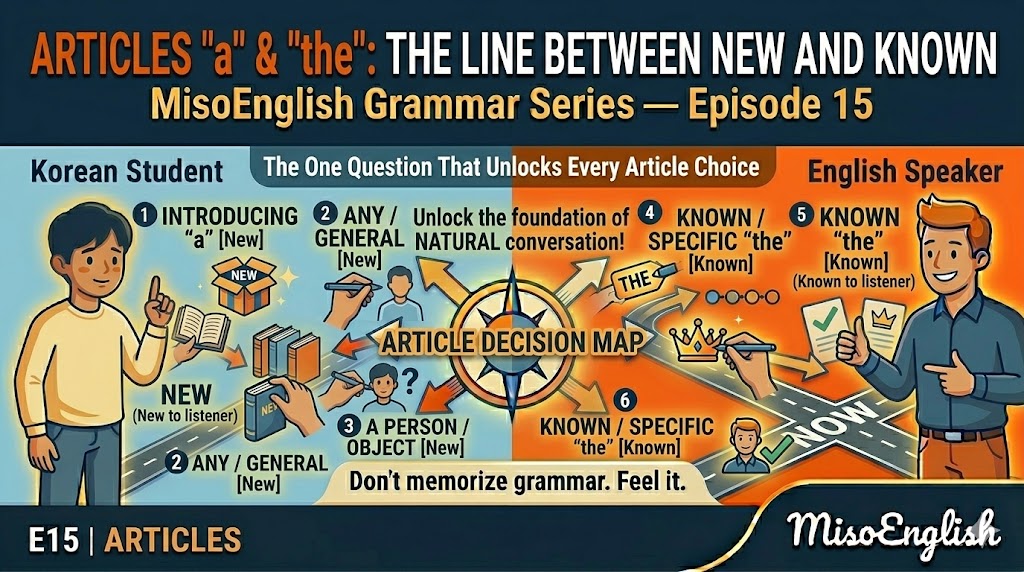
MisoEnglish Grammar Series
Episode 15 — 관사 a와 the
새 정보와 아는 정보를 나누는 기준
"문법을 외우지 말고, 느껴라" Don't memorize grammar. Feel it.
🧭 들어가며 | Introduction
한국어에는 관사가 없다.
"사과 먹었어", "그 사과 먹었어" — 문맥이 알아서 처리한다.
Korean has no articles.
"사과 먹었어", "그 사과 먹었어" — context handles everything.
영어는 다르다.
명사 앞에 반드시 a / an / the 또는 아무것도 없음(무관사)을 결정해야 한다.
English is different.
Before almost every noun, you must choose: a / an / the — or nothing (zero article).
이 선택은 단순한 문법 규칙이 아니다.
"내가 지금 말하는 이것을 상대방이 이미 알고 있는가, 아니면 처음 듣는가" 를 선언하는 행위다.
This choice isn't just a grammar rule. It's a declaration:
"Does the listener already know what I'm talking about, or is this the first time they're hearing about it?"
이 감각 하나를 잡으면, 관사가 보이기 시작한다.
Grasp this one feeling — and articles start to make sense.
1. a / an — 처음 등장하는 정보 | First Mention
a / an은 명사가 처음으로 대화에 등장할 때 쓴다. "어떤 ~", "한 ~" — 상대방이 아직 모르는 것.
a / an is used when a noun appears for the first time in a conversation. "A certain ~", "one ~" — something the listener doesn't know yet.
I saw a dog on my way home.
집에 오는 길에 개를 봤어.
→ 어떤 개인지 상대방은 모른다. 처음 등장.
→ The listener has no idea which dog. First mention.
She is reading a book.
그녀는 책을 읽고 있다.
→ 어떤 책인지 특정되지 않음.
→ No specific book identified.
I need a pen.
펜이 필요해.
→ 어떤 펜이든, 하나.
→ Any pen. Just one.
a vs an
a → 자음 소리로 시작하는 단어 앞 an → 모음 소리(a, e, i, o, u)로 시작하는 단어 앞
a → before words starting with a consonant sound an → before words starting with a vowel sound (a, e, i, o, u)
a cat / a book / a university (유니버시티 — 자음 소리 'y')
an apple / an hour (아워 — h가 묵음, 모음 소리) / an honest man
⚠️ 소리 기준이지 철자 기준이 아니다!
It's about the sound, not the spelling!
a university ✅ (발음: yu-niversity — 자음 소리)
an hour ✅ (발음: ow-er — h 묵음, 모음 소리)
2. the — 이미 아는 정보 | Known Information
the는 화자와 청자 모두 무엇을 말하는지 알고 있을 때 쓴다.
the is used when both speaker and listener know exactly what's being referred to.
앞에서 이미 언급된 것 | Previously Mentioned
I saw a dog on my way home. The dog was huge.
집에 오는 길에 개를 봤어. 그 개가 엄청 컸어.
→ 첫 번째 언급 → a dog / 두 번째 언급 → the dog
She bought a dress. The dress was beautiful.
그녀는 드레스를 샀다. 그 드레스는 아름다웠다.
상황상 서로 알고 있는 것 | Mutually Known
말하지 않아도 서로 알고 있는 것.
Something both parties know without it being stated.
Can you close the door?
문 좀 닫아줄래? (같은 방에 있는 그 문)
The sun is bright today.
오늘 태양이 밝다. (세상에 하나뿐인 태양)
I need to go to the bathroom.
화장실에 가야 해. (건물 안에 있는 그 화장실)
세상에 하나뿐인 것 | Unique Things
The moon rises in the east.
달은 동쪽에서 뜬다.
The Internet changed everything.
인터넷은 모든 것을 바꿨다.
The president gave a speech.
대통령이 연설을 했다.
최상급과 함께 | With Superlatives
She is the best student in class.
그녀는 반에서 가장 뛰어난 학생이다.
It was the worst movie I've ever seen.
내가 본 영화 중 최악이었다.
서수와 함께 | With Ordinals
He finished the first.
그는 1등으로 끝냈다.
This is the second time I've been here.
여기는 두 번째 방문이다.
3. 무관사(Ø) — 관사가 없는 경우 | Zero Article
관사를 아예 쓰지 않는 경우도 있다.
Sometimes no article is used at all.
일반적 개념이나 종류 전체 | General Concepts or Categories
I love music. 나는 음악을 좋아한다. (음악이라는 개념 전체)
Dogs are loyal. 개는 충성스럽다. (개라는 종 전체)
Life is short. 인생은 짧다. (인생이라는 개념)
Water is essential. 물은 필수적이다. (물이라는 물질 전체)
고유명사 | Proper Nouns
I live in Korea. 나는 한국에 산다.
She studied at Harvard. 그녀는 하버드에서 공부했다.
He flew to Paris. 그는 파리로 날아갔다.
⚠️ 예외 — the가 붙는 고유명사들 Exceptions — proper nouns that take "the"
the United States / the United Kingdom (복수형 국가명)
the Amazon / the Nile (강)
the Pacific Ocean (바다)
the Alps (산맥)
식사, 운동, 과목 | Meals, Sports, Subjects
I had breakfast.
아침을 먹었다.
She plays tennis.
그녀는 테니스를 친다.
He studies mathematics.
그는 수학을 공부한다.
교통수단과 통신수단 | Transport and Communication
I go to work by bus.
나는 버스로 출근한다.
We talked on the phone.
우리는 전화로 이야기했다.
4. a vs the — 핵심 비교 | The Core Comparison
이 두 관사의 차이를 가장 잘 보여주는 예시:
The clearest comparison:
I'm looking for a restaurant.
나는 식당을 찾고 있어. (어떤 식당이든, 처음 언급)
I'm looking for the restaurant.
나는 그 식당을 찾고 있어. (우리 둘 다 아는 그 특정 식당)
She wants to be a doctor.
그녀는 의사가 되고 싶다. (의사라는 직업군 중 한 명)
She is the doctor I told you about.
그녀가 내가 얘기했던 그 의사야. (특정 인물)
5. 관사 실수 TOP 5 | Top 5 Article Mistakes
① 처음 언급에 the 쓰기
~~I saw the dog on my way home.~~ ❌ (상대방이 어느 개인지 모름)
I saw a dog on my way home. ✅
② 일반 개념에 the 쓰기
~~I love the music.~~ ❌ (특정 음악이 아닌 한)
I love music. ✅
③ 고유명사에 a 쓰기
~~She lives in a Korea.~~ ❌
She lives in Korea. ✅
④ 소리가 아닌 철자로 a/an 결정하기
~~a hour~~ ❌ → an hour ✅
~~an university~~ ❌ → a university ✅
⑤ 직업 앞에 관사 빼기
~~She is doctor.~~ ❌ She is a doctor. ✅
6. 관사 감각 키우기 | Building the Article Instinct
관사는 규칙을 외워서 쓰는 게 아니라, "상대방이 이미 아는 것인가?" 라는 질문을 습관화해야 한다.
Articles aren't memorized rules — they're the result of asking: "Does the listener already know what I mean?"
명사가 등장할 때마다 물어보자:
Every time a noun appears, ask:

상대방이 모른다 (처음 등장) → a / an
상대방이 안다 (이미 언급 / 상황상 공유) → the
개념 전체 / 고유명사 → 무관사 (Ø)
📌 이번 편 요약 | Episode Summary
- a/an = 처음 등장, 상대방이 모르는 것 — 어떤 ~, 하나의 ~ a/an = first mention, unknown to listener — "a certain ~"
- the = 이미 아는 것 — 앞서 언급됨 / 상황상 공유 / 세상에 하나 the = already known — previously mentioned / mutually known / unique
- 무관사(Ø) = 개념 전체, 고유명사, 식사·운동·과목 Zero article = general concepts, proper nouns, meals/sports/subjects
- a vs an = 소리 기준 — 모음 소리 앞이면 an a vs an = sound-based — vowel sound = an
- 핵심 질문: 상대방이 이미 아는가? — Yes → the / No → a / 개념 → Ø Key question: does the listener know? Yes → the / No → a / concept → Ø
🔜 다음 편 예고 | Coming Up Next
Episode 16 — 셀 수 있는 명사 vs 셀 수 없는 명사 : 영어는 왜 나누는가 Countable vs Uncountable Nouns: Why English Draws the Line
영어는 명사를 두 종류로 나눈다 — 셀 수 있는 것과 셀 수 없는 것. 한국어에는 없는 이 구분이 관사, 복수형, 수량 표현 전체에 영향을 준다.
English divides nouns into two categories — countable and uncountable. This distinction, absent in Korean, affects articles, plurals, and quantity expressions.
© MisoEnglish Grammar Series | Level 3 — Episode 15 "문법을 외우지 말고, 느껴라" | "Don't memorize grammar. Feel it."
Articles "a" and "the": The Line Between New and Known
The One Question That Unlocks Every Article Choice
MisoEnglish Grammar Series — Episode 15
"Don't memorize grammar. Feel it."
Introduction
Korean has no articles. Context does the work that "a" and "the" do in English — and because of that, Korean speakers often treat articles as a minor grammatical detail to memorize and move on from.
They're not. Every time an English speaker uses a noun, they're making a split-second decision: "Does my listener already know what I'm referring to — or am I introducing it for the first time?"
That single question is the key to every article choice. Once you internalize it, articles stop being a source of confusion and start being something you feel.
1. "a / an" — First Mention
Use a / an when a noun is being introduced for the first time — when the listener has no prior knowledge of which specific thing you mean.
I saw a dog on my way home.
She is reading a book.
I need a pen.
In each case: the listener doesn't know which dog, which book, which pen. It could be any one. That's the feeling of "a."
a vs. an
a → before a consonant sound an → before a vowel sound (a, e, i, o, u)
a cat / a book / a university (sounds like "yoo" — consonant sound)
an apple / an hour (h is silent — vowel sound) / an honest man
It's about the sound, not the spelling:
a university ✅ / an hour ✅
2. "the" — Already Known
Use the when both speaker and listener know exactly what's being referred to.
Previously mentioned
I saw a dog on my way home.
The dog was huge.
She bought a dress.
The dress was beautiful.
First appearance → "a." Every appearance after → "the."
Mutually understood from context
Can you close the door? (the door in this room — you both know which one)
The sun is bright today. (there's only one)
I need to go to the bathroom. (the one in this building)
Unique things
The moon / the Internet / the president / the Earth
With superlatives and ordinals
She is the best student in class.
This is the second time I've been here.
3. Zero Article (Ø) — No Article at All
General concepts or entire categories
I love music. (music as a concept — all music)
Dogs are loyal. (dogs as a species)
Life is short. (life as a concept)
Proper nouns
I live in Korea. / She studied at Harvard. / He flew to Paris.
Exceptions — proper nouns that take "the":
the United States / the Amazon / the Pacific Ocean / the Alps
Meals, sports, academic subjects
I had breakfast. / She plays tennis. / He studies mathematics.
4. The Core Comparison
I'm looking for a restaurant.
(any restaurant — you don't know which one I mean)
I'm looking for the restaurant.
(a specific one we both already know about)
She wants to be a doctor.
(one member of the profession)
She is the doctor I told you about.
(that specific person)
5. Top 5 Article Mistakes
① Using "the" on the first mention:
~~I saw the dog on my way home.~~ ❌ → I saw a dog. ✅
② Using "the" for general concepts:
~~I love the music.~~ ❌ → I love music. ✅
③ Using an article with proper nouns:
~~She lives in a Korea.~~ ❌ → She lives in Korea. ✅
④ Choosing a/an by spelling, not sound:
~~a hour~~ ❌ → an hour ✅
~~an university~~ ❌ → a university ✅
⑤ Dropping the article before job titles:
~~She is doctor.~~ ❌ → She is a doctor. ✅
6. The Article Instinct
Every time a noun appears, ask:

Does the listener know which one I mean?
├─ No (first mention / unspecified) → a / an
├─ Yes (already known / unique / mutually understood) → the
└─ General concept / proper noun / meal / sport → Ø (nothing)
Episode Summary
- a/an = first mention — the listener doesn't know which one yet.
- the = already known — previously mentioned, mutually understood, or unique.
- Zero article = general concepts, proper nouns, meals, sports.
- a vs. an = sound-based — vowel sound gets "an."
- The key question: does the listener already know?
Coming Up Next
Episode 16 — Countable vs. Uncountable Nouns: Why English Draws the Line
English divides all nouns into two categories: things you can count, and things you can't. This distinction — invisible in Korean — shapes how you use articles, plurals, and every quantity expression in the language.
© MisoEnglish Grammar Series | Level 3 — Episode 15 "Don't memorize grammar. Feel it."
⚠️ 저작권 안내
본 블로그(MisoEnglish · slowblooms.tistory.com)의 모든 콘텐츠는 저작권법의 보호를 받습니다. 글, 예시 문장, 분석 내용 등 블로그에 게시된 모든 창작물은 저작자의 동의 없이 무단으로 복사, 복제, 배포, 2차 가공하는 행위를 금지합니다. 출처를 밝히지 않은 전재, SNS·커뮤니티·타 블로그 등에의 무단 게시, 상업적 이용은 모두 금지되며, 무단 불펌 적발 시 저작권법에 따라 법적 조치가 취해질 수 있습니다. 콘텐츠 사용 문의는 slowblooms.tistory.com으로 연락 주세요.
© MisoEnglish · slowblooms.tistory.com. All rights reserved.
━━━━━━━━━━━━━━━━━━━━━━━━━━━━━━━━
⚠️ Copyright Notice
All content published on this blog (MisoEnglish · slowblooms.tistory.com) is protected by copyright law. Copying, reproducing, distributing, or adapting any written posts, example sentences, or analyses without the explicit consent of the author is strictly prohibited. Unauthorised reposting on other blogs, social media, online communities, or any public platform — with or without modification — is not permitted, and may result in legal action under applicable copyright law. For content licensing enquiries, please contact us via slowblooms.tistory.com.
© MisoEnglish · slowblooms.tistory.com. All rights reserved.
'English Mechanism' 카테고리의 다른 글
| Episode 17 — 전치사 in · on · at: 공간과 시간을 느끼는 법 (0) | 2026.02.28 |
|---|---|
| Episode 16 — 셀 수 있는 명사 vs 셀 수 없는 명사 (0) | 2026.02.28 |
| Episode 14 — 시제 총정리: 시간의 지도를 완성하라 (0) | 2026.02.27 |
| Episode 13 — 과거완료: 과거 속의 또 다른 과거 (0) | 2026.02.27 |
| Episode 12 — 현재완료: 과거와 현재를 하나로 잇는 다리 (0) | 2026.02.27 |


