
- 분류 전체보기 (1053)

- Linguistics (고급 영어학) (10)
- Stylistics (6)
- Etymology & Word Building (15)
- Philosophy Meets Grammar (6)
- Collection of Famous Quotes (22)
- English Mechanism (276)
- The Language Beyond Grammar (274)
- Living English (81)
- Miso’s Life Notes (18)
- My English Journey and Refl.. (16)
- Philosophy (132)
- Video Clip (16)
- Airline English (항공 영어) (47)
- Creative Corner (35)
- Sally & Sia (1)
| 일 | 월 | 화 | 수 | 목 | 금 | 토 |
|---|---|---|---|---|---|---|
| 1 | 2 | 3 | 4 | |||
| 5 | 6 | 7 | 8 | 9 | 10 | 11 |
| 12 | 13 | 14 | 15 | 16 | 17 | 18 |
| 19 | 20 | 21 | 22 | 23 | 24 | 25 |
| 26 | 27 | 28 | 29 | 30 |
- MisoEnglish#철학입문 #Philosophy #종교철학 #PhilosophyOfReligion #철학공부 #신존재증명 #악의문제 #PhilosophyForBeginners #교육콘텐츠 #철학시리즈
- 영어접속사
- 🌿 English with Heart
- MisoEnglish#한국철학 #KoreanPhilosophy #홍익인간 #Hongik #화랑도 #Hwarang #단군 #Dangun #풍류도 #ThreeKingdoms#동양철학
- English for Korean Learners
- AirlineOpsEnglish
- 영어문법
- MisoEnglish#철학입문 #Philosophy #심리철학 #PhilosophyOfMind #철학공부 #의식 #마음 #PhilosophyForBeginners #교육콘텐츠 #철학시리즈
- MisoEnglish#철학입문 #Philosophy #윤리학 #Ethics #도덕철학 #철학공부 #칸트 #공리주의 #교육콘텐츠 #철학시리즈
- 인도철학 #동양철학 #인문학 #요가 #명상 #힌두교 #불교 #간디 #타고르 #정통6파 #철학공부 #마음공부 #MisoEnglish #인문학영어
- 영어공부
- everyday English
- 동양정치철학 #시리즈완결 #아시아적가치 #동서양비교 #유교 #민주주의 #정치사상 #인문학 #비교철학 #글로벌정치 #문화다양성 #2500년철학사
- MisoEnglish#도교철학 #Taoism #도덕경 #TaoTeChing #무위자연 #WuWei #노자 #Laozi #장자 #YinYang
- Basic English Verbs
- MisoEnglish#철학입문 #Philosophy #형이상학 #Metaphysics #철학공부 #존재론 #실재론 #PhilosophyForBeginners #교육콘텐츠 #철학시리즈
- 영국사 #영국역사 #세계사 #역사연재 #브리튼에서영국까지
- pnr
- English Speaking Practice
- English in English
- 영문법
- MisoEnglish#불교철학 #BuddhismPhilosophy #사성제 #FourNobleTruths #공사상 #Emptiness #명상 #Mindfulness #열반 #EasternWisdom
- 감성영어
- MisoEnglish#철학입문 #Philosophy #과학철학 #PhilosophyOfScience #철학공부 #포퓨퍼 #쿠hn #과학방법론 #교육콘텐츠 #철학시리즈
- MisoEnglish#철학입문 #Philosophy #정치철학 #PoliticalPhilosophy #철학공부 #정의론 #자유주의 #PhilosophyForBeginners #교육콘텐츠 #철학시리즈
- MisoEnglish#유교철학 #Confucianism #성리학 #NeoConfucianism #인의예지 #Virtue #맹자 #Mencius #실학 #KoreanScholarship
- 영어회화
- misoenglish
- ticketing
- EnglishWriting #AcademicWriting #Grammar #EnglishLanguage #EssayWriting #ParagraphStructure #SentenceStructure #BusinessEnglish #EnglishTips #WritingSkills #Linguistics #ESL
- Today
- Total
MisoEnglish
Episode 12 — 현재완료: 과거와 현재를 하나로 잇는 다리 본문
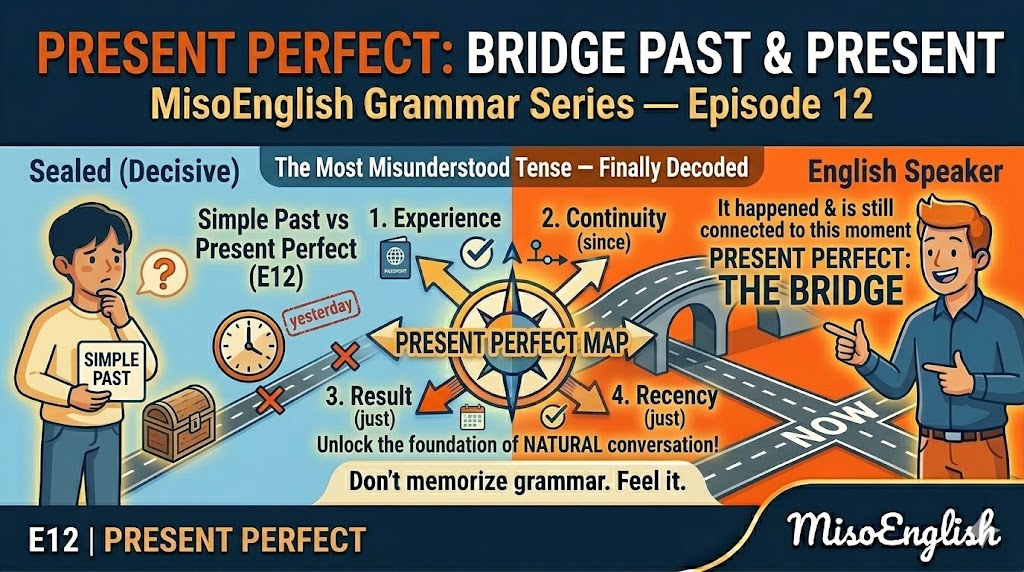
MisoEnglish Grammar Series
Episode 12 — 현재완료
과거와 현재를 하나로 잇는 다리
"문법을 외우지 말고, 느껴라" Don't memorize grammar. Feel it.
🧭 들어가며 | Introduction
현재완료는 한국인 학습자가 가장 어려워하는 시제다. 이유는 단 하나 — 한국어에 이 개념이 없기 때문이다.
Present perfect is the tense Korean learners struggle with most. The reason is simple — Korean has no equivalent concept.
단순과거가 "과거를 과거에 가두는" 시제라면, 현재완료는 "과거의 일이 지금 이 순간과 연결되어 있다" 는 것을 선언하는 시제다.
If simple past seals the past in the past, present perfect declares that a past event is still connected to this moment.
이 감각 하나를 잡으면, 현재완료의 네 가지 쓰임이 모두 자연스럽게 따라온다.
Grasp this one feeling, and all four uses of the present perfect follow naturally.
1. 현재완료의 구조 | The Structure
have / has + 과거분사 (p.p.)
have / has + past participle
주어 Subject have/has 과거분사 p.p.
| I / You / We / They | have | done, seen, been... |
| He / She / It | has | done, seen, been... |
I have seen that movie. 나는 그 영화를 본 적이 있다.
She has finished her work. 그녀는 일을 끝냈다.
They have lived here for ten years. 그들은 10년째 여기서 살고 있다.
부정문과 의문문 | Negative and Question
I haven't (have not) seen it. 나는 그것을 본 적이 없다.
She hasn't (has not) called. 그녀가 전화를 안 했다.
Have you ever been to Paris? 파리에 가본 적 있어?
Has he finished? 그가 끝냈어?
2. 현재완료의 네 가지 쓰임 | Four Uses of Present Perfect
① 경험 — ~해본 적이 있다 | Experience
지금까지 살면서 그 일을 경험한 적이 있는지를 말한다. 언제인지는 중요하지 않다. 경험 자체가 현재와 연결되어 있다.
Whether you've had a certain experience at any point in your life. When exactly doesn't matter — the experience itself is connected to who you are now.
I have been to Japan. 나는 일본에 가본 적이 있다.
She has tried sushi before. 그녀는 전에 스시를 먹어본 적이 있다.
Have you ever ridden a horse? 말을 타본 적 있어?
I have never seen snow. 나는 눈을 본 적이 없다.
자주 쓰이는 표현 | Common Expressions:
- ever (경험 여부) / never (경험 없음)
- before / once / twice / many times
② 완료 — 막 끝났다 | Completion (Just Finished)
방금 막 완료된 일을 표현한다. 그 결과가 지금 이 순간에 영향을 미친다.
An action that has just been completed. Its result affects this present moment.
I have just finished my homework.
나는 방금 숙제를 끝냈다. (그래서 지금 자유롭다)
She has just left.
그녀는 방금 떠났다. (그래서 지금 여기 없다)
The train has just arrived.
기차가 방금 도착했다. (지금 플랫폼에 있다)
자주 쓰이는 표현 | Common Expressions:
- just / already / yet
Have you done it yet? 아직 했어? (아직 안 했을 수 있다는 뉘앙스)
I have already done it. 나는 이미 했어. (예상보다 빨리)
③ 결과 — 그래서 지금 | Result (Consequence Now)
과거의 행동이 지금 이 순간에 영향을 남기고 있다. "그래서 지금 ~한 상태다"라는 느낌.
A past action that still has an impact on the present moment. The feeling: "and that's why things are the way they are now."
I have lost my keys.
열쇠를 잃어버렸다. (그래서 지금 열쇠가 없다)
She has broken her leg.
그녀는 다리가 부러졌다. (그래서 지금 못 걷는다)
He has gone to Paris.
그는 파리에 갔다. (그래서 지금 여기 없다)
My phone has died.
휴대폰이 꺼졌다. (그래서 지금 쓸 수 없다)
④ 계속 — 지금도 계속되고 있다 | Duration (Still Ongoing)
과거에 시작해서 지금 이 순간까지 계속되고 있는 상황을 표현한다. for (기간)와 since (시작 시점)와 함께 쓰인다.
A situation that started in the past and is still continuing now. Used with for (duration) and since (starting point).
I have lived here for ten years.
나는 10년째 여기서 살고 있다.
She has worked at this company since 2018.
그녀는 2018년부터 이 회사에서 일해왔다.
We have known each other for a long time.
우리는 오랫동안 서로를 알아왔다.
He has been sick since Monday.
그는 월요일부터 아파왔다.
for vs since:
for + 기간(period): for two years, for a month, for ages since + 시작점(starting point): since 2020, since Monday, since I was a child
3. 현재완료 vs 단순과거 — 가장 중요한 비교 | The Most Important Comparison
한국어로는 둘 다 "~했다"로 번역되는 경우가 많다. 하지만 영어 화자에게 이 둘은 전혀 다른 시제다.
In Korean, both often translate as "~했다." But for English speakers, these are completely different tenses.
핵심 차이 | The Core Difference
단순과거 Simple Past 현재완료 Present Perfect
| 연결 Connection | 과거 ↔ 현재 단절 | 과거 ↔ 현재 연결 |
| 시점 When | 특정 시점 명시 | 시점 중요하지 않음 |
| 느낌 Feeling | "그때 그랬어" | "지금도 그 영향이 있어" |
비교 예문 | Comparison Examples
I lost my keys. → 그냥 과거의 사실. 지금 찾았는지 모름.
I have lost my keys. → 그래서 지금도 없다. 지금 문제다.
Did you eat? → 단순한 과거 질문. (오늘 밥 먹었어?)
Have you eaten? → 지금 배고프지 않은지. (지금 상태 확인)
She was sick. → 아팠는데 지금은 나았다.
She has been sick. → 아파왔고 지금도 그 상황이 이어진다.
I went to Paris. → 파리에 갔다. (언제? 어떤 상황?)
I have been to Paris. → 파리에 가본 경험이 있다. (경험의 유무)
⚠️ 과거 시점 표현이 있으면 단순과거! | Specific Time = Simple Past!
"언제"를 명시하는 표현이 있으면 현재완료를 쓸 수 없다.
If a specific time expression is present, simple past is required — not present perfect.
~~I have seen her yesterday.~~ ❌ I saw her yesterday. ✅
~~She has called me last night.~~ ❌ She called me last night. ✅
~~Have you eaten this morning?~~ ❌ (this morning이 이미 끝난 시점이면) Did you eat this morning? ✅
4. have been vs have gone | "가본 적 있다" vs "가고 없다"
많은 학습자들이 헷갈리는 포인트.
A point that confuses many learners.
She has been to Paris.
그녀는 파리에 가본 적이 있다. (경험, 지금은 돌아왔다)
She has gone to Paris.
그녀는 파리에 갔다. (그래서 지금 여기 없다)
I have been to that restaurant.
나 그 식당 가봤어. (경험)
He has gone to the restaurant.
그는 그 식당에 갔어. (지금 거기 있음)
5. 현재완료 진행형 | Present Perfect Progressive
현재완료와 진행형을 합치면? 과거에 시작해서 지금 이 순간까지 계속 진행 중인 동작을 표현한다.
What happens when you combine present perfect with progressive? An action that started in the past and is still actively continuing right now.
have / has + been + -ing
I have been waiting for an hour.
나는 한 시간째 기다리고 있다.
She has been studying all day.
그녀는 하루 종일 공부하고 있다.
They have been arguing since morning.
그들은 아침부터 말다툼 중이다.
현재완료 vs 현재완료 진행형
I have read the book.
나는 그 책을 읽었다. (완료 — 다 읽었다)
I have been reading the book.
나는 그 책을 읽어오고 있다. (아직 진행 중)
She has lived here for 10 years.
10년간 살았다. (완료된 사실)
She has been living here for 10 years.
10년째 살고 있다. (지금도 살고 있음 강조)
📌 이번 편 요약 | Episode Summary
- 현재완료 = have/has + p.p. — 과거와 현재를 연결하는 다리 Present perfect = have/has + p.p. — a bridge between past and present.
- 경험 — ever/never/before, 살면서 ~해본 적 있는가 Experience — ever/never/before, have you done it in your life?
- 완료 — just/already/yet, 방금 끝난 일과 그 결과 Completion — just/already/yet, just finished with a present result.
- 결과 — 그래서 지금 ~한 상태다 Result — past action, present consequence.
- 계속 — for/since, 과거부터 지금까지 이어지는 상황 Duration — for/since, from the past until right now.
- 단순과거 vs 현재완료 — 특정 시점 있으면 단순과거, 지금과 연결되면 현재완료 Simple past vs present perfect — specific time = past; connected to now = perfect.
🔜 다음 편 예고 | Coming Up Next
Episode 13 — 과거완료 : 과거 속의 또 다른 과거 Past Perfect: The Past Within the Past
과거의 이야기를 하다가, 그보다 더 이전의 일을 말해야 할 때. had + p.p.가 만드는 "과거 속의 과거" 감각을 파헤친다.
When you're already talking about the past, and need to refer to something that happened even earlier. We dig into the "past within the past" — had + p.p.
© MisoEnglish Grammar Series | Level 2 — Episode 12 "문법을 외우지 말고, 느껴라" | "Don't memorize grammar. Feel it."
Present Perfect: The Bridge Between Past and Present
The Most Misunderstood Tense in English — Finally Decoded
MisoEnglish Grammar Series — Episode 12
"Don't memorize grammar. Feel it."
Introduction
No tense trips up Korean learners more consistently than the present perfect. The reason isn't complexity — it's that Korean simply doesn't make this distinction. In Korean, both "I ate" and "I have eaten" translate the same way.
But in English, they mean something fundamentally different. Simple past says: "It happened. It's over. Separate from now." Present perfect says: "It happened — and it's still connected to this moment."
That connection to the present is everything. Once you feel it, the four uses of present perfect all fall into place.
1. The Structure
have / has + past participle (p.p.)
Subject Form
| I / You / We / They | have + p.p. |
| He / She / It | has + p.p. |
I have seen that movie.
She has finished her work.
They have lived here for ten years.
Negative: haven't / hasn't + p.p. Question: Have/Has + subject + p.p.?
2. Four Uses of Present Perfect
① Experience — Have you ever...?
Used to talk about whether something has happened at any point in your life. The specific time doesn't matter — what matters is whether the experience exists as part of who you are now.
I have been to Japan.
She has tried sushi before.
Have you ever ridden a horse?
I have never seen snow.
Key words: ever, never, before, once, twice, many times
② Completion — Just finished, result is now
An action recently completed, with a result that's visible or relevant right now.
I have just finished my homework. (so I'm free now)
She has just left. (so she's not here now)
The train has just arrived. (it's at the platform right now)
Key words: just, already, yet
Have you done it yet? (I'm wondering if it's been completed)
I have already done it. (sooner than expected)
③ Result — That's why things are this way now
A past action whose consequence is still present.
I have lost my keys. (I still don't have them — it's a problem now)
She has broken her leg. (she can't walk now)
He has gone to Paris. (he's not here now)
My phone has died. (I can't use it now)
The feeling: "something happened, and that's why the present is the way it is."
④ Duration — Started then, still true now
A situation that began in the past and continues to this moment.
I have lived here for ten years.
She has worked here since 2018.
We have known each other for a long time.
He has been sick since Monday.
for + period of time: for two years, for a month, for ages since + starting point: since 2020, since Monday, since I was a child
3. Present Perfect vs. Simple Past
This is the comparison that matters most for Korean speakers.
Simple Past Present Perfect
| Connection | Disconnected from now | Connected to now |
| Time | Specific time stated | Time not specified |
| Feeling | "That happened back then" | "And it still affects now" |
Head-to-head:
I lost my keys. → A past fact. No statement about now.
I have lost my keys. → They're still missing. It's a current problem.
Did you eat? → Simple past question. (Did you eat at some point?)
Have you eaten? → Current state check. (Are you still hungry now?)
She was sick. → She was sick. She recovered.
She has been sick. → She's been sick — and it's still relevant now.
I went to Paris. → I went. When? What happened?
I have been to Paris. → I have that experience. It's part of who I am.
Specific time = simple past, always
~~I have seen her yesterday.~~ ❌ → I saw her yesterday. ✅
~~She has called me last night.~~ ❌ → She called me last night. ✅
If you name when it happened, simple past is required. "Yesterday," "last night," "in 2020" — these close the door on present perfect.
4. "have been" vs. "have gone"
She has been to Paris. → She went and came back. (experience)
She has gone to Paris. → She went and isn't here. (current absence)
"Have been to" = visited and returned. "Have gone to" = went and is still there.
5. Present Perfect Progressive
Combine present perfect with progressive and you get: an action that started in the past and is still actively ongoing right now.
have / has + been + -ing
I have been waiting for an hour.
She has been studying all day.
They have been arguing since morning.
The difference from plain present perfect:
I have read the book. → Finished. Done.
I have been reading the book. → Still reading. Not done yet.
She has lived here for 10 years. → Completed fact.
She has been living here for 10 years. → Emphasis on the ongoing nature.
Episode Summary
- Present perfect = have/has + p.p. — the bridge between past and present.
- Experience — ever/never/before, has this happened in your life?
- Completion — just/already/yet, finished with a present result.
- Result — past action, present consequence.
- Duration — for/since, started then and still true now.
- Specific time = simple past — yesterday, last night, in 2020 → no present perfect.
Coming Up Next
Episode 13 — Past Perfect: The Past Within the Past
When you're already talking about the past, and need to reach back even further. had + p.p. — the tense that creates depth in a timeline, and makes complex stories clear.
© MisoEnglish Grammar Series | Level 2 — Episode 12 "Don't memorize grammar. Feel it."
⚠️ 저작권 안내
본 블로그(MisoEnglish · slowblooms.tistory.com)의 모든 콘텐츠는 저작권법의 보호를 받습니다. 글, 예시 문장, 분석 내용 등 블로그에 게시된 모든 창작물은 저작자의 동의 없이 무단으로 복사, 복제, 배포, 2차 가공하는 행위를 금지합니다. 출처를 밝히지 않은 전재, SNS·커뮤니티·타 블로그 등에의 무단 게시, 상업적 이용은 모두 금지되며, 무단 불펌 적발 시 저작권법에 따라 법적 조치가 취해질 수 있습니다. 콘텐츠 사용 문의는 slowblooms.tistory.com으로 연락 주세요.
© MisoEnglish · slowblooms.tistory.com. All rights reserved.
━━━━━━━━━━━━━━━━━━━━━━━━━━━━━━━━
⚠️ Copyright Notice
All content published on this blog (MisoEnglish · slowblooms.tistory.com) is protected by copyright law. Copying, reproducing, distributing, or adapting any written posts, example sentences, or analyses without the explicit consent of the author is strictly prohibited. Unauthorised reposting on other blogs, social media, online communities, or any public platform — with or without modification — is not permitted, and may result in legal action under applicable copyright law. For content licensing enquiries, please contact us via slowblooms.tistory.com.
© MisoEnglish · slowblooms.tistory.com. All rights reserved.
'English Mechanism' 카테고리의 다른 글
| Episode 14 — 시제 총정리: 시간의 지도를 완성하라 (0) | 2026.02.27 |
|---|---|
| Episode 13 — 과거완료: 과거 속의 또 다른 과거 (0) | 2026.02.27 |
| Episode 11 — 진행형: 딱 이 순간, 일어나고 있는 일 (0) | 2026.02.27 |
| Episode 10 — 미래시제: will과 be going to는 왜 다른가 (0) | 2026.02.26 |
| Episode 09 — 과거시제: 끝난 일을 깔끔하게 말하는 법 (0) | 2026.02.26 |


