
- 분류 전체보기 (1058)

- Linguistics (고급 영어학) (10)
- Stylistics (6)
- Etymology & Word Building (15)
- Philosophy Meets Grammar (6)
- Collection of Famous Quotes (22)
- English Mechanism (276)
- The Language Beyond Grammar (279)
- Living English (81)
- Miso’s Life Notes (18)
- My English Journey and Refl.. (16)
- Philosophy (132)
- Video Clip (16)
- Airline English (항공 영어) (47)
- Creative Corner (35)
- Sally & Sia (1)
| 일 | 월 | 화 | 수 | 목 | 금 | 토 |
|---|---|---|---|---|---|---|
| 1 | 2 | 3 | 4 | |||
| 5 | 6 | 7 | 8 | 9 | 10 | 11 |
| 12 | 13 | 14 | 15 | 16 | 17 | 18 |
| 19 | 20 | 21 | 22 | 23 | 24 | 25 |
| 26 | 27 | 28 | 29 | 30 |
- 동양정치철학 #시리즈완결 #아시아적가치 #동서양비교 #유교 #민주주의 #정치사상 #인문학 #비교철학 #글로벌정치 #문화다양성 #2500년철학사
- MisoEnglish#철학입문 #Philosophy #정치철학 #PoliticalPhilosophy #철학공부 #정의론 #자유주의 #PhilosophyForBeginners #교육콘텐츠 #철학시리즈
- 🌿 English with Heart
- everyday English
- English in English
- MisoEnglish#유교철학 #Confucianism #성리학 #NeoConfucianism #인의예지 #Virtue #맹자 #Mencius #실학 #KoreanScholarship
- MisoEnglish#철학입문 #Philosophy #종교철학 #PhilosophyOfReligion #철학공부 #신존재증명 #악의문제 #PhilosophyForBeginners #교육콘텐츠 #철학시리즈
- 인도철학 #동양철학 #인문학 #요가 #명상 #힌두교 #불교 #간디 #타고르 #정통6파 #철학공부 #마음공부 #MisoEnglish #인문학영어
- MisoEnglish#철학입문 #Philosophy #형이상학 #Metaphysics #철학공부 #존재론 #실재론 #PhilosophyForBeginners #교육콘텐츠 #철학시리즈
- English Speaking Practice
- 영문법
- 감성영어
- 영국사 #영국역사 #세계사 #역사연재 #브리튼에서영국까지
- 영어공부
- MisoEnglish#철학입문 #Philosophy #심리철학 #PhilosophyOfMind #철학공부 #의식 #마음 #PhilosophyForBeginners #교육콘텐츠 #철학시리즈
- MisoEnglish#철학입문 #Philosophy #과학철학 #PhilosophyOfScience #철학공부 #포퓨퍼 #쿠hn #과학방법론 #교육콘텐츠 #철학시리즈
- EnglishWriting #AcademicWriting #Grammar #EnglishLanguage #EssayWriting #ParagraphStructure #SentenceStructure #BusinessEnglish #EnglishTips #WritingSkills #Linguistics #ESL
- misoenglish
- MisoEnglish#도교철학 #Taoism #도덕경 #TaoTeChing #무위자연 #WuWei #노자 #Laozi #장자 #YinYang
- MisoEnglish#한국철학 #KoreanPhilosophy #홍익인간 #Hongik #화랑도 #Hwarang #단군 #Dangun #풍류도 #ThreeKingdoms#동양철학
- MisoEnglish#불교철학 #BuddhismPhilosophy #사성제 #FourNobleTruths #공사상 #Emptiness #명상 #Mindfulness #열반 #EasternWisdom
- MisoEnglish#철학입문 #Philosophy #윤리학 #Ethics #도덕철학 #철학공부 #칸트 #공리주의 #교육콘텐츠 #철학시리즈
- English for Korean Learners
- pnr
- Basic English Verbs
- 영어접속사
- 영어회화
- ticketing
- AirlineOpsEnglish
- 영어문법
- Today
- Total
MisoEnglish
Episode 11 — 진행형: 딱 이 순간, 일어나고 있는 일 본문
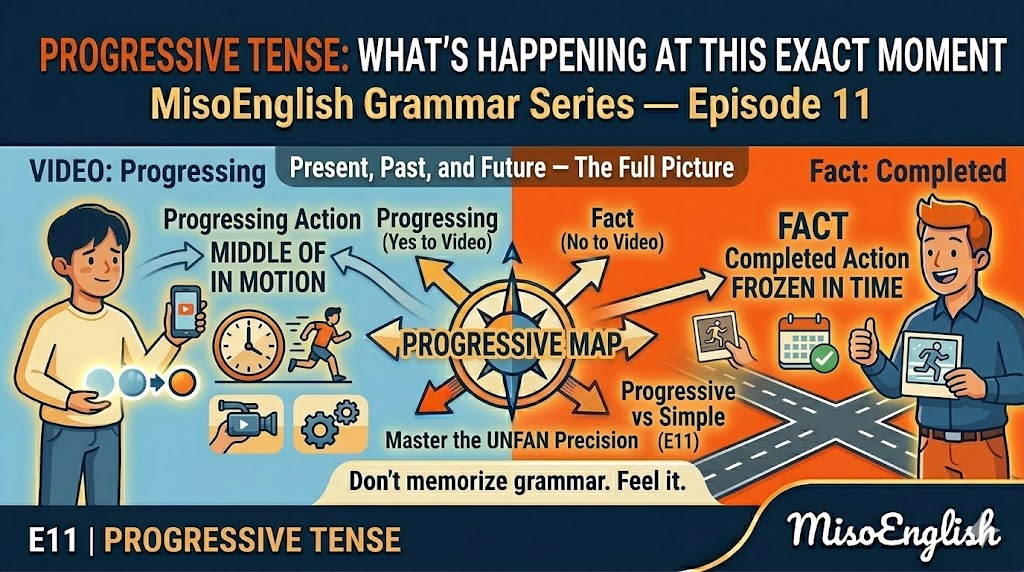
MisoEnglish Grammar Series
Episode 11 — 진행형
딱 이 순간, 일어나고 있는 일
"문법을 외우지 말고, 느껴라" Don't memorize grammar. Feel it.
🧭 들어가며 | Introduction
진행형은 하나의 강력한 이미지를 전달한다.
The progressive tense delivers one powerful image.
"지금 한창 ~하는 중이다." "Right in the middle of doing something."
단순히 "한다"가 아니라, 그 행동이 펼쳐지고 있는 장면 자체를 포착한다. 마치 카메라가 움직이는 장면을 찍듯이.
Not just "does" — but the scene of the action unfolding. Like a camera catching something in motion.
진행형은 현재·과거·미래 모두 만들 수 있다. 이번 편에서 세 가지를 모두 다룬다.
Progressive forms exist for present, past, and future. This episode covers all three.
1. 진행형의 구조 | The Structure of Progressive
진행형의 구조는 단순하다:
The structure is simple:
be동사 + 동사원형 + -ing
be verb + base verb + -ing
시제 Tense 구조 Structure 예문 Example
| 현재진행 Present | am / is / are + -ing | She is running. |
| 과거진행 Past | was / were + -ing | She was running. |
| 미래진행 Future | will be + -ing | She will be running. |
2. 현재진행형 | Present Progressive
기본 쓰임 — 지금 이 순간 | Basic Use — Right Now
말하는 바로 이 순간 진행 중인 행동을 표현한다.
An action in progress at the exact moment of speaking.
She is sleeping right now. 그녀는 지금 자고 있다.
I am studying for the exam. 나는 시험 공부를 하고 있다.
They are building a new school. 그들은 새 학교를 짓고 있다.
It is raining outside. 밖에 비가 오고 있다.
요즘 일어나고 있는 일 | Temporary Situations
지금 이 순간이 아니라, 요즘 한동안 일어나고 있는 일도 표현한다.
Also used for situations happening around this period — not just this second.
I am reading a really good book these days.
요즘 정말 좋은 책을 읽고 있다. (지금 이 순간 읽고 있지 않더라도)
She is taking an online course this semester.
그녀는 이번 학기에 온라인 강의를 듣고 있다.
He is living with his parents for now.
그는 지금 당분간 부모님과 함께 살고 있다.
현재진행형 시간 표현 | Time Expressions
표현 예문
| right now / now | She is working right now. |
| at the moment | He is eating at the moment. |
| these days / nowadays | I am learning guitar these days. |
| this week / month | We are preparing for the event this week. |
| currently | She is currently living in Seoul. |
3. 과거진행형 | Past Progressive
기본 쓰임 — 과거의 한 시점에 진행 중이던 일 | In Progress at a Past Moment
특정 과거 시점에 한창 진행 중이었던 행동을 표현한다.
An action that was in progress at a specific moment in the past.
I was sleeping when you called.
네가 전화했을 때 나는 자고 있었다.
She was cooking dinner at 6 pm.
그녀는 오후 6시에 저녁을 요리하고 있었다.
They were arguing when I arrived.
내가 도착했을 때 그들은 말다툼을 하고 있었다.
과거진행 + 단순과거 — 배경과 사건 | Background + Sudden Event
과거진행형은 배경이 되는 상황을, 단순과거는 그 중간에 갑자기 일어난 사건을 표현한다. 이 조합이 이야기를 생동감 있게 만든다.
*Past progressive = the background situation. Simple past = the sudden event that interrupted it. This combination makes storytelling vivid.
I was walking home when it started to rain.
집에 걸어가던 중에 비가 내리기 시작했다.
→ 걷는 중(배경) + 비가 오기 시작함(사건)
She was reading when someone knocked on the door.
그녀가 책을 읽고 있을 때 누군가 문을 두드렸다.
→ 읽는 중(배경) + 문 두드림(사건)
We were having dinner when the power went out.
우리가 저녁을 먹고 있을 때 정전이 됐다.
핵심 패턴 | Key Pattern:
was/were + -ing (배경 / background)
+
단순과거 (사건 / sudden event)
4. 미래진행형 | Future Progressive
미래의 특정 시점에 진행 중일 일 | In Progress at a Future Moment
미래의 어느 시점에 한창 진행 중일 것을 표현한다.
An action that will be in progress at a specific future moment.
This time tomorrow, I will be flying to New York.
내일 이 시간에 나는 뉴욕으로 날아가고 있을 것이다.
Don't call at 9 — she will be sleeping.
9시에는 전화하지 마 — 자고 있을 거야.
When you arrive, we will be waiting for you.
네가 도착할 때 우리는 기다리고 있을 거야.
정중한 질문 | Polite Inquiries
미래진행형은 상대방의 계획을 자연스럽고 정중하게 물을 때도 쓴다. 단순히 "Will you...?"보다 훨씬 부드럽다.
Future progressive is also used to ask about someone's plans in a natural, polite way. Much softer than a plain "Will you...?"
Will you be joining us for dinner?
저녁 같이 하실 건가요?
Will you be needing the car tomorrow?
내일 차 쓰실 건가요?
5. 진행형을 쓸 수 없는 동사 | Verbs That Don't Take Progressive
Episode 06에서 잠깐 언급했던 상태 동사는 진행형으로 쓸 수 없다.
As briefly mentioned in Episode 06, stative verbs cannot be used in progressive form.
진행형은 "한창 진행 중인 동작"을 표현하는데, 상태는 진행되는 것이 아니라 그냥 존재하는 것이기 때문이다.
Progressive expresses an action unfolding. But a state doesn't unfold — it simply exists.
카테고리 동사 ❌ 진행형 ✅ 단순형
| 감정 Emotions | love, hate, like, prefer | ~~I am loving it.~~ | I love it. |
| 인식 Mental | know, believe, think*, understand | ~~I am knowing.~~ | I know. |
| 감각 Senses | see*, hear, smell*, taste* | ~~I am seeing it.~~ | I see it. |
| 소유 Possession | have*, own, belong | ~~I am having a car.~~ | I have a car. |
| 존재 Existence | be*, seem, appear | ~~She is being tired.~~ | She seems tired. |
⚠️ 예외 — 뜻이 달라지는 경우 | Exceptions — When Meaning Changes
일부 동사는 진행형과 단순형에서 의미가 달라진다.
Some verbs change meaning between progressive and simple form.
I think you're right. 네 말이 맞는 것 같아. (의견/상태)
I am thinking about you. 너 생각하고 있어. (지금 생각하는 행동)
I have a car. 나는 차가 있다. (소유/상태)
I am having lunch. 나는 점심을 먹고 있다. (행동)
She is kind. 그녀는 친절하다. (성격/상태)
She is being kind today. 그녀는 오늘 친절하게 굴고 있다. (평소와 다른 행동)
I see what you mean. 무슨 말인지 알겠어. (이해/상태)
I am seeing a doctor. 나는 의사를 만나고 있다. (만남/행동)
6. -ing 만드는 철자 규칙 | Spelling Rules for -ing
동사 어미 규칙 예
| 대부분 | + -ing | work → working |
| -e로 끝남 | e 제거 + -ing | make → making |
| 단모음 + 단자음 | 자음 두 번 + -ing | run → running, sit → sitting |
| -ie로 끝남 | -ie → y + -ing | lie → lying, die → dying |
📌 이번 편 요약 | Episode Summary
- 진행형 = be + -ing — 현재·과거·미래 모두 가능 Progressive = be + -ing — works for present, past, and future.
- 현재진행형 — 지금 이 순간 + 요즘 일어나고 있는 임시 상황 Present progressive — right now + temporary situations these days.
- 과거진행형 — 과거의 배경 상황, 단순과거와 함께 쓰면 생동감 UP Past progressive — background in the past, vivid with simple past.
- 미래진행형 — 미래 특정 시점에 진행 중일 것 + 정중한 질문 Future progressive — in progress at a future moment + polite inquiries.
- 상태 동사는 진행형 불가 — love, know, have, seem 등 Stative verbs don't take progressive — love, know, have, seem.
- 일부 동사는 진행형/단순형에서 의미가 달라진다 — think, have, be, see Some verbs change meaning — think, have, be, see.
🔜 다음 편 예고 | Coming Up Next
Episode 12 — 현재완료 : 과거와 현재를 하나로 잇는 다리 Present Perfect: The Bridge Between Past and Present
영어에서 가장 오해받는 시제.
"나 그거 해봤어", "나 아직 안 했어", "나 방금 했어"
— have + p.p.가 만드는 네 가지 의미를 완전히 해부한다.The most misunderstood tense in English.
"I've done it before", "I haven't done it yet", "I just did it"
— We fully dissect the four meanings of have + p.p.
© MisoEnglish Grammar Series | Level 2 — Episode 11 "문법을 외우지 말고, 느껴라" | "Don't memorize grammar. Feel it."
Progressive Tense: What's Happening at This Exact Moment
Present, Past, and Future — The Full Picture
MisoEnglish Grammar Series — Episode 11
"Don't memorize grammar. Feel it."
Introduction
The progressive tense captures one powerful image: something in motion, right in the middle of happening. Not "she runs" — but "she is running." Not "it rained" — but "it was raining."
Think of it like a camera. The simple tense takes a photograph — a frozen fact. The progressive shoots video — an action unfolding, live.
This episode covers all three progressive forms: present, past, and future.
1. The Structure
Every progressive form follows the same pattern:
be verb + base verb + -ing
Tense Structure Example
| Present Progressive | am / is / are + -ing | She is running. |
| Past Progressive | was / were + -ing | She was running. |
| Future Progressive | will be + -ing | She will be running. |
2. Present Progressive
Right now
She is sleeping right now.
I am studying for the exam.
It is raining outside.
The action is literally happening at this moment.
Temporary situations
Present progressive also works for things happening around this period — even if not at this exact second:
I am reading a really good book these days.
She is taking an online course this semester.
He is living with his parents for now.
The key word: temporary. These situations are ongoing but won't last forever.
Common time expressions: right now, at the moment, these days, nowadays, currently, this week / month
3. Past Progressive
In progress at a past moment
I was sleeping when you called.
She was cooking dinner at 6 pm.
They were arguing when I arrived.
Something was already underway at a specific past moment.
Background + sudden event
This is where past progressive becomes a storytelling tool. Combine it with the simple past to create a scene: the progressive sets the background, the simple past delivers the interruption.
I was walking home when it started to rain.
She was reading when someone knocked on the door.
We were having dinner when the power went out.
was/were + -ing  →  the ongoing background
simple past      →  the sudden interruption
This combination gives writing and storytelling its sense of depth and motion.
4. Future Progressive
In progress at a future moment
This time tomorrow, I will be flying to New York.
Don't call at 9 — she will be sleeping.
When you arrive, we will be waiting for you.
Something will already be underway at a specific future point in time.
Polite inquiries
Future progressive is softer and more natural than "Will you...?" when asking about someone's plans:
Will you be joining us for dinner?
Will you be needing the car tomorrow?
The difference in tone is subtle but real — less like a demand, more like a gentle check.
5. Verbs That Don't Take Progressive
Stative verbs — those expressing states rather than actions — cannot be used in progressive form. A state doesn't unfold; it simply exists.
Category Verbs ❌ Progressive ✅ Simple
| Emotions | love, hate, like, prefer | ~~I am loving it.~~ | I love it. |
| Mental states | know, believe, understand | ~~I am knowing.~~ | I know. |
| Senses | see, hear | ~~I am seeing it.~~ | I see it. |
| Possession | have, own, belong | ~~I am having a car.~~ | I have a car. |
When meaning changes
Some verbs shift meaning between simple and progressive:
I think you're right. (opinion — state)
I am thinking about you. (active mental process — action)
I have a car. (possession — state)
I am having lunch. (eating — action)
She is kind. (permanent character — state)
She is being kind today. (behaving unusually — temporary action)
I see what you mean. (understanding — state)
I am seeing a doctor. (meeting — action)
6. -ing Spelling Rules
Verb ending Rule Example
| Most verbs | + -ing | work → working |
| Ends in -e | Drop e + -ing | make → making |
| Short vowel + single consonant | Double consonant + -ing | run → running |
| Ends in -ie | Change to y + -ing | lie → lying |
Episode Summary
- Progressive = be + -ing — present, past, and future all follow the same structure.
- Present progressive — right now, or temporary situations these days.
- Past progressive — background in the past; powerful paired with simple past.
- Future progressive — in progress at a future moment; also used for polite questions.
- Stative verbs don't take -ing — love, know, have, seem.
- Some verbs change meaning — think, have, be, see.
Coming Up Next
Episode 12 — Present Perfect: The Bridge Between Past and Present
The most misunderstood tense in English for Korean speakers. I've been there, I haven't done it yet, I just finished — four distinct meanings, all from one structure: have + past participle. We dissect all of them.
© MisoEnglish Grammar Series | Level 2 — Episode 11 "Don't memorize grammar. Feel it."
⚠️ 저작권 안내
본 블로그(MisoEnglish · slowblooms.tistory.com)의 모든 콘텐츠는 저작권법의 보호를 받습니다. 글, 예시 문장, 분석 내용 등 블로그에 게시된 모든 창작물은 저작자의 동의 없이 무단으로 복사, 복제, 배포, 2차 가공하는 행위를 금지합니다. 출처를 밝히지 않은 전재, SNS·커뮤니티·타 블로그 등에의 무단 게시, 상업적 이용은 모두 금지되며, 무단 불펌 적발 시 저작권법에 따라 법적 조치가 취해질 수 있습니다. 콘텐츠 사용 문의는 slowblooms.tistory.com으로 연락 주세요.
© MisoEnglish · slowblooms.tistory.com. All rights reserved.
━━━━━━━━━━━━━━━━━━━━━━━━━━━━━━━━
⚠️ Copyright Notice
All content published on this blog (MisoEnglish · slowblooms.tistory.com) is protected by copyright law. Copying, reproducing, distributing, or adapting any written posts, example sentences, or analyses without the explicit consent of the author is strictly prohibited. Unauthorised reposting on other blogs, social media, online communities, or any public platform — with or without modification — is not permitted, and may result in legal action under applicable copyright law. For content licensing enquiries, please contact us via slowblooms.tistory.com.
© MisoEnglish · slowblooms.tistory.com. All rights reserved.
'English Mechanism' 카테고리의 다른 글
| Episode 13 — 과거완료: 과거 속의 또 다른 과거 (0) | 2026.02.27 |
|---|---|
| Episode 12 — 현재완료: 과거와 현재를 하나로 잇는 다리 (0) | 2026.02.27 |
| Episode 10 — 미래시제: will과 be going to는 왜 다른가 (0) | 2026.02.26 |
| Episode 09 — 과거시제: 끝난 일을 깔끔하게 말하는 법 (0) | 2026.02.26 |
| Episode 08 — 현재시제: 지금을 말하는 게 아닐 수도 있다 (0) | 2026.02.26 |


