
- 분류 전체보기 (1053)

- Linguistics (고급 영어학) (10)
- Stylistics (6)
- Etymology & Word Building (15)
- Philosophy Meets Grammar (6)
- Collection of Famous Quotes (22)
- English Mechanism (276)
- The Language Beyond Grammar (274)
- Living English (81)
- Miso’s Life Notes (18)
- My English Journey and Refl.. (16)
- Philosophy (132)
- Video Clip (16)
- Airline English (항공 영어) (47)
- Creative Corner (35)
- Sally & Sia (1)
| 일 | 월 | 화 | 수 | 목 | 금 | 토 |
|---|---|---|---|---|---|---|
| 1 | 2 | 3 | 4 | |||
| 5 | 6 | 7 | 8 | 9 | 10 | 11 |
| 12 | 13 | 14 | 15 | 16 | 17 | 18 |
| 19 | 20 | 21 | 22 | 23 | 24 | 25 |
| 26 | 27 | 28 | 29 | 30 |
- AirlineOpsEnglish
- 🌿 English with Heart
- MisoEnglish#유교철학 #Confucianism #성리학 #NeoConfucianism #인의예지 #Virtue #맹자 #Mencius #실학 #KoreanScholarship
- English Speaking Practice
- MisoEnglish#철학입문 #Philosophy #정치철학 #PoliticalPhilosophy #철학공부 #정의론 #자유주의 #PhilosophyForBeginners #교육콘텐츠 #철학시리즈
- Basic English Verbs
- MisoEnglish#철학입문 #Philosophy #윤리학 #Ethics #도덕철학 #철학공부 #칸트 #공리주의 #교육콘텐츠 #철학시리즈
- 감성영어
- MisoEnglish#한국철학 #KoreanPhilosophy #홍익인간 #Hongik #화랑도 #Hwarang #단군 #Dangun #풍류도 #ThreeKingdoms#동양철학
- MisoEnglish#철학입문 #Philosophy #심리철학 #PhilosophyOfMind #철학공부 #의식 #마음 #PhilosophyForBeginners #교육콘텐츠 #철학시리즈
- MisoEnglish#도교철학 #Taoism #도덕경 #TaoTeChing #무위자연 #WuWei #노자 #Laozi #장자 #YinYang
- 동양정치철학 #시리즈완결 #아시아적가치 #동서양비교 #유교 #민주주의 #정치사상 #인문학 #비교철학 #글로벌정치 #문화다양성 #2500년철학사
- 인도철학 #동양철학 #인문학 #요가 #명상 #힌두교 #불교 #간디 #타고르 #정통6파 #철학공부 #마음공부 #MisoEnglish #인문학영어
- misoenglish
- 영문법
- 영국사 #영국역사 #세계사 #역사연재 #브리튼에서영국까지
- ticketing
- everyday English
- EnglishWriting #AcademicWriting #Grammar #EnglishLanguage #EssayWriting #ParagraphStructure #SentenceStructure #BusinessEnglish #EnglishTips #WritingSkills #Linguistics #ESL
- pnr
- English in English
- English for Korean Learners
- 영어공부
- 영어문법
- MisoEnglish#철학입문 #Philosophy #형이상학 #Metaphysics #철학공부 #존재론 #실재론 #PhilosophyForBeginners #교육콘텐츠 #철학시리즈
- 영어회화
- MisoEnglish#철학입문 #Philosophy #종교철학 #PhilosophyOfReligion #철학공부 #신존재증명 #악의문제 #PhilosophyForBeginners #교육콘텐츠 #철학시리즈
- MisoEnglish#철학입문 #Philosophy #과학철학 #PhilosophyOfScience #철학공부 #포퓨퍼 #쿠hn #과학방법론 #교육콘텐츠 #철학시리즈
- MisoEnglish#불교철학 #BuddhismPhilosophy #사성제 #FourNobleTruths #공사상 #Emptiness #명상 #Mindfulness #열반 #EasternWisdom
- 영어접속사
- Today
- Total
MisoEnglish
Episode 08 — 현재시제: 지금을 말하는 게 아닐 수도 있다 본문
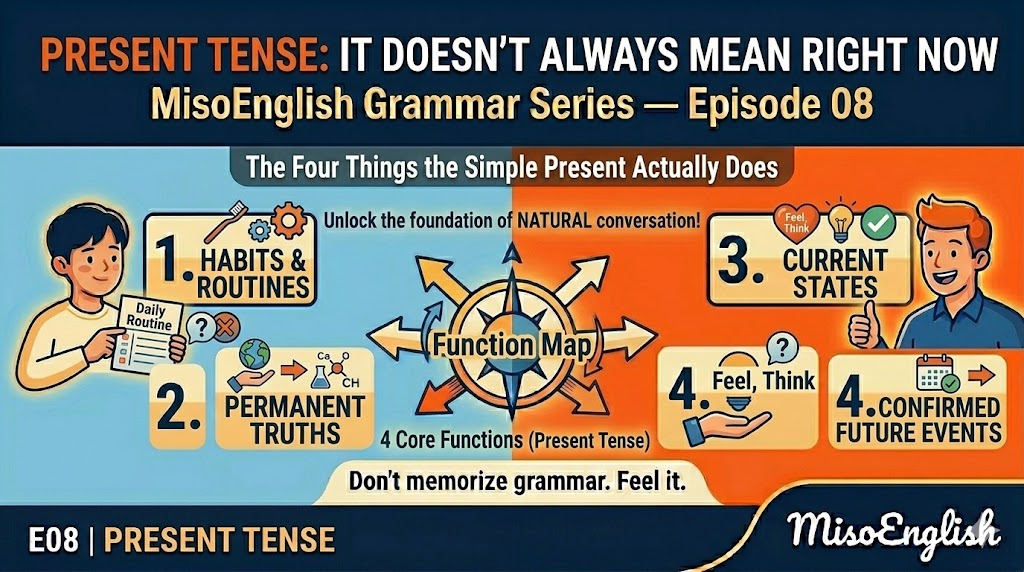
MisoEnglish Grammar Series
Episode 08 — 현재시제
지금을 말하는 게 아닐 수도 있다
"문법을 외우지 말고, 느껴라" Don't memorize grammar. Feel it.
🧭 들어가며 | Introduction
"현재시제는 지금 일어나는 일을 말한다." 많은 사람들이 이렇게 알고 있다. 하지만 이건 절반만 맞는 말이다.
"Present tense describes what's happening right now." Many people believe this. But it's only half true.
영어의 현재시제는 생각보다 훨씬 넓은 의미를 품고 있다. 지금 이 순간뿐만 아니라, 습관, 사실, 진리, 예정된 미래까지 표현한다.
The English present tense carries far more meaning than most learners realize. It expresses not just this moment, but also habits, facts, truths, and even scheduled future events.
Level 2의 첫 번째 편으로, 시제의 세계로 들어가는 관문이다.
This is the first episode of Level 2 — the gateway into the world of tense.
1. 현재시제의 네 가지 쓰임 | Four Uses of the Present Tense
① 반복되는 습관과 행동 | Repeated Habits and Actions
가장 흔한 쓰임이다. "항상, 보통, 매일, 자주" 처럼 반복되는 행동을 표현한다.
The most common use. Expresses repeated actions — always, usually, every day, often.
She drinks coffee every morning.
그녀는 매일 아침 커피를 마신다.
I go to the gym three times a week.
나는 일주일에 세 번 헬스장에 간다.
He takes the subway to work.
그는 지하철을 타고 출근한다.
They meet every Friday.
그들은 매주 금요일에 만난다.
② 변하지 않는 사실과 진리 | Permanent Facts and Truths
과학적 사실, 지리, 일반적 진리처럼 항상 참인 것을 표현한다. 과거에도 사실이었고, 지금도, 미래에도 사실일 것들.
Used for things that are always true — scientific facts, geography, general truths. True in the past, true now, true in the future.
The Earth orbits the sun.
지구는 태양 주위를 돈다.
Water boils at 100°C.
물은 100도에서 끓는다.
Cats hate water.
고양이는 물을 싫어한다.
The Amazon flows through Brazil.
아마존 강은 브라질을 통해 흐른다.
③ 현재의 상태 | Current States
지금 이 순간의 상태나 감정을 표현한다. 행동이 아니라 상태이기 때문에 진행형(-ing)을 쓰지 않는다.
Expresses a current state or feeling at this moment. Because it's a state, not an action, the progressive (-ing) form is not used.
I know the answer. 나는 답을 안다.
She loves him. 그녀는 그를 사랑한다.
He seems tired. 그는 피곤해 보인다.
We want to leave. 우리는 떠나고 싶다.
④ 예정된 미래 | Scheduled Future Events
시간표나 공식 일정처럼 이미 확정된 미래를 표현할 때도 현재시제를 쓴다.
Present tense can also describe confirmed, scheduled future events — like timetables or official plans.
The train leaves at 7.
기차는 7시에 떠난다.
The concert starts at 8 pm.
콘서트는 저녁 8시에 시작한다.
School opens next Monday.
학교는 다음 월요일에 개학한다.
The meeting ends at noon.
회의는 정오에 끝난다.
2. 현재시제 vs 현재진행형 | Simple Present vs Present Progressive
많은 학습자들이 헷갈리는 부분이다. "지금 일어나는 일"을 말할 때, 현재시제와 현재진행형 중 어느 것을 써야 할까?
This is where many learners get confused. When talking about something happening now, which do you use — simple present or present progressive?
현재시제 (Simple Present) — 반복, 습관, 사실
She works at a hospital. 그녀는 병원에서 일한다. (직업 = 반복적 사실)
현재진행형 (Present Progressive) — 지금 이 순간 진행 중
She is working right now.
그녀는 지금 일하고 있다. (지금 이 순간)
비교해보기 | Compare:
I read books. 나는 책을 읽는다. (습관)
I am reading a book. 나는 책을 읽고 있다. (지금 이 순간)
He plays soccer. 그는 축구를 한다. (취미/습관)
He is playing soccer. 그는 축구를 하고 있다. (지금 이 순간)
3. 현재시제와 자주 쓰이는 시간 표현 | Time Expressions with Simple Present
현재시제는 이런 표현들과 자주 함께 쓰인다.
These time expressions often appear with the simple present.
표현 의미 예문
| always | 항상 | She always wakes up early. |
| usually | 보통 | I usually have lunch at noon. |
| often | 자주 | He often forgets his keys. |
| sometimes | 가끔 | They sometimes walk to school. |
| rarely / seldom | 거의 안 | She rarely eats fast food. |
| never | 절대 안 | I never skip breakfast. |
| every day / week | 매일/매주 | We meet every Friday. |
| on Mondays | 월요일마다 | He works on Mondays. |
4. 한국어 습관이 만드는 실수 | Mistakes from Korean Habits
한국어는 현재와 미래를 같은 형태로 표현하는 경우가 많다. "나 내일 가" — 미래지만 동사 형태는 현재와 같다.
Korean often uses the same verb form for present and future. "나 내일 가" — future meaning, but the verb looks like present.
이 습관 때문에 영어에서도 습관/사실을 말할 때 진행형(-ing)을 과도하게 쓰는 경우가 생긴다.
This habit causes some learners to overuse the progressive (-ing) in English even when talking about habits and facts.
~~I am going to the gym every day.~~ ❌
(습관을 말할 때) I go to the gym every day. ✅
~~Water is boiling at 100°C.~~ ❌
(과학적 사실) Water boils at 100°C. ✅
~~She is loving him.~~ ❌
(상태 동사) She loves him. ✅
5. 현재시제로 역사적 사건 묘사하기 | Historic Present
글이나 이야기에서 과거 사건을 마치 지금 일어나는 것처럼 생생하게 묘사할 때 현재시제를 쓰기도 한다. 이를 **역사적 현재(Historic Present)**라고 한다.
In writing and storytelling, the present tense is sometimes used to describe past events as if they're happening right now — making the narrative feel vivid and immediate. This is called the Historic Present.
So Napoleon looks at the map, turns to his generals, and says, "We march at dawn."
나폴레옹이 지도를 보고, 장군들에게 몸을 돌리며 말한다, "우리는 새벽에 출발한다."
소설, 영화 리뷰, 스포츠 중계 등에서 자주 볼 수 있다.
You'll often see this in novels, movie reviews, and sports commentary.
📌 이번 편 요약 | Episode Summary
- 현재시제 ≠ 지금 이 순간만 — 습관·사실·상태·예정된 미래까지 포함 Simple present ≠ only right now — it covers habits, facts, states, and scheduled future.
- 반복되는 습관 — always, usually, every day와 함께 Repeated habits — with always, usually, every day.
- 변하지 않는 사실과 진리 — 과학, 지리, 일반 법칙 Permanent facts and truths — science, geography, general laws.
- 현재시제 vs 현재진행형 — 습관이면 현재시제, 지금 이 순간이면 진행형 Simple present vs progressive — habit = simple; right now = progressive.
- 상태 동사는 진행형 불가 — love, know, want, seem은 -ing 금지 Stative verbs don't take -ing — love, know, want, seem.
🔜 다음 편 예고 | Coming Up Next
Episode 09 — 과거시제 : 끝난 일을 깔끔하게 말하는 법 Past Tense: How to Talk About Things That Are Done and Gone
과거시제는 단순하다. 끝난 일, 끝난 상태.
하지만 "언제 끝났는지"를 어떻게 표현하느냐에서 영어의 정밀함이 드러난다.Past tense is clean and simple — finished actions, finished states.
But the precision of English shows in exactly how it marks when things ended.
© MisoEnglish Grammar Series | Level 2 — Episode 08 "문법을 외우지 말고, 느껴라" | "Don't memorize grammar. Feel it."
Present Tense: It Doesn't Always Mean Right Now
The Four Things the Simple Present Actually Does
MisoEnglish Grammar Series — Episode 08
"Don't memorize grammar. Feel it."
Introduction
Ask most learners what the present tense means and they'll say: "things happening right now." It's a reasonable guess — but it's only part of the picture.
The English simple present is one of the most versatile tenses in the language. It covers habits, permanent truths, current states, and even confirmed future events. Understanding all four uses — and knowing when not to use the progressive instead — is what separates learners who sound natural from those who don't.
1. Repeated Habits and Actions
The most familiar use. When something happens regularly — always, usually, every day, every week — use the simple present.
She drinks coffee every morning.
I go to the gym three times a week.
He takes the subway to work.
They meet every Friday.
These aren't happening right now. They happen repeatedly, as part of a routine.
2. Permanent Facts and Truths
For things that are always true — scientific facts, geographical facts, general laws of nature — the simple present is the right choice.
The Earth orbits the sun.
Water boils at 100°C.
Cats hate water.
The Amazon flows through Brazil.
These were true yesterday, are true today, and will be true tomorrow. The simple present captures that timelessness.
3. Current States
When describing a state — a feeling, a belief, a mental condition — the simple present is used even if it's true at this exact moment.
I know the answer.
She loves him.
He seems tired.
We want to leave.
This is because states aren't happening — they simply exist. And as we covered in Episode 06, stative verbs (know, love, want, seem, believe) don't take the progressive form.
~~She is loving him.~~ ❌
She loves him. ✅
4. Scheduled Future Events
When a future event is officially confirmed — a timetable, a schedule, an institutional plan — the simple present works perfectly.
The train leaves at 7.
The concert starts at 8 pm.
School opens next Monday.
The meeting ends at noon.
The logic: if it's on a schedule, it's treated as a fixed fact — and facts use the simple present.
5. Simple Present vs. Present Progressive
This is the comparison that trips up Korean learners most often.
Simple present → habit or repeated action:
She works at a hospital. (her job — a repeated fact)
I read books. (a habit)
He plays soccer. (a hobby)
Present progressive → happening right now:
She is working right now. (at this specific moment)
I am reading a book. (right now)
He is playing soccer. (happening as we speak)
The key question: Is this a pattern, or is it unfolding right now?
6. Common Mistakes from Korean Habits
Korean uses the same verb form for habitual and immediate actions — context does the work. English doesn't allow that flexibility.
~~I am going to the gym every day.~~ ❌
I go to the gym every day. ✅
~~Water is boiling at 100°C.~~ ❌
Water boils at 100°C. ✅
~~She is loving him.~~ ❌
She loves him. ✅
When it's a habit, fact, or state — simple present, always.
Time Expressions That Signal Simple Present
Expression Example
| always | She always wakes up early. |
| usually | I usually have lunch at noon. |
| often | He often forgets his keys. |
| sometimes | They sometimes walk to school. |
| rarely / never | I never skip breakfast. |
| every day / week | We meet every Friday. |
| on Mondays | He works on Mondays. |
When you see these in a sentence, simple present is almost always the right choice.
Episode Summary
- Simple present ≠ only right now — it covers habits, facts, states, and scheduled future.
- Habits and routines — pair with always, usually, every day.
- Permanent facts — science, geography, timeless truths.
- Current states — stative verbs, never progressive.
- Simple present vs. progressive — pattern vs. right now.
Coming Up Next
Episode 09 — Past Tense: How to Talk About Things That Are Done and Gone
Past tense is clean and decisive — an action finished, a state that no longer exists. But the precision English brings to when something ended is worth a closer look.
© MisoEnglish Grammar Series | Level 2 — Episode 08 "Don't memorize grammar. Feel it."
⚠️ 저작권 안내
본 블로그(MisoEnglish · slowblooms.tistory.com)의 모든 콘텐츠는 저작권법의 보호를 받습니다. 글, 예시 문장, 분석 내용 등 블로그에 게시된 모든 창작물은 저작자의 동의 없이 무단으로 복사, 복제, 배포, 2차 가공하는 행위를 금지합니다. 출처를 밝히지 않은 전재, SNS·커뮤니티·타 블로그 등에의 무단 게시, 상업적 이용은 모두 금지되며, 무단 불펌 적발 시 저작권법에 따라 법적 조치가 취해질 수 있습니다. 콘텐츠 사용 문의는 slowblooms.tistory.com으로 연락 주세요.
© MisoEnglish · slowblooms.tistory.com. All rights reserved.
━━━━━━━━━━━━━━━━━━━━━━━━━━━━━━━━
⚠️ Copyright Notice
All content published on this blog (MisoEnglish · slowblooms.tistory.com) is protected by copyright law. Copying, reproducing, distributing, or adapting any written posts, example sentences, or analyses without the explicit consent of the author is strictly prohibited. Unauthorised reposting on other blogs, social media, online communities, or any public platform — with or without modification — is not permitted, and may result in legal action under applicable copyright law. For content licensing enquiries, please contact us via slowblooms.tistory.com.
© MisoEnglish · slowblooms.tistory.com. All rights reserved.
'English Mechanism' 카테고리의 다른 글
| Episode 10 — 미래시제: will과 be going to는 왜 다른가 (0) | 2026.02.26 |
|---|---|
| Episode 09 — 과거시제: 끝난 일을 깔끔하게 말하는 법 (0) | 2026.02.26 |
| Episode 07 — 의문문과 부정문: 문장을 뒤집는 두 가지 방법 (0) | 2026.02.26 |
| Episode 06 — 일반동사: 움직임과 상태를 표현하는 법 (0) | 2026.02.26 |
| Episode 05 — be동사: "있다"와 "이다"를 동시에 품은 동사 (0) | 2026.02.25 |


