
- 분류 전체보기 (1053)

- Linguistics (고급 영어학) (10)
- Stylistics (6)
- Etymology & Word Building (15)
- Philosophy Meets Grammar (6)
- Collection of Famous Quotes (22)
- English Mechanism (276)
- The Language Beyond Grammar (274)
- Living English (81)
- Miso’s Life Notes (18)
- My English Journey and Refl.. (16)
- Philosophy (132)
- Video Clip (16)
- Airline English (항공 영어) (47)
- Creative Corner (35)
- Sally & Sia (1)
| 일 | 월 | 화 | 수 | 목 | 금 | 토 |
|---|---|---|---|---|---|---|
| 1 | 2 | 3 | 4 | |||
| 5 | 6 | 7 | 8 | 9 | 10 | 11 |
| 12 | 13 | 14 | 15 | 16 | 17 | 18 |
| 19 | 20 | 21 | 22 | 23 | 24 | 25 |
| 26 | 27 | 28 | 29 | 30 |
- 인도철학 #동양철학 #인문학 #요가 #명상 #힌두교 #불교 #간디 #타고르 #정통6파 #철학공부 #마음공부 #MisoEnglish #인문학영어
- MisoEnglish#철학입문 #Philosophy #형이상학 #Metaphysics #철학공부 #존재론 #실재론 #PhilosophyForBeginners #교육콘텐츠 #철학시리즈
- ticketing
- MisoEnglish#철학입문 #Philosophy #심리철학 #PhilosophyOfMind #철학공부 #의식 #마음 #PhilosophyForBeginners #교육콘텐츠 #철학시리즈
- English for Korean Learners
- pnr
- 영국사 #영국역사 #세계사 #역사연재 #브리튼에서영국까지
- MisoEnglish#도교철학 #Taoism #도덕경 #TaoTeChing #무위자연 #WuWei #노자 #Laozi #장자 #YinYang
- MisoEnglish#철학입문 #Philosophy #종교철학 #PhilosophyOfReligion #철학공부 #신존재증명 #악의문제 #PhilosophyForBeginners #교육콘텐츠 #철학시리즈
- English Speaking Practice
- 동양정치철학 #시리즈완결 #아시아적가치 #동서양비교 #유교 #민주주의 #정치사상 #인문학 #비교철학 #글로벌정치 #문화다양성 #2500년철학사
- 영어회화
- MisoEnglish#철학입문 #Philosophy #정치철학 #PoliticalPhilosophy #철학공부 #정의론 #자유주의 #PhilosophyForBeginners #교육콘텐츠 #철학시리즈
- Basic English Verbs
- English in English
- everyday English
- 영어공부
- MisoEnglish#유교철학 #Confucianism #성리학 #NeoConfucianism #인의예지 #Virtue #맹자 #Mencius #실학 #KoreanScholarship
- misoenglish
- MisoEnglish#철학입문 #Philosophy #윤리학 #Ethics #도덕철학 #철학공부 #칸트 #공리주의 #교육콘텐츠 #철학시리즈
- 🌿 English with Heart
- MisoEnglish#한국철학 #KoreanPhilosophy #홍익인간 #Hongik #화랑도 #Hwarang #단군 #Dangun #풍류도 #ThreeKingdoms#동양철학
- 영문법
- 영어접속사
- EnglishWriting #AcademicWriting #Grammar #EnglishLanguage #EssayWriting #ParagraphStructure #SentenceStructure #BusinessEnglish #EnglishTips #WritingSkills #Linguistics #ESL
- 영어문법
- 감성영어
- MisoEnglish#철학입문 #Philosophy #과학철학 #PhilosophyOfScience #철학공부 #포퓨퍼 #쿠hn #과학방법론 #교육콘텐츠 #철학시리즈
- MisoEnglish#불교철학 #BuddhismPhilosophy #사성제 #FourNobleTruths #공사상 #Emptiness #명상 #Mindfulness #열반 #EasternWisdom
- AirlineOpsEnglish
- Today
- Total
MisoEnglish
Episode 10 — 미래시제: will과 be going to는 왜 다른가 본문
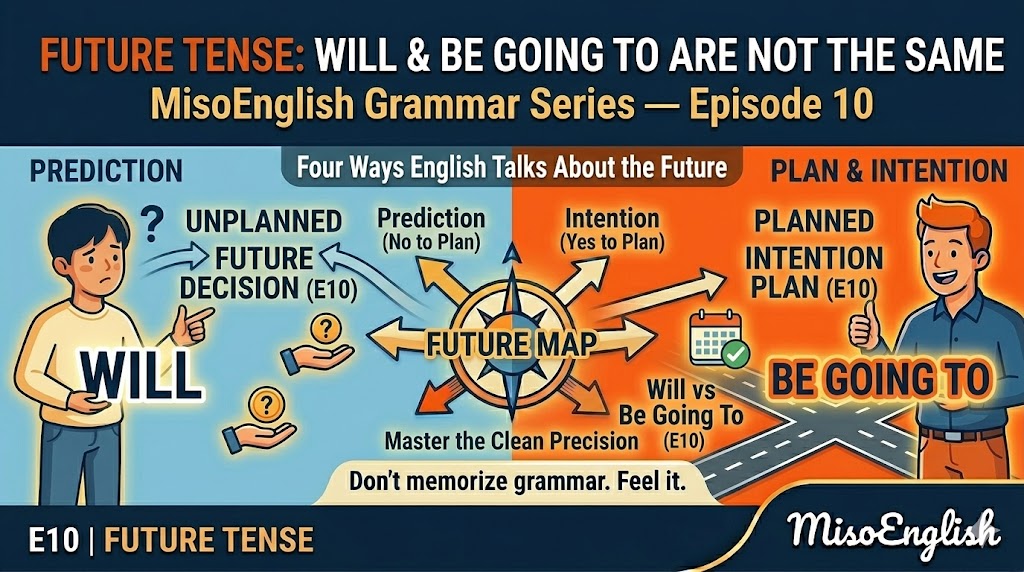
MisoEnglish Grammar Series
Episode 10 — 미래시제
will과 be going to는 왜 다른가
"문법을 외우지 말고, 느껴라" Don't memorize grammar. Feel it.
🧭 들어가며 | Introduction
영어로 미래를 말하는 방법은 하나가 아니다.
In English, there's more than one way to talk about the future.
I will call you. 내가 전화할게.
I am going to call you. 나 전화하려고 했어 / 할 거야.
I am calling you tomorrow. 나 내일 전화해.
The meeting starts at 9. 회의는 9시에 시작해.
같은 "미래"인데 왜 이렇게 다양한 표현이 있을까?
이것이 한국어와의 결정적 차이다.
한국어는 "할게", "할 거야" 정도로 해결되지만,
영어는 "어떤 종류의 미래인가" 를 구분한다.
Same future — why so many forms?
This is a key difference from Korean.
Korean gets by with "할게" or "할 거야"
— but English distinguishes what kind of future it is.
이번 편에서 그 감각을 완성한다.
This episode is about building that sense.
1. will — 즉흥적 결정과 예측 | Spontaneous Decisions and Predictions
will은 지금 이 순간 결정하거나, 미래를 예측할 때 쓴다. 계획된 것이 아니라, 지금 막 마음이 움직인 것이다.
will is used for decisions made at this exact moment, or for predictions about the future. Not pre-planned — just decided right now.
즉흥적 결정 | Spontaneous Decision
A: The phone is ringing. B:
I'll get it. 내가 받을게.
→ 지금 막 결정한 것. 미리 계획한 게 아님.
→ Decided right now. Not planned in advance.
A: We're out of coffee.
B: I'll buy some on the way home.
집에 오는 길에 살게.
A: This bag looks heavy.
B: I'll help you. 내가 도와줄게.
예측 | Prediction
It will rain tomorrow.
내일 비가 올 것이다.
She will be a great doctor someday.
그녀는 언젠가 훌륭한 의사가 될 것이다
.
I think he will like it.
그가 좋아할 것 같다.
will의 부정과 의문문
I won't (will not) be there. 나는 거기 없을 거야.
Will you help me? 나 도와줄 거야?
Will she come? 그녀 올까?
2. be going to — 계획과 근거 있는 예측 | Plans and Evidence-Based Predictions
be going to는 이미 마음속에 계획이 잡혀 있을 때 쓴다. 또는 지금 눈앞의 증거를 보고 일어날 것이 분명할 때.
be going to is used when a plan already exists in your mind. Or when current evidence makes something clearly about to happen.
이미 세운 계획 | Pre-made Plans
I am going to visit my parents this weekend.
나는 이번 주말에 부모님을 방문할 계획이다.
→ 이미 결정된 계획. will처럼 즉흥적인 게 아님.
She is going to study abroad next year.
그녀는 내년에 유학할 계획이다.
We are going to move to a new apartment.
우리는 새 아파트로 이사할 계획이다.
근거 있는 예측 | Evidence-Based Prediction
지금 보이는 증거가 있을 때. "저러다 ~되겠네" 하는 느낌.
When there's visible evidence right now — "this is clearly about to happen."
Look at those clouds. It is going to rain.
저 구름 봐. 비 오겠다. (지금 구름이 보임)
He is going to fall!
그 사람 넘어지겠다! (지금 비틀거리고 있음)
She's not studying at all. She is going to fail the exam.
그녀는 공부를 전혀 안 하고 있어. 시험에 떨어지겠다.
3. will vs be going to — 핵심 비교 | The Core Comparison
이 둘의 차이를 가장 잘 보여주는 예시:
The clearest example of the difference:
상황 | Situation: 친구가 주말 계획을 묻는다. A friend asks about your weekend plans.
I'm going to see a movie this weekend.
나 이번 주말에 영화 볼 거야.
→ 이미 계획함. 티켓도 샀을 수도 있음.
→ Already planned. Maybe even bought tickets.
I'll see a movie this weekend.
나 이번 주말에 영화나 볼까.
→ 지금 막 생각한 것. 즉흥적.
→ Just thought of it now. Spontaneous.
또 다른 예 | Another Example:
A: The printer is broken.
B: I'll fix it. ← 지금 막 결정 (즉흥)내가 고칠게.
← Decided this second
A: The printer is broken.
B: I'm going to fix it. ← 이미 알고 계획했음 나 그거 고치려고 했어.
← Already had this in mind
한눈에 비교 | Quick Reference:
will be going to
| 결정 시점 | 지금 이 순간 | 이미 전에 |
| 느낌 | 즉흥적, 자발적 | 계획적, 의도적 |
| 예측 | 그냥 예측 | 증거 기반 예측 |
| 예문 | I'll call you. | I'm going to call you. |
4. 그 외 미래 표현들 | Other Ways to Express the Future
영어에서 미래를 표현하는 방법은 will과 be going to만이 아니다.
English has even more ways to express the future.
현재진행형 — 확정된 약속 | Present Progressive — Confirmed Appointments
가까운 미래에 이미 약속이나 일정이 잡혀 있을 때. 주로 사람과의 약속, 구체적 계획에 쓴다.
Used when an appointment or arrangement is already set and confirmed. Often for plans involving other people.
I am meeting Jake tomorrow.
나 내일 Jake 만나.
She is flying to London on Friday.
그녀는 금요일에 런던으로 날아간다.
We are having dinner together tonight.
우리 오늘 저녁 같이 먹어.
현재시제 — 시간표와 공식 일정 | Simple Present — Timetables and Official Schedules
Episode 08에서 다뤘듯이, 공식 시간표에는 현재시제를 쓴다.
As covered in Episode 08, official timetables use the simple present.
The train leaves at 7. 기차는 7시에 출발한다.
The concert starts at 8. 콘서트는 8시에 시작한다.
5. will의 다른 쓰임들 | Other Uses of "will"
will은 미래 외에도 다양한 뉘앙스로 쓰인다.
"will" is used for more than just future tense.
요청 | Requests
Will you open the window? 창문 좀 열어줄래?
Will you help me with this? 이거 좀 도와줄래?
강한 의지 | Strong Intention
I will not give up.
나는 절대 포기하지 않을 것이다.
She will succeed no matter what.
그녀는 무슨 일이 있어도 성공할 것이다.
습관적 행동 (현재) | Habitual Behavior (Present)
He will sit there for hours.
그는 몇 시간이고 거기 앉아 있곤 한다.
She will always find something to complain about.
그녀는 항상 불평거리를 찾아낸다.
6. 한국어 학습자가 자주 틀리는 부분 | Common Mistakes for Korean Learners
한국어의 "~할 거야"는 will과 be going to를 모두 포함한다. 그래서 둘 중 어느 것을 쓸지 선택하는 게 낯설게 느껴진다.
Korean "~할 거야" covers both will and be going to. That's why choosing between them feels unfamiliar.
~~I will visit my parents this weekend.~~
← 어색함 (계획이 이미 있으면)
I'm going to visit my parents this weekend. ✅
~~I'm going to get it.~~
← 어색함 (전화가 지금 울리고 있는데)
I'll get it. ✅
그리고 will 뒤에는 반드시 동사원형이 온다.
And after "will," always use the base form of the verb.
~~I will goes.~~ ❌ → I will go. ✅
~~She will studies.~~ ❌ → She will study. ✅
📌 이번 편 요약 | Episode Summary
- will = 즉흥적 결정 + 단순 예측 — 지금 이 순간 마음이 움직인 것 will = spontaneous decision + simple prediction — decided right now.
- be going to = 계획 + 증거 기반 예측 — 이미 마음에 있던 것 be going to = pre-made plan + evidence-based prediction — already in mind.
- 현재진행형 = 확정된 약속 — 사람과의 구체적 일정 Present progressive = confirmed appointment — specific plans with others.
- 현재시제 = 공식 시간표 — 기차, 콘서트, 수업 등 Simple present = official timetable — trains, concerts, classes.
- will 뒤는 반드시 동사원형 — will goes ❌ / will go ✅ Always base form after will — will goes ❌ / will go ✅
🔜 다음 편 예고 | Coming Up Next
Episode 11 — 진행형 : 딱 이 순간, 일어나고 있는 일 Progressive Tense: What's Happening at This Exact Moment
현재진행형만 있는 게 아니다.
과거진행형, 미래진행형까지
— 진행형이 만드는 "한창 ~하는 중" 의 감각을 파헤친다.It's not just present progressive.
Past progressive, future progressive
— we dig into the feeling of "right in the middle of doing something."
© MisoEnglish Grammar Series | Level 2 — Episode 10 "문법을 외우지 말고, 느껴라" | "Don't memorize grammar. Feel it."
Future Tense: Why "will" and "be going to" Are Not the Same
Four Ways English Talks About the Future — and When to Use Each
MisoEnglish Grammar Series — Episode 10
"Don't memorize grammar. Feel it."
Introduction
In Korean, the future is simple: "~할게" or "~할 거야" covers just about everything. English is more precise. It distinguishes between different kinds of future — and using the wrong one doesn't just sound odd, it changes the meaning.
The two main players are will and be going to. Many learners treat them as interchangeable. They're not. And once you feel the difference, you'll never mix them up again.
1. "will" — Spontaneous Decisions and Predictions
"Will" is the future of this moment. You didn't plan it. Something happened, and right now you've decided.
Spontaneous decisions
A: The phone is ringing.
B: I'll get it. (decided this second)
A: We're out of coffee.
B: I'll buy some on the way home.
A: This bag looks heavy.
B: I'll help you.
In each case, the decision is born in the moment. There was no plan five minutes ago. "Will" captures that immediacy.
Predictions
It will rain tomorrow.
She will be a great doctor someday.
I think he will like it.
These are predictions based on general belief or intuition — not on visible evidence right now.
Negatives and questions
I won't be there.
Will you help me?
Will she come?
2. "be going to" — Plans and Evidence-Based Predictions
"Be going to" is the future of intention. The decision was already made. You had this in mind before the conversation started.
Pre-made plans
I am going to visit my parents this weekend.
She is going to study abroad next year.
We are going to move to a new apartment.
These are plans that existed before this moment. The speaker already decided.
Evidence-based predictions
When you can see or sense something is clearly about to happen:
Look at those clouds. It is going to rain.
He is going to fall! (he's already stumbling)
She's not studying at all. She is going to fail.
The evidence is present, visible, right now. "Be going to" carries that certainty.
3. The Core Comparison
Same situation, two different meanings:
I'm going to see a movie this weekend.
→ Already planned. Maybe bought tickets.
A pre-existing intention.
I'll see a movie this weekend.
→ Just thought of it.
Spontaneous, decided in this conversation.
One more:
A: The printer is broken.
B: I'll fix it.
→ Decided just now.
B: I'm going to fix it.
→ I already had this in mind.
will be going to
| When decided | Right now | Already decided |
| Feeling | Spontaneous | Intentional, planned |
| Prediction type | General / intuitive | Evidence-based |
4. Two More Ways to Talk About the Future
Present Progressive — Confirmed Appointments
When you have a specific, confirmed arrangement — especially with another person:
I am meeting Jake tomorrow.
She is flying to London on Friday.
We are having dinner together tonight.
The difference from "be going to": present progressive implies the arrangement is already locked in — there's a social commitment involved.
Simple Present — Official Timetables
For fixed institutional schedules — transport, events, classes:
The train leaves at 7.
The concert starts at 8.
School opens next Monday.
5. Other Uses of "will"
"Will" does more than express future tense.
Requests:
Will you open the window?
Strong determination:
I will not give up.
She will succeed no matter what.
Habitual present behavior:
He will sit there for hours. (he tends to do this)
6. The Most Common Mistakes
For Korean speakers, the challenge is that "~할 거야" maps onto both "will" and "be going to." Choosing between them requires a new instinct.
~~I will visit my parents this weekend.~~
← awkward (if it's a pre-made plan)
I'm going to visit my parents this weekend. ✅
~~I'm going to get it.~~
← awkward (if the phone is ringing right now)
I'll get it. ✅
And always: will + base form. No exceptions.
~~I will goes.~~ ❌ → I will go. ✅
~~She will studies.~~ ❌ → She will study. ✅
Episode Summary
- will = spontaneous decision + simple prediction — born in this moment.
- be going to = pre-made plan + evidence-based prediction — already decided.
- Present progressive = confirmed appointments — locked-in plans with others.
- Simple present = official timetables — trains, concerts, schedules.
- will + base form always — no -s, no past form.
Coming Up Next
Episode 11 — Progressive Tense: What's Happening at This Exact Moment
It's not just present progressive. Past progressive, future progressive — we dig into the full sense of "right in the middle of doing something," and when English demands that sense be expressed.
© MisoEnglish Grammar Series | Level 2 — Episode 10 "Don't memorize grammar. Feel it."
⚠️ 저작권 안내
본 블로그(MisoEnglish · slowblooms.tistory.com)의 모든 콘텐츠는 저작권법의 보호를 받습니다. 글, 예시 문장, 분석 내용 등 블로그에 게시된 모든 창작물은 저작자의 동의 없이 무단으로 복사, 복제, 배포, 2차 가공하는 행위를 금지합니다. 출처를 밝히지 않은 전재, SNS·커뮤니티·타 블로그 등에의 무단 게시, 상업적 이용은 모두 금지되며, 무단 불펌 적발 시 저작권법에 따라 법적 조치가 취해질 수 있습니다. 콘텐츠 사용 문의는 slowblooms.tistory.com으로 연락 주세요.
© MisoEnglish · slowblooms.tistory.com. All rights reserved.
━━━━━━━━━━━━━━━━━━━━━━━━━━━━━━━━
⚠️ Copyright Notice
All content published on this blog (MisoEnglish · slowblooms.tistory.com) is protected by copyright law. Copying, reproducing, distributing, or adapting any written posts, example sentences, or analyses without the explicit consent of the author is strictly prohibited. Unauthorised reposting on other blogs, social media, online communities, or any public platform — with or without modification — is not permitted, and may result in legal action under applicable copyright law. For content licensing enquiries, please contact us via slowblooms.tistory.com.
© MisoEnglish · slowblooms.tistory.com. All rights reserved.
'English Mechanism' 카테고리의 다른 글
| Episode 12 — 현재완료: 과거와 현재를 하나로 잇는 다리 (0) | 2026.02.27 |
|---|---|
| Episode 11 — 진행형: 딱 이 순간, 일어나고 있는 일 (0) | 2026.02.27 |
| Episode 09 — 과거시제: 끝난 일을 깔끔하게 말하는 법 (0) | 2026.02.26 |
| Episode 08 — 현재시제: 지금을 말하는 게 아닐 수도 있다 (0) | 2026.02.26 |
| Episode 07 — 의문문과 부정문: 문장을 뒤집는 두 가지 방법 (0) | 2026.02.26 |


