
- 분류 전체보기 (1058)

- Linguistics (고급 영어학) (10)
- Stylistics (6)
- Etymology & Word Building (15)
- Philosophy Meets Grammar (6)
- Collection of Famous Quotes (22)
- English Mechanism (276)
- The Language Beyond Grammar (279)
- Living English (81)
- Miso’s Life Notes (18)
- My English Journey and Refl.. (16)
- Philosophy (132)
- Video Clip (16)
- Airline English (항공 영어) (47)
- Creative Corner (35)
- Sally & Sia (1)
| 일 | 월 | 화 | 수 | 목 | 금 | 토 |
|---|---|---|---|---|---|---|
| 1 | 2 | 3 | 4 | |||
| 5 | 6 | 7 | 8 | 9 | 10 | 11 |
| 12 | 13 | 14 | 15 | 16 | 17 | 18 |
| 19 | 20 | 21 | 22 | 23 | 24 | 25 |
| 26 | 27 | 28 | 29 | 30 |
- English Speaking Practice
- MisoEnglish#철학입문 #Philosophy #종교철학 #PhilosophyOfReligion #철학공부 #신존재증명 #악의문제 #PhilosophyForBeginners #교육콘텐츠 #철학시리즈
- Basic English Verbs
- MisoEnglish#철학입문 #Philosophy #정치철학 #PoliticalPhilosophy #철학공부 #정의론 #자유주의 #PhilosophyForBeginners #교육콘텐츠 #철학시리즈
- 영문법
- 인도철학 #동양철학 #인문학 #요가 #명상 #힌두교 #불교 #간디 #타고르 #정통6파 #철학공부 #마음공부 #MisoEnglish #인문학영어
- MisoEnglish#철학입문 #Philosophy #심리철학 #PhilosophyOfMind #철학공부 #의식 #마음 #PhilosophyForBeginners #교육콘텐츠 #철학시리즈
- MisoEnglish#불교철학 #BuddhismPhilosophy #사성제 #FourNobleTruths #공사상 #Emptiness #명상 #Mindfulness #열반 #EasternWisdom
- 🌿 English with Heart
- 영어문법
- English in English
- 영어접속사
- 동양정치철학 #시리즈완결 #아시아적가치 #동서양비교 #유교 #민주주의 #정치사상 #인문학 #비교철학 #글로벌정치 #문화다양성 #2500년철학사
- MisoEnglish#철학입문 #Philosophy #윤리학 #Ethics #도덕철학 #철학공부 #칸트 #공리주의 #교육콘텐츠 #철학시리즈
- MisoEnglish#도교철학 #Taoism #도덕경 #TaoTeChing #무위자연 #WuWei #노자 #Laozi #장자 #YinYang
- English for Korean Learners
- AirlineOpsEnglish
- 감성영어
- pnr
- MisoEnglish#유교철학 #Confucianism #성리학 #NeoConfucianism #인의예지 #Virtue #맹자 #Mencius #실학 #KoreanScholarship
- 영어공부
- MisoEnglish#철학입문 #Philosophy #과학철학 #PhilosophyOfScience #철학공부 #포퓨퍼 #쿠hn #과학방법론 #교육콘텐츠 #철학시리즈
- MisoEnglish#한국철학 #KoreanPhilosophy #홍익인간 #Hongik #화랑도 #Hwarang #단군 #Dangun #풍류도 #ThreeKingdoms#동양철학
- misoenglish
- 영국사 #영국역사 #세계사 #역사연재 #브리튼에서영국까지
- 영어회화
- MisoEnglish#철학입문 #Philosophy #형이상학 #Metaphysics #철학공부 #존재론 #실재론 #PhilosophyForBeginners #교육콘텐츠 #철학시리즈
- everyday English
- EnglishWriting #AcademicWriting #Grammar #EnglishLanguage #EssayWriting #ParagraphStructure #SentenceStructure #BusinessEnglish #EnglishTips #WritingSkills #Linguistics #ESL
- ticketing
- Today
- Total
MisoEnglish
Episode 05 — be동사: "있다"와 "이다"를 동시에 품은 동사 본문
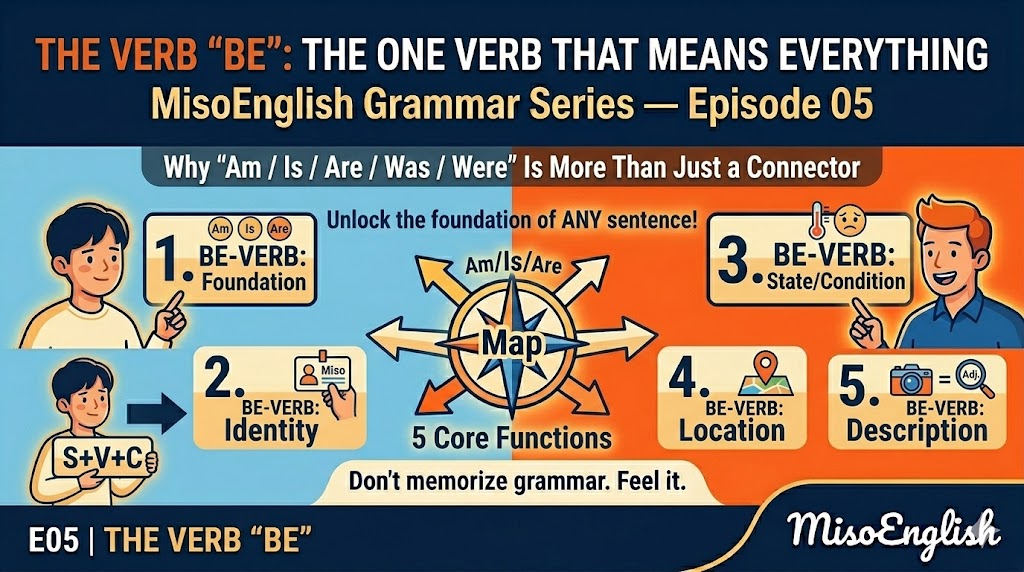
MisoEnglish Grammar Series
Episode 05 — be동사
"있다"와 "이다"를 동시에 품은 동사
"문법을 외우지 말고, 느껴라" Don't memorize grammar. Feel it.
🧭 들어가며 | Introduction
영어에서 가장 많이 쓰이는 동사는 무엇일까? run? love? go? 아니다.
What is the most used verb in English? run? love? go? None of those.
정답은 be다.
The answer is be.
am, is, are, was, were, been, being — 이 모든 것이 하나의 동사 be의 변신이다.
am, is, are, was, were, been, being — all of these are forms of the single verb be.
한국어에는 be동사에 딱 떨어지는 대응어가 없다. "이다"와 "있다"를 합쳐놓은 듯한 이 동사를 많은 학습자들이 "그냥 연결어"로 가볍게 여기고 지나친다.
Korean has no clean equivalent of "be." It's somewhere between "이다" and "있다." Many learners treat it as "just a connector" and move on.
그게 가장 큰 실수다. be동사는 영어 문장의 심장 중의 심장이다.
That's the biggest mistake. "Be" is the heart of hearts in English.
1. be동사의 모든 형태 | All Forms of "Be"
be동사는 영어에서 불규칙 변화가 가장 많은 동사다. 주어와 시제에 따라 형태가 완전히 달라진다.
"Be" is the most irregularly conjugated verb in English. Its form changes completely depending on the subject and tense.
현재형 Present
주어 Subject be동사 형태 Form
| I | am |
| You | are |
| He / She / It | is |
| We / They | are |
I am tired.
나는 피곤하다.
She is a doctor.
그녀는 의사다.
They are here.
그들은 여기 있다.
과거형 Past
주어 Subject be동사 형태 Form
| I | was |
| You | were |
| He / She / It | was |
| We / They | were |
I was late.
나는 늦었다.
She was happy.
그녀는 행복했다.
They were wrong.
그들은 틀렸다.
기타 형태 Other Forms
형태 Form 쓰임 Use 예문 Example
| be | 원형 / 조동사 뒤 | I want to be free. |
| been | 완료형 (have + been) | I have been here before. |
| being | 진행형 / 수동태 | She is being treated. |
2. be동사의 두 가지 얼굴 | Two Faces of "Be"
be동사는 크게 두 가지 의미로 쓰인다.
"Be" is used in two fundamental ways.
① "이다" — 정체와 상태를 선언한다 | Declaring Identity and State
주어가 무엇인지, 어떤 상태인지를 말할 때. 이때 be동사는 **2형식(S+V+C)**의 핵심이다.
When telling us what the subject is or what state it's in. Here, "be" is the engine of Pattern 2 (S+V+C).
정체 선언 (Declaring Identity):
She is a teacher.
그녀는 선생님이다.
I am Korean.
나는 한국인이다.
That is a great idea.
그것은 좋은 생각이다.
상태 선언 (Declaring State):
He is tired.
그는 피곤하다.
We are ready.
우리는 준비됐다.
The door is open.
문이 열려 있다.
② "있다" — 존재와 위치를 선언한다 | Declaring Existence and Location
주어가 어디에 있는지, 존재하는지를 말할 때. 이때 be동사는 **1형식(S+V)**에 가깝게 쓰인다.
When telling us where the subject is or that it exists. Here, "be" is used closer to Pattern 1 (S+V).
She is at home.
그녀는 집에 있다.
The keys are on the table.
열쇠는 테이블 위에 있다.
He was in the kitchen.
그는 주방에 있었다.
There is a problem.
문제가 있다.
There are many options.
선택지가 많다.
3. be동사는 조동사와도 함께 일한다 | "Be" Works with Other Verbs Too
be동사는 단독으로 쓰일 뿐만 아니라, 진행형과 수동태를 만들 때도 핵심 역할을 한다.
"Be" doesn't just work alone. It's also the key ingredient in progressive tenses and passive voice.
진행형 Progressive (be + -ing)
She is running.
그녀는 달리고 있다.
They were laughing.
그들은 웃고 있었다.
I am working on it.
나는 그것을 작업 중이다.
수동태 Passive Voice (be + p.p.)
The window was broken.
창문이 깨졌다.
English is spoken all over the world.
영어는 전 세계에서 쓰인다.
The project is being reviewed.
프로젝트가 검토되고 있다.
이 둘은 Level 3~4에서 깊이 다루겠지만, 지금은 "be동사가 혼자 일하는 게 아니다"는 것만 기억해두자.
We'll go deep on both of these in Levels 3–4. For now, just remember: "be" doesn't always work alone.
4. be동사의 부정문과 의문문 | Negatives and Questions with "Be"
be동사 문장의 부정문과 의문문은 be동사 자체를 움직이면 된다. 일반동사와 달리 do/does/did가 필요 없다.
To make negatives and questions with "be," just move the "be" itself. Unlike regular verbs, you don't need do/does/did.
부정문 Negative (be + not)
She is not (isn't) here.
그녀는 여기 없다.
I am not late.
나는 늦지 않았다
.
They were not (weren't) ready.
그들은 준비가 안 됐다.
의문문 Question (be + 주어)
Is she here?
그녀 여기 있어?
Are you okay?
너 괜찮아?
Was he at the party?
그는 파티에 있었어?
⚠️ 흔한 실수 | Common Mistake
~~Do you are a student?~~ ❌ Are you a student? ✅
~~She doesn't is tired.~~ ❌ She isn't tired. ✅
be동사 문장에는 do / does / did를 절대 쓰지 않는다. 이것은 규칙이 아니라, be동사와 일반동사의 작동 방식이 근본적으로 다르기 때문이다.
Never use do/does/did with "be" verbs. It's not just a rule — it's because "be" and regular verbs operate on completely different logic.
5. be동사가 없으면 생기는 일 | What Happens Without "Be"
한국어는 "나 피곤해", "그녀 선생님이야"처럼 be동사 없이도 자연스러운 문장이 된다.
In Korean, "나 피곤해", "그녀 선생님이야" — perfectly natural without a separate "be" verb.
영어 학습자들이 가장 많이 저지르는 실수 중 하나가 이 습관을 영어에 그대로 가져오는 것이다.
One of the most common errors Korean learners make is carrying this habit directly into English.
~~I tired.~~ ❌ → I am tired. ✅
~~She a teacher.~~ ❌ → She is a teacher. ✅
~~They not here.~~ ❌ → They are not here. ✅
~~He very smart.~~ ❌ → He is very smart. ✅
~~The meeting tomorrow.~~ ❌ → The meeting is tomorrow. ✅
영어 문장에서 be동사는 생략할 수 없다. 아무리 짧은 문장이라도, 주어와 보어(또는 장소) 사이에는 반드시 be동사가 있어야 한다.
In English, "be" cannot be dropped. No matter how short the sentence, there must be a "be" between the subject and its complement or location.
📌 이번 편 요약 | Episode Summary
- be동사는 am / is / are / was / were 등으로 변신한다 — 주어와 시제에 따라 "Be" takes the forms am/is/are/was/were — depending on subject and tense.
- "이다" — 정체와 상태를 선언한다 — S + be + 보어 "Is/am/are" declares identity and state — S + be + complement.
- "있다" — 존재와 위치를 선언한다 — S + be + 장소 "Is/am/are" declares existence and location — S + be + place.
- be동사는 진행형·수동태도 만든다 — be + -ing / be + p.p. "Be" also builds progressives and passives — be + -ing / be + p.p.
- 부정·의문문은 be 자체를 움직인다 — do/does/did 절대 사용 안 함 Negatives and questions move "be" itself — never use do/does/did.
🔜 다음 편 예고 | Coming Up Next
Episode 06 — 일반동사 : 움직임과 상태를 표현하는 법 Regular Verbs: How to Express Action and State
be동사가 "존재"라면, 일반동사는 "행위"다. run, eat, think, love, know — 이 수천 개의 동사들이 영어 문장의 살과 피를 이룬다.
If "be" is existence, regular verbs are action. run, eat, think, love, know — these thousands of verbs are the flesh and blood of English sentences.
© MisoEnglish Grammar Series | Level 1 — Episode 05 "문법을 외우지 말고, 느껴라" | "Don't memorize grammar. Feel it."
The Verb "Be": The One Verb That Means Everything
Why "Am / Is / Are / Was / Were" Is More Than Just a Connector
MisoEnglish Grammar Series — Episode 05
"Don't memorize grammar. Feel it."
Introduction
If you had to guess the most frequently used verb in the English language, you might think of go, have, or do. The answer is be — and it's not even close.
am, is, are, was, were, been, being — seven different forms, all belonging to one verb. And yet many Korean learners treat "be" as a throwaway connector, something to slap between a subject and a description and move on.
That's a mistake. Understanding what "be" actually does — what it means, how it behaves, and why it can't be dropped — is foundational to everything else in English.
1. All the Forms of "Be"
"Be" is the most irregularly conjugated verb in English. No other verb changes its shape this dramatically.
Present tense:
Subject Form
| I | am |
| You | are |
| He / She / It | is |
| We / They | are |
Past tense:
Subject Form
| I | was |
| You | were |
| He / She / It | was |
| We / They | were |
Other forms:
Form Use Example
| be | Base form / after modals | I want to be free. |
| been | Perfect tenses | I have been here before. |
| being | Progressive / passive | She is being treated. |
2. The Two Faces of "Be"
"Be" carries two distinct meanings, and knowing which one is at work in any given sentence makes a huge difference.
Face One: "Is/Am/Are" as Identity and State
This is "be" as the engine of Pattern 2 — the subject complement structure.
Declaring identity:
She is a teacher.
I am Korean.
That is a great idea.
Declaring state:
He is tired.
We are ready.
The door is open.
In every case, subject = complement. The "be" verb is the equals sign made verbal.
Face Two: "Is/Am/Are" as Existence and Location
This is "be" saying that something exists or is somewhere.
She is at home.
The keys are on the table.
There is a problem.
There are many options.
Here, no complement follows — just a location or the fact of existence.
3. "Be" as a Helper Verb
"Be" doesn't only work as the main verb. It's also the core ingredient in two major grammatical structures.
Progressive tenses (be + -ing):
She is running.
They were laughing.
I am working on it.
Passive voice (be + past participle):
The window was broken.
English is spoken all over the world.
The project is being reviewed.
We'll go deep on both of these in later episodes. For now, the key point: "be" does far more than connect a subject to a description.
4. Negatives and Questions — No "Do" Needed
This is where "be" diverges sharply from regular verbs. With regular verbs, you need do/does/did to form negatives and questions. With "be," you just move the verb itself.
Negative (be + not):
She isn't here.
I am not late.
They weren't ready.
Question (be + subject):
Is she here?
Are you okay?
Was he at the party?
The most common mistake Korean learners make here:
~~Do you are a student?~~ ❌ → Are you a student? ✅
~~She doesn't is tired.~~ ❌ → She isn't tired. ✅
"Be" and regular verbs run on completely different logic. The moment you recognize which type of verb you're dealing with, the right structure follows automatically.
5. The Verb You Cannot Drop
In Korean, leaving out the equivalent of "be" is perfectly natural. "나 피곤해", "그녀 선생님이야" — both are fluent, everyday Korean.
Carrying this habit into English produces some of the most persistent errors among Korean learners:
~~I tired.~~ ❌ → I am tired. ✅
~~She a teacher.~~ ❌ → She is a teacher. ✅
~~They not here.~~ ❌ → They are not here. ✅
~~He very smart.~~ ❌ → He is very smart. ✅
~~The meeting tomorrow.~~ ❌ → The meeting is tomorrow. ✅
In English, "be" cannot be dropped. No matter how short or simple the sentence, if there's a subject and a complement — or a subject and a location — there must be a "be" verb standing between them.
Episode Summary
- "Be" takes seven forms — am, is, are, was, were, been, being.
- Face one: identity and state — subject = complement (Pattern 2).
- Face two: existence and location — the subject is somewhere, or simply is.
- "Be" also builds progressives and passives — be + -ing / be + p.p.
- Negatives and questions move "be" directly — never use do/does/did.
- "Be" cannot be dropped — it's not optional, ever.
Coming Up Next
Episode 06 — Regular Verbs: How to Express Action and State
If "be" is existence, regular verbs are action. run, eat, think, love, know — these are the thousands of verbs that give English sentences their motion, their color, their life.
© MisoEnglish Grammar Series | Level 1 — Episode 05 "Don't memorize grammar. Feel it."
⚠️ 저작권 안내
본 블로그(MisoEnglish · slowblooms.tistory.com)의 모든 콘텐츠는 저작권법의 보호를 받습니다. 글, 예시 문장, 분석 내용 등 블로그에 게시된 모든 창작물은 저작자의 동의 없이 무단으로 복사, 복제, 배포, 2차 가공하는 행위를 금지합니다. 출처를 밝히지 않은 전재, SNS·커뮤니티·타 블로그 등에의 무단 게시, 상업적 이용은 모두 금지되며, 무단 불펌 적발 시 저작권법에 따라 법적 조치가 취해질 수 있습니다. 콘텐츠 사용 문의는 slowblooms.tistory.com으로 연락 주세요.
© MisoEnglish · slowblooms.tistory.com. All rights reserved.
━━━━━━━━━━━━━━━━━━━━━━━━━━━━━━━━
⚠️ Copyright Notice
All content published on this blog (MisoEnglish · slowblooms.tistory.com) is protected by copyright law. Copying, reproducing, distributing, or adapting any written posts, example sentences, or analyses without the explicit consent of the author is strictly prohibited. Unauthorised reposting on other blogs, social media, online communities, or any public platform — with or without modification — is not permitted, and may result in legal action under applicable copyright law. For content licensing enquiries, please contact us via slowblooms.tistory.com.
© MisoEnglish · slowblooms.tistory.com. All rights reserved.
'English Mechanism' 카테고리의 다른 글
| Episode 07 — 의문문과 부정문: 문장을 뒤집는 두 가지 방법 (0) | 2026.02.26 |
|---|---|
| Episode 06 — 일반동사: 움직임과 상태를 표현하는 법 (0) | 2026.02.26 |
| Episode 04 — 영어 5형식: 문장의 모든 틀은 다섯 개뿐이다 (0) | 2026.02.25 |
| Episode 03 — 목적어와 보어: 동사 뒤에 무엇이 오는가 (0) | 2026.02.25 |
| Episode 02 — 주어와 동사: 모든 문장은 이 둘에서 시작된다 (0) | 2026.02.25 |


