
- 분류 전체보기 (1058)

- Linguistics (고급 영어학) (10)
- Stylistics (6)
- Etymology & Word Building (15)
- Philosophy Meets Grammar (6)
- Collection of Famous Quotes (22)
- English Mechanism (276)
- The Language Beyond Grammar (279)
- Living English (81)
- Miso’s Life Notes (18)
- My English Journey and Refl.. (16)
- Philosophy (132)
- Video Clip (16)
- Airline English (항공 영어) (47)
- Creative Corner (35)
- Sally & Sia (1)
| 일 | 월 | 화 | 수 | 목 | 금 | 토 |
|---|---|---|---|---|---|---|
| 1 | 2 | 3 | 4 | |||
| 5 | 6 | 7 | 8 | 9 | 10 | 11 |
| 12 | 13 | 14 | 15 | 16 | 17 | 18 |
| 19 | 20 | 21 | 22 | 23 | 24 | 25 |
| 26 | 27 | 28 | 29 | 30 |
- 영어회화
- 영어문법
- AirlineOpsEnglish
- 🌿 English with Heart
- MisoEnglish#철학입문 #Philosophy #종교철학 #PhilosophyOfReligion #철학공부 #신존재증명 #악의문제 #PhilosophyForBeginners #교육콘텐츠 #철학시리즈
- Basic English Verbs
- ticketing
- English Speaking Practice
- pnr
- 영국사 #영국역사 #세계사 #역사연재 #브리튼에서영국까지
- 영어접속사
- MisoEnglish#도교철학 #Taoism #도덕경 #TaoTeChing #무위자연 #WuWei #노자 #Laozi #장자 #YinYang
- 감성영어
- EnglishWriting #AcademicWriting #Grammar #EnglishLanguage #EssayWriting #ParagraphStructure #SentenceStructure #BusinessEnglish #EnglishTips #WritingSkills #Linguistics #ESL
- 동양정치철학 #시리즈완결 #아시아적가치 #동서양비교 #유교 #민주주의 #정치사상 #인문학 #비교철학 #글로벌정치 #문화다양성 #2500년철학사
- MisoEnglish#한국철학 #KoreanPhilosophy #홍익인간 #Hongik #화랑도 #Hwarang #단군 #Dangun #풍류도 #ThreeKingdoms#동양철학
- English in English
- MisoEnglish#철학입문 #Philosophy #심리철학 #PhilosophyOfMind #철학공부 #의식 #마음 #PhilosophyForBeginners #교육콘텐츠 #철학시리즈
- everyday English
- MisoEnglish#불교철학 #BuddhismPhilosophy #사성제 #FourNobleTruths #공사상 #Emptiness #명상 #Mindfulness #열반 #EasternWisdom
- MisoEnglish#철학입문 #Philosophy #윤리학 #Ethics #도덕철학 #철학공부 #칸트 #공리주의 #교육콘텐츠 #철학시리즈
- misoenglish
- MisoEnglish#유교철학 #Confucianism #성리학 #NeoConfucianism #인의예지 #Virtue #맹자 #Mencius #실학 #KoreanScholarship
- MisoEnglish#철학입문 #Philosophy #과학철학 #PhilosophyOfScience #철학공부 #포퓨퍼 #쿠hn #과학방법론 #교육콘텐츠 #철학시리즈
- MisoEnglish#철학입문 #Philosophy #정치철학 #PoliticalPhilosophy #철학공부 #정의론 #자유주의 #PhilosophyForBeginners #교육콘텐츠 #철학시리즈
- 인도철학 #동양철학 #인문학 #요가 #명상 #힌두교 #불교 #간디 #타고르 #정통6파 #철학공부 #마음공부 #MisoEnglish #인문학영어
- 영문법
- English for Korean Learners
- MisoEnglish#철학입문 #Philosophy #형이상학 #Metaphysics #철학공부 #존재론 #실재론 #PhilosophyForBeginners #교육콘텐츠 #철학시리즈
- 영어공부
- Today
- Total
MisoEnglish
Episode 04 — 영어 5형식: 문장의 모든 틀은 다섯 개뿐이다 본문
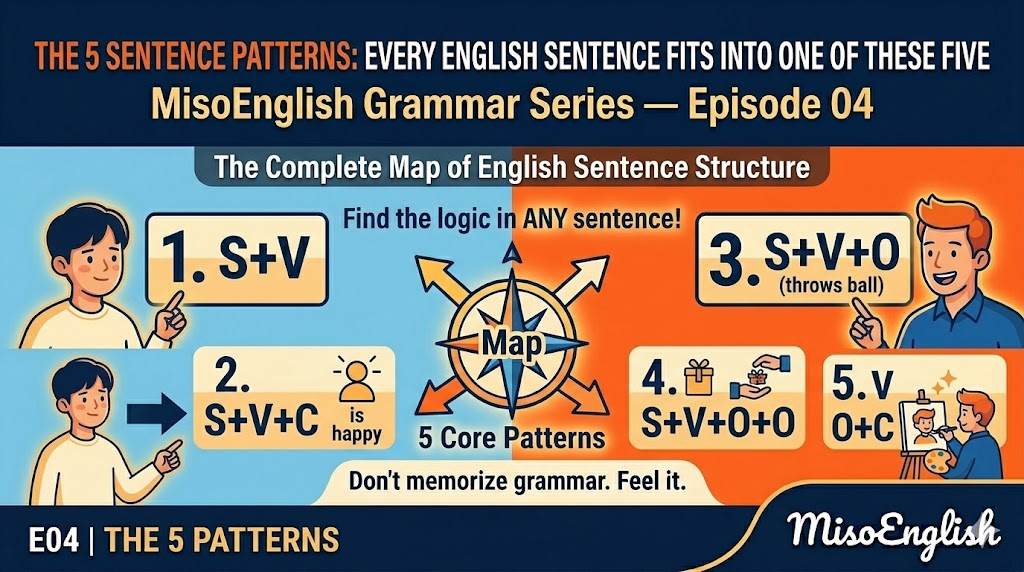
MisoEnglish Grammar Series
Episode 04 — 영어 5형식
문장의 모든 틀은 다섯 개뿐이다
"문법을 외우지 말고, 느껴라" Don't memorize grammar. Feel it.
🧭 들어가며 | Introduction
영어 문장은 아무리 길고 복잡해 보여도, 결국 다섯 가지 틀 중 하나에 들어간다.
No matter how long or complex an English sentence looks, it always fits into one of five patterns.
이 다섯 개의 틀을 5형식이라고 부른다. 1형식부터 5형식까지, 각각의 틀이 어떻게 작동하는지 이번 편에서 완성한다.
These five patterns are called the 5 sentence structures. In this episode, we'll complete the map — all five, how they work, and how to feel the difference.
앞선 두 편(02, 03)에서 주어, 동사, 목적어, 보어를 배웠다. 이제 그것들이 어떻게 조합되는지 볼 차례다.
In Episodes 02 and 03, we covered subjects, verbs, objects, and complements. Now it's time to see how they combine.
1형식 — 주어 + 동사 | S + V
동사 하나로 문장이 완성된다. 동사 뒤에 아무것도 필요 없는 완전자동사가 쓰인다.
The verb alone completes the sentence. These verbs are complete intransitive verbs — they need nothing after them.
She laughed.
그녀가 웃었다.
He runs.
그는 달린다.
The baby cried.
아기가 울었다.
Birds fly.
새는 난다
.
It happened.
그것이 일어났다.
물론 부사나 전치사구가 붙을 수 있다. 하지만 그것들은 필수 요소가 아니다.
Adverbs or prepositional phrases can attach — but they're not required.
She laughed loudly. ✅ (loudly는 수식어, 없어도 문장 성립)
He runs every morning. ✅ (every morning은 수식어)
2형식 — 주어 + 동사 + 보어 | S + V + C
동사 뒤에 주격 보어가 온다. 주어가 "무엇인지, 어떤 상태인지"를 설명한다. 주어 = 보어 관계가 성립한다.
A subject complement follows the verb. It describes what the subject is or what state it's in. Subject = Complement always holds.
She is a teacher.
그녀는 선생님이다. (She = a teacher)
He became famous.
그는 유명해졌다. (He = famous)
The food smells good.
음식 냄새가 좋다. (The food = good)
You look tired.
너 피곤해 보인다. (You = tired)
The sky turned gray.
하늘이 회색으로 변했다. (The sky = gray)
💡 2형식에 자주 쓰이는 동사들 | Common 2nd Pattern Verbs
동사 의미 예문
| be | ~이다 / ~있다 | She is kind. |
| become | ~이 되다 | He became a doctor. |
| seem | ~처럼 보이다 | It seems fine. |
| look | ~해 보이다 | You look great. |
| feel | ~하게 느껴지다 | I feel tired. |
| sound | ~하게 들리다 | That sounds fun. |
| smell | ~한 냄새가 나다 | It smells amazing. |
| taste | ~한 맛이 나다 | This tastes sweet. |
| stay / remain | ~한 상태로 있다 | Stay calm. |
| turn / go | ~로 변하다 | Her face turned red. |
3형식 — 주어 + 동사 + 목적어 | S + V + O
가장 많이 쓰이는 형식. 동사 뒤에 목적어가 온다. 동사의 행위가 향하는 대상이다.
The most common pattern. An object follows the verb — the target of the action.
She loves him.
그녀는 그를 사랑한다.
I drink coffee.
나는 커피를 마신다.
He broke the window.
그는 창문을 깼다.
They finished the project.
그들은 프로젝트를 완성했다.
I know what she wants.
나는 그녀가 뭘 원하는지 안다.
⚠️ 2형식과 3형식 구분법 | Telling 2nd and 3rd Apart
She is a teacher. → 2형식 (She = a teacher ✅)
She loves a teacher. → 3형식 (She = a teacher ❌)
동사가 be / seem / look / feel 계열이면 2형식, 행위를 하는 동사(love, break, drink)면 3형식일 가능성이 높다.
If the verb is be / seem / look / feel → likely 2nd pattern. If the verb expresses action (love, break, drink) → likely 3rd pattern.
4형식 — 주어 + 동사 + 간접목적어 + 직접목적어 | S + V + IO + DO
동사 뒤에 목적어가 두 개 온다. "누구에게(IO) + 무엇을(DO)" 순서로.
Two objects follow the verb. Order: "to whom (IO)" + "what (DO)."
He gave me a gift.
그는 나에게 선물을 줬다.
She taught us English.
그녀는 우리에게 영어를 가르쳤다.
I sent him a message.
나는 그에게 메시지를 보냈다.
Can you tell me the way?
길을 알려줄 수 있어요?
My mom made me lunch.
엄마가 나에게 점심을 만들어줬다.
💡 3형식으로 바꾸기 | Converting to 3rd Pattern
4형식은 전치사 to / for를 이용해 3형식으로 바꿀 수 있다.
4th pattern sentences can be rewritten as 3rd pattern using to or for.
He gave me a gift. → He gave a gift to me.
She taught us English. → She taught English to us.
My mom made me lunch. → My mom made lunch for me.
to vs for 구분:
- to: give, send, teach, show, tell, pass → 행위의 수신자
- for: make, buy, cook, find, get → 행위의 수혜자
Use to for: give, send, teach, show, tell → the receiver of the action. Use for for: make, buy, cook, find, get → the beneficiary of the action.
5형식 — 주어 + 동사 + 목적어 + 목적격 보어 | S + V + O + OC
동사 뒤에 목적어 + 목적격 보어가 온다. 보어가 목적어의 상태나 정체를 설명한다. 목적어 = 목적격 보어 관계가 성립한다.
An object + object complement follows the verb. The complement describes the object's state or identity. Object = Object Complement always holds.
They call him a genius.
그들은 그를 천재라고 부른다. (him = a genius)
She made me happy.
그녀는 나를 행복하게 만들었다. (me = happy)
I found the book boring.
나는 그 책이 지루하다고 느꼈다. (the book = boring)
He kept the room clean.
그는 방을 깨끗하게 유지했다. (the room = clean)
We elected her president.
우리는 그녀를 대통령으로 선출했다. (her = president)
💡 5형식에 자주 쓰이는 동사들 | Common 5th Pattern Verbs
동사 예문
| make | She made me happy. |
| call | They call him a hero. |
| find | I found it interesting. |
| keep | Keep it secret. |
| leave | Don't leave me alone. |
| name | They named the dog Max. |
| elect | We elected him leader. |
| consider | I consider her a friend. |
5형식 전체 정리 | All 5 Patterns at a Glance
형식 구조 핵심 예문
| 1형식 | S + V | 동사로 완결 | She laughed. |
| 2형식 | S + V + C | 주어 = 보어 | She is a teacher. |
| 3형식 | S + V + O | 동사 → 목적어 | She loves him. |
| 4형식 | S + V + IO + DO | 두 개의 목적어 | He gave me a gift. |
| 5형식 | S + V + O + OC | 목적어 = 보어 | She made me happy. |
실전 감각 키우기 | Building the Feel
문장을 읽을 때마다 이 질문을 던져보자:
Ask yourself these questions every time you read a sentence:
- 주어가 뭔가? What is the subject?
- 동사가 뭔가? What is the verb?
- 동사 뒤에 뭐가 왔나? What comes after the verb?
- 아무것도 없다 → 1형식
- 보어(주어=보어) → 2형식
- 목적어 하나 → 3형식
- 목적어 두 개 → 4형식
- 목적어 + 보어(목적어=보어) → 5형식
처음엔 천천히 분석하지만, 반복하면 문장을 보는 순간 구조가 느껴진다.
At first, analyze slowly. With repetition, the structure becomes something you feel, not think about.
📌 이번 편 요약 | Episode Summary
- 1형식 S+V — 동사로 완결, 보어도 목적어도 없다 S+V — complete with just the verb.
- 2형식 S+V+C — 주어=보어, be/seem/look/feel 계열 동사 S+V+C — subject = complement, stative verbs.
- 3형식 S+V+O — 가장 흔한 형식, 동사의 행위가 목적어에 닿는다 S+V+O — most common, the action lands on the object.
- 4형식 S+V+IO+DO — 목적어 두 개, to/for로 3형식 전환 가능 S+V+IO+DO — two objects, convertible to 3rd with to/for.
- 5형식 S+V+O+OC — 목적어=보어, 목적어의 상태/정체 설명 S+V+O+OC — object = complement, describes the object.
🔜 다음 편 예고 | Coming Up Next
Episode 05 — be동사 : "있다"와 "이다"를 동시에 품은 동사 The Verb "Be": The One Verb That Means Everything
be동사는 영어에서 가장 많이 쓰이는 동사이자, 가장 많이 오해받는 동사다. am / is / are / was / were — 이것들이 단순한 연결어가 아닌 이유를 파헤친다.
"Be" is the most used verb in English — and the most misunderstood. am / is / are / was / were — we dig into why these are far more than just connectors.
© MisoEnglish Grammar Series | Level 1 — Episode 04 "문법을 외우지 말고, 느껴라" | "Don't memorize grammar. Feel it."
The 5 Sentence Patterns: Every English Sentence Fits into One of These Five
The Complete Map of English Sentence Structure
MisoEnglish Grammar Series — Episode 04
"Don't memorize grammar. Feel it."
Introduction
In Episodes 02 and 03, we built up the pieces: subject, verb, object, complement. Now it's time to see how those pieces combine — and here's the remarkable thing about English:
Every sentence that has ever been written or spoken in English fits into one of exactly five patterns.
Not fifty. Not a hundred. Five. Once you internalize these five frames, the structure of any sentence — no matter how complex — becomes visible.
Pattern 1 — S + V
The verb is complete on its own. Nothing is required after it.
She laughed.
He runs.
The baby cried.
It happened.
Adverbs and prepositional phrases can attach — She laughed loudly, He runs every morning — but they're optional. Strip them away and the sentence still stands.
Pattern 2 — S + V + Complement
The verb is followed by a subject complement — a word or phrase that describes what the subject is or is like.
She is a teacher. → She = a teacher
He became famous. → He = famous
The food smells good. → The food = good
You look tired. → You = tired
The key: the complement and the subject refer to the same thing. They're connected by an equals sign.
Verbs that trigger this pattern: be, become, seem, look, feel, sound, smell, taste, stay, remain, turn, go.
Pattern 3 — S + V + Object
The most common pattern in English. The verb's action travels across to hit a target — the object.
She loves him.
I drink coffee.
He broke the window.
They finished the project.
How to tell Pattern 2 from Pattern 3: apply the equals sign test.
She is a teacher. → She = a teacher ✅ → Pattern 2
She loves a teacher. → She = a teacher ❌ → Pattern 3
Pattern 4 — S + V + Indirect Object + Direct Object
The verb takes two objects: first the recipient (to whom), then the thing (what).
He gave me a gift. She taught us English. I sent him a message. My mom made me lunch.
The indirect object is almost always a person. The direct object is almost always a thing or piece of information.
These sentences can be rewritten in Pattern 3 using to or for:
He gave a gift to me.
My mom made lunch for me.
Use to with: give, send, teach, show, tell. Use for with: make, buy, cook, find, get.
Pattern 5 — S + V + Object + Object Complement
The verb takes an object — and then a complement that describes that object.
They call him a genius. → him = a genius
She made me happy. → me = happy
I found the book boring. → the book = boring
He kept the room clean. → the room = clean
We elected her president. → her = president
The object complement can be a noun (a genius, president) or an adjective (happy, boring, clean). Either way, it equals the object.
Common verbs for this pattern: make, call, find, keep, leave, name, elect, consider, appoint.
All 5 Patterns at a Glance
Pattern Structure Key Feature Example
| 1st | S + V | Verb is complete | She laughed. |
| 2nd | S + V + C | Subject = Complement | She is a teacher. |
| 3rd | S + V + O | Action hits a target | She loves him. |
| 4th | S + V + IO + DO | Two objects | He gave me a gift. |
| 5th | S + V + O + OC | Object = Complement | She made me happy. |
Building the Feel
Every time you read an English sentence, train yourself to ask:
- What is the subject?
- What is the verb?
- What comes after the verb?
- Nothing → Pattern 1
- A complement (subject = complement) → Pattern 2
- One object → Pattern 3
- Two objects → Pattern 4
- Object + complement (object = complement) → Pattern 5
At first, this takes conscious effort. With enough repetition, it becomes instinct — you don't analyze the pattern, you feel it.
Episode Summary
- Pattern 1 (S+V) — the verb stands alone, complete.
- Pattern 2 (S+V+C) — subject = complement, stative verbs.
- Pattern 3 (S+V+O) — most common, action hits a target.
- Pattern 4 (S+V+IO+DO) — two objects, rewritable with to/for.
- Pattern 5 (S+V+O+OC) — object = complement.
Coming Up Next
Episode 05 — The Verb "Be": The One Verb That Means Everything
am, is, are, was, were — these aren't just connectors. "Be" is the most fundamental verb in English, and understanding what it actually does changes the way you see every sentence it appears in.
© MisoEnglish Grammar Series | Level 1 — Episode 04 "Don't memorize grammar. Feel it."
⚠️ 저작권 안내
본 블로그(MisoEnglish · slowblooms.tistory.com)의 모든 콘텐츠는 저작권법의 보호를 받습니다. 글, 예시 문장, 분석 내용 등 블로그에 게시된 모든 창작물은 저작자의 동의 없이 무단으로 복사, 복제, 배포, 2차 가공하는 행위를 금지합니다. 출처를 밝히지 않은 전재, SNS·커뮤니티·타 블로그 등에의 무단 게시, 상업적 이용은 모두 금지되며, 무단 불펌 적발 시 저작권법에 따라 법적 조치가 취해질 수 있습니다. 콘텐츠 사용 문의는 slowblooms.tistory.com으로 연락 주세요.
© MisoEnglish · slowblooms.tistory.com. All rights reserved.
━━━━━━━━━━━━━━━━━━━━━━━━━━━━━━━━
⚠️ Copyright Notice
All content published on this blog (MisoEnglish · slowblooms.tistory.com) is protected by copyright law. Copying, reproducing, distributing, or adapting any written posts, example sentences, or analyses without the explicit consent of the author is strictly prohibited. Unauthorised reposting on other blogs, social media, online communities, or any public platform — with or without modification — is not permitted, and may result in legal action under applicable copyright law. For content licensing enquiries, please contact us via slowblooms.tistory.com.
© MisoEnglish · slowblooms.tistory.com. All rights reserved.
'English Mechanism' 카테고리의 다른 글
| Episode 06 — 일반동사: 움직임과 상태를 표현하는 법 (0) | 2026.02.26 |
|---|---|
| Episode 05 — be동사: "있다"와 "이다"를 동시에 품은 동사 (0) | 2026.02.25 |
| Episode 03 — 목적어와 보어: 동사 뒤에 무엇이 오는가 (0) | 2026.02.25 |
| Episode 02 — 주어와 동사: 모든 문장은 이 둘에서 시작된다 (0) | 2026.02.25 |
| Episode 01 — 영어는 어떤 언어인가: 한국어와 근본적으로 다른 이유 (0) | 2026.02.25 |


