
- 분류 전체보기 (1053)

- Linguistics (고급 영어학) (10)
- Stylistics (6)
- Etymology & Word Building (15)
- Philosophy Meets Grammar (6)
- Collection of Famous Quotes (22)
- English Mechanism (276)
- The Language Beyond Grammar (274)
- Living English (81)
- Miso’s Life Notes (18)
- My English Journey and Refl.. (16)
- Philosophy (132)
- Video Clip (16)
- Airline English (항공 영어) (47)
- Creative Corner (35)
- Sally & Sia (1)
| 일 | 월 | 화 | 수 | 목 | 금 | 토 |
|---|---|---|---|---|---|---|
| 1 | 2 | 3 | 4 | |||
| 5 | 6 | 7 | 8 | 9 | 10 | 11 |
| 12 | 13 | 14 | 15 | 16 | 17 | 18 |
| 19 | 20 | 21 | 22 | 23 | 24 | 25 |
| 26 | 27 | 28 | 29 | 30 |
- MisoEnglish#유교철학 #Confucianism #성리학 #NeoConfucianism #인의예지 #Virtue #맹자 #Mencius #실학 #KoreanScholarship
- 영어회화
- 감성영어
- English for Korean Learners
- misoenglish
- MisoEnglish#철학입문 #Philosophy #심리철학 #PhilosophyOfMind #철학공부 #의식 #마음 #PhilosophyForBeginners #교육콘텐츠 #철학시리즈
- 인도철학 #동양철학 #인문학 #요가 #명상 #힌두교 #불교 #간디 #타고르 #정통6파 #철학공부 #마음공부 #MisoEnglish #인문학영어
- EnglishWriting #AcademicWriting #Grammar #EnglishLanguage #EssayWriting #ParagraphStructure #SentenceStructure #BusinessEnglish #EnglishTips #WritingSkills #Linguistics #ESL
- English Speaking Practice
- MisoEnglish#철학입문 #Philosophy #정치철학 #PoliticalPhilosophy #철학공부 #정의론 #자유주의 #PhilosophyForBeginners #교육콘텐츠 #철학시리즈
- MisoEnglish#도교철학 #Taoism #도덕경 #TaoTeChing #무위자연 #WuWei #노자 #Laozi #장자 #YinYang
- MisoEnglish#철학입문 #Philosophy #과학철학 #PhilosophyOfScience #철학공부 #포퓨퍼 #쿠hn #과학방법론 #교육콘텐츠 #철학시리즈
- 영어문법
- 느리지만단단하게
- 영어공부
- MisoEnglish#한국철학 #KoreanPhilosophy #홍익인간 #Hongik #화랑도 #Hwarang #단군 #Dangun #풍류도 #ThreeKingdoms#동양철학
- ticketing
- English in English
- 영어접속사
- MisoEnglish#철학입문 #Philosophy #형이상학 #Metaphysics #철학공부 #존재론 #실재론 #PhilosophyForBeginners #교육콘텐츠 #철학시리즈
- MisoEnglish#불교철학 #BuddhismPhilosophy #사성제 #FourNobleTruths #공사상 #Emptiness #명상 #Mindfulness #열반 #EasternWisdom
- pnr
- AirlineOpsEnglish
- 영문법
- everyday English
- MisoEnglish#철학입문 #Philosophy #종교철학 #PhilosophyOfReligion #철학공부 #신존재증명 #악의문제 #PhilosophyForBeginners #교육콘텐츠 #철학시리즈
- Basic English Verbs
- MisoEnglish#철학입문 #Philosophy #윤리학 #Ethics #도덕철학 #철학공부 #칸트 #공리주의 #교육콘텐츠 #철학시리즈
- 🌿 English with Heart
- 동양정치철학 #시리즈완결 #아시아적가치 #동서양비교 #유교 #민주주의 #정치사상 #인문학 #비교철학 #글로벌정치 #문화다양성 #2500년철학사
- Today
- Total
MisoEnglish
Episode 16 — 셀 수 있는 명사 vs 셀 수 없는 명사 본문
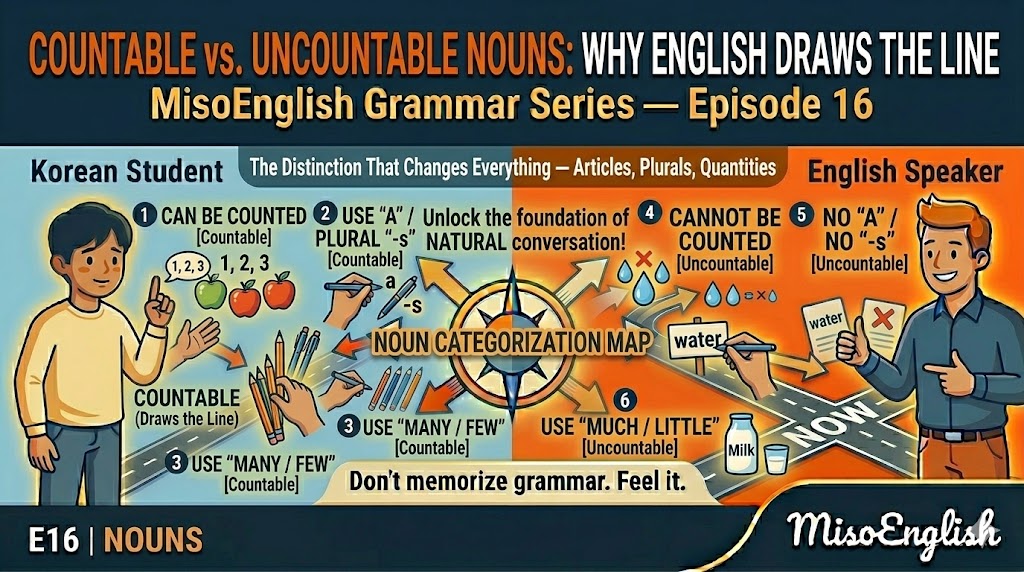
MisoEnglish Grammar Series
Episode 16 — 셀 수 있는 명사 vs 셀 수 없는 명사
영어는 왜 나누는가
"문법을 외우지 말고, 느껴라" Don't memorize grammar. Feel it.
🧭 들어가며 | Introduction
영어는 모든 명사를 두 종류로 나눈다.
English divides every noun into two categories.
셀 수 있는 명사 (Countable Nouns) 셀 수 없는 명사 (Uncountable Nouns)
한국어에는 이 구분이 없다. "사과 하나, 사과 둘" — "물 하나, 물 둘"처럼 뭐든 셀 수 있다.
Korean doesn't make this distinction. "사과 하나, 사과 둘" — "물 하나, 물 둘" — you can count anything.
영어는 다르다. "물"은 하나, 둘로 셀 수 없다. "사과"는 셀 수 있다. 이 구분이 관사, 복수형, 수량 표현 전체에 영향을 준다.
English is different. "Water" cannot be counted as one, two. "Apple" can. This distinction affects articles, plurals, and every quantity expression.
1. 셀 수 있는 명사 | Countable Nouns
하나, 둘, 셋... 으로 셀 수 있는 명사. 단수와 복수 형태가 있다.
Nouns you can count as one, two, three... They have singular and plural forms.
an apple / two apples a book / three books a cat / five cats an idea / many ideas
셀 수 있는 명사의 특징 | Features
- 단수: a / an 또는 the 사용
- 복수: -s / -es 붙임
- 수량: many, few, a few, several, a number of
I have a dog. 나는 개 한 마리가 있다.
I have three dogs. 나는 개 세 마리가 있다.
How many dogs do you have? 개가 몇 마리야?
I have a few friends. 나는 친구가 몇 명 있다.
2. 셀 수 없는 명사 | Uncountable Nouns
하나, 둘로 셀 수 없는 명사. 복수형이 없고, a / an을 쓸 수 없다.
Nouns that cannot be counted as one, two. No plural form. Cannot use a / an.
셀 수 없는 명사의 종류 | Categories
① 물질 / 액체 / 기체 | Substances / Liquids / Gases
water, milk, coffee, tea, oil, air, smoke, gold, silver, wood, paper
② 추상 개념 | Abstract Concepts
love, happiness, freedom, knowledge, information, advice, news, music, time, money*
③ 학문 / 언어 | Academic Subjects / Languages
English, mathematics, history, science, Chinese
④ 음식 재료 | Food Ingredients
rice, bread, meat, butter, flour, sugar, salt, cheese
⑤ 집합적 개념 | Collective Concepts
furniture, luggage, baggage, equipment, clothing, traffic, weather, homework
셀 수 없는 명사의 특징 | Features
- a / an 사용 불가
- 복수형(-s) 없음
- 수량: much, little, a little, a great deal of, a lot of
~~a water~~ ❌ / ~~two waters~~ ❌ → water / some water ✅
~~an information~~ ❌ → information / some information ✅
~~advices~~ ❌ → advice ✅
~~furnitures~~ ❌ → furniture ✅
How much water do you drink? 물을 얼마나 마셔?
I have a little time. 시간이 조금 있어.
She gave me a lot of advice. 그녀는 나에게 많은 조언을 해줬다.
3. 단위 표현으로 셀 수 없는 명사 세기 | Counting Uncountable Nouns with Units
셀 수 없는 명사를 세고 싶을 때는 **단위 명사(unit noun)**를 앞에 붙이면 된다.
When you need to count uncountable nouns, add a unit noun in front.
a + 단위명사 + of + 셀 수 없는 명사
a + unit noun + of + uncountable noun
셀 수 없는 명사 단위 표현 예문
| water | a glass of / a bottle of | a glass of water |
| coffee | a cup of | a cup of coffee |
| bread | a slice of / a loaf of | a slice of bread |
| cheese | a piece of | a piece of cheese |
| advice | a piece of | a piece of advice |
| information | a piece of | a piece of information |
| furniture | a piece of | a piece of furniture |
| paper | a sheet of | a sheet of paper |
| news | a piece of | a piece of news |
| music | a piece of | a piece of music |
Can I have two glasses of water? 물 두 잔 주실 수 있어요?
She gave me a piece of advice. 그녀가 조언을 하나 해줬어.
I need three sheets of paper. 종이 세 장이 필요해.
4. 주의! 같은 단어가 두 가지로 쓰이는 경우 | Watch Out! Same Word, Two Uses
같은 단어가 셀 수 있는 명사와 셀 수 없는 명사 둘 다로 쓰이는 경우가 있다. 의미가 달라진다.
Some words work as both countable and uncountable — with different meanings.
단어 셀 수 없는 명사 (불가산) 셀 수 있는 명사 (가산)
| chicken | chicken 닭고기 (재료) | a chicken 닭 한 마리 (동물) |
| paper | paper 종이 (재료) | a paper 신문 / 논문 |
| glass | glass 유리 (재료) | a glass 유리잔 |
| iron | iron 철 (재료) | an iron 다리미 |
| time | time 시간 (개념) | a time 한 번, 때 |
| hair | hair 머리카락 전체 | a hair 머리카락 한 올 |
| room | room 공간, 여유 | a room 방 |
| experience | experience 경험 (일반) | an experience 경험 (특정 사건) |
I love chicken.
나는 닭고기를 좋아한다. (음식)
There is a chicken in the yard.
마당에 닭이 한 마리 있다. (동물)
Do you have room for one more?
한 명 더 들어갈 자리 있어? (공간)
This is a nice room.
이 방은 멋지다. (방)
5. 자주 틀리는 불가산 명사 | Commonly Mistaken Uncountable Nouns
한국어로는 복수처럼 느껴지지만 영어에서는 셀 수 없는 명사들.
These feel countable in Korean — but they're uncountable in English.
~~informations~~ ❌ → information ✅
~~advices~~ ❌ → advice ✅
~~furnitures~~ ❌ → furniture ✅
~~homeworks~~ ❌ → homework ✅
~~luggages~~ ❌ → luggage ✅ ~
~equipments~~ ❌ → equipment ✅
~~traffics~~ ❌ → traffic ✅
~~weathers~~ ❌ → weather ✅
~~musics~~ ❌ → music ✅
~~moneys~~ ❌ → money ✅
6. 수량 표현 총정리 | Quantity Expressions — Complete Guide
표현 셀 수 있는 명사 셀 수 없는 명사
| 많다 | many books | much water |
| 적다 | few books (거의 없다) | little water (거의 없다) |
| 조금 있다 | a few books | a little water |
| 많다 (구어) | a lot of books | a lot of water |
| 충분하다 | enough books | enough water |
| 얼마나? | How many? | How much? |
I have few friends. 친구가 거의 없다. (부정적)
I have a few friends. 친구가 몇 명 있다. (긍정적)
There is little hope. 희망이 거의 없다. (부정적)
There is a little hope. 희망이 조금 있다. (긍정적)
few vs a few / little vs a little — 이 차이를 꼭 느껴야 한다! Feel the difference — few/little (barely any) vs a few/a little (some).
📌 이번 편 요약 | Episode Summary
- 셀 수 있는 명사 — a/an 가능, 복수(-s) 가능, many/few/a few 사용 Countable — a/an OK, plurals OK, use many/few/a few.
- 셀 수 없는 명사 — a/an 불가, 복수 불가, much/little/a little 사용 Uncountable — no a/an, no plurals, use much/little/a little.
- 단위 명사로 셀 수 없는 명사 세기 — a cup of, a piece of, a glass of Count uncountables with unit nouns — a cup of, a piece of, a glass of.
- 같은 단어가 두 가지 의미 — chicken(닭고기 vs 닭), room(공간 vs 방) Same word, two meanings — chicken (meat vs animal), room (space vs room).
- few vs a few / little vs a little — 거의 없다 vs 조금 있다 few/little = barely any. a few/a little = some (positive).
🔜 다음 편 예고 | Coming Up Next
Episode 17 — 전치사 in·on·at : 공간과 시간을 느끼는 법 Prepositions in / on / at: How to Feel Space and Time
전치사는 외우는 게 아니다. in, on, at
— 이 세 개가 공간과 시간을 표현하는 방식에는 각각의 이미지가 있다.
그 이미지를 느끼는 순간, 전치사가 보인다.Prepositions aren't memorized — they're felt. in, on, at
— each one carries a distinct image of space and time.
The moment you see those images, prepositions click.
© MisoEnglish Grammar Series | Level 3 — Episode 16 "문법을 외우지 말고, 느껴라" | "Don't memorize grammar. Feel it."
Countable vs. Uncountable Nouns: Why English Draws the Line
The Distinction That Changes Everything — Articles, Plurals, Quantities
MisoEnglish Grammar Series — Episode 16
"Don't memorize grammar. Feel it."
Introduction
In Korean, you can count almost anything. "사과 하나, 사과 둘" — "물 하나, 물 둘." The language doesn't force you to categorize.
English does. Every noun in English is either countable or uncountable — and that categorization affects which articles you use, whether you can add -s, and which quantity words are correct.
This is one of the most persistent sources of error for Korean learners — not because it's complicated, but because the instinct simply doesn't exist in Korean.
1. Countable Nouns
Things you can count as individual units: one, two, three...
an apple / two apples a book / three books an idea / many ideas
Countable nouns:
- Take a / an in singular
- Add -s / -es for plural
- Use many, few, a few, several for quantity
I have a dog. / I have three dogs. How many dogs do you have? I have a few friends.
2. Uncountable Nouns
Things that exist as a mass or concept — not as individual countable units.
No plural form. No a / an.
Common categories:
- Substances / liquids / gases: water, milk, coffee, air, gold, wood, paper
- Abstract concepts: love, happiness, knowledge, information, advice, news, music, time
- Academic subjects / languages: English, mathematics, history
- Food ingredients: rice, bread, meat, butter, sugar, salt
- Collective concepts: furniture, luggage, equipment, clothing, traffic, homework, weather
~~a water~~ ❌ / ~~two waters~~ ❌ → water / some water ✅
~~an information~~ ❌ → information / some information ✅
~~advices~~ ❌ → advice ✅
~~furnitures~~ ❌ → furniture ✅
Use much, little, a little, a lot of for quantity:
How much water do you drink?
I have a little time.
She gave me a lot of advice.
3. Counting Uncountable Nouns with Unit Nouns
When you need to express a specific amount of an uncountable noun, place a unit noun in front:
a + unit noun + of + uncountable noun
Uncountable Unit Expression Example
| water | a glass of / a bottle of | a glass of water |
| coffee | a cup of | a cup of coffee |
| bread | a slice of / a loaf of | a slice of bread |
| advice | a piece of | a piece of advice |
| information | a piece of | a piece of information |
| furniture | a piece of | a piece of furniture |
| paper | a sheet of | a sheet of paper |
Can I have two glasses of water?
She gave me a piece of advice.
I need three sheets of paper.
4. Same Word, Two Uses
Some words function as both countable and uncountable — with different meanings.
Word Uncountable Countable
| chicken | chicken (the meat) | a chicken (the animal) |
| paper | paper (the material) | a paper (a newspaper / essay) |
| glass | glass (the material) | a glass (a drinking glass) |
| room | room (space) | a room (a physical room) |
| time | time (the concept) | a time (an occasion) |
| hair | hair (all of it) | a hair (a single strand) |
| experience | experience (in general) | an experience (a specific event) |
I love chicken. (the food)
There is a chicken in the yard. (the bird)
Do you have room for one more? (space)
This is a nice room. (the physical room)
5. The Most Commonly Mistaken Uncountable Nouns
These feel countable in Korean — but they're not in English:
~~informations~~ ❌ → information ✅
~~advices~~ ❌ → advice ✅
~~furnitures~~ ❌ → furniture ✅
~~homeworks~~ ❌ → homework ✅
~~luggages~~ ❌ → luggage ✅
~~equipments~~ ❌ → equipment ✅
~~traffics~~ ❌ → traffic ✅
~~moneys~~ ❌ → money ✅
6. Quantity Expressions — The Complete Guide
Expression Countable Uncountable
| A lot | many books | much water |
| Almost none | few books | little water |
| Some (positive) | a few books | a little water |
| Informal "a lot" | a lot of books | a lot of water |
| Enough | enough books | enough water |
| Question | How many? | How much? |
The critical distinction:
I have few friends. → Almost none. (negative feeling)
I have a few friends. → Some. (positive — I'm not alone)
There is little hope. → Almost none. (negative)
There is a little hope. → Some. (positive — don't give up)
The "a" makes all the difference.
Episode Summary
- Countable — a/an OK, plurals OK, use many/few/a few.
- Uncountable — no a/an, no plurals, use much/little/a little.
- Unit nouns — count uncountables with a cup of, a piece of, a glass of.
- Same word, two meanings — chicken, room, paper, glass, time, hair.
- few vs. a few / little vs. a little — barely any vs. some.
Coming Up Next
Episode 17 — Prepositions in / on / at: How to Feel Space and Time
Prepositions aren't memorized — they're felt. in, on, at each carry a distinct image. Once you see those images clearly, the right preposition stops being a guess and starts being obvious.
© MisoEnglish Grammar Series | Level 3 — Episode 16 "Don't memorize grammar. Feel it."
⚠️ 저작권 안내
본 블로그(MisoEnglish · slowblooms.tistory.com)의 모든 콘텐츠는 저작권법의 보호를 받습니다. 글, 예시 문장, 분석 내용 등 블로그에 게시된 모든 창작물은 저작자의 동의 없이 무단으로 복사, 복제, 배포, 2차 가공하는 행위를 금지합니다. 출처를 밝히지 않은 전재, SNS·커뮤니티·타 블로그 등에의 무단 게시, 상업적 이용은 모두 금지되며, 무단 불펌 적발 시 저작권법에 따라 법적 조치가 취해질 수 있습니다. 콘텐츠 사용 문의는 slowblooms.tistory.com으로 연락 주세요.
© MisoEnglish · slowblooms.tistory.com. All rights reserved.
━━━━━━━━━━━━━━━━━━━━━━━━━━━━━━━━
⚠️ Copyright Notice
All content published on this blog (MisoEnglish · slowblooms.tistory.com) is protected by copyright law. Copying, reproducing, distributing, or adapting any written posts, example sentences, or analyses without the explicit consent of the author is strictly prohibited. Unauthorised reposting on other blogs, social media, online communities, or any public platform — with or without modification — is not permitted, and may result in legal action under applicable copyright law. For content licensing enquiries, please contact us via slowblooms.tistory.com.
© MisoEnglish · slowblooms.tistory.com. All rights reserved.
'English Mechanism' 카테고리의 다른 글
| Episode 18 — 전치사 심화: 규칙이 아니라 이미지로 익혀라 (0) | 2026.02.28 |
|---|---|
| Episode 17 — 전치사 in · on · at: 공간과 시간을 느끼는 법 (0) | 2026.02.28 |
| Episode 15 — 관사 a와 the: 새 정보와 아는 정보를 나누는 기준 (0) | 2026.02.27 |
| Episode 14 — 시제 총정리: 시간의 지도를 완성하라 (0) | 2026.02.27 |
| Episode 13 — 과거완료: 과거 속의 또 다른 과거 (0) | 2026.02.27 |


