
- 분류 전체보기 (1053)

- Linguistics (고급 영어학) (10)
- Stylistics (6)
- Etymology & Word Building (15)
- Philosophy Meets Grammar (6)
- Collection of Famous Quotes (22)
- English Mechanism (276)
- The Language Beyond Grammar (274)
- Living English (81)
- Miso’s Life Notes (18)
- My English Journey and Refl.. (16)
- Philosophy (132)
- Video Clip (16)
- Airline English (항공 영어) (47)
- Creative Corner (35)
- Sally & Sia (1)
| 일 | 월 | 화 | 수 | 목 | 금 | 토 |
|---|---|---|---|---|---|---|
| 1 | 2 | 3 | 4 | |||
| 5 | 6 | 7 | 8 | 9 | 10 | 11 |
| 12 | 13 | 14 | 15 | 16 | 17 | 18 |
| 19 | 20 | 21 | 22 | 23 | 24 | 25 |
| 26 | 27 | 28 | 29 | 30 |
- MisoEnglish#도교철학 #Taoism #도덕경 #TaoTeChing #무위자연 #WuWei #노자 #Laozi #장자 #YinYang
- 영어문법
- 🌿 English with Heart
- MisoEnglish#철학입문 #Philosophy #과학철학 #PhilosophyOfScience #철학공부 #포퓨퍼 #쿠hn #과학방법론 #교육콘텐츠 #철학시리즈
- Basic English Verbs
- pnr
- English in English
- English for Korean Learners
- MisoEnglish#한국철학 #KoreanPhilosophy #홍익인간 #Hongik #화랑도 #Hwarang #단군 #Dangun #풍류도 #ThreeKingdoms#동양철학
- 영문법
- MisoEnglish#철학입문 #Philosophy #윤리학 #Ethics #도덕철학 #철학공부 #칸트 #공리주의 #교육콘텐츠 #철학시리즈
- 인도철학 #동양철학 #인문학 #요가 #명상 #힌두교 #불교 #간디 #타고르 #정통6파 #철학공부 #마음공부 #MisoEnglish #인문학영어
- MisoEnglish#불교철학 #BuddhismPhilosophy #사성제 #FourNobleTruths #공사상 #Emptiness #명상 #Mindfulness #열반 #EasternWisdom
- MisoEnglish#철학입문 #Philosophy #심리철학 #PhilosophyOfMind #철학공부 #의식 #마음 #PhilosophyForBeginners #교육콘텐츠 #철학시리즈
- MisoEnglish#철학입문 #Philosophy #정치철학 #PoliticalPhilosophy #철학공부 #정의론 #자유주의 #PhilosophyForBeginners #교육콘텐츠 #철학시리즈
- English Speaking Practice
- everyday English
- EnglishWriting #AcademicWriting #Grammar #EnglishLanguage #EssayWriting #ParagraphStructure #SentenceStructure #BusinessEnglish #EnglishTips #WritingSkills #Linguistics #ESL
- 영어공부
- MisoEnglish#철학입문 #Philosophy #형이상학 #Metaphysics #철학공부 #존재론 #실재론 #PhilosophyForBeginners #교육콘텐츠 #철학시리즈
- 영어회화
- MisoEnglish#유교철학 #Confucianism #성리학 #NeoConfucianism #인의예지 #Virtue #맹자 #Mencius #실학 #KoreanScholarship
- misoenglish
- 영어접속사
- 느리지만단단하게
- ticketing
- 감성영어
- 동양정치철학 #시리즈완결 #아시아적가치 #동서양비교 #유교 #민주주의 #정치사상 #인문학 #비교철학 #글로벌정치 #문화다양성 #2500년철학사
- MisoEnglish#철학입문 #Philosophy #종교철학 #PhilosophyOfReligion #철학공부 #신존재증명 #악의문제 #PhilosophyForBeginners #교육콘텐츠 #철학시리즈
- AirlineOpsEnglish
- Today
- Total
MisoEnglish
Episode 20 — 부사: 동사와 문장 전체를 조율하는 법 본문
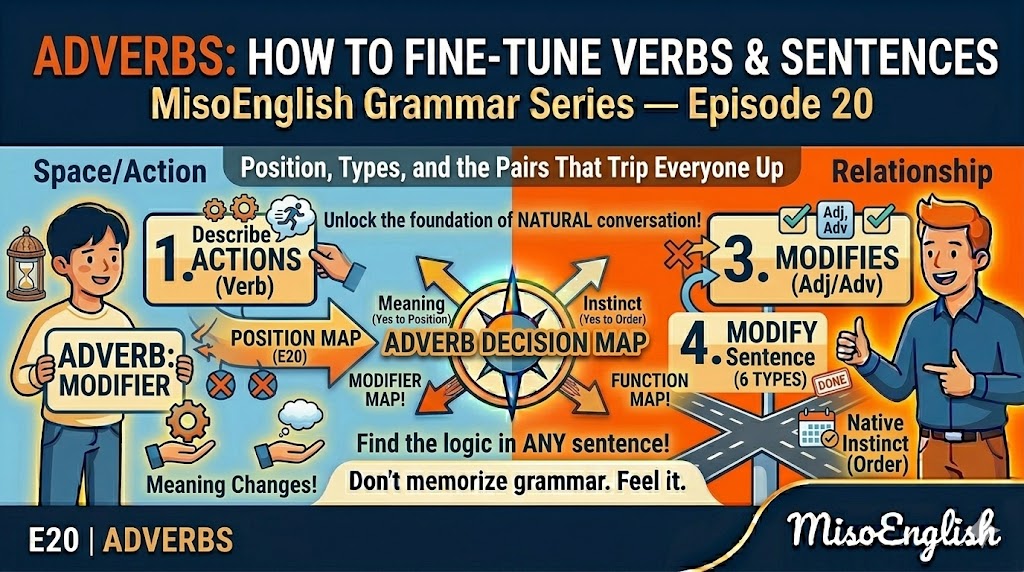
MisoEnglish Grammar Series
Episode 20 — 부사
동사와 문장 전체를 조율하는 법
"문법을 외우지 말고, 느껴라" Don't memorize grammar. Feel it.
🧭 들어가며 | Introduction
부사는 "-게"를 붙이는 것이라고 배웠을 것이다. 빠르게, 조용히, 천천히 — 맞는 말이다.
You probably learned that adverbs add "-ly." Quickly, quietly, slowly — that's true.
하지만 부사는 그것보다 훨씬 넓은 역할을 한다.
But adverbs do far more than that.
동사를 수식하고, 형용사를 수식하고, 다른 부사를 수식하고, 문장 전체를 수식한다. 그리고 어디에 위치하느냐에 따라 강조점이 달라진다.
They modify verbs, adjectives, other adverbs, and even entire sentences. And their position changes the emphasis.
이번 편에서 부사의 모든 것을 정리한다.
This episode maps out everything about adverbs.
1. 부사가 수식하는 것들 | What Adverbs Modify
① 동사 수식 | Modifying Verbs
She quickly finished her work. 그녀는 빠르게 일을 끝냈다.
He carefully opened the box. 그는 조심스럽게 상자를 열었다.
They suddenly stopped. 그들은 갑자기 멈췄다.
② 형용사 수식 | Modifying Adjectives
She is very beautiful. 그녀는 매우 아름답다.
It's extremely hot today. 오늘 엄청나게 덥다.
He is surprisingly calm. 그는 놀랍도록 침착하다.
③ 다른 부사 수식 | Modifying Other Adverbs
She runs incredibly fast.
그녀는 믿을 수 없을 정도로 빠르게 달린다.
He works surprisingly well.
그는 놀랍도록 잘 일한다.
She spoke very quietly.
그녀는 매우 조용하게 말했다.
④ 문장 전체 수식 | Modifying the Entire Sentence
Fortunately, no one was hurt. 다행히, 아무도 다치지 않았다.
Honestly, I don't know. 솔직히, 나는 모른다.
Clearly, something went wrong. 분명히, 뭔가 잘못됐다.
Obviously, she was upset. 분명히, 그녀는 속상했다.
2. 부사 만들기 | Forming Adverbs
형용사 + -ly | Adjective + -ly
대부분의 부사는 형용사에 -ly를 붙여 만든다.
Most adverbs are formed by adding -ly to an adjective.
형용사 부사 형용사 부사
| quick | quickly | slow | slowly |
| careful | carefully | loud | loudly |
| beautiful | beautifully | quiet | quietly |
| sudden | suddenly | happy | happily |
| easy | easily | heavy | heavily |
불규칙 부사 | Irregular Adverbs
형용사 부사
| good | well |
| fast | fast (그대로) |
| hard | hard (그대로) |
| late | late (그대로) / lately (최근에, 의미 다름!) |
| early | early (그대로) |
| high | high (그대로) / highly (매우, 의미 다름!) |
⚠️ 헷갈리는 쌍 | Confusing Pairs
He works hard. 그는 열심히 일한다. (부사 hard = 열심히)
He hardly works. 그는 거의 일하지 않는다. (hardly = 거의 ~않다)
She arrived late. 그녀는 늦게 도착했다. (late = 늦게)
Lately, she's been tired. 최근에, 그녀는 피곤했다. (lately = 최근에)
The bird flew high. 새가 높이 날았다. (high = 높이)
I highly recommend it. 나는 그것을 매우 추천한다. (highly = 매우, 강력히)
3. 부사의 종류 | Types of Adverbs
① 방법 부사 | Manner Adverbs
어떻게 행동하는지를 표현. How something is done.
quickly, slowly, carefully, loudly, gently, well, badly
② 시간 부사 | Time Adverbs
언제 일어나는지를 표현. When something happens.
now, then, today, yesterday, soon, already, still, yet, recently, lately
③ 장소 부사 | Place Adverbs
어디서 일어나는지를 표현. Where something happens.
here, there, everywhere, nearby, abroad, outside, inside, upstairs
④ 빈도 부사 | Frequency Adverbs
얼마나 자주 일어나는지를 표현. How often something happens.
always, usually, often, sometimes, rarely, never, occasionally, frequently
⑤ 정도 부사 | Degree Adverbs
얼마나 강하게인지를 표현. To what degree or extent.
very, extremely, quite, rather, fairly, too, enough, almost, nearly, barely, hardly, just
⑥ 문장 부사 | Sentence Adverbs
문장 전체에 화자의 태도를 표현. The speaker's attitude toward the whole sentence.
fortunately, unfortunately, honestly, obviously, clearly, surprisingly, apparently
4. 빈도 부사의 위치 | Position of Frequency Adverbs
빈도 부사는 위치 규칙이 있다. 이것을 모르면 어색한 문장이 된다.
Frequency adverbs follow position rules. Ignoring them produces unnatural sentences.
규칙 | The Rules
① 일반동사 앞
She always wakes up early. 그녀는 항상 일찍 일어난다.
I usually have coffee in the morning. 나는 보통 아침에 커피를 마신다.
He never eats breakfast. 그는 절대 아침을 먹지 않는다.
② be동사 / 조동사 뒤
She is always late. 그녀는 항상 늦는다.
He can never remember names. 그는 이름을 절대 기억 못 한다.
They are usually busy. 그들은 보통 바쁘다.
③ sometimes / often / usually는 문장 앞이나 뒤에도 올 수 있다
Sometimes I feel lonely. ✅
I feel lonely sometimes. ✅
I sometimes feel lonely. ✅
빈도 부사 스펙트럼 | Frequency Spectrum
100%                                                    0%
always — usually — often — sometimes — rarely — never
항상      보통      자주     가끔       거의안함   절대안함
5. 부사의 위치와 강조 | Adverb Position and Emphasis
부사는 어디에 놓느냐에 따라 강조점이 달라진다. 특히 방법 부사와 시간 부사가 그렇다.
Where you place an adverb shifts the emphasis. This is especially true for manner and time adverbs.
Slowly, she opened the door.
천천히 — 그 방식이 강조된다.
(The slowness is emphasized.)
She opened the door slowly.
그녀가 문을 열었다, 천천히. — 행동 후 방식.
(Action first, manner added after.)
She slowly opened the door.
그녀는 천천히 문을 열었다. — 자연스러운 중립.
(Natural, neutral emphasis.)
6. 주의해야 할 부사들 | Tricky Adverbs
already / still / yet
I already finished. 나는 이미 끝냈다. (긍정문)
She still hasn't called. 그녀는 아직도 전화하지 않았다. (부정문, 계속)
Have you eaten yet? 아직 먹었어? (의문문)
I haven't eaten yet. 나는 아직 먹지 않았다. (부정문)
too / either
I like it, too. 나도 좋아해. (긍정문 동의)
I don't like it, either. 나도 좋아하지 않아. (부정문 동의)
very / too / enough
She is very tall. 그녀는 매우 키가 크다. (중립)
She is too tall. 그녀는 너무 키가 크다. (문제가 있음을 암시)
She is tall enough. 그녀는 충분히 키가 크다. (필요한 만큼)
The coffee is too hot to drink.
커피가 너무 뜨거워서 마실 수 없다.
The coffee is hot enough to drink.
커피가 마실 수 있을 만큼 뜨겁다.
📌 이번 편 요약 | Episode Summary
- 부사는 동사·형용사·부사·문장 전체를 수식한다 Adverbs modify verbs, adjectives, other adverbs, and whole sentences.
- 형용사 + -ly = 부사 — happy→happily, easy→easily Adjective + -ly = adverb — irregular: good→well, fast→fast, hard→hard
- hard ≠ hardly / late ≠ lately / high ≠ highly — 완전히 다른 의미 hard ≠ hardly / late ≠ lately / high ≠ highly — completely different meanings.
- 빈도 부사 위치 — 일반동사 앞 / be동사·조동사 뒤 Frequency adverbs: before regular verbs / after be verbs and modals.
- already(긍정) / still(부정·계속) / yet(의문·부정) already (positive) / still (negative, ongoing) / yet (question, negative)
- very(중립) / too(문제 암시) / enough(충분) very (neutral) / too (implies a problem) / enough (sufficient)
🔜 다음 편 예고 | Coming Up Next
Episode 21 — 비교급과 최상급 : 더하고 빼는 영어의 방식 Comparatives and Superlatives: How English Adds and Subtracts
더 크다, 가장 크다 — 영어가 정도를 표현하는 방식.
-er / -est vs more / most— 언제 어떤 것을 쓰는가?
그리고 good→better→best처럼 완전히 불규칙한 것들까지.Bigger, biggest — how English expresses degree.
-er/-est vs more/most — when to use which?
And the completely irregular ones like good→better→best.
© MisoEnglish Grammar Series | Level 3 — Episode 20 "문법을 외우지 말고, 느껴라" | "Don't memorize grammar. Feel it."
Adverbs: How to Fine-Tune Verbs and Entire Sentences
Position, Types, and the Pairs That Trip Everyone Up
MisoEnglish Grammar Series — Episode 20
"Don't memorize grammar. Feel it."
Introduction
Most learners think of adverbs as words ending in "-ly" that describe how something is done. That's a start — but adverbs do much more.
They modify verbs, adjectives, other adverbs, and even entire sentences. They come in six distinct types. And where you place them in a sentence changes what you're emphasizing.
This episode maps out the full picture of English adverbs.
1. What Adverbs Modify
Verbs:
She quickly finished her work.
He carefully opened the box.
Adjectives:
She is very beautiful.
It's extremely hot today.
Other adverbs:
She runs incredibly fast.
He works surprisingly well.
Entire sentences:
Fortunately, no one was hurt. Honestly,
I don't know. Obviously, she was upset.
2. Forming Adverbs
Adjective + -ly:
Adjective Adverb
| quick | quickly |
| careful | carefully |
| happy | happily (y → i) |
| easy | easily (y → i) |
Irregular adverbs — same form as adjective:
fast → fast / hard → hard / late → late / early → early
Irregular — completely different:
good → well
The Confusing Pairs
He works hard. (hard = diligently)
He hardly works. (hardly = almost not at all)
She arrived late. (late = not on time)
Lately, she's been tired. (lately = recently)
The bird flew high. (high = at a high altitude)
I highly recommend it. (highly = strongly, very much)
3. Six Types of Adverbs
Type Function Examples
| Manner | How | quickly, carefully, well, badly |
| Time | When | now, soon, already, still, yet, recently |
| Place | Where | here, there, abroad, outside, nearby |
| Frequency | How often | always, usually, often, sometimes, never |
| Degree | How much | very, extremely, quite, too, enough, barely |
| Sentence | Speaker's attitude | fortunately, honestly, obviously, clearly |
4. Frequency Adverbs — Position Rules
Before regular verbs:
She always wakes up early.
I usually have coffee in the morning.
He never eats breakfast.
After be verbs and modals:
She is always late.
He can never remember names.
They are usually busy.
Sometimes / often / usually can also go at the start or end:
Sometimes I feel lonely. ✅
I feel lonely sometimes. ✅
I sometimes feel lonely. ✅
The frequency spectrum:
100%                                          0%
always — usually — often — sometimes — rarely — never
5. Position Changes Emphasis
Slowly, she opened the door. → The slowness is the focus.
She opened the door slowly. → Action first, manner added.
She slowly opened the door. → Neutral, natural.
All three are correct — but each emphasizes something slightly different.
6. Tricky Adverbs
already / still / yet
I already finished. (positive — sooner than expected)
She still hasn't called. (negative — ongoing, expected to happen)
Have you eaten yet? (question — has it happened?)
I haven't eaten yet. (negative — not happened so far)
too / either
I like it, too. (agreement with positive)
I don't like it, either. (agreement with negative)
very / too / enough
She is very tall. (neutral observation)
She is too tall. (implies a problem — too tall for something)
She is tall enough. (sufficient for a purpose)
The coffee is too hot to drink.
The coffee is hot enough to drink.
Episode Summary
- Adverbs modify verbs, adjectives, other adverbs, and whole sentences.
- Adjective + -ly = adverb — but irregular forms exist: good→well, fast→fast.
- hard ≠ hardly / late ≠ lately / high ≠ highly — completely different meanings.
- Frequency adverbs: before regular verbs / after be and modals.
- already / still / yet — each goes with a specific sentence type.
- very / too / enough — neutral / problem implied / sufficient.
Coming Up Next
Episode 21 — Comparatives and Superlatives: How English Adds and Subtracts
Bigger, the biggest. More beautiful, the most beautiful. And then the irregular ones — good, better, best. This episode maps the full system of comparison in English.
© MisoEnglish Grammar Series | Level 3 — Episode 20 "Don't memorize grammar. Feel it."
⚠️ 저작권 안내
본 블로그(MisoEnglish · slowblooms.tistory.com)의 모든 콘텐츠는 저작권법의 보호를 받습니다. 글, 예시 문장, 분석 내용 등 블로그에 게시된 모든 창작물은 저작자의 동의 없이 무단으로 복사, 복제, 배포, 2차 가공하는 행위를 금지합니다. 출처를 밝히지 않은 전재, SNS·커뮤니티·타 블로그 등에의 무단 게시, 상업적 이용은 모두 금지되며, 무단 불펌 적발 시 저작권법에 따라 법적 조치가 취해질 수 있습니다. 콘텐츠 사용 문의는 slowblooms.tistory.com으로 연락 주세요.
© MisoEnglish · slowblooms.tistory.com. All rights reserved.
━━━━━━━━━━━━━━━━━━━━━━━━━━━━━━━━
⚠️ Copyright Notice
All content published on this blog (MisoEnglish · slowblooms.tistory.com) is protected by copyright law. Copying, reproducing, distributing, or adapting any written posts, example sentences, or analyses without the explicit consent of the author is strictly prohibited. Unauthorised reposting on other blogs, social media, online communities, or any public platform — with or without modification — is not permitted, and may result in legal action under applicable copyright law. For content licensing enquiries, please contact us via slowblooms.tistory.com.
© MisoEnglish · slowblooms.tistory.com. All rights reserved.
'English Mechanism' 카테고리의 다른 글
| Episode 22 — 조동사: can · will · must · should가 만드는 뉘앙스 (0) | 2026.03.01 |
|---|---|
| Episode 21 — 비교급과 최상급: 더하고 빼는 영어의 방식 (1) | 2026.03.01 |
| Episode 19 — 형용사: 명사를 살아있게 만드는 법 (0) | 2026.02.28 |
| Episode 18 — 전치사 심화: 규칙이 아니라 이미지로 익혀라 (0) | 2026.02.28 |
| Episode 17 — 전치사 in · on · at: 공간과 시간을 느끼는 법 (0) | 2026.02.28 |


