
- 분류 전체보기 (1048)

- Linguistics (고급 영어학) (10)
- Stylistics (6)
- Etymology & Word Building (15)
- Philosophy Meets Grammar (6)
- Collection of Famous Quotes (22)
- English Mechanism (276)
- The Language Beyond Grammar (269)
- Living English (81)
- Miso’s Life Notes (18)
- My English Journey and Refl.. (16)
- Philosophy (132)
- Video Clip (16)
- Airline English (항공 영어) (47)
- Creative Corner (35)
- Sally & Sia (1)
| 일 | 월 | 화 | 수 | 목 | 금 | 토 |
|---|---|---|---|---|---|---|
| 1 | 2 | 3 | 4 | |||
| 5 | 6 | 7 | 8 | 9 | 10 | 11 |
| 12 | 13 | 14 | 15 | 16 | 17 | 18 |
| 19 | 20 | 21 | 22 | 23 | 24 | 25 |
| 26 | 27 | 28 | 29 | 30 |
- MisoEnglish#도교철학 #Taoism #도덕경 #TaoTeChing #무위자연 #WuWei #노자 #Laozi #장자 #YinYang
- ticketing
- 감성영어
- 영어접속사
- MisoEnglish#철학입문 #Philosophy #심리철학 #PhilosophyOfMind #철학공부 #의식 #마음 #PhilosophyForBeginners #교육콘텐츠 #철학시리즈
- MisoEnglish#한국철학 #KoreanPhilosophy #홍익인간 #Hongik #화랑도 #Hwarang #단군 #Dangun #풍류도 #ThreeKingdoms#동양철학
- 영어회화
- MisoEnglish#철학입문 #Philosophy #종교철학 #PhilosophyOfReligion #철학공부 #신존재증명 #악의문제 #PhilosophyForBeginners #교육콘텐츠 #철학시리즈
- MisoEnglish#철학입문 #Philosophy #정치철학 #PoliticalPhilosophy #철학공부 #정의론 #자유주의 #PhilosophyForBeginners #교육콘텐츠 #철학시리즈
- English Speaking Practice
- Basic English Verbs
- MisoEnglish#철학입문 #Philosophy #윤리학 #Ethics #도덕철학 #철학공부 #칸트 #공리주의 #교육콘텐츠 #철학시리즈
- MisoEnglish#철학입문 #Philosophy #형이상학 #Metaphysics #철학공부 #존재론 #실재론 #PhilosophyForBeginners #교육콘텐츠 #철학시리즈
- 동양정치철학 #시리즈완결 #아시아적가치 #동서양비교 #유교 #민주주의 #정치사상 #인문학 #비교철학 #글로벌정치 #문화다양성 #2500년철학사
- 느리지만단단하게
- English in English
- 🌿 English with Heart
- 영문법
- 인도철학 #동양철학 #인문학 #요가 #명상 #힌두교 #불교 #간디 #타고르 #정통6파 #철학공부 #마음공부 #MisoEnglish #인문학영어
- MisoEnglish#불교철학 #BuddhismPhilosophy #사성제 #FourNobleTruths #공사상 #Emptiness #명상 #Mindfulness #열반 #EasternWisdom
- English for Korean Learners
- EnglishWriting #AcademicWriting #Grammar #EnglishLanguage #EssayWriting #ParagraphStructure #SentenceStructure #BusinessEnglish #EnglishTips #WritingSkills #Linguistics #ESL
- 영어공부
- everyday English
- pnr
- MisoEnglish#철학입문 #Philosophy #과학철학 #PhilosophyOfScience #철학공부 #포퓨퍼 #쿠hn #과학방법론 #교육콘텐츠 #철학시리즈
- 영어문법
- MisoEnglish#유교철학 #Confucianism #성리학 #NeoConfucianism #인의예지 #Virtue #맹자 #Mencius #실학 #KoreanScholarship
- misoenglish
- AirlineOpsEnglish
- Today
- Total
MisoEnglish
Episode 21 — 비교급과 최상급: 더하고 빼는 영어의 방식 본문
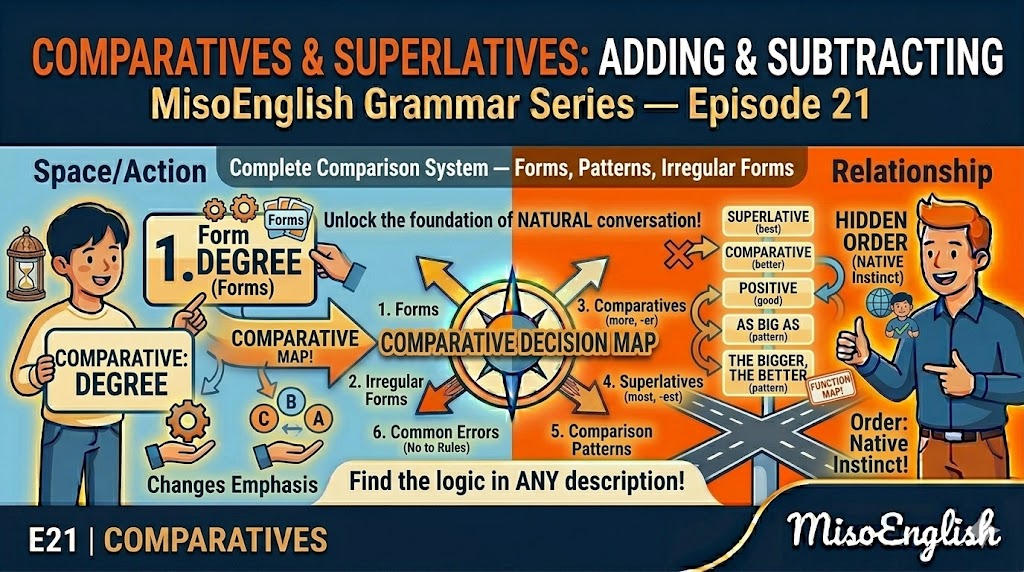
MisoEnglish Grammar Series
Episode 21 — 비교급과 최상급
더하고 빼는 영어의 방식
"문법을 외우지 말고, 느껴라" Don't memorize grammar. Feel it.
🧭 들어가며 | Introduction
"더 크다", "가장 크다" — 영어는 이것을 형용사와 부사의 형태 변화로 표현한다.
"Bigger", "the biggest" — English expresses degree by changing the form of adjectives and adverbs.
비교급(Comparative)은 둘을 비교할 때, 최상급(Superlative)은 셋 이상 중 가장 ~할 때 쓴다.
Comparative = comparing two things. Superlative = the extreme among three or more.
단순해 보이지만, 어떤 형태를 쓰느냐와 불규칙 변화에서 많은 학습자들이 막힌다. 이번 편에서 완전히 정리한다.
It sounds simple — but which form to use and irregular changes trip up many learners. This episode settles it all.
1. 비교급과 최상급 만들기 | Forming Comparatives and Superlatives
① 짧은 형용사/부사 (1~2음절) | Short Adjectives/Adverbs (1–2 syllables)
-er / -est를 붙인다.
Add -er / -est.
원급 비교급 최상급
| tall | taller | the tallest |
| fast | faster | the fastest |
| old | older | the oldest |
| young | younger | the youngest |
| smart | smarter | the smartest |
철자 규칙 | Spelling Rules:
- -e로 끝나면: large → larger / largest
- 자음+모음+자음이면: big → bigger / biggest
- 자음+-y이면: happy → happier / happiest
② 긴 형용사/부사 (3음절 이상) | Long Adjectives/Adverbs (3+ syllables)
more / most를 앞에 붙인다.
Add more / most before the adjective.
원급 비교급 최상급
| beautiful | more beautiful | the most beautiful |
| interesting | more interesting | the most interesting |
| expensive | more expensive | the most expensive |
| carefully | more carefully | the most carefully |
| important | more important | the most important |
③ 불규칙 변화 | Irregular Forms
완전히 외워야 한다. 이것들은 패턴이 없다.
These must be memorized. No pattern here.
원급 비교급 최상급
| good / well | better | the best |
| bad / badly | worse | the worst |
| many / much | more | the most |
| little | less | the least |
| far | farther / further | the farthest / furthest |
| old | older / elder | the oldest / eldest |
She is a better cook than I am.
그녀는 나보다 요리를 더 잘한다.
This is the worst movie I've ever seen.
이것은 내가 본 것 중 최악의 영화다.
I need more time.
나는 시간이 더 필요하다.
2. 비교급 문장 만들기 | Building Comparative Sentences
기본 구조 | Basic Structure
A + be동사 + 비교급 + than + B
A is + comparative + than + B
She is taller than him.
그녀는 그보다 키가 크다.
This book is more interesting than that one.
이 책이 저것보다 더 흥미롭다.
He runs faster than I do.
그는 나보다 빠르게 달린다.
Today is worse than yesterday.
오늘은 어제보다 더 나쁘다.
than 뒤의 형태 | After "than"
She is taller than I (am).
✅ ← 격식체 She is taller than me.
✅ ← 구어체, 둘 다 맞음
3. 최상급 문장 만들기 | Building Superlative Sentences
기본 구조 | Basic Structure
the + 최상급 + (명사) + in/of + 범위
the + superlative + (noun) + in/of + group
She is the tallest student in the class.
그녀는 반에서 가장 키가 큰 학생이다.
This is the most expensive restaurant in the city.
이것은 도시에서 가장 비싼 식당이다.
He is the best player on the team.
그는 팀에서 가장 훌륭한 선수다.
It was the worst day of my life.
그것은 내 인생에서 최악의 날이었다.
in vs of:
in + 장소/그룹: the best in the class / in the world
of + 복수명사/기간: the best of all / of my life
4. 비교 표현의 다양한 패턴 | Various Comparison Patterns
① as ~ as — 동등 비교 | Equal Comparison
두 가지가 같은 정도임을 표현. Expressing that two things are equally.
as + 원급 + as
She is as tall as her sister.
그녀는 언니만큼 키가 크다.
He runs as fast as a cheetah.
그는 치타만큼 빠르게 달린다.
This is as good as I expected.
이것은 내가 기대했던 것만큼 좋다.
부정 동등 비교 | Negative Equal Comparison
She is not as tall as her sister.
그녀는 언니만큼 키가 크지 않다.
= She is shorter than her sister.
② 비교급 + and + 비교급 — 점점 더 | Getting More and More
It's getting colder and colder.
점점 더 추워지고 있다.
She became more and more confident.
그녀는 점점 더 자신감 있어졌다.
The problem grew worse and worse.
문제는 점점 더 나빠졌다.
③ the + 비교급, the + 비교급 — ~할수록 더 | The More... The More...
The harder you work, the more you earn.
더 열심히 일할수록, 더 많이 번다.
The more you practice, the better you get.
더 많이 연습할수록, 더 나아진다.
The older I get, the wiser I become.
나이가 들수록, 더 현명해진다.
④ much / far / even / a lot + 비교급 — 훨씬 더 | Much More
비교급을 강조할 때. To emphasize a comparative.
She is much taller than him.
그녀는 그보다 훨씬 키가 크다.
This is far more expensive.
이것은 훨씬 더 비싸다.
He is even better than before.
그는 전보다 훨씬 더 낫다.
Today is a lot worse than yesterday.
오늘은 어제보다 훨씬 더 나쁘다.
5. 주의해야 할 포인트들 | Points to Watch Out For
① 이중 비교급 금지 | No Double Comparatives
~~more faster~~ ❌ → faster ✅
~~more better~~ ❌ → better ✅
~~more taller~~ ❌ → taller ✅
-er과 more를 동시에 쓰면 안 된다.
Never use -er and more at the same time.
② elder vs older | 어른 vs 나이 든
my elder brother 내 형/오빠 (가족 관계에서)
He is older than me. 그는 나보다 나이가 많다. (일반 비교)
elder는 가족 관계에서 나이 순서를 말할 때만 쓴다.
"Elder" is used only for family birth order.
③ farther vs further | 거리 vs 정도
The store is farther than I thought.
가게는 내가 생각했던 것보다 더 멀다. (물리적 거리)
We need to discuss this further.
우리는 이것을 더 논의해야 한다. (정도, 추가)
6. 비교 표현 총정리 | Complete Comparison Map
표현 의미 예문
| 비교급 + than | ~보다 더 | taller than |
| as ~ as | ~만큼 | as tall as |
| not as ~ as | ~만큼 ~하지 않다 | not as tall as |
| the + 최상급 | 가장 ~ | the tallest |
| 비교급 and 비교급 | 점점 더 | taller and taller |
| the 비교급, the 비교급 | ~할수록 더 | the taller, the better |
| much/far/even + 비교급 | 훨씬 더 | much taller |
🎉 Level 3 완료! | Level 3 Complete!
Episode 15부터 21까지, 명사·관사·전치사·형용사·부사의 세계를 완성했다.
From Episode 15 to 21, we've completed the world of nouns, articles, prepositions, adjectives, and adverbs.
편 주제
| 15 | 관사 a와 the — 새 정보와 아는 정보를 나누는 기준 |
| 16 | 셀 수 있는 명사 vs 셀 수 없는 명사 |
| 17 | 전치사 in·on·at — 공간과 시간을 느끼는 법 |
| 18 | 전치사 심화 — 규칙이 아니라 이미지로 |
| 19 | 형용사 — 명사를 살아있게 만드는 법 |
| 20 | 부사 — 동사와 문장 전체를 조율하는 법 |
| 21 | 비교급과 최상급 — 더하고 빼는 영어의 방식 |
🔜 다음 레벨 예고 | Coming Up: Level 4
Level 4 — 문장을 확장하는 법 (Episodes 22–28)
단문에서 복문으로. 조동사, 수동태, to부정사, 동명사, 관계사, 접속사, 가정법 — 영어 표현의 폭을 완전히 넓히는 마지막 레벨이다.
From simple to complex. Modal verbs, passive voice, infinitives, gerunds, relative clauses, conjunctions, conditionals — the final level that fully expands your English expression.
Episode 22 — 조동사 : can·will·must·should가 만드는 뉘앙스 Modal Verbs: The Nuance Behind can, will, must, and should
© MisoEnglish Grammar Series | Level 3 — Episode 21 "문법을 외우지 말고, 느껴라" | "Don't memorize grammar. Feel it."
Comparatives and Superlatives: How English Adds and Subtracts
The Complete System of Comparison — Forms, Patterns, and Irregular Forms
MisoEnglish Grammar Series — Episode 21
"Don't memorize grammar. Feel it."
Introduction
"Bigger." "The biggest." "As big as." "The bigger, the better."
English has a full system for expressing degree and comparison — and it's more varied than most learners realize. This episode maps it out completely: how to form comparatives and superlatives, how to use them in sentences, and the patterns that make comparisons vivid and precise.
1. Forming Comparatives and Superlatives
Short adjectives/adverbs (1–2 syllables) → -er / -est
Base Comparative Superlative
| tall | taller | the tallest |
| fast | faster | the fastest |
| old | older | the oldest |
| smart | smarter | the smartest |
Spelling rules:
- Ends in -e: large → larger / largest
- Consonant + vowel + consonant: big → bigger / biggest
- Consonant + y: happy → happier / happiest
Long adjectives/adverbs (3+ syllables) → more / most
Base Comparative Superlative
| beautiful | more beautiful | the most beautiful |
| interesting | more interesting | the most interesting |
| expensive | more expensive | the most expensive |
| carefully | more carefully | the most carefully |
Irregular forms — memorize these
Base Comparative Superlative
| good / well | better | the best |
| bad / badly | worse | the worst |
| many / much | more | the most |
| little | less | the least |
| far | farther / further | the farthest / furthest |
2. Comparative Sentences
A + be verb + comparative + than + B
She is taller than him.
This book is more interesting than that one.
He runs faster than I do.
Today is worse than yesterday.
After "than": both subject and object pronouns are acceptable in modern English.
She is taller than I (am). (formal)
She is taller than me. (informal — both correct)
3. Superlative Sentences
the + superlative + (noun) + in/of + group
She is the tallest student in the class.
This is the most expensive restaurant in the city.
It was the worst day of my life.
in + place/group: the best in the class / in the world
of + plural noun/period: the best of all / of my life
4. Comparison Patterns
as ~ as — equal comparison
She is as tall as her sister.
He runs as fast as a cheetah.
This is as good as I expected.
Negative:
She is not as tall as her sister.
= She is shorter than her sister.
Comparative + and + comparative — getting more and more
It's getting colder and colder.
She became more and more confident.
The problem grew worse and worse.
The + comparative, the + comparative — the more... the more...
The harder you work, the more you earn.
The more you practice, the better you get.
The older I get, the wiser I become.
much / far / even / a lot + comparative — emphasizing degree
She is much taller than him.
This is far more expensive.
He is even better than before.
Today is a lot worse than yesterday.
5. Points to Watch Out For
No double comparatives
~~more faster~~ ❌ → faster ✅
~~more better~~ ❌ → better ✅
Never combine -er and more.
elder vs. older
my elder brother (family birth order only)
He is older than me. (general age comparison)
farther vs. further
The store is farther than I thought. (physical distance)
We need to discuss this further. (degree, extent, additional)
6. Complete Comparison Map
Pattern Meaning Example
| comparative + than | more than | taller than |
| as ~ as | equal to | as tall as |
| not as ~ as | less than | not as tall as |
| the + superlative | most | the tallest |
| comp. and comp. | increasingly | taller and taller |
| the comp., the comp. | the more... the more | the taller, the better |
| much/far/even + comp. | much more | much taller |
🎉 Level 3 Complete!
Episode Topic
| 15 | Articles a and the — new vs. known information |
| 16 | Countable vs. Uncountable Nouns |
| 17 | Prepositions in / on / at |
| 18 | Prepositions in Depth |
| 19 | Adjectives — position, order, and usage |
| 20 | Adverbs — types, position, and tricky pairs |
| 21 | Comparatives and Superlatives |
Coming Up: Level 4 — Expanding the Sentence
From simple to complex. Modal verbs, passive voice, infinitives, gerunds, relative clauses, conjunctions, conditionals — the final level that unlocks the full range of English expression.
Episode 22 — Modal Verbs: The Nuance Behind can, will, must, and should
© MisoEnglish Grammar Series | Level 3 — Episode 21 "Don't memorize grammar. Feel it."
⚠️ 저작권 안내
본 블로그(MisoEnglish · slowblooms.tistory.com)의 모든 콘텐츠는 저작권법의 보호를 받습니다. 글, 예시 문장, 분석 내용 등 블로그에 게시된 모든 창작물은 저작자의 동의 없이 무단으로 복사, 복제, 배포, 2차 가공하는 행위를 금지합니다. 출처를 밝히지 않은 전재, SNS·커뮤니티·타 블로그 등에의 무단 게시, 상업적 이용은 모두 금지되며, 무단 불펌 적발 시 저작권법에 따라 법적 조치가 취해질 수 있습니다. 콘텐츠 사용 문의는 slowblooms.tistory.com으로 연락 주세요.
© MisoEnglish · slowblooms.tistory.com. All rights reserved.
━━━━━━━━━━━━━━━━━━━━━━━━━━━━━━━━
⚠️ Copyright Notice
All content published on this blog (MisoEnglish · slowblooms.tistory.com) is protected by copyright law. Copying, reproducing, distributing, or adapting any written posts, example sentences, or analyses without the explicit consent of the author is strictly prohibited. Unauthorised reposting on other blogs, social media, online communities, or any public platform — with or without modification — is not permitted, and may result in legal action under applicable copyright law. For content licensing enquiries, please contact us via slowblooms.tistory.com.
© MisoEnglish · slowblooms.tistory.com. All rights reserved.
'English Mechanism' 카테고리의 다른 글
| Episode 23 — 수동태: 당하는 입장에서 말할 때 (0) | 2026.03.01 |
|---|---|
| Episode 22 — 조동사: can · will · must · should가 만드는 뉘앙스 (0) | 2026.03.01 |
| Episode 20 — 부사: 동사와 문장 전체를 조율하는 법 (0) | 2026.02.28 |
| Episode 19 — 형용사: 명사를 살아있게 만드는 법 (0) | 2026.02.28 |
| Episode 18 — 전치사 심화: 규칙이 아니라 이미지로 익혀라 (0) | 2026.02.28 |


