
- 분류 전체보기 (1383)

- Linguistics (언어학·영어학) (21)
- Stylistics (문체론) (6)
- Etymology & Word Building (.. (15)
- Collection of Famous Quotes.. (109)
- TOEIC & TOEFL English (시험 영.. (0)
- English Mechanism (영어 구조의 원.. (344)
- The Language Beyond Grammar.. (86)
- Living English (생활영어) (211)
- Video Clip (영상 클립) (16)
- Miso’s Life Notes (미소의 삶의 기.. (31)
- My English Journey and Refl.. (8)
- Philosophy (철학) (300)
- Philosophy of Language (언어철.. (12)
- Ethics (윤리학) (8)
- Epistemology (인식론) (7)
- Metaphysics (형이상학) (7)
- Philosophy of Mind (심리철학) (8)
- Philosophy of Religion (종교철.. (8)
- Christian Philosophy (기독교 철.. (44)
- Political Philosophy (정치철학) (11)
- Philosophy of Science (과학철학.. (8)
- Eastern Philosophy (동양철학) (56)
- Comparative Philosophy (비교철.. (6)
- Ancient Philosophy (고대철학) (38)
- Medieval Philosophy (중세철학) (11)
- Modern Philosophy (근대철학) (11)
- Postmodern philosophy (포스트모.. (8)
- Contemporary Philosophy (현대.. (56)
- World History & Culture (세계.. (41)
- Airline English (항공 영어) (47)
- AI & Digital Life (인공지능) (32)
- Books & Insights (북 리뷰) (79)
- Creative Corner (35)
- Sally & Sia (1)
- Linguistics (언어학·영어학) (21)
| 일 | 월 | 화 | 수 | 목 | 금 | 토 |
|---|---|---|---|---|---|---|
| 1 | 2 | 3 | 4 | 5 | 6 | |
| 7 | 8 | 9 | 10 | 11 | 12 | 13 |
| 14 | 15 | 16 | 17 | 18 | 19 | 20 |
| 21 | 22 | 23 | 24 | 25 | 26 | 27 |
| 28 | 29 | 30 |
- EnglishWriting #AcademicWriting #Grammar #EnglishLanguage #EssayWriting #ParagraphStructure #SentenceStructure #BusinessEnglish #EnglishTips #WritingSkills #Linguistics #ESL
- 영어문법
- everyday English
- MisoEnglish#철학입문 #Philosophy #윤리학 #Ethics #도덕철학 #철학공부 #칸트 #공리주의 #교육콘텐츠 #철학시리즈
- 영문법
- MisoEnglish#철학입문 #Philosophy #종교철학 #PhilosophyOfReligion #철학공부 #신존재증명 #악의문제 #PhilosophyForBeginners #교육콘텐츠 #철학시리즈
- 영어접속사
- 동양정치철학 #시리즈완결 #아시아적가치 #동서양비교 #유교 #민주주의 #정치사상 #인문학 #비교철학 #글로벌정치 #문화다양성 #2500년철학사
- ticketing
- pnr
- 🌿 English with Heart
- AirlineOpsEnglish
- MisoEnglish#철학입문 #Philosophy #과학철학 #PhilosophyOfScience #철학공부 #포퓨퍼 #쿠hn #과학방법론 #교육콘텐츠 #철학시리즈
- 영국사 #영국역사 #세계사 #역사연재 #브리튼에서영국까지
- MisoEnglish#불교철학 #BuddhismPhilosophy #사성제 #FourNobleTruths #공사상 #Emptiness #명상 #Mindfulness #열반 #EasternWisdom
- 영어회화
- MisoEnglish#철학입문 #Philosophy #심리철학 #PhilosophyOfMind #철학공부 #의식 #마음 #PhilosophyForBeginners #교육콘텐츠 #철학시리즈
- English for Korean Learners
- 감성영어
- 인도철학 #동양철학 #인문학 #요가 #명상 #힌두교 #불교 #간디 #타고르 #정통6파 #철학공부 #마음공부 #MisoEnglish #인문학영어
- English Speaking Practice
- MisoEnglish#철학입문 #Philosophy #정치철학 #PoliticalPhilosophy #철학공부 #정의론 #자유주의 #PhilosophyForBeginners #교육콘텐츠 #철학시리즈
- 미소잉글리시
- 영어공부
- MisoEnglish#도교철학 #Taoism #도덕경 #TaoTeChing #무위자연 #WuWei #노자 #Laozi #장자 #YinYang
- MisoEnglish#한국철학 #KoreanPhilosophy #홍익인간 #Hongik #화랑도 #Hwarang #단군 #Dangun #풍류도 #ThreeKingdoms#동양철학
- misoenglish
- Basic English Verbs
- MisoEnglish#유교철학 #Confucianism #성리학 #NeoConfucianism #인의예지 #Virtue #맹자 #Mencius #실학 #KoreanScholarship
- 영어공부법
- Today
- Total
MisoEnglish
Alexander the Great - The Man Who Won the World at Thirty-Three — and Lost It 본문
Alexander the Great - The Man Who Won the World at Thirty-Three — and Lost It
slowblooms 2026. 5. 7. 02:19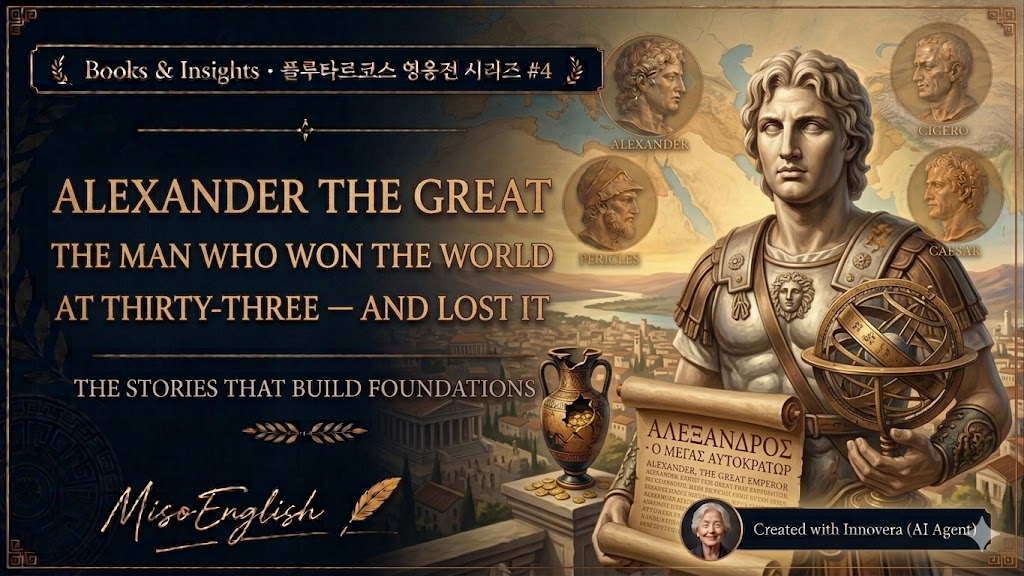
Books & Insights · Plutarch's Lives Series #4
Alexander the Great
The Man Who Won the World at Thirty-Three — and Lost It
📚 Series Contents
- What Is Plutarch's Lives?
- Theseus
- Romulus
- Alexander the Great ← You are here
- Julius Caesar
- The Vessel of a Conqueror — and Its Breaking Point
- Pericles
- Cicero
- The Rise and Fall of Heroes
- Why We Still Read Plutarch's Lives Today
No one in recorded history conquered more land in less time. But that is not why Plutarch wrote about Alexander. He is not interested in the map. He wants to look inside the man who drew it — at the place where genius and destruction lived side by side, and eventually could no longer be told apart.
A Fire From the Beginning
Alexander was born in 356 BC in Macedonia. His father was Philip II — the king who forged Macedonia into the most formidable military power in Greece. His mother was Olympias — fierce, mystical, a princess of Epirus who believed her son had been fathered by a god. Neither parent was who Alexander wanted to be. He wanted to be more.
The ambition showed early. When news arrived of one of Philip's victories, the boy would grow quiet and withdrawn. His companions asked why. He told them without hesitation.
"My father will leave me nothing to conquer."
— Alexander, Plutarch's Lives, Alexander
The Student of Aristotle
Philip hired the greatest philosopher alive to tutor his son. From age thirteen to sixteen, Alexander studied under Aristotle — philosophy, medicine, natural science, literature. He developed a particular love for Homer's Iliad, which he kept under his pillow on campaign alongside a dagger, annotated in Aristotle's hand.
BucephalusAt twelve years old, Alexander tamed a horse that no one else could handle. He noticed the animal was terrified of its own shadow, turned its head toward the sun, and the horse went calm. Philip watched, and wept. "My son," he said, "Macedonia is too small a kingdom for you." The horse was named Bucephalus. Alexander rode him until the day the horse died, deep in India — and named a city after him.
The Conquest Begins
Philip was assassinated in 336 BC. Alexander became king at twenty. Two years later, he launched his campaign against Persia — the greatest empire the world had known. No one seriously believed he could win.
- 334 BC Battle of the GranicusFirst engagement against Persian forces. Alexander crosses into Asia and defeats the Persian garrison.
- 333 BC The Gordian KnotAn ancient prophecy: whoever untied the knot would rule Asia. Alexander drew his sword and cut through it.
- 331 BC Battle of GaugamelaDarius III defeated decisively. Persepolis falls. Alexander becomes lord of the Persian Empire.
- 326 BC The Edge of IndiaAt the Hyphasis River, his army refuses to march further. For the first time, Alexander is stopped — not by an enemy, but by his own men.
Plutarch is less interested in the battles than in the moments between them. At Gordium, when Alexander cut the knot rather than untied it, he was not simply solving a puzzle. He was announcing something about who he was: a man who rewrites the rules of the problem rather than playing by them.
The King Who Changed
The deeper Alexander went into Persia, the more he became someone else. He began wearing Persian robes. He demanded that his court prostrate themselves before him in the Persian fashion. He proclaimed himself a son of the gods. His Macedonian generals seethed. The king they had marched beside was disappearing.
The Killing of CleitusIn 328 BC, at a banquet, Alexander's old friend and general Cleitus openly mocked his adoption of Persian customs and questioned whether his achievements surpassed his father's. In a drunken fury, Alexander seized a spear and ran him through. Cleitus died instantly. When Alexander sobered the next morning, he wept for days and refused to eat. The grief was real. Cleitus was still dead.
Plutarch holds this scene at the center of his account. Alexander's courage in battle was never in doubt. But power had changed him. When no one can say no to you, something essential begins to rot. Alexander is Plutarch's most dramatic answer to the question of what unchecked authority does to even the most gifted of men.
Hephaestion
There is one name that runs through Alexander's life like a second thread. Hephaestion — his closest friend since childhood, his companion on every campaign. When the two of them visited Troy early in the expedition, Alexander laid a wreath on the tomb of Achilles. Hephaestion laid one on the tomb of Patroclus. No explanation was needed.
In 324 BC, Hephaestion died suddenly of fever. Alexander's grief was beyond consolation. He stopped eating. He lay beside the body for days. Those around him said he no longer seemed to be alive himself. Within a year, Alexander was dead too.
Babylon, 323 BC
Alexander fell ill in Babylon in June of 323 BC. He held on for ten days. Then he was gone. He was thirty-three years old. The empire he had spent his entire adult life building fractured within months of his death. His generals divided it among themselves. It was never reunited.
| At a Glance | Alexander |
|---|---|
| Territory conquered | Greece to Egypt to Persia to the borders of India — ~2 million sq mi |
| Years of campaign | 13 years (336–323 BC) |
| Age at death | 33 |
| Paired with | Julius Caesar (next episode) |
Plutarch's final question about Alexander is one he refuses to answer neatly: was this man great, or merely terrifying? He built libraries and cities. He spread Greek culture across three continents. He also killed his friend in a rage, crushed those who questioned him, and declared himself divine. Both things are true. Plutarch does not resolve them. He simply holds them together and asks you to sit with the discomfort.
'Books & Insights (북 리뷰)' 카테고리의 다른 글
| Julius Caesar - The Man Who Seized Rome — and Was Killed by It (1) | 2026.05.07 |
|---|---|
| 카이사르 - 로마를 손에 넣고, 로마에게 죽은 사람 (1) | 2026.05.07 |
| 알렉산드로스 - 서른셋에 세계를 손에 넣고, 세계를 잃은 사람 (0) | 2026.05.07 |
| Romulus - The Man Who Killed His Brother to Build a City (0) | 2026.05.07 |
| 로물루스 - 형제를 죽이고 도시를 세운 사람 (1) | 2026.05.06 |


