
- 분류 전체보기 (1378)

- Linguistics (언어학·영어학) (21)
- Stylistics (문체론) (6)
- Etymology & Word Building (.. (15)
- Collection of Famous Quotes.. (109)
- TOEIC & TOEFL English (시험 영.. (0)
- English Mechanism (영어 구조의 원.. (344)
- The Language Beyond Grammar.. (86)
- Living English (생활영어) (211)
- Video Clip (영상 클립) (16)
- Miso’s Life Notes (미소의 삶의 기.. (30)
- My English Journey and Refl.. (8)
- Philosophy (철학) (300)
- Philosophy of Language (언어철.. (12)
- Ethics (윤리학) (8)
- Epistemology (인식론) (7)
- Metaphysics (형이상학) (7)
- Philosophy of Mind (심리철학) (8)
- Philosophy of Religion (종교철.. (8)
- Christian Philosophy (기독교 철.. (44)
- Political Philosophy (정치철학) (11)
- Philosophy of Science (과학철학.. (8)
- Eastern Philosophy (동양철학) (56)
- Comparative Philosophy (비교철.. (6)
- Ancient Philosophy (고대철학) (38)
- Medieval Philosophy (중세철학) (11)
- Modern Philosophy (근대철학) (11)
- Postmodern philosophy (포스트모.. (8)
- Contemporary Philosophy (현대.. (56)
- World History & Culture (세계.. (41)
- Airline English (항공 영어) (47)
- AI & Digital Life (인공지능) (28)
- Books & Insights (북 리뷰) (79)
- Creative Corner (35)
- Sally & Sia (1)
- Linguistics (언어학·영어학) (21)
| 일 | 월 | 화 | 수 | 목 | 금 | 토 |
|---|---|---|---|---|---|---|
| 1 | 2 | 3 | 4 | 5 | 6 | |
| 7 | 8 | 9 | 10 | 11 | 12 | 13 |
| 14 | 15 | 16 | 17 | 18 | 19 | 20 |
| 21 | 22 | 23 | 24 | 25 | 26 | 27 |
| 28 | 29 | 30 |
- MisoEnglish#철학입문 #Philosophy #윤리학 #Ethics #도덕철학 #철학공부 #칸트 #공리주의 #교육콘텐츠 #철학시리즈
- MisoEnglish#불교철학 #BuddhismPhilosophy #사성제 #FourNobleTruths #공사상 #Emptiness #명상 #Mindfulness #열반 #EasternWisdom
- 영어접속사
- 영어공부
- MisoEnglish#도교철학 #Taoism #도덕경 #TaoTeChing #무위자연 #WuWei #노자 #Laozi #장자 #YinYang
- pnr
- 영국사 #영국역사 #세계사 #역사연재 #브리튼에서영국까지
- MisoEnglish#한국철학 #KoreanPhilosophy #홍익인간 #Hongik #화랑도 #Hwarang #단군 #Dangun #풍류도 #ThreeKingdoms#동양철학
- MisoEnglish#철학입문 #Philosophy #심리철학 #PhilosophyOfMind #철학공부 #의식 #마음 #PhilosophyForBeginners #교육콘텐츠 #철학시리즈
- 감성영어
- 영어회화
- MisoEnglish#철학입문 #Philosophy #과학철학 #PhilosophyOfScience #철학공부 #포퓨퍼 #쿠hn #과학방법론 #교육콘텐츠 #철학시리즈
- 동양정치철학 #시리즈완결 #아시아적가치 #동서양비교 #유교 #민주주의 #정치사상 #인문학 #비교철학 #글로벌정치 #문화다양성 #2500년철학사
- Basic English Verbs
- misoenglish
- MisoEnglish#철학입문 #Philosophy #정치철학 #PoliticalPhilosophy #철학공부 #정의론 #자유주의 #PhilosophyForBeginners #교육콘텐츠 #철학시리즈
- EnglishWriting #AcademicWriting #Grammar #EnglishLanguage #EssayWriting #ParagraphStructure #SentenceStructure #BusinessEnglish #EnglishTips #WritingSkills #Linguistics #ESL
- everyday English
- 영문법
- 인도철학 #동양철학 #인문학 #요가 #명상 #힌두교 #불교 #간디 #타고르 #정통6파 #철학공부 #마음공부 #MisoEnglish #인문학영어
- MisoEnglish#철학입문 #Philosophy #종교철학 #PhilosophyOfReligion #철학공부 #신존재증명 #악의문제 #PhilosophyForBeginners #교육콘텐츠 #철학시리즈
- 미소잉글리시
- AirlineOpsEnglish
- MisoEnglish#철학입문 #Philosophy #형이상학 #Metaphysics #철학공부 #존재론 #실재론 #PhilosophyForBeginners #교육콘텐츠 #철학시리즈
- MisoEnglish#유교철학 #Confucianism #성리학 #NeoConfucianism #인의예지 #Virtue #맹자 #Mencius #실학 #KoreanScholarship
- English Speaking Practice
- English for Korean Learners
- 영어문법
- 🌿 English with Heart
- ticketing
- Today
- Total
MisoEnglish
Romulus - The Man Who Killed His Brother to Build a City 본문
Romulus - The Man Who Killed His Brother to Build a City
slowblooms 2026. 5. 7. 02:16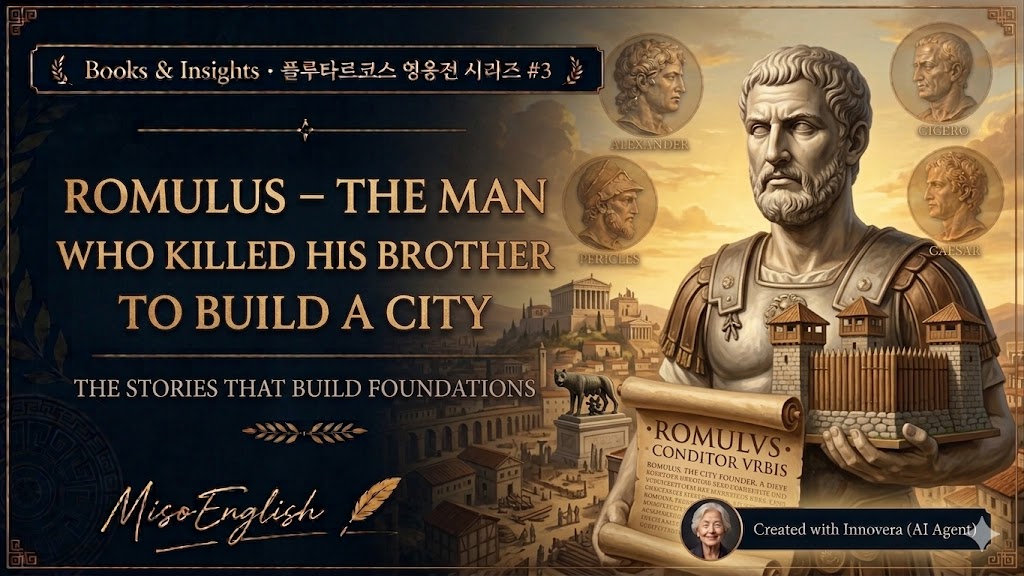
Books & Insights · Plutarch's Lives Series #3
Romulus
The Man Who Killed His Brother to Build a City
📚 Series Contents
- What Is Plutarch's Lives?
- Theseus
- Romulus ← You are here
- Alexander the Great
- Julius Caesar
- The Vessel of a Conqueror — and Its Breaking Point
- Pericles
- Cicero
- The Rise and Fall of Heroes
- Why We Still Read Plutarch's Lives Today
Every great beginning casts a shadow. The founding myth of Rome is proof of that. The man who built the most powerful city in the ancient world was a child abandoned to die, raised by a wolf, and crowned by the blood of his own twin. Plutarch does not look away from any of it.
Children Nursed by a Wolf
The birth of Romulus is extraordinary from the start. His mother Rhea Silvia, a Vestal Virgin, is said to have conceived by the war god Mars. The reigning king of Alba Longa, Amulius, had every reason to fear what those children might become. He ordered the twin boys — Romulus and Remus — thrown into the Tiber.
They did not drown. The basket carrying them came to rest in shallow water near a fig tree. A she-wolf found them and nursed them. A shepherd named Faustulus discovered the boys and brought them home to raise. Plutarch records the legend faithfully — and then, characteristically, offers a rational alternative: the "wolf" may have been a woman called Lupa, a nickname common among women of rough reputation, who took the infants in.
"Plutarch neither dismisses the myth nor swallows it whole. He searches inside the legend for the human truth beneath it."
— How to read Plutarch
The Death of a Brother
When the twins came of age, they overthrew Amulius and resolved to found a city of their own. But they disagreed on where to build it. To settle the dispute, they turned to augury — the Roman practice of reading the will of the gods through the flight of birds. Remus saw six birds from his hill; Romulus saw twelve from his.
Each claimed victory. Remus had seen his birds first; Romulus had seen more. The argument turned violent. Remus died — by Romulus's hand, or by that of one of his followers. The accounts differ. The result does not.
The Leap That Sealed ItWhen Romulus began marking the boundary of his new city with a ditch, Remus mocked it and jumped across to prove how easily it could be crossed. Romulus was furious. "So dies anyone who leaps my walls," he is said to have declared. Remus fell where he stood.
Plutarch does not assign blame cleanly. He simply records what happened and what it cost: Rome was founded on a brother's blood. Romulus would carry that weight for the rest of his life.
How to Fill a City
The boundaries were drawn. But a city needs people. Romulus declared Rome a sanctuary — open to runaway slaves, debtors, exiles, and outcasts of every kind. Men came quickly. Women did not.
The Rape of the Sabine WomenRomulus invited the neighboring Sabine people to a festival in Rome. At the height of the celebrations, Roman men seized the Sabine women and carried them off. It is one of the darkest episodes in the story of Rome's founding.
Plutarch does not dress this up. But he records what followed: the abducted women married Roman men, and when war broke out between Rome and the Sabines, the women themselves ran between the two armies and brokered peace. A community born of violence became a community held together by those who had most reason to resent it. Plutarch notes the irony quietly, but he makes sure you feel it.
Romulus the King
Romulus did not only found Rome — he gave it its skeleton. He established the Senate, organized the military, and laid down the basic laws and customs that would define Roman life for centuries. In battle he led from the front. There are accounts of him killing enemy commanders in single combat, dedicating their armor as spoils to Jupiter.
| Achievement | What He Did | Historical Significance |
|---|---|---|
| Founding of Rome | Built the city on the Palatine Hill, 753 BC | Birth of Western civilization's center |
| The Senate | Established a council of one hundred elders | Root of the Roman Republic |
| Sabine Integration | United Romans and Sabines under shared rule | Template for Rome's multiethnic growth |
The King Who Vanished
The death of Romulus is one of history's great unsolved moments. During a military review in the Forum, a sudden storm descended. When the clouds cleared, Romulus was gone. The people believed he had been taken up to the gods — deified under the name Quirinus, he became one of Rome's patron spirits.
But Plutarch records a second version: that Romulus had grown autocratic in his final years, and that senators, resentful of his tyranny, had killed him and hidden the pieces of his body beneath their cloaks. The god and the murder victim. Plutarch offers both and decides nothing.
"Even the greatest founder can be changed by power. The disappearance of Romulus is Rome's permanent unanswered question about what it did to the man who made it."
— Plutarch's lens on Romulus
Theseus and Romulus — Two Founders, One Mirror
Plutarch's reason for pairing these two men becomes unmistakable. Across two different civilizations, the pattern is almost identical.
Theseus
• Father uncertain — mortal or god
• Caused his father's death
• Unified Athens; shared power
• Expelled from the city he built
• Died alone in exile
Romulus
• Father uncertain — mortal or god
• Caused his brother's death
• Built Rome; founded the Senate
• Vanished — murdered or divine
• Truth of his death suppressed
Both men built cities that outlasted them by millennia. Both caused the deaths of those closest to them. Both were ultimately consumed by the worlds they created. Plutarch's argument runs quietly beneath the parallel: greatness does not protect you from tragedy. It may, in fact, invite it.
'Books & Insights (북 리뷰)' 카테고리의 다른 글
| Alexander the Great - The Man Who Won the World at Thirty-Three — and Lost It (0) | 2026.05.07 |
|---|---|
| 알렉산드로스 - 서른셋에 세계를 손에 넣고, 세계를 잃은 사람 (0) | 2026.05.07 |
| 로물루스 - 형제를 죽이고 도시를 세운 사람 (1) | 2026.05.06 |
| Theseus - The Man Who Carried Athens on His Shoulders (0) | 2026.05.06 |
| 테세우스 - 아테네라는 도시를 두 어깨에 짊어진 사람 (0) | 2026.05.06 |


