
- 분류 전체보기 (1378)

- Linguistics (언어학·영어학) (21)
- Stylistics (문체론) (6)
- Etymology & Word Building (.. (15)
- Collection of Famous Quotes.. (109)
- TOEIC & TOEFL English (시험 영.. (0)
- English Mechanism (영어 구조의 원.. (344)
- The Language Beyond Grammar.. (86)
- Living English (생활영어) (211)
- Video Clip (영상 클립) (16)
- Miso’s Life Notes (미소의 삶의 기.. (30)
- My English Journey and Refl.. (8)
- Philosophy (철학) (300)
- Philosophy of Language (언어철.. (12)
- Ethics (윤리학) (8)
- Epistemology (인식론) (7)
- Metaphysics (형이상학) (7)
- Philosophy of Mind (심리철학) (8)
- Philosophy of Religion (종교철.. (8)
- Christian Philosophy (기독교 철.. (44)
- Political Philosophy (정치철학) (11)
- Philosophy of Science (과학철학.. (8)
- Eastern Philosophy (동양철학) (56)
- Comparative Philosophy (비교철.. (6)
- Ancient Philosophy (고대철학) (38)
- Medieval Philosophy (중세철학) (11)
- Modern Philosophy (근대철학) (11)
- Postmodern philosophy (포스트모.. (8)
- Contemporary Philosophy (현대.. (56)
- World History & Culture (세계.. (41)
- Airline English (항공 영어) (47)
- AI & Digital Life (인공지능) (28)
- Books & Insights (북 리뷰) (79)
- Creative Corner (35)
- Sally & Sia (1)
- Linguistics (언어학·영어학) (21)
| 일 | 월 | 화 | 수 | 목 | 금 | 토 |
|---|---|---|---|---|---|---|
| 1 | 2 | 3 | 4 | 5 | 6 | |
| 7 | 8 | 9 | 10 | 11 | 12 | 13 |
| 14 | 15 | 16 | 17 | 18 | 19 | 20 |
| 21 | 22 | 23 | 24 | 25 | 26 | 27 |
| 28 | 29 | 30 |
- 🌿 English with Heart
- EnglishWriting #AcademicWriting #Grammar #EnglishLanguage #EssayWriting #ParagraphStructure #SentenceStructure #BusinessEnglish #EnglishTips #WritingSkills #Linguistics #ESL
- 감성영어
- MisoEnglish#불교철학 #BuddhismPhilosophy #사성제 #FourNobleTruths #공사상 #Emptiness #명상 #Mindfulness #열반 #EasternWisdom
- everyday English
- 동양정치철학 #시리즈완결 #아시아적가치 #동서양비교 #유교 #민주주의 #정치사상 #인문학 #비교철학 #글로벌정치 #문화다양성 #2500년철학사
- 영어문법
- MisoEnglish#철학입문 #Philosophy #심리철학 #PhilosophyOfMind #철학공부 #의식 #마음 #PhilosophyForBeginners #교육콘텐츠 #철학시리즈
- English for Korean Learners
- Basic English Verbs
- MisoEnglish#철학입문 #Philosophy #정치철학 #PoliticalPhilosophy #철학공부 #정의론 #자유주의 #PhilosophyForBeginners #교육콘텐츠 #철학시리즈
- misoenglish
- MisoEnglish#한국철학 #KoreanPhilosophy #홍익인간 #Hongik #화랑도 #Hwarang #단군 #Dangun #풍류도 #ThreeKingdoms#동양철학
- 영어공부
- pnr
- 인도철학 #동양철학 #인문학 #요가 #명상 #힌두교 #불교 #간디 #타고르 #정통6파 #철학공부 #마음공부 #MisoEnglish #인문학영어
- 영어회화
- MisoEnglish#철학입문 #Philosophy #형이상학 #Metaphysics #철학공부 #존재론 #실재론 #PhilosophyForBeginners #교육콘텐츠 #철학시리즈
- MisoEnglish#유교철학 #Confucianism #성리학 #NeoConfucianism #인의예지 #Virtue #맹자 #Mencius #실학 #KoreanScholarship
- MisoEnglish#철학입문 #Philosophy #윤리학 #Ethics #도덕철학 #철학공부 #칸트 #공리주의 #교육콘텐츠 #철학시리즈
- 영어접속사
- MisoEnglish#철학입문 #Philosophy #과학철학 #PhilosophyOfScience #철학공부 #포퓨퍼 #쿠hn #과학방법론 #교육콘텐츠 #철학시리즈
- 미소잉글리시
- MisoEnglish#철학입문 #Philosophy #종교철학 #PhilosophyOfReligion #철학공부 #신존재증명 #악의문제 #PhilosophyForBeginners #교육콘텐츠 #철학시리즈
- ticketing
- English Speaking Practice
- 영문법
- 영국사 #영국역사 #세계사 #역사연재 #브리튼에서영국까지
- MisoEnglish#도교철학 #Taoism #도덕경 #TaoTeChing #무위자연 #WuWei #노자 #Laozi #장자 #YinYang
- AirlineOpsEnglish
- Today
- Total
MisoEnglish
Theseus - The Man Who Carried Athens on His Shoulders 본문
Theseus - The Man Who Carried Athens on His Shoulders
slowblooms 2026. 5. 6. 00:46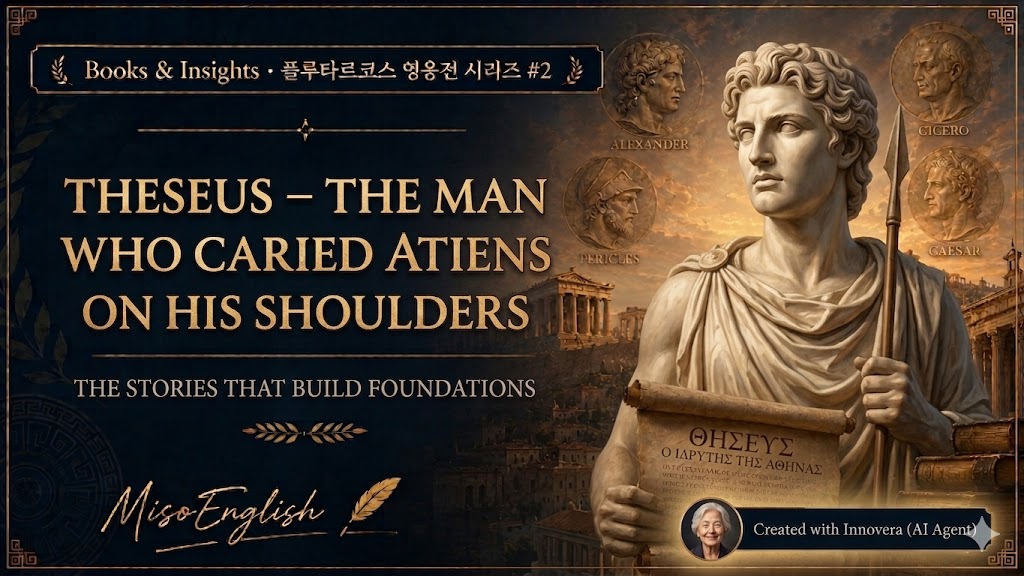
Books & Insights · Plutarch's Lives Series #2
Theseus
The Man Who Carried Athens on His Shoulders
📚 Series Contents
- What Is Plutarch's Lives?
- Theseus ← You are here
- Romulus
- Alexander the Great
- Julius Caesar
- The Vessel of a Conqueror — and Its Breaking Point
- Pericles
- Cicero
- The Rise and Fall of Heroes
- Why We Still Read Plutarch's Lives Today
The first figure in Plutarch's Lives is not a general. Not a conqueror. It is Theseus — the man who lived the founding myth of Athens from the inside. He slew a monster, built a city, and planted the seeds of democracy. And despite all of it, he died alone, far from the home he had made.
Between Myth and History
Plutarch opens his account of Theseus with a confession: "I am entering territory where history gives way to legend." Theseus is half-mythic. Even his parentage is uncertain. His mother Aethra, it is said, spent the same night with two men — Aegeus, the mortal king of Athens, and Poseidon, god of the sea.
But Plutarch is not troubled by the ambiguity. He searches for human choices even inside myth. What matters to him is not whose blood runs in Theseus's veins, but what kind of man those veins carried. That is the only question Plutarch ever asks.
The Sword Beneath the Rock
The story begins with a single scene. When Theseus turns sixteen, his mother leads him to a great boulder. "If you can move it," she tells him, "look beneath it." Under the stone his father Aegeus had left a sword and a pair of sandals — proof of lineage, a claim to a name. Theseus lifts the rock, takes what is his, and sets out for Athens.
"His mother and grandfather urged him to make the journey by sea. But Theseus chose the road."
— Plutarch, Lives, Theseus
The road to Athens was dangerous. Bandits and killers had made it their hunting ground. The sea was the safe choice. Theseus chose the road. Plutarch sees in this moment the essence of the man: someone who does not avoid the test, who moves toward difficulty rather than away from it. The choice of route is already a statement of character.
Into the Labyrinth
Athens carried an old shame. As tribute to King Minos of Crete, the city was required to send seven young men and seven young women every nine years — offerings to the Minotaur, the monster at the center of Minos's labyrinth. Theseus volunteers to go among them.
The MinotaurA creature with the body of a man and the head of a bull, born of the queen of Crete through a divine curse. King Minos ordered the architect Daedalus to build the Labyrinth — an inescapable maze — to contain it.
The Thread of AriadneMinos's daughter Ariadne falls in love with Theseus at first sight. She gives him a spool of thread: tie one end at the entrance, unwind it as you go, and it will lead you back out.
Theseus kills the Minotaur, follows the thread back through the darkness, and leads the Athenian captives out of Crete. As a hero's story, it ends here — clean, triumphant, complete. But Plutarch does not stop at the exit of the labyrinth.
The Black Sails
Before Theseus sailed for Crete, his father Aegeus made him promise: if you come back alive, change the sails from black to white. Let that be the sign that you have survived. Theseus agreed. On the return voyage, he forgot.
Aegeus had been watching from a cliff above the sea. He saw the black sails. He believed his son was dead. He threw himself into the water below. The sea that received him has carried his name ever since — the Aegean.
"He abandoned Ariadne. He let his father die by forgetting. His greatness and his carelessness lived inside the same man."
— Plutarch's lens on Theseus
Plutarch lingers on this. Theseus did not intend his father's death. But his inattention caused it. This is the weight a hero carries that ordinary people do not — when someone of his stature forgets, the consequences are not personal. They are catastrophic.
Theseus the Founder
The deeper reason Plutarch places Theseus first is this: he was not merely a hero. He was a builder of something that lasted.
The region of Attica was then a scatter of small, independent villages. Theseus gathered them into one — creating the city-state of Athens. And then he did something unusual for a man who had just consolidated power: he gave some of it away. He established a council in which nobles and citizens both had a voice, and declared that he himself would hold authority only over matters of war and foreign affairs.
| Achievement | What He Did | Historical Significance |
|---|---|---|
| Unification of Attica | Merged scattered villages into Athens | Birth of the city-state |
| Sharing of Power | Transferred part of royal authority to a council | The seed of democracy |
| Panathenaic Festival | Founded a civic festival for all Athenians | Forging a shared identity |
This is why Plutarch pairs him with Romulus. As Romulus founded Rome, Theseus founded Athens. Both were builders. Both met a bitter end. The parallel is not accidental — it is Plutarch's argument that the capacity to create and the capacity for tragedy often live in the same person.
The Hero's Twilight
The end of Theseus's life is bleak. He loses the trust of his people, is driven out of Athens, and dies in exile on a remote island — pushed from a cliff, some say, by the local king. Or perhaps he simply lost his footing. The truth is lost.
But Plutarch draws meaning from the ending anyway. That the great founder of a city should be expelled by the city he founded — this irony is precisely what lifts Theseus out of myth and into the human condition. Achievement does not protect you. The people you gave a home can take yours away. A hero can be made obsolete by the very world he created.
'Books & Insights (북 리뷰)' 카테고리의 다른 글
| Romulus - The Man Who Killed His Brother to Build a City (0) | 2026.05.07 |
|---|---|
| 로물루스 - 형제를 죽이고 도시를 세운 사람 (1) | 2026.05.06 |
| 테세우스 - 아테네라는 도시를 두 어깨에 짊어진 사람 (0) | 2026.05.06 |
| What Is Plutarch's Lives? (2) | 2026.05.06 |
| 플루타르코스 영웅전이란 무엇인가 (0) | 2026.05.06 |


