
- 분류 전체보기 (1388)

- Linguistics (언어학·영어학) (21)
- Stylistics (문체론) (6)
- Etymology & Word Building (.. (15)
- Collection of Famous Quotes.. (109)
- TOEIC & TOEFL English (시험 영.. (5)
- English Mechanism (영어 구조의 원.. (344)
- The Language Beyond Grammar.. (75)
- Living English (생활영어) (211)
- Video Clip (영상 클립) (16)
- Miso’s Life Notes (미소의 삶의 기.. (30)
- My English Journey and Refl.. (8)
- Philosophy (철학) (300)
- Philosophy of Language (언어철.. (12)
- Ethics (윤리학) (8)
- Epistemology (인식론) (7)
- Metaphysics (형이상학) (7)
- Philosophy of Mind (심리철학) (8)
- Philosophy of Religion (종교철.. (8)
- Christian Philosophy (기독교 철.. (44)
- Political Philosophy (정치철학) (11)
- Philosophy of Science (과학철학.. (8)
- Eastern Philosophy (동양철학) (56)
- Comparative Philosophy (비교철.. (6)
- Ancient Philosophy (고대철학) (38)
- Medieval Philosophy (중세철학) (11)
- Modern Philosophy (근대철학) (11)
- Postmodern philosophy (포스트모.. (8)
- Contemporary Philosophy (현대.. (56)
- World History & Culture (세계.. (41)
- Airline English (항공 영어) (47)
- AI & Digital Life (인공지능) (32)
- Books & Insights (북 리뷰) (79)
- Creative Corner (35)
- Sally & Sia (1)
| 일 | 월 | 화 | 수 | 목 | 금 | 토 |
|---|---|---|---|---|---|---|
| 1 | 2 | 3 | 4 | 5 | 6 | |
| 7 | 8 | 9 | 10 | 11 | 12 | 13 |
| 14 | 15 | 16 | 17 | 18 | 19 | 20 |
| 21 | 22 | 23 | 24 | 25 | 26 | 27 |
| 28 | 29 | 30 |
- 감성영어
- MisoEnglish#도교철학 #Taoism #도덕경 #TaoTeChing #무위자연 #WuWei #노자 #Laozi #장자 #YinYang
- misoenglish
- ticketing
- 영어공부법
- 미소잉글리시
- 🌿 English with Heart
- 영어시제
- Basic English Verbs
- 영어공부
- 인도철학 #동양철학 #인문학 #요가 #명상 #힌두교 #불교 #간디 #타고르 #정통6파 #철학공부 #마음공부 #MisoEnglish #인문학영어
- AirlineOpsEnglish
- everyday English
- 영문법
- MisoEnglish#유교철학 #Confucianism #성리학 #NeoConfucianism #인의예지 #Virtue #맹자 #Mencius #실학 #KoreanScholarship
- 영어회화
- MisoEnglish#철학입문 #Philosophy #심리철학 #PhilosophyOfMind #철학공부 #의식 #마음 #PhilosophyForBeginners #교육콘텐츠 #철학시리즈
- English for Korean Learners
- MisoEnglish#철학입문 #Philosophy #종교철학 #PhilosophyOfReligion #철학공부 #신존재증명 #악의문제 #PhilosophyForBeginners #교육콘텐츠 #철학시리즈
- 영어접속사
- pnr
- MisoEnglish#불교철학 #BuddhismPhilosophy #사성제 #FourNobleTruths #공사상 #Emptiness #명상 #Mindfulness #열반 #EasternWisdom
- English Speaking Practice
- MisoEnglish#철학입문 #Philosophy #과학철학 #PhilosophyOfScience #철학공부 #포퓨퍼 #쿠hn #과학방법론 #교육콘텐츠 #철학시리즈
- 영국사 #영국역사 #세계사 #역사연재 #브리튼에서영국까지
- MisoEnglish#철학입문 #Philosophy #윤리학 #Ethics #도덕철학 #철학공부 #칸트 #공리주의 #교육콘텐츠 #철학시리즈
- 동양정치철학 #시리즈완결 #아시아적가치 #동서양비교 #유교 #민주주의 #정치사상 #인문학 #비교철학 #글로벌정치 #문화다양성 #2500년철학사
- 영어문법
- MisoEnglish#철학입문 #Philosophy #정치철학 #PoliticalPhilosophy #철학공부 #정의론 #자유주의 #PhilosophyForBeginners #교육콘텐츠 #철학시리즈
- MisoEnglish#한국철학 #KoreanPhilosophy #홍익인간 #Hongik #화랑도 #Hwarang #단군 #Dangun #풍류도 #ThreeKingdoms#동양철학
- Today
- Total
MisoEnglish
Julius Caesar - The Man Who Seized Rome — and Was Killed by It 본문
Julius Caesar - The Man Who Seized Rome — and Was Killed by It
slowblooms 2026. 5. 7. 02:22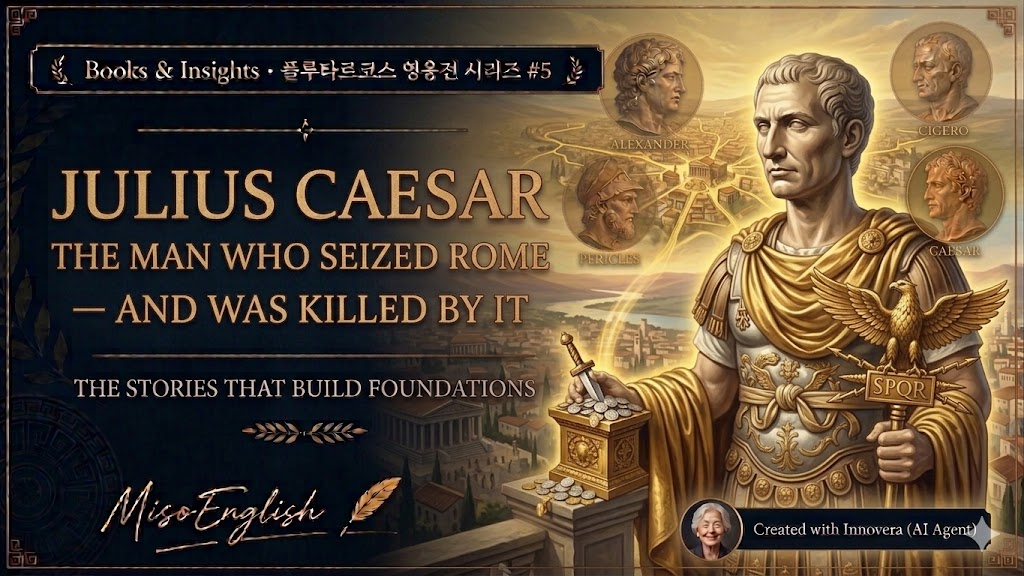
Books & Insights · Plutarch's Lives Series #5
Julius Caesar
The Man Who Seized Rome — and Was Killed by It
📚 Series Contents
- What Is Plutarch's Lives?
- Theseus
- Romulus
- Alexander the Great
- Julius Caesar ← You are here
- The Vessel of a Conqueror — and Its Breaking Point
- Pericles
- Cicero
- The Rise and Fall of Heroes
- Why We Still Read Plutarch's Lives Today
While serving as a young official in Spain, Caesar came upon a statue of Alexander the Great and wept. He was the same age Alexander had been when he had already conquered the known world. Caesar had not yet done anything. Plutarch records the moment and says simply: that is the man. Everything else follows from that tear.
The Aristocrat Captured by Pirates
Gaius Julius Caesar (100–44 BC) was born into one of Rome's oldest patrician families. His early years gave little sign of what was coming. Sailing the Aegean as a young man, he was captured by pirates. When they demanded a ransom of twenty talents of silver, Caesar laughed at them.
"Do you know who I am? Demand fifty." He spent thirty-eight days in their company — joking with them, reciting poetry he had written himself, and insulting their taste when they failed to appreciate it. He also told them, as though it were a casual remark, that he would have them all crucified once he was free. They thought it was a joke. When the ransom was paid and Caesar was released, he hired warships, hunted them down, and carried out his promise to the letter.
"Caesar made his threats sound like jokes, and his jokes sound like promises. That was what made him dangerous."
— Plutarch's lens on Caesar
The Rise of a Political Animal
Caesar was a brilliant orator and a masterful political operator. He spent vast sums — far beyond his means — on public games and spectacles to win the affection of ordinary Romans. By the time the conservative senators of the Republic began to see him as a threat, he already had the people.
The First TriumvirateIn 60 BC, Caesar formed a secret alliance with Rome's greatest general, Pompey, and its richest man, Crassus. Together, the three could override the Senate on almost anything. It was the real beginning of the Republic's unraveling.
The Gallic WarsFrom 58 BC, Caesar spent eight years conquering Gaul — modern-day France. Ancient sources record a million dead and a million enslaved. Caesar documented the campaign himself in his Commentarii de Bello Gallico, one of history's most effective pieces of self-promotion, written in the spare, authoritative third person: "Caesar did this. Caesar decided that."
Crossing the Rubicon
In January of 49 BC, Caesar stood on the northern bank of the Rubicon River. Roman law was absolute on one point: no general could cross this boundary with his army intact. To do so was an act of war against the state. The Senate had ordered him to disband his legions and return to Rome as a private citizen.
He paused. Then he gave the order to advance. According to Plutarch, the words he spoke at that moment were these:
"The die is cast."
— Caesar, crossing the Rubicon, 49 BC
Civil war began. Pompey fled to Greece. Caesar took Rome. At the Battle of Pharsalus the following year, he crushed Pompey's forces. Pompey escaped to Egypt — where he was assassinated on the shore before Caesar even arrived. When Caesar landed and his men presented him with Pompey's severed head, he turned away and wept. Pompey had once been his ally, then his rival. He had not wanted this.
Dictator Perpetuo
In 44 BC, Caesar was named Dictator in Perpetuity — a title with no precedent in Roman history. He reformed the calendar (the Julian calendar he created is the basis of the one we use today), expanded citizenship to provincials, and drew up ambitious plans for public works. The reforms were real. But to the senators watching him accumulate power without limit, it looked like the beginning of a monarchy.
- 49 BC The RubiconCivil war begins. Pompey flees Italy. Caesar takes Rome without a battle.
- 48 BC Battle of PharsalusPompey defeated. Caesar becomes the undisputed master of the Roman world.
- 47 BC CleopatraIn Egypt, Caesar meets Cleopatra VII. Their son Caesarion is born the following year.
- 44 BC Dictator PerpetuoUnprecedented concentration of power. The conspiracy against him begins to take shape.
The Ides of March
March 15, 44 BC. Caesar walked into the Senate. The warnings had come. A soothsayer had told him to beware the Ides of March. His wife Calpurnia had dreamed of blood and begged him to stay home. Caesar dismissed it all and went.
The moment he entered, senators crowded around him. Blades appeared. Twenty-three stab wounds. Plutarch records that Caesar fought back at first — swatting at the attackers, pulling his toga around his wounds. Then he saw Brutus among the men with knives drawn. He pulled his toga over his face and stopped resisting. He fell at the base of Pompey's statue.
Brutus and CaesarMarcus Junius Brutus had fought on Pompey's side in the civil war. Caesar pardoned him personally and gave him positions of honor. That same man stood among the assassins. Shakespeare gave Caesar the line "Et tu, Brute?" — and you, Brutus? Plutarch says Caesar said nothing. He only covered his face.
What Plutarch Asks of Caesar
Was Caesar trying to make himself king? Plutarch does not answer definitively. The assassins believed they were saving the Republic. Instead, their knives drove its final nail. Caesar's death cleared the path for Octavian — soon to become Augustus, Rome's first emperor. The Republic they killed Caesar to defend never returned.
| At a Glance | Caesar |
|---|---|
| Lived | 100–44 BC (age 55) |
| Defining moment | Crossing the Rubicon — the choice with no return |
| Assassins | 23 senators, 23 stab wounds |
| Paired with | Alexander the Great |
Plutarch pairs Caesar with Alexander for a reason that sharpens the longer you look at it. Both men were brilliant, magnetic, unstoppable — and ultimately consumed by the world they had made. In the next episode, we set them side by side and ask why two men separated by three centuries followed the same arc to the same end.
'Books & Insights (북 리뷰)' 카테고리의 다른 글
| The Vessel of a Conqueror — and Its Breaking Point (0) | 2026.05.08 |
|---|---|
| 정복자의 그릇과 파국 — 왜 두 천재는 같은 방식으로 무너졌는가 (0) | 2026.05.08 |
| 카이사르 - 로마를 손에 넣고, 로마에게 죽은 사람 (1) | 2026.05.07 |
| Alexander the Great - The Man Who Won the World at Thirty-Three — and Lost It (0) | 2026.05.07 |
| 알렉산드로스 - 서른셋에 세계를 손에 넣고, 세계를 잃은 사람 (0) | 2026.05.07 |


