
- 분류 전체보기 (1388)

- Linguistics (언어학·영어학) (21)
- Stylistics (문체론) (6)
- Etymology & Word Building (.. (15)
- Collection of Famous Quotes.. (109)
- TOEIC & TOEFL English (시험 영.. (5)
- English Mechanism (영어 구조의 원.. (344)
- The Language Beyond Grammar.. (75)
- Living English (생활영어) (211)
- Video Clip (영상 클립) (16)
- Miso’s Life Notes (미소의 삶의 기.. (30)
- My English Journey and Refl.. (8)
- Philosophy (철학) (300)
- Philosophy of Language (언어철.. (12)
- Ethics (윤리학) (8)
- Epistemology (인식론) (7)
- Metaphysics (형이상학) (7)
- Philosophy of Mind (심리철학) (8)
- Philosophy of Religion (종교철.. (8)
- Christian Philosophy (기독교 철.. (44)
- Political Philosophy (정치철학) (11)
- Philosophy of Science (과학철학.. (8)
- Eastern Philosophy (동양철학) (56)
- Comparative Philosophy (비교철.. (6)
- Ancient Philosophy (고대철학) (38)
- Medieval Philosophy (중세철학) (11)
- Modern Philosophy (근대철학) (11)
- Postmodern philosophy (포스트모.. (8)
- Contemporary Philosophy (현대.. (56)
- World History & Culture (세계.. (41)
- Airline English (항공 영어) (47)
- AI & Digital Life (인공지능) (32)
- Books & Insights (북 리뷰) (79)
- Creative Corner (35)
- Sally & Sia (1)
| 일 | 월 | 화 | 수 | 목 | 금 | 토 |
|---|---|---|---|---|---|---|
| 1 | 2 | 3 | 4 | 5 | 6 | |
| 7 | 8 | 9 | 10 | 11 | 12 | 13 |
| 14 | 15 | 16 | 17 | 18 | 19 | 20 |
| 21 | 22 | 23 | 24 | 25 | 26 | 27 |
| 28 | 29 | 30 |
- MisoEnglish#철학입문 #Philosophy #과학철학 #PhilosophyOfScience #철학공부 #포퓨퍼 #쿠hn #과학방법론 #교육콘텐츠 #철학시리즈
- MisoEnglish#도교철학 #Taoism #도덕경 #TaoTeChing #무위자연 #WuWei #노자 #Laozi #장자 #YinYang
- 영어접속사
- 영국사 #영국역사 #세계사 #역사연재 #브리튼에서영국까지
- 미소잉글리시
- 동양정치철학 #시리즈완결 #아시아적가치 #동서양비교 #유교 #민주주의 #정치사상 #인문학 #비교철학 #글로벌정치 #문화다양성 #2500년철학사
- 🌿 English with Heart
- 영어공부
- MisoEnglish#유교철학 #Confucianism #성리학 #NeoConfucianism #인의예지 #Virtue #맹자 #Mencius #실학 #KoreanScholarship
- AirlineOpsEnglish
- English Speaking Practice
- 인도철학 #동양철학 #인문학 #요가 #명상 #힌두교 #불교 #간디 #타고르 #정통6파 #철학공부 #마음공부 #MisoEnglish #인문학영어
- 영어공부법
- everyday English
- 영문법
- pnr
- misoenglish
- ticketing
- MisoEnglish#철학입문 #Philosophy #종교철학 #PhilosophyOfReligion #철학공부 #신존재증명 #악의문제 #PhilosophyForBeginners #교육콘텐츠 #철학시리즈
- MisoEnglish#불교철학 #BuddhismPhilosophy #사성제 #FourNobleTruths #공사상 #Emptiness #명상 #Mindfulness #열반 #EasternWisdom
- MisoEnglish#철학입문 #Philosophy #윤리학 #Ethics #도덕철학 #철학공부 #칸트 #공리주의 #교육콘텐츠 #철학시리즈
- MisoEnglish#철학입문 #Philosophy #심리철학 #PhilosophyOfMind #철학공부 #의식 #마음 #PhilosophyForBeginners #교육콘텐츠 #철학시리즈
- 감성영어
- Basic English Verbs
- 영어시제
- 영어문법
- MisoEnglish#한국철학 #KoreanPhilosophy #홍익인간 #Hongik #화랑도 #Hwarang #단군 #Dangun #풍류도 #ThreeKingdoms#동양철학
- MisoEnglish#철학입문 #Philosophy #정치철학 #PoliticalPhilosophy #철학공부 #정의론 #자유주의 #PhilosophyForBeginners #교육콘텐츠 #철학시리즈
- English for Korean Learners
- 영어회화
- Today
- Total
MisoEnglish
The Vessel of a Conqueror — and Its Breaking Point 본문
The Vessel of a Conqueror — and Its Breaking Point
slowblooms 2026. 5. 8. 01:45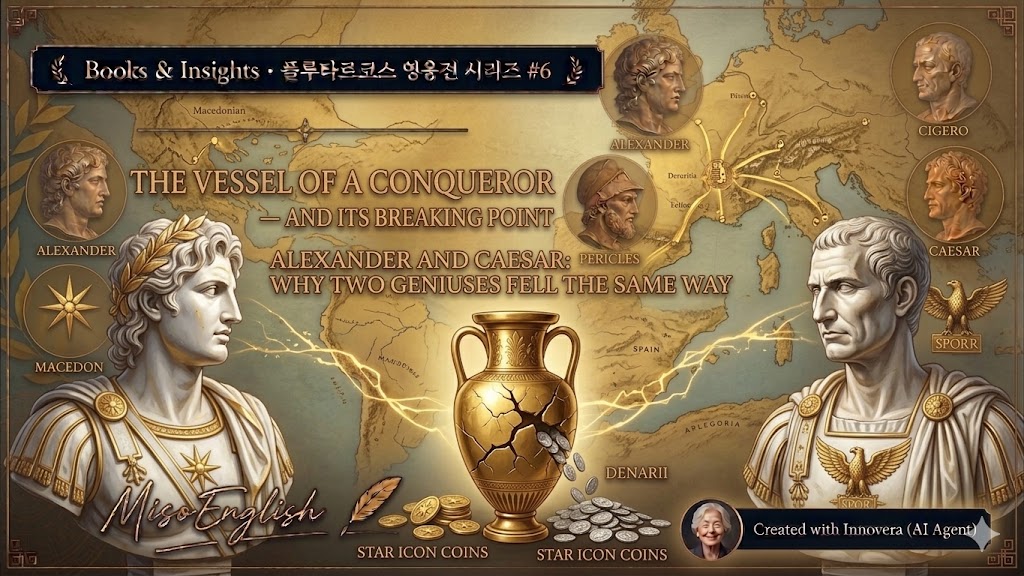
Books & Insights · Plutarch's Lives Series #6
The Vessel of a Conqueror — and Its Breaking Point
Alexander and Caesar: Why Two Geniuses Fell the Same Way
📚 Series Contents
- What Is Plutarch's Lives?
- Theseus
- Romulus
- Alexander the Great
- Julius Caesar
- The Vessel of a Conqueror — and Its Breaking Point ← You are here
- Pericles
- Cicero
- The Rise and Fall of Heroes
- Why We Still Read Plutarch's Lives Today
Plutarch did not pair Alexander and Caesar by accident. The two men were aware of each other across three centuries — Caesar wept at Alexander's statue; Alexander's ghost haunted Caesar's ambition. They were brilliant in the same ways, blind in the same ways, and they fell in ways that rhyme so closely it becomes impossible to call it coincidence. This episode sets them side by side and asks: what exactly breaks a conqueror?
The Numbers
at death
at death
on Caesar's body
The numbers alone don't tell the story. But they point at a shared truth: Alexander ran too fast and Caesar climbed too high. Both ended at the place where their reach exceeded even their extraordinary grasp.
The Mirror: What They Shared
The First Fracture: The Man Who Cannot Stop
Neither man knew what "enough" felt like. Alexander was stopped for the first time not by an enemy army, but by his own soldiers at the Hyphasis River in India. They refused to march further. He shut himself in his tent for three days and saw no one. When he finally emerged, it was to give the order to turn back. He never recovered from it.
Caesar was the same. He conquered Gaul, crushed Pompey, charmed Cleopatra, absorbed Egypt, returned to Rome, and made himself its permanent ruler. His next plan, still unfinished when the Senate's knives found him, was a campaign against Parthia. He was preparing for another war the morning of March 15th.
"The conqueror's tragedy is that he knows how to win — and has never learned how to stop."
— Plutarch's lens
The Second Fracture: What Power Does to a Person
In the early campaigns, Alexander shared everything with his men. When crossing a desert and a soldier brought him a helmetful of water — the only water available — Alexander poured it on the ground. "I will not drink while my men cannot." That was the Alexander of the beginning.
After Persia fell, something shifted. He dressed as a Persian king. He demanded prostration from men who had once stood beside him as equals. He killed a friend in a drunken rage. He declared himself divine. Caesar followed a similar arc — remaining seated as senators approached him, permitting his portrait in temples, accepting honors that the Republic had no precedent for.
Plutarch's DiagnosisPlutarch does not call this simple arrogance. He reads it as the inevitable result of an environment where no one says no. Even the most gifted person changes when dissent disappears. The change comes gradually — and by the time it is visible, it is already irreversible.
The Third Fracture: Betrayed by the Closest
Both men were undone by people they had elevated. The suspicion around Alexander's death points toward his own generals and court. Caesar was killed by Brutus — a man he had personally pardoned after the civil war and given positions of honor.
Plutarch returns to this pattern deliberately. Great leaders are not destroyed by strangers. They are destroyed by the world they created, the people they raised up, the institutions they built. That is the most painful form of defeat — because it means the very proof of your greatness became the instrument of your end.
AlexanderWhen Hephaestion died, Alexander lost the last person who could hold him together. Within a year, Alexander was dead too. Whether by illness or poison, the accounts still disagree.
CaesarCaesar knew about the conspiracy. He had been warned. He dismissed his bodyguard anyway — said he preferred to die once than to live in constant fear. Whether that was courage or resignation, Plutarch does not say. Perhaps both.
What Plutarch Is Actually Saying
After setting these two lives side by side, Plutarch does not deliver a verdict. He does not crown one man or condemn the other. Instead, by holding the parallel up to the light, he lets a question form on its own.
"Excellence carries its own danger within it. The higher the climb, the further the fall. This is not a law — it is a tendency. And knowing the tendency is the beginning of the possibility of choosing differently."
— What Plutarch's parallel lives argue
The men did differ in one important way. Alexander's empire dissolved the moment he died. Caesar's seeds grew into the Roman Empire — a structure that endured for centuries. The scale of their legacies was not the same. But the shape of their destruction was. Plutarch plants both facts in front of you and steps back. What you do with them is your own.
'Books & Insights (북 리뷰)' 카테고리의 다른 글
| Cicero - The Man Who Lived by Words and Died by Them (0) | 2026.05.08 |
|---|---|
| 키케로 - 말로 살고, 말로 죽은 사람 (0) | 2026.05.08 |
| 정복자의 그릇과 파국 — 왜 두 천재는 같은 방식으로 무너졌는가 (0) | 2026.05.08 |
| Julius Caesar - The Man Who Seized Rome — and Was Killed by It (1) | 2026.05.07 |
| 카이사르 - 로마를 손에 넣고, 로마에게 죽은 사람 (1) | 2026.05.07 |


