
- 분류 전체보기 (1053)

- Linguistics (고급 영어학) (10)
- Stylistics (6)
- Etymology & Word Building (15)
- Philosophy Meets Grammar (6)
- Collection of Famous Quotes (22)
- English Mechanism (276)
- The Language Beyond Grammar (274)
- Living English (81)
- Miso’s Life Notes (18)
- My English Journey and Refl.. (16)
- Philosophy (132)
- Video Clip (16)
- Airline English (항공 영어) (47)
- Creative Corner (35)
- Sally & Sia (1)
| 일 | 월 | 화 | 수 | 목 | 금 | 토 |
|---|---|---|---|---|---|---|
| 1 | 2 | 3 | 4 | |||
| 5 | 6 | 7 | 8 | 9 | 10 | 11 |
| 12 | 13 | 14 | 15 | 16 | 17 | 18 |
| 19 | 20 | 21 | 22 | 23 | 24 | 25 |
| 26 | 27 | 28 | 29 | 30 |
- everyday English
- MisoEnglish#철학입문 #Philosophy #심리철학 #PhilosophyOfMind #철학공부 #의식 #마음 #PhilosophyForBeginners #교육콘텐츠 #철학시리즈
- 동양정치철학 #시리즈완결 #아시아적가치 #동서양비교 #유교 #민주주의 #정치사상 #인문학 #비교철학 #글로벌정치 #문화다양성 #2500년철학사
- AirlineOpsEnglish
- English Speaking Practice
- MisoEnglish#철학입문 #Philosophy #정치철학 #PoliticalPhilosophy #철학공부 #정의론 #자유주의 #PhilosophyForBeginners #교육콘텐츠 #철학시리즈
- 영어공부
- 🌿 English with Heart
- 인도철학 #동양철학 #인문학 #요가 #명상 #힌두교 #불교 #간디 #타고르 #정통6파 #철학공부 #마음공부 #MisoEnglish #인문학영어
- 영어접속사
- pnr
- MisoEnglish#철학입문 #Philosophy #종교철학 #PhilosophyOfReligion #철학공부 #신존재증명 #악의문제 #PhilosophyForBeginners #교육콘텐츠 #철학시리즈
- MisoEnglish#철학입문 #Philosophy #윤리학 #Ethics #도덕철학 #철학공부 #칸트 #공리주의 #교육콘텐츠 #철학시리즈
- 영어문법
- MisoEnglish#철학입문 #Philosophy #과학철학 #PhilosophyOfScience #철학공부 #포퓨퍼 #쿠hn #과학방법론 #교육콘텐츠 #철학시리즈
- MisoEnglish#유교철학 #Confucianism #성리학 #NeoConfucianism #인의예지 #Virtue #맹자 #Mencius #실학 #KoreanScholarship
- Basic English Verbs
- English in English
- EnglishWriting #AcademicWriting #Grammar #EnglishLanguage #EssayWriting #ParagraphStructure #SentenceStructure #BusinessEnglish #EnglishTips #WritingSkills #Linguistics #ESL
- English for Korean Learners
- MisoEnglish#도교철학 #Taoism #도덕경 #TaoTeChing #무위자연 #WuWei #노자 #Laozi #장자 #YinYang
- 감성영어
- MisoEnglish#불교철학 #BuddhismPhilosophy #사성제 #FourNobleTruths #공사상 #Emptiness #명상 #Mindfulness #열반 #EasternWisdom
- MisoEnglish#철학입문 #Philosophy #형이상학 #Metaphysics #철학공부 #존재론 #실재론 #PhilosophyForBeginners #교육콘텐츠 #철학시리즈
- 영국사 #영국역사 #세계사 #역사연재 #브리튼에서영국까지
- misoenglish
- MisoEnglish#한국철학 #KoreanPhilosophy #홍익인간 #Hongik #화랑도 #Hwarang #단군 #Dangun #풍류도 #ThreeKingdoms#동양철학
- 영어회화
- 영문법
- ticketing
- Today
- Total
MisoEnglish
윤리학 입문 (8) - 피터 싱어: 실천 윤리학, 동물 해방, 그리고 효과적 이타주의 본문
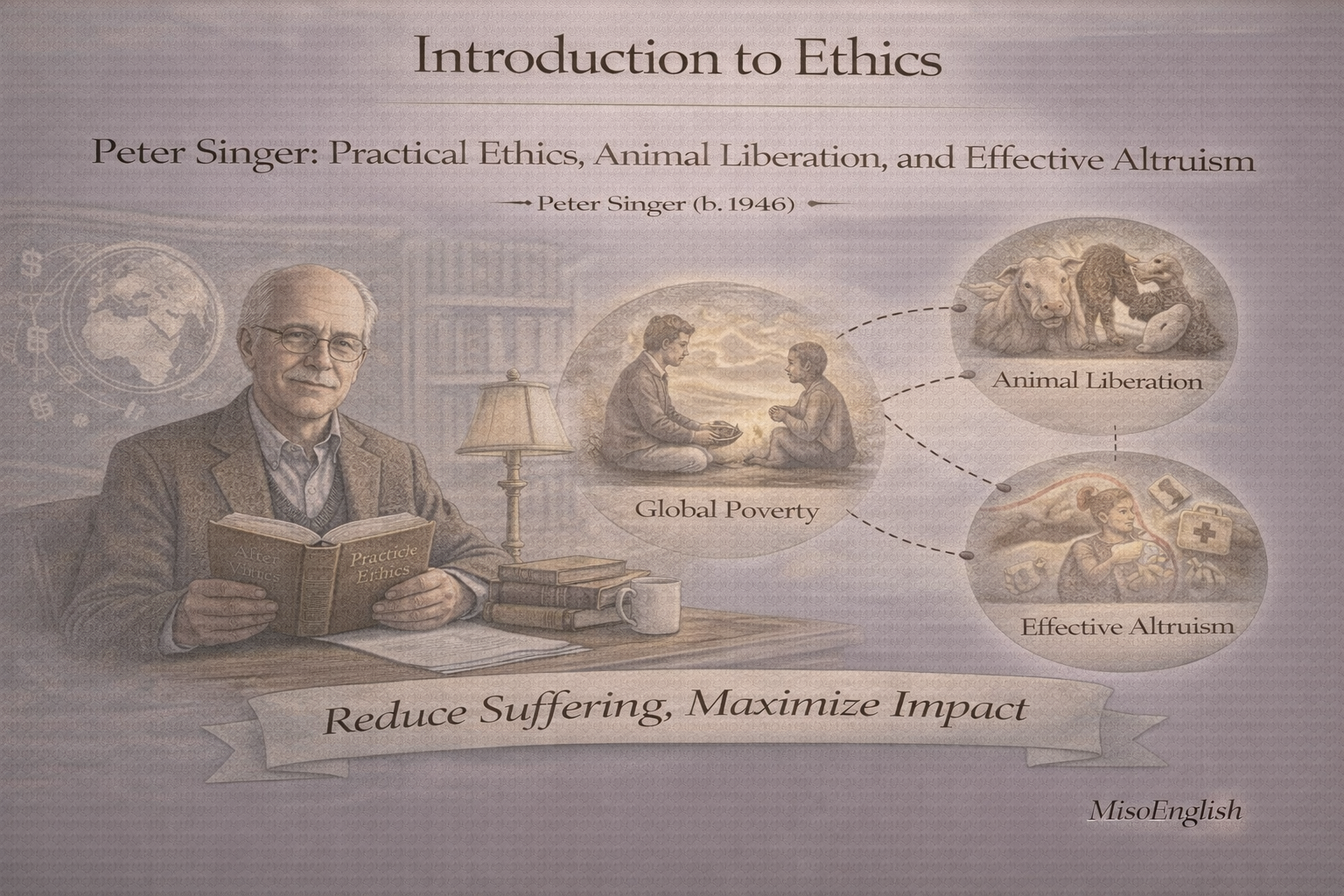
Introduction to Ethics (8)
- Peter Singer: Practical Ethics, Animal Liberation, and Effective Altruism
Welcome to our final post in the ethics series! After exploring foundational theories from Aristotle to MacIntyre, we now turn to a philosopher who applies ethics to concrete, real-world problems with radical conclusions: Peter Singer (b. 1946). As perhaps the most influential living practical philosopher, Singer has transformed how we think about animal rights, global poverty, and our moral obligations—all grounded in a straightforward utilitarian approach.
The Practical Philosopher
Peter Singer is an Australian moral philosopher who pioneered the field of practical ethics—applying philosophical reasoning to actual moral problems rather than abstract theory.
Singer's approach:
- Utilitarian - classical preference utilitarianism
- Consequentialist - focus on outcomes, especially suffering
- Practical - addresses real issues: animals, poverty, environment, euthanasia
- Radical - reaches controversial conclusions
- Influential - sparked social movements (animal rights, effective altruism)
- Public philosopher - writes for general audiences, engages in activism
His central commitment: If we take ethics seriously, it demands dramatic changes in how we live.
Major works:
- Animal Liberation (1975) - founded modern animal rights movement
- Practical Ethics (1979) - systematic application of utilitarianism
- The Life You Can Save (2009) - on global poverty and our obligations
- The Most Good You Can Do (2015) - on effective altruism
Singer's Utilitarianism
Preference Utilitarianism
Singer's version of utilitarianism:
Classical utilitarianism (Bentham, Mill): Maximize pleasure/happiness, minimize pain
Singer's preference utilitarianism: Maximize satisfaction of preferences, minimize frustration of preferences
Why preferences?
1. More objective: Preferences can be identified without making judgments about what should make people happy.
2. Respects autonomy: What matters is what beings actually want, not what we think they should want.
3. Works for non-humans: Animals have preferences (avoid pain, seek food) even if not "happiness" in human sense.
Equal Consideration of Interests
Singer's fundamental principle:
"The interests of every being affected by an action are to be taken into account and given the same weight as the like interests of any other being."
What this means:
Equal consideration ≠ Equal treatment
We should give equal weight to equal interests, but:
- Different beings have different interests
- A dog's interest in not suffering = a human's interest in not suffering (equal weight)
- But humans have interests dogs don't have (reading, voting, career)
The key: Don't discount interests based on species, race, sex, etc.
The Expanding Circle
Singer's historical/evolutionary view:
Humans naturally care about:
- Themselves
- Family
- Tribe/community
- Nation
But reason requires expanding the circle:
- Race (abolition of slavery)
- Sex (women's rights)
- Sexual orientation (LGBTQ+ rights)
- Species (animal rights) ← Singer's focus
- Future generations (environmental ethics)
- All sentient beings
The expanding circle = moral progress
Why stop at species? If beings can suffer, their suffering matters.
Animal Liberation
The Argument Against Speciesism
Singer's most famous contribution:
Speciesism = Discrimination based on species membership
The analogy:
- Racism = unjustified discrimination based on race
- Sexism = unjustified discrimination based on sex
- Speciesism = unjustified discrimination based on species
Singer's argument:
1. If a being can suffer, it has interests
- Interest in avoiding suffering
- This matters morally
2. No morally relevant difference between human and animal suffering
- Pain is pain, regardless of species
- Equal suffering = equal moral weight
3. We systematically discount animal interests
- Factory farming
- Animal experimentation
- Entertainment
4. This is speciesism—unjustified, like racism or sexism
Therefore: We must give equal consideration to animal interests.
What About Plants?
Objection: "But plants are alive too!"
Singer's response:
The capacity to suffer is the key.
Plants:
- No nervous system
- No brain
- No capacity for pain/suffering
- No preferences
Animals (at least vertebrates and many invertebrates):
- Nervous systems
- Can feel pain
- Have preferences (avoid suffering, seek pleasure)
- Their interests matter
The line: Sentience (capacity to feel/suffer), not life itself.
Implications for How We Treat Animals
If we take equal consideration seriously:
1. Factory farming is morally wrong
Current practices:
- Chickens in tiny cages
- Pigs in gestation crates
- Calves separated from mothers
- Massive suffering
Singer's view:
- Produces enormous suffering
- For trivial human interests (taste preference)
- Unjustifiable
Conclusion: We should stop eating factory-farmed meat (at minimum).
2. Much animal experimentation is wrong
Singer doesn't oppose all animal research, but:
- Most causes significant suffering
- Much is for trivial purposes (cosmetics, minor medicines)
- If we wouldn't experiment on humans with similar mental capacities (infants, severely disabled), we shouldn't on animals
The key question: Would you do this experiment on a human with similar mental capacities?
If no → then don't do it on animals (that's speciesism)
3. Using animals for entertainment is often wrong
- Circuses
- Zoos (unless primarily for conservation)
- Bullfighting
- Hunting for sport
Singer's principle: Don't cause suffering for trivial reasons.
What About Marginal Cases?
The argument from marginal cases:
Problem for those who deny animal rights:
Some humans have mental capacities below some animals:
- Severely intellectually disabled humans
- Infants
- Those in persistent vegetative states
If we say: "Humans have rights because of rationality/autonomy/language"
Then: These "marginal" humans don't have rights either.
But we think they DO have rights.
Therefore: Either:
- Rights aren't based on these capacities alone, OR
- Animals with similar/higher capacities also have rights
Singer argues: This shows speciesism. We're giving humans special treatment just because they're human, not based on morally relevant capacities.
Impact of Animal Liberation
Singer's work sparked:
- Modern animal rights movement
- Growth of veganism/vegetarianism
- Animal welfare legislation
- Changes in research practices
- Reduction in animal testing
- Public awareness of factory farming
Concrete changes:
- European bans on battery cages
- Reduced animal testing for cosmetics
- Growth of plant-based food industry
- Corporate animal welfare policies
Global Poverty and Our Obligations
The Drowning Child Argument
Singer's most powerful thought experiment:
The scenario:
You're walking past a shallow pond. You see a child drowning.
You could easily save the child, but:
- Your expensive shoes will be ruined ($200)
- You'll be late for work
Question: Are you obligated to save the child?
Answer: Obviously yes! Trivial cost vs. child's life.
Singer's point:
There are children dying right now from preventable causes:
- Malaria
- Diarrheal diseases
- Malnutrition
You could save them:
- Donate to effective charities
- Cost: ~$3,000-5,000 per life saved (Against Malaria Foundation, etc.)
If you're obligated to save the drowning child, you're obligated to donate.
There's no morally relevant difference between:
- Child drowning in front of you
- Child dying of malaria in another country
Distance doesn't matter morally.
The Argument Formalized
Singer's argument:
P1: Suffering and death from lack of food, shelter, medical care are bad
P2: If it's in your power to prevent something bad from happening, without sacrificing anything nearly as important, you ought to do it
P3: By donating to effective charities, you can prevent suffering and death, without sacrificing anything nearly as important
Conclusion: You ought to donate
How Much Should We Give?
The radical conclusion:
We should give until: The marginal utility of giving more equals the marginal utility of keeping it.
In practice: Give until you'd cause comparable suffering to yourself or your dependents.
For most wealthy-country citizens:
- Give away most of your income
- Keep only what you need for basic wellbeing
- Live modestly
Example: If you earn $100,000/year:
- Keep $30,000 (enough to live)
- Donate $70,000
Singer himself:
- Donates ~1/3 of his income
- Acknowledges he doesn't meet his own standard
- But argues the standard is correct even if hard to meet
Objections and Responses
Objection 1: Demandingness
"This is too demanding! We can't be expected to sacrifice so much."
Singer's response:
- The conclusion follows from premises we accept
- Demandingness doesn't make it wrong
- We've just become accustomed to selfishness
- Compare to historical moral progress (abolition was "demanding")
Objection 2: Charity begins at home
"We should help our own community first."
Singer's response:
- This is like nationalism or racism
- Suffering matters equally regardless of location
- We can help more people more effectively internationally
- Giving $100 locally might buy a toy; internationally might save a life
Objection 3: It's governments' responsibility
"Governments should solve global poverty, not individuals."
Singer's response:
- Governments should, but they don't
- While we wait, people are dying
- Individual action doesn't preclude political action
- We should do both
Objection 4: What about systemic change?
"Charity doesn't address root causes; we need systemic change."
Singer's response:
- We need both immediate relief AND systemic change
- Children dying now can't wait for systemic change
- Many effective interventions are systemic (health system strengthening, policy change)
Objection 5: Cultural differences
"Different cultures have different values; who are we to impose?"
Singer's response:
- Suffering is bad in all cultures
- Preventing death isn't "imposing values"
- Cultural relativism can't justify letting children die
Effective Altruism
The Movement Singer Inspired
Effective Altruism (EA): Use evidence and reason to figure out how to benefit others the most, and take action.
Key ideas:
1. Cause-neutrality: Focus on where you can do the most good, not just causes you're emotionally drawn to.
2. Evidence-based: Use data to determine what actually works.
3. Effectiveness: Some charities are 100x more effective than others—choose carefully.
4. Scale, tractability, neglectedness:
- How big is the problem?
- How solvable is it?
- How much is already being done?
5. Long-term thinking: Consider future generations, existential risks.
Comparing Causes
EA asks: How much good does a dollar do?
Examples:
Guide dogs for the blind (developed countries):
- Cost: ~$40,000 per dog
- Benefit: Significant quality-of-life improvement for one person
Preventing blindness from trachoma (developing countries):
- Cost: ~$100 for surgery
- Benefit: Sight restored
Preventing death from malaria:
- Cost: ~$3,000-5,000 per life saved (bed nets, treatment)
Singer's point: Some interventions are far more effective than others.
Top Charities and Cause Areas
GiveWell's top charities (as of recent years):
- Against Malaria Foundation
- GiveDirectly (cash transfers)
- Malaria Consortium
- Helen Keller International (vitamin A)
Cause areas EA focuses on:
- Global health and development (proven, cost-effective)
- Animal welfare (huge scale of suffering, tractable, neglected)
- Long-term future (existential risks, AI safety)
- Meta causes (improving EA itself, research)
Earning to Give
A controversial EA idea:
Traditional: Do good directly (become a doctor, work at charity)
Earning to give:
- Take high-paying job (finance, tech)
- Donate large portion to effective charities
- Might do more good than direct work
Example:
- Doctor in developing country: Help ~100 people/year
- Investment banker donating 50% of salary: Fund treatment for ~1,000 people/year
Controversial because:
- Seems counterintuitive
- Potential for rationalization
- Ethical concerns about some high-paying jobs
But: Can be extremely effective for some people.
Long-Termism
Recent EA focus:
The far future matters.
Why:
- Far more people will exist in the future than exist now
- Their interests count equally
- Small changes now can have huge long-term effects
Priorities:
- Preventing existential risks (nuclear war, climate catastrophe, AI alignment)
- Ensuring good long-term trajectory for humanity
- Space colonization
Singer on long-termism: Sympathetic but focuses more on near-term suffering.
Other Controversial Views
Euthanasia and End-of-Life Ethics
Singer supports:
- Voluntary euthanasia (at patient's request)
- Non-voluntary euthanasia in some cases (when patient can't consent, severely suffering, no prospect of improvement)
His reasoning:
- Life isn't valuable in itself—only valuable if worth living
- If life is net-negative (more suffering than happiness), death may be better
- Autonomy: people should control their own deaths
- Infanticide in severe cases may be permissible (controversial!)
Why infanticide claim is controversial:
Singer argues:
- A newborn isn't a "person" in the morally relevant sense (no self-awareness, no preferences about future)
- If severe disability means life will be net-negative suffering
- May be permissible to let die or actively end life
This has led to:
- Protests against Singer
- Accusations of "ableism"
- Bans from speaking at some venues
Singer's defense:
- Talking about extreme cases (anencephalic infants, etc.)
- Parents should decide
- Not advocating killing disabled people generally
- But the argument remains extremely controversial
Population Ethics
Repugnant Conclusion:
The problem:
Compare two populations:
- Population A: 10 billion people, very high quality of life
- Population Z: 10 trillion people, barely worth living (but positive)
Total utilitarianism says: Z is better (more total happiness).
But this seems repugnant!
Singer:
- Acknowledges the problem
- Has explored average utilitarianism
- No fully satisfactory solution
- But leans toward: we should care about future people
Abortion
Singer's view:
Fetuses aren't "persons" in morally relevant sense:
- No self-awareness
- No sense of future
- No preferences about continuing to exist
Therefore:
- Early abortion permissible
- Less wrong than killing non-human animals with higher mental capacities
- Woman's interests outweigh fetus's interests
But: As pregnancy progresses, fetus develops interests—becomes more problematic.
This follows from his principle: What matters morally is capacity to suffer and have preferences, not species or "potential."
Criticisms of Singer
1. Too Demanding
The objection:
Singer's ethics requires:
- Giving away most income
- Becoming vegetarian/vegan
- Constant moral calculation
- Sacrificing personal projects
This is psychologically unrealistic and unfairly demanding.
Response:
- Demandingness doesn't make it false
- Many ethical requirements are demanding (abolition was demanding)
- We can do better than we do, even if not perfect
2. Ignores Special Obligations
The objection:
Singer treats all interests equally, but:
- We have special obligations to family, friends, community
- It's not wrong to give your child birthday presents instead of donating
Response:
- Singer acknowledges practical limitations
- But theoretically, equal suffering matters equally
- Special obligations may be justified instrumentally (makes us happier, more effective)
3. Problematic View of Disability
The objection:
Singer's views on euthanasia/infanticide:
- Devalue lives of disabled people
- Assume disabled lives aren't worth living
- "Ableist"
Response:
- Singer distinguishes suffering from disability
- Acknowledges many disabled people live flourishing lives
- But some conditions involve only suffering
- Parents should decide in extreme cases
Counter: Still deeply problematic to many.
4. Utilitarian Problems Generally
All objections to utilitarianism apply:
- Might justify killing one to save five
- Doesn't respect rights absolutely
- Ignores justice/fairness in distribution
- Reduces everything to calculation
5. Empirical Questions
Many of Singer's claims depend on empirical facts:
- Which charities are most effective?
- Do animals suffer like humans?
- Would donating more actually help?
If facts change, conclusions change.
6. Public Relations Problem
Singer's controversial views:
- Infanticide
- Euthanasia
- Bestiality (has defended in some cases)
These overshadow his positive contributions and alienate potential allies.
Singer's Influence
Animal Rights Movement
Singer's work led to:
- Modern animal rights activism
- Growth of vegetarianism/veganism (millions converted)
- Legal changes protecting animals
- Changes in research and farming practices
- Plant-based food innovation
Effective Altruism
Singer inspired a movement:
- GiveWell (charity evaluator)
- 80,000 Hours (career advice for doing good)
- Open Philanthropy
- Giving What We Can (giving pledges)
- Billions donated more effectively
Public Philosophy
Singer demonstrated:
- Philosophy can address real issues
- Academic ideas can change the world
- Philosophers should engage public
Practical Ethics as Field
Singer pioneered applying philosophy to:
- Bioethics
- Environmental ethics
- Development ethics
- Global justice
Comparison with Other Theories
Singer vs. Kant
Fundamental differences:
Kant:
- Rights-based
- Humans have dignity
- Categorical rules
- Animals not moral patients
Singer:
- Consequences-based
- No inherent dignity—interests matter
- Flexible—depends on outcomes
- Animals are moral patients
Singer vs. Virtue Ethics (MacIntyre)
MacIntyre:
- Focus on character, practices, traditions
- Embedded in communities
- No universal principles
Singer:
- Focus on outcomes
- Universal principles (equal consideration)
- Reason-based, not tradition-based
Singer vs. Rawls
Rawls:
- Contractarian
- Focus on domestic justice
- Difference principle
Singer:
- Utilitarian
- Focus on global suffering
- Simple equal consideration
Singer's Consistency
Singer is remarkably consistent:
- Applies same principle (equal consideration) across all issues
- Follows logic wherever it leads
- Willing to accept controversial conclusions
This is both:
- Strength: Intellectually honest, systematic
- Weakness: Reaches deeply counterintuitive conclusions
Conclusion
Peter Singer revolutionized practical ethics with his unflinching application of utilitarian principles:
Key insights:
1. Equal consideration of interests Give equal weight to equal interests, regardless of species, nationality, etc.
2. Speciesism is unjustified Like racism and sexism, discriminating based on species alone is wrong.
3. We have strong obligations to distant strangers Geography doesn't matter morally—should donate substantially to help others.
4. Effectiveness matters Some ways of helping are far more effective than others—use evidence.
5. Consistency required If we accept basic moral principles, they have radical implications.
6. Philosophy should be practical Ethics isn't just abstract theory—it should change how we live.
His enduring questions:
"Why does distance matter morally?" "Are we really doing enough?" "Can we justify eating animals?" "What do we owe those suffering far away?"
Strengths:
- Applies ethics to urgent real-world problems
- Consistent and systematic
- Inspired massive positive impact (EA, animal rights)
- Intellectually honest—follows logic to conclusions
- Accessible to general public
Weaknesses:
- Very demanding
- Controversial conclusions (infanticide, etc.)
- All problems of utilitarianism
- May not adequately account for special obligations
- Some empirical claims disputed
Legacy:
Singer has done more than perhaps any living philosopher to:
- Reduce animal suffering (millions became vegetarian/vegan)
- Increase effective giving (billions redirected to effective charities)
- Make philosophy relevant to ordinary people
- Demonstrate ethics has real-world implications
Whether you agree or disagree with Singer, his work forces us to confront uncomfortable questions about how we live and what we owe to others.
References
- Peter Singer, Animal Liberation (1975, updated 2015)
- Peter Singer, Practical Ethics (3rd ed., 2011)
- Peter Singer, The Life You Can Save (2009)
- Peter Singer, The Most Good You Can Do (2015)
- William MacAskill, Doing Good Better (2015)
Conclusion to Ethics Series
This concludes our journey through ethical theories! We've explored:
- Aristotle's virtue ethics
- Kant's deontology
- Mill's utilitarianism
- Hume's sentimentalism
- Rawls' justice as fairness
- Nozick's libertarianism
- MacIntyre's communitarianism
- Singer's practical ethics
Each offers valuable insights. The diversity of approaches shows ethics' richness and complexity. May these frameworks help you think more carefully about how to live and what we owe to each other.
Are you doing enough to help others? Should you stop eating animals? How effective is your giving? Share your thoughts on Singer's practical ethics and the implications for how we should live!
윤리학 입문 (8) - 피터 싱어: 실천 윤리학, 동물 해방, 그리고 효과적 이타주의
윤리학 시리즈의 마지막 포스팅에 오신 걸 환영합니다! 아리스토텔레스에서 매킨타이어까지 기초 이론들을 탐구한 후, 이제 윤리학을 구체적이고 실제적인 문제들에 적용하여 급진적 결론에 도달하는 철학자로 돌아갑니다: 피터 싱어 (1946년생). 아마도 현존하는 가장 영향력 있는 실천 철학자로서, 싱어는 동물권, 지구적 빈곤, 그리고 우리의 도덕적 의무에 대한 우리의 생각을 변화시켰습니다—모두 직설적인 공리주의 접근에 근거하여.
실천 철학자
피터 싱어는 추상적 이론보다는 실제 도덕 문제들에 철학적 추론을 적용하는 실천 윤리학 분야를 개척한 호주 도덕철학자입니다.
싱어의 접근:
- 공리주의적 - 고전적 선호 공리주의
- 결과주의적 - 결과에 집중, 특히 고통
- 실천적 - 실제 문제들 다룸: 동물, 빈곤, 환경, 안락사
- 급진적 - 논쟁적 결론에 도달
- 영향력 - 사회 운동 촉발 (동물권, 효과적 이타주의)
- 공공 철학자 - 일반 청중을 위해 글 쓰고, 행동주의 참여
그의 중심 헌신: 윤리학을 진지하게 받아들인다면, 그것은 우리가 사는 방식에서 극적인 변화를 요구합니다.
주요 저작들:
- 『동물 해방』 (1975) - 현대 동물권 운동 창시
- 『실천 윤리학』 (1979) - 공리주의의 체계적 적용
- 『당신이 구할 수 있는 생명』 (2009) - 지구적 빈곤과 우리의 의무에 관해
- 『당신이 할 수 있는 가장 선한 일』 (2015) - 효과적 이타주의에 관해
싱어의 공리주의
선호 공리주의
싱어의 공리주의 버전:
고전적 공리주의 (벤담, 밀): 쾌락/행복 최대화, 고통 최소화
싱어의 선호 공리주의: 선호의 충족 최대화, 선호의 좌절 최소화
왜 선호인가?
1. 더 객관적: 선호는 무엇이 사람들을 행복하게 만들어야 하는지에 대한 판단 없이 확인될 수 있습니다.
2. 자율성 존중: 중요한 것은 존재들이 실제로 원하는 것이지, 우리가 그들이 원해야 한다고 생각하는 것이 아닙니다.
3. 비인간에게도 작동: 동물들은 인간적 의미의 "행복"이 아니더라도 선호를 갖습니다 (고통 피하기, 음식 찾기).
이익의 동등한 고려
싱어의 근본 원리:
"행동에 의해 영향받는 모든 존재의 이익은 고려되어야 하고 다른 존재의 동일한 이익과 같은 무게를 부여받아야 한다."
이것이 의미하는 것:
동등한 고려 ≠ 동등한 대우
우리는 동등한 이익에 동등한 무게를 부여해야 하지만:
- 다른 존재들은 다른 이익을 갖는다
- 개의 고통 받지 않을 이익 = 인간의 고통 받지 않을 이익 (동등한 무게)
- 하지만 인간은 개가 갖지 않는 이익을 갖는다 (읽기, 투표, 경력)
핵심: 종, 인종, 성별 등에 기반하여 이익을 할인하지 마라.
확장하는 원
싱어의 역사적/진화적 견해:
인간은 자연스럽게 다음을 돌본다:
- 자기 자신
- 가족
- 부족/공동체
- 국가
하지만 이성은 원을 확장하는 것을 요구한다:
- 인종 (노예제 폐지)
- 성별 (여성 권리)
- 성적 지향 (LGBTQ+ 권리)
- 종 (동물권) ← 싱어의 초점
- 미래 세대 (환경 윤리학)
- 모든 감각 있는 존재
확장하는 원 = 도덕적 진보
종에서 멈춰야 하는 이유는? 존재들이 고통받을 수 있다면, 그들의 고통이 중요합니다.
동물 해방
종차별주의에 반대하는 논증
싱어의 가장 유명한 기여:
종차별주의 = 종 소속에 기반한 차별
비유:
- 인종차별주의 = 인종에 기반한 부당한 차별
- 성차별주의 = 성별에 기반한 부당한 차별
- 종차별주의 = 종에 기반한 부당한 차별
싱어의 논증:
1. 존재가 고통받을 수 있다면, 이익을 갖는다
- 고통을 피할 이익
- 이것은 도덕적으로 중요하다
2. 인간과 동물 고통 사이에 도덕적으로 관련된 차이가 없다
- 고통은 종과 무관하게 고통이다
- 동등한 고통 = 동등한 도덕적 무게
3. 우리는 체계적으로 동물 이익을 할인한다
- 공장식 축산
- 동물 실험
- 오락
4. 이것은 종차별주의다—인종차별주의나 성차별주의처럼 부당하다
따라서: 우리는 동물 이익에 동등한 고려를 제공해야 합니다.
식물은 어떻게 하는가?
반론: "하지만 식물도 살아있다!"
싱어의 응답:
고통받을 능력이 핵심입니다.
식물:
- 신경계 없음
- 뇌 없음
- 고통/고통받을 능력 없음
- 선호 없음
동물 (적어도 척추동물과 많은 무척추동물):
- 신경계
- 고통을 느낄 수 있음
- 선호를 갖는다 (고통 피하기, 쾌락 찾기)
- 그들의 이익이 중요하다
선: 감각 (느끼기/고통받을 능력), 생명 자체가 아니다.
동물을 대하는 방식에 대한 함의
동등한 고려를 진지하게 받아들인다면:
1. 공장식 축산은 도덕적으로 잘못되었다
현재 관행들:
- 작은 우리에 닭들
- 임신 우리에 돼지들
- 어미로부터 분리된 송아지들
- 대규모 고통
싱어의 견해:
- 엄청난 고통을 낳는다
- 사소한 인간 이익을 위해 (미각 선호)
- 정당화할 수 없다
결론: 우리는 공장식 축산 고기 먹는 것을 중단해야 합니다 (최소한).
2. 많은 동물 실험이 잘못되었다
싱어는 모든 동물 연구를 반대하지 않지만:
- 대부분이 상당한 고통을 야기한다
- 많은 것이 사소한 목적을 위해 (화장품, 부차적 약)
- 유사한 정신 능력을 가진 인간에게 하지 않을 실험 (유아, 중증 장애인)이라면, 동물에게도 하지 말아야 한다
핵심 질문: 유사한 정신 능력을 가진 인간에게 이 실험을 하겠는가?
아니오라면 → 동물에게도 하지 마라 (그것이 종차별주의)
3. 오락을 위해 동물을 사용하는 것은 종종 잘못되었다
- 서커스
- 동물원 (주로 보존을 위한 경우가 아니라면)
- 투우
- 스포츠 사냥
싱어의 원리: 사소한 이유로 고통을 야기하지 마라.
한계 사례는 어떻게 하는가?
한계 사례로부터의 논증:
동물권을 부정하는 사람들의 문제:
일부 인간은 일부 동물보다 낮은 정신 능력을 갖습니다:
- 중증 지적 장애인
- 유아
- 지속적 식물 상태인 사람들
만약 우리가 말한다면: "인간은 합리성/자율성/언어 때문에 권리를 갖는다"
그렇다면: 이 "한계" 인간들도 권리를 갖지 않습니다.
하지만 우리는 그들이 권리를 갖는다고 생각합니다.
따라서: 다음 중 하나:
- 권리는 이 능력들만에 기반하지 않는다, 또는
- 유사하거나/더 높은 능력을 가진 동물들도 권리를 갖는다
싱어는 주장합니다: 이것은 종차별주의를 보여줍니다. 우리는 도덕적으로 관련된 능력에 기반하지 않고, 단지 인간이기 때문에 인간들에게 특별 대우를 하고 있습니다.
동물 해방의 영향
싱어의 작업이 촉발했습니다:
- 현대 동물권 운동
- 비건/채식주의의 성장
- 동물 복지 입법
- 연구 관행의 변화
- 동물 실험 감소
- 공장식 축산에 대한 대중 인식
구체적 변화들:
- 배터리 케이지에 대한 유럽 금지
- 화장품 동물 실험 감소
- 식물 기반 식품 산업 성장
- 기업 동물 복지 정책
지구적 빈곤과 우리의 의무
익사하는 아이 논증
싱어의 가장 강력한 사고실험:
시나리오:
당신은 얕은 연못을 지나가고 있습니다. 아이가 익사하는 것을 봅니다.
당신은 쉽게 아이를 구할 수 있지만:
- 비싼 신발이 망가질 것입니다 ($200)
- 직장에 늦을 것입니다
질문: 아이를 구할 의무가 있습니까?
답: 분명히 예! 사소한 비용 대 아이의 생명.
싱어의 요점:
지금 예방 가능한 원인으로 죽어가는 아이들이 있습니다:
- 말라리아
- 설사병
- 영양실조
당신이 그들을 구할 수 있습니다:
- 효과적인 자선단체에 기부
- 비용: 구한 생명당 ~$3,000-5,000 (Against Malaria Foundation 등)
익사하는 아이를 구할 의무가 있다면, 기부할 의무가 있습니다.
다음 사이에 도덕적으로 관련된 차이가 없습니다:
- 앞에서 익사하는 아이
- 다른 나라에서 말라리아로 죽어가는 아이
거리는 도덕적으로 중요하지 않습니다.
공식화된 논증
싱어의 논증:
P1: 음식, 주거, 의료 부족으로 인한 고통과 죽음은 나쁘다
P2: 거의 중요하지 않은 것을 희생하지 않고 나쁜 일이 일어나는 것을 막을 수 있다면, 그렇게 해야 한다
P3: 효과적인 자선단체에 기부함으로써, 거의 중요하지 않은 것을 희생하지 않고 고통과 죽음을 막을 수 있다
결론: 당신은 기부해야 한다
우리는 얼마나 주어야 하는가?
급진적 결론:
우리는 다음까지 주어야 한다: 더 주는 한계 효용이 그것을 유지하는 한계 효용과 같아질 때까지.
실제로: 자신이나 부양가족에게 비슷한 고통을 야기할 때까지 주어라.
대부분의 부유한 나라 시민들에게:
- 소득의 대부분을 기부하라
- 기본 복지에 필요한 것만 유지하라
- 겸손하게 살아라
예시: 연간 $100,000를 번다면:
- $30,000 유지 (살기에 충분)
- $70,000 기부
싱어 자신:
- 소득의 ~1/3을 기부
- 자신의 기준을 충족하지 못한다는 것을 인정
- 하지만 충족하기 어렵더라도 기준이 옳다고 주장
반론들과 응답들
반론 1: 요구성
"이것은 너무 요구적이다! 그렇게 많이 희생할 것으로 기대될 수 없다."
싱어의 응답:
- 결론은 우리가 받아들이는 전제들로부터 따라온다
- 요구성이 그것을 틀리게 만들지 않는다
- 우리는 단지 이기심에 익숙해졌을 뿐이다
- 역사적 도덕적 진보와 비교하라 (폐지는 "요구적"이었다)
반론 2: 자선은 집에서 시작한다
"우리는 우리 자신의 공동체를 먼저 도와야 한다."
싱어의 응답:
- 이것은 국수주의나 인종차별주의와 같다
- 고통은 위치와 무관하게 동등하게 중요하다
- 우리는 국제적으로 더 많은 사람들을 더 효과적으로 도울 수 있다
- 지역적으로 $100 기부는 장난감을 살 수 있다; 국제적으로는 생명을 구할 수 있다
반론 3: 정부의 책임이다
"정부가 지구적 빈곤을 해결해야 하지, 개인이 아니다."
싱어의 응답:
- 정부가 해야 하지만, 하지 않는다
- 우리가 기다리는 동안, 사람들이 죽어가고 있다
- 개인 행동이 정치적 행동을 배제하지 않는다
- 우리는 둘 다 해야 한다
반론 4: 체계적 변화는 어떻게 하는가?
"자선은 근본 원인을 다루지 않는다; 우리는 체계적 변화가 필요하다."
싱어의 응답:
- 우리는 즉각적 구제와 체계적 변화 둘 다 필요하다
- 지금 죽어가는 아이들은 체계적 변화를 기다릴 수 없다
- 많은 효과적 개입들은 체계적이다 (보건 체계 강화, 정책 변화)
반론 5: 문화적 차이
"다른 문화들은 다른 가치를 갖는다; 우리가 누구인가 부과하려고?"
싱어의 응답:
- 고통은 모든 문화에서 나쁘다
- 죽음을 예방하는 것은 "가치를 부과하는" 것이 아니다
- 문화 상대주의는 아이들이 죽게 하는 것을 정당화할 수 없다
효과적 이타주의
싱어가 영감을 준 운동
효과적 이타주의 (EA): 증거와 이성을 사용하여 다른 사람들에게 가장 많은 이익을 주는 방법을 파악하고, 행동을 취하라.
핵심 아이디어들:
1. 원인-중립성: 감정적으로 끌리는 원인만이 아니라 가장 선을 할 수 있는 곳에 집중하라.
2. 증거-기반: 실제로 무엇이 작동하는지 결정하기 위해 데이터를 사용하라.
3. 효과성: 일부 자선단체들은 다른 것들보다 100배 더 효과적이다—신중하게 선택하라.
4. 규모, 다루기 쉬움, 무시됨:
- 문제가 얼마나 큰가?
- 얼마나 해결 가능한가?
- 이미 얼마나 많이 행해지고 있는가?
5. 장기적 사고: 미래 세대, 실존적 위험들을 고려하라.
원인들 비교하기
EA는 묻는다: 1달러가 얼마나 많은 선을 하는가?
예시들:
맹인을 위한 안내견 (선진국):
- 비용: 개당 ~$40,000
- 이익: 한 사람을 위한 상당한 삶의 질 향상
트라코마로 인한 실명 예방 (개발도상국):
- 비용: 수술당 ~$100
- 이익: 시력 회복
말라리아로 인한 죽음 예방:
- 비용: 구한 생명당 ~$3,000-5,000 (모기장, 치료)
싱어의 요점: 일부 개입들은 다른 것들보다 훨씬 더 효과적입니다.
최고 자선단체들과 원인 영역들
GiveWell의 최고 자선단체들 (최근 년도 기준):
- Against Malaria Foundation
- GiveDirectly (현금 이전)
- Malaria Consortium
- Helen Keller International (비타민 A)
EA가 집중하는 원인 영역들:
- 지구적 건강과 발전 (입증됨, 비용-효과적)
- 동물 복지 (거대한 규모의 고통, 다루기 쉬움, 무시됨)
- 장기 미래 (실존적 위험들, AI 안전)
- 메타 원인들 (EA 자체 개선, 연구)
벌어서 기부하기
논쟁적 EA 아이디어:
전통적: 직접 선을 하라 (의사가 되거나, 자선단체에서 일하기)
벌어서 기부하기:
- 고소득 직업을 갖는다 (금융, 기술)
- 급여의 큰 부분을 효과적 자선단체에 기부
- 직접 일보다 더 많은 선을 할 수 있다
예시:
- 개발도상국 의사: 연간 ~100명 돕기
- 급여의 50%를 기부하는 투자은행가: 연간 ~1,000명 치료 자금 제공
논쟁적인 이유:
- 직관에 반하는 것 같다
- 합리화의 가능성
- 일부 고소득 직업에 대한 윤리적 우려
하지만: 일부 사람들에게 극도로 효과적일 수 있다.
장기주의
최근 EA 초점:
먼 미래가 중요합니다.
이유:
- 지금 존재하는 것보다 미래에 훨씬 더 많은 사람들이 존재할 것이다
- 그들의 이익이 동등하게 계산된다
- 지금의 작은 변화들이 거대한 장기 효과를 가질 수 있다
우선순위들:
- 실존적 위험 예방 (핵전쟁, 기후 재앙, AI 정렬)
- 인류를 위한 좋은 장기 궤적 보장
- 우주 식민지화
장기주의에 대한 싱어: 동정적이지만 단기 고통에 더 집중합니다.
다른 논쟁적 견해들
안락사와 삶의 마지막 윤리학
싱어는 지지합니다:
- 자발적 안락사 (환자의 요청에서)
- 일부 경우 비자발적 안락사 (환자가 동의할 수 없을 때, 심각하게 고통받고, 개선 전망 없음)
그의 추론:
- 생명은 그 자체로 가치 있지 않다—오직 살 가치가 있다면 가치 있다
- 생명이 순-부정적이라면 (행복보다 더 많은 고통), 죽음이 더 나을 수 있다
- 자율성: 사람들은 자신의 죽음을 통제해야 한다
- 심각한 경우 유아 살해가 허용될 수 있다 (논쟁적!)
유아 살해 주장이 논쟁적인 이유:
싱어는 주장합니다:
- 신생아는 도덕적으로 관련된 의미에서 "인격"이 아니다 (자기-인식 없음, 미래에 대한 선호 없음)
- 심각한 장애가 순-부정적 고통의 삶을 의미한다면
- 죽게 하거나 적극적으로 생명을 끝내는 것이 허용될 수 있다
이것은 다음으로 이어졌습니다:
- 싱어에 반대하는 시위들
- "능력주의" 비난
- 일부 장소에서 연설 금지
싱어의 방어:
- 극단적 경우에 대해 이야기하는 것 (무뇌증 유아 등)
- 부모가 결정해야 한다
- 일반적으로 장애인을 죽이는 것을 옹호하지 않는다
- 하지만 논증은 여전히 극도로 논쟁적이다
인구 윤리학
혐오스러운 결론:
문제:
두 인구를 비교하세요:
- 인구 A: 100억 명, 매우 높은 삶의 질
- 인구 Z: 10조 명, 겨우 살 가치가 있음 (하지만 긍정적)
총 공리주의는 말합니다: Z가 더 낫다 (더 많은 총 행복).
하지만 이것은 혐오스럽게 보인다!
싱어:
- 문제를 인정한다
- 평균 공리주의를 탐구했다
- 완전히 만족스러운 해결책 없음
- 하지만 다음으로 기울인다: 우리는 미래 사람들을 돌봐야 한다
낙태
싱어의 견해:
태아는 도덕적으로 관련된 의미에서 "인격"이 아니다:
- 자기-인식 없음
- 미래 감각 없음
- 계속 존재하는 것에 대한 선호 없음
따라서:
- 초기 낙태 허용 가능
- 더 높은 정신 능력을 가진 비인간 동물을 죽이는 것보다 덜 잘못됨
- 여성의 이익이 태아의 이익을 능가한다
하지만: 임신이 진행될수록, 태아는 이익을 발달시킨다—더 문제적이 된다.
이것은 그의 원리를 따른다: 도덕적으로 중요한 것은 고통받고 선호를 가질 능력이지, 종이나 "잠재력"이 아니다.
싱어에 대한 비판들
1. 너무 요구적
반론:
싱어의 윤리학은 요구합니다:
- 대부분의 소득 기부
- 채식주의자/비건 되기
- 지속적인 도덕 계산
- 개인 프로젝트 희생
이것은 심리학적으로 비현실적이고 불공정하게 요구적입니다.
응답:
- 요구성이 그것을 거짓으로 만들지 않는다
- 많은 윤리적 요구사항들이 요구적이다 (폐지는 요구적이었다)
- 완벽하지 않더라도, 우리가 하는 것보다 더 잘할 수 있다
2. 특별한 의무들을 무시한다
반론:
싱어는 모든 이익을 동등하게 취급하지만:
- 우리는 가족, 친구, 공동체에 특별한 의무를 갖는다
- 기부 대신 자녀에게 생일 선물을 주는 것은 잘못이 아니다
응답:
- 싱어는 실제적 제한들을 인정한다
- 하지만 이론적으로, 동등한 고통은 동등하게 중요하다
- 특별한 의무들은 도구적으로 정당화될 수 있다 (우리를 더 행복하고 효과적으로 만든다)
3. 문제적 장애 견해
반론:
안락사/유아 살해에 대한 싱어의 견해들:
- 장애인의 삶을 평가절하한다
- 장애인의 삶이 살 가치가 없다고 가정한다
- "능력주의적"
응답:
- 싱어는 장애로부터 고통을 구분한다
- 많은 장애인들이 번영하는 삶을 산다는 것을 인정한다
- 하지만 일부 조건들은 오직 고통만 수반한다
- 부모가 극단적 경우에 결정해야 한다
반론: 여전히 많은 사람들에게 깊이 문제적입니다.
4. 공리주의 문제들 일반적으로
공리주의에 대한 모든 반론들이 적용됩니다:
- 다섯을 구하기 위해 하나를 죽이는 것을 정당화할 수 있다
- 권리를 절대적으로 존중하지 않는다
- 분배에서 정의/공정성을 무시한다
- 모든 것을 계산으로 축소한다
5. 경험적 질문들
싱어의 많은 주장들이 경험적 사실들에 의존합니다:
- 어느 자선단체들이 가장 효과적인가?
- 동물들이 인간처럼 고통받는가?
- 더 기부하는 것이 실제로 도움이 될까?
사실들이 변하면, 결론들이 변합니다.
6. 홍보 문제
싱어의 논쟁적 견해들:
- 유아 살해
- 안락사
- 수간 (일부 경우에 옹호했다)
이것들이 그의 긍정적 기여들을 가리고 잠재적 동맹자들을 소외시킵니다.
싱어의 영향
동물권 운동
싱어의 작업이 다음으로 이어졌습니다:
- 현대 동물권 행동주의
- 채식주의/비건주의의 성장 (수백만 전환)
- 동물 보호 법적 변화
- 연구와 축산 관행의 변화
- 식물 기반 식품 혁신
효과적 이타주의
싱어는 운동을 영감시켰습니다:
- GiveWell (자선단체 평가자)
- 80,000 Hours (선을 하기 위한 경력 조언)
- Open Philanthropy
- Giving What We Can (기부 서약)
- 더 효과적으로 기부된 수십억 달러
공공 철학
싱어는 보여주었습니다:
- 철학이 실제 문제들을 다룰 수 있다
- 학문적 아이디어들이 세상을 바꿀 수 있다
- 철학자들은 대중과 관여해야 한다
분야로서의 실천 윤리학
싱어는 다음에 철학을 적용하는 것을 개척했습니다:
- 생명윤리학
- 환경 윤리학
- 개발 윤리학
- 지구적 정의
다른 이론들과의 비교
싱어 vs. 칸트
근본적 차이들:
칸트:
- 권리 기반
- 인간은 존엄을 갖는다
- 정언적 규칙
- 동물은 도덕적 환자가 아니다
싱어:
- 결과 기반
- 고유한 존엄 없음—이익이 중요
- 유연함—결과에 달려 있다
- 동물은 도덕적 환자다
싱어 vs. 덕 윤리학 (매킨타이어)
매킨타이어:
- 성품, 실천, 전통에 집중
- 공동체에 내장된
- 보편적 원리 없음
싱어:
- 결과에 집중
- 보편적 원리 (동등한 고려)
- 전통 기반이 아니라 이성 기반
싱어 vs. 롤스
롤스:
- 계약론자
- 국내 정의에 집중
- 차등의 원칙
싱어:
- 공리주의자
- 지구적 고통에 집중
- 단순한 동등한 고려
싱어의 일관성
싱어는 놀랍도록 일관적입니다:
- 모든 문제들에 걸쳐 같은 원리 (동등한 고려)를 적용
- 논리를 어디로 이끄는지 따라간다
- 논쟁적 결론들을 받아들일 의지가 있다
이것은 둘 다:
- 강점: 지적으로 정직하고, 체계적
- 약점: 깊이 반직관적인 결론에 도달
마치며
피터 싱어는 공리주의 원리들의 주저하지 않는 적용으로 실천 윤리학을 혁명했습니다:
핵심 통찰들:
1. 이익의 동등한 고려 종, 국적 등과 무관하게 동등한 이익에 동등한 무게를 부여하라.
2. 종차별주의는 부당하다 인종차별주의와 성차별주의처럼, 종만에 기반하여 차별하는 것은 잘못이다.
3. 우리는 먼 낯선 사람들에 대한 강한 의무를 갖는다 지리는 도덕적으로 중요하지 않다—다른 사람들을 돕기 위해 상당히 기부해야 한다.
4. 효과성이 중요하다 일부 도움 방식들이 다른 것들보다 훨씬 더 효과적이다—증거를 사용하라.
5. 일관성이 요구된다 기본 도덕 원리들을 받아들인다면, 그것들은 급진적 함의를 갖는다.
6. 철학은 실천적이어야 한다 윤리학은 단지 추상적 이론이 아니다—그것은 우리가 사는 방식을 바꿔야 한다.
그의 지속적인 질문들:
"거리가 왜 도덕적으로 중요한가?" "우리는 정말로 충분히 하고 있는가?" "동물을 먹는 것을 정당화할 수 있는가?" "멀리서 고통받는 사람들에게 무엇을 빚지는가?"
강점들:
- 긴급한 실제 문제들에 윤리학을 적용
- 일관적이고 체계적
- 대규모 긍정적 영향 영감 (EA, 동물권)
- 지적으로 정직—결론까지 논리를 따라감
- 일반 대중에게 접근 가능
약점들:
- 매우 요구적
- 논쟁적 결론들 (유아 살해 등)
- 공리주의의 모든 문제들
- 특별한 의무들을 적절히 설명하지 못할 수 있다
- 일부 경험적 주장들이 논쟁됨
유산:
싱어는 아마도 현존하는 어떤 철학자보다도 더 많이 했습니다:
- 동물 고통 감소 (수백만이 채식주의자/비건이 됨)
- 효과적 기부 증가 (수십억이 효과적 자선단체로 재배치됨)
- 철학을 보통 사람들과 관련되게 만들기
- 윤리학이 실제 함의를 갖는다는 것을 보여주기
싱어에 동의하든 동의하지 않든, 그의 작업은 우리가 어떻게 살고 다른 사람들에게 무엇을 빚지는지에 대한 불편한 질문들에 직면하도록 강제합니다.
참고문헌
- 피터 싱어, 『동물 해방』 (1975, 개정 2015)
- 피터 싱어, 『실천 윤리학』 (3판, 2011)
- 피터 싱어, 『당신이 구할 수 있는 생명』 (2009)
- 피터 싱어, 『당신이 할 수 있는 가장 선한 일』 (2015)
- 윌리엄 맥어스킬, 『더 나은 선행』 (2015)
윤리학 시리즈 결론
이것으로 윤리 이론들을 통한 우리의 여정을 마칩니다! 우리는 탐구했습니다:
- 아리스토텔레스의 덕 윤리학
- 칸트의 의무론
- 밀의 공리주의
- 흄의 감정론
- 롤스의 공정으로서의 정의
- 노직의 자유지상주의
- 매킨타이어의 공동체주의
- 싱어의 실천 윤리학
각각은 가치 있는 통찰들을 제공합니다. 접근들의 다양성은 윤리학의 풍부함과 복잡성을 보여줍니다. 이 틀들이 어떻게 살고 우리가 서로에게 무엇을 빚지는지에 대해 더 신중하게 생각하는 데 도움이 되기를 바랍니다.
다른 사람들을 돕기에 충분히 하고 있는가? 동물 먹는 것을 멈춰야 하는가? 기부가 얼마나 효과적인가? 싱어의 실천 윤리학과 우리가 어떻게 살아야 하는지에 대한 함의에 대한 생각을 공유해주세요!
[ MisoEnglish 저작권 안내 ] 본 블로그의 모든 게시물은 저작권법의 보호를 받으며, 무단 도용 및 배포 시 사전 고지 없이 법적 조치를 취할 수 있습니다. All posts are protected under copyright law. Unauthorized use may result in legal action.
Copyright 2026. MisoEnglish. All rights reserved.
'Philosophy > Ethics' 카테고리의 다른 글
| 윤리학 입문 (7) - 앨러스데어 매킨타이어: 덕 윤리학, 전통, 그리고 덕의 상실 이후 (0) | 2026.01.23 |
|---|---|
| 윤리학 입문 (6) - 로버트 노직: 자유지상주의, 권리, 그리고 최소 국가 (0) | 2026.01.23 |
| 윤리학 입문 (5) - 존 롤스: 공정으로서의 정의와 원초적 입장 (0) | 2026.01.23 |
| 윤리학 입문 (4) - 데이비드 흄: 도덕 감정, 공감, 그리고 이성의 한계 (1) | 2026.01.23 |
| 윤리학 입문 (3) - 밀 & 벤담: 공리주의와 최대 행복 원리 (1) | 2026.01.23 |


