
- 분류 전체보기 (1053)

- Linguistics (고급 영어학) (10)
- Stylistics (6)
- Etymology & Word Building (15)
- Philosophy Meets Grammar (6)
- Collection of Famous Quotes (22)
- English Mechanism (276)
- The Language Beyond Grammar (274)
- Living English (81)
- Miso’s Life Notes (18)
- My English Journey and Refl.. (16)
- Philosophy (132)
- Video Clip (16)
- Airline English (항공 영어) (47)
- Creative Corner (35)
- Sally & Sia (1)
| 일 | 월 | 화 | 수 | 목 | 금 | 토 |
|---|---|---|---|---|---|---|
| 1 | 2 | 3 | 4 | |||
| 5 | 6 | 7 | 8 | 9 | 10 | 11 |
| 12 | 13 | 14 | 15 | 16 | 17 | 18 |
| 19 | 20 | 21 | 22 | 23 | 24 | 25 |
| 26 | 27 | 28 | 29 | 30 |
- English in English
- 영국사 #영국역사 #세계사 #역사연재 #브리튼에서영국까지
- Basic English Verbs
- 영어회화
- EnglishWriting #AcademicWriting #Grammar #EnglishLanguage #EssayWriting #ParagraphStructure #SentenceStructure #BusinessEnglish #EnglishTips #WritingSkills #Linguistics #ESL
- AirlineOpsEnglish
- 인도철학 #동양철학 #인문학 #요가 #명상 #힌두교 #불교 #간디 #타고르 #정통6파 #철학공부 #마음공부 #MisoEnglish #인문학영어
- MisoEnglish#철학입문 #Philosophy #종교철학 #PhilosophyOfReligion #철학공부 #신존재증명 #악의문제 #PhilosophyForBeginners #교육콘텐츠 #철학시리즈
- 감성영어
- everyday English
- MisoEnglish#철학입문 #Philosophy #과학철학 #PhilosophyOfScience #철학공부 #포퓨퍼 #쿠hn #과학방법론 #교육콘텐츠 #철학시리즈
- 영문법
- pnr
- MisoEnglish#한국철학 #KoreanPhilosophy #홍익인간 #Hongik #화랑도 #Hwarang #단군 #Dangun #풍류도 #ThreeKingdoms#동양철학
- MisoEnglish#철학입문 #Philosophy #형이상학 #Metaphysics #철학공부 #존재론 #실재론 #PhilosophyForBeginners #교육콘텐츠 #철학시리즈
- misoenglish
- MisoEnglish#철학입문 #Philosophy #정치철학 #PoliticalPhilosophy #철학공부 #정의론 #자유주의 #PhilosophyForBeginners #교육콘텐츠 #철학시리즈
- MisoEnglish#철학입문 #Philosophy #심리철학 #PhilosophyOfMind #철학공부 #의식 #마음 #PhilosophyForBeginners #교육콘텐츠 #철학시리즈
- 동양정치철학 #시리즈완결 #아시아적가치 #동서양비교 #유교 #민주주의 #정치사상 #인문학 #비교철학 #글로벌정치 #문화다양성 #2500년철학사
- 영어공부
- English Speaking Practice
- 🌿 English with Heart
- 영어문법
- MisoEnglish#철학입문 #Philosophy #윤리학 #Ethics #도덕철학 #철학공부 #칸트 #공리주의 #교육콘텐츠 #철학시리즈
- ticketing
- 영어접속사
- MisoEnglish#불교철학 #BuddhismPhilosophy #사성제 #FourNobleTruths #공사상 #Emptiness #명상 #Mindfulness #열반 #EasternWisdom
- MisoEnglish#유교철학 #Confucianism #성리학 #NeoConfucianism #인의예지 #Virtue #맹자 #Mencius #실학 #KoreanScholarship
- English for Korean Learners
- MisoEnglish#도교철학 #Taoism #도덕경 #TaoTeChing #무위자연 #WuWei #노자 #Laozi #장자 #YinYang
- Today
- Total
MisoEnglish
윤리학 입문 (7) - 앨러스데어 매킨타이어: 덕 윤리학, 전통, 그리고 덕의 상실 이후 본문
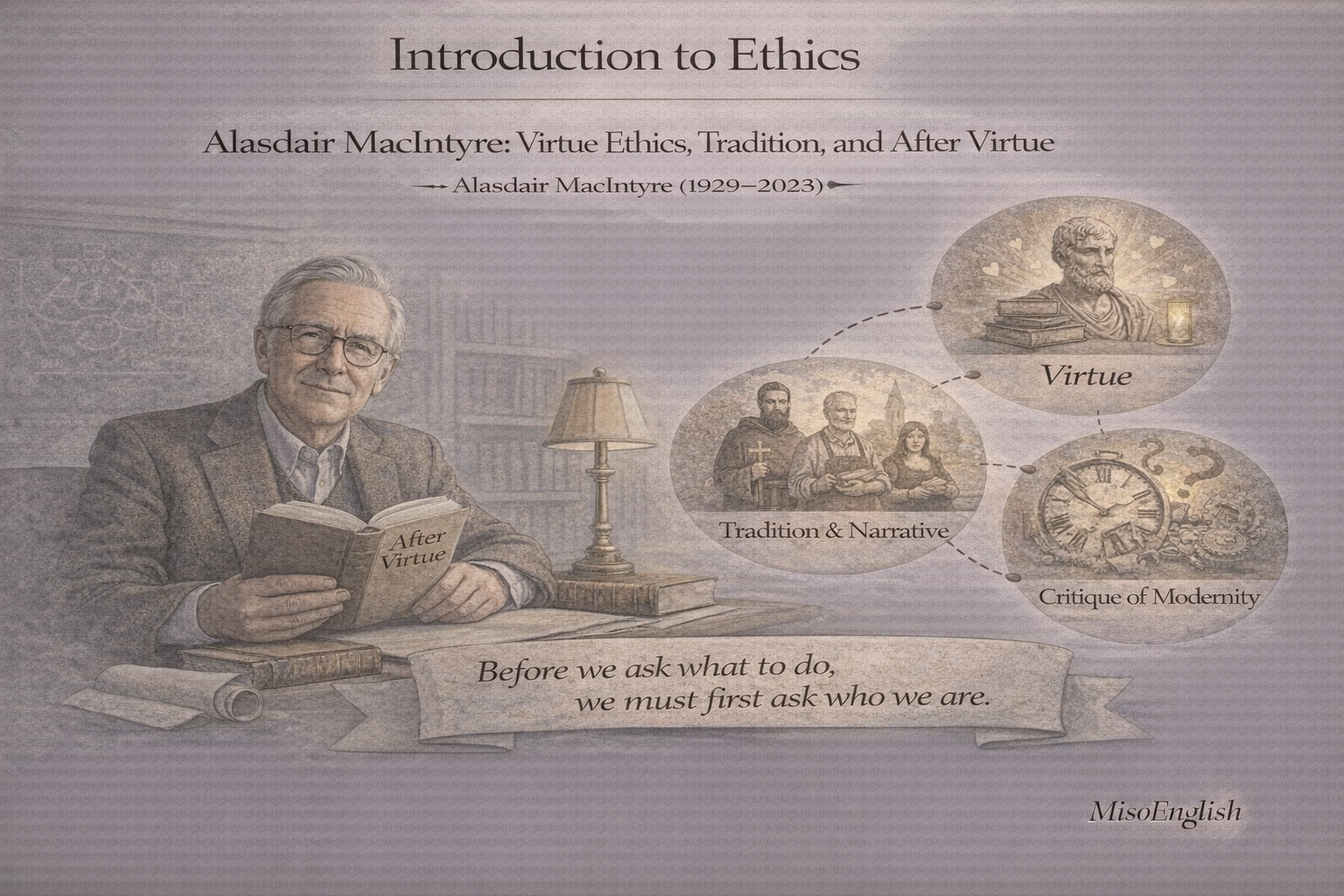
Introduction to Ethics (7)
- Alasdair MacIntyre: Virtue Ethics, Tradition, and After Virtue
Welcome back! After exploring the great debate between Rawls and Nozick, we now turn to a philosopher who argued that both were wrong because they shared false assumptions about the self and morality: Alasdair MacIntyre (1929-2023). His influential work After Virtue (1981) diagnosed a crisis in modern moral discourse and called for a return to Aristotelian virtue ethics—but with a communitarian twist.
The Communitarian Critic
Alasdair MacIntyre was a Scottish-American philosopher whose After Virtue became one of the most influential works in late 20th-century ethics. A former Marxist who became a Thomistic Aristotelian, MacIntyre offered a devastating critique of modern liberalism.
MacIntyre's approach:
- Historical - understands ethics through historical development
- Communitarian - morality is rooted in communities and traditions
- Virtue-based - returns to Aristotelian virtue ethics
- Narrative - the self is constituted by narrative
- Tradition-dependent - rationality itself depends on tradition
- Anti-Enlightenment - rejects the Enlightenment project in ethics
His central claim: Modern moral discourse has suffered a catastrophic breakdown, leaving us with the fragments of once-coherent moral traditions.
The Central Argument of After Virtue
The Diagnosis: Emotivism
MacIntyre's startling claim:
Modern moral discourse is actually emotivism in disguise.
Emotivism (recall from Hume post): Moral statements don't express truths—they express emotions/preferences.
"Murder is wrong" = "Murder: Boo!" + "Don't murder!"
MacIntyre argues:
Even though people think they're making objective moral claims, in practice modern moral discourse functions like emotivism:
- Moral arguments are interminable (never resolved)
- No rational way to settle disputes
- Appeal to incommensurable principles
- Eventually reduce to "I prefer..." vs. "I prefer..."
The emotivism thesis: Contemporary moral utterances are really just expressions of preference masked as objective claims.
Why Moral Discourse Failed
MacIntyre's historical story:
1. Pre-modern era (Aristotelian):
- Coherent moral framework
- Shared conception of human telos (purpose/end)
- Virtues = qualities needed to achieve telos
- Rational moral discourse possible
2. The Enlightenment project:
- Tried to justify morality without teleology
- Rejected shared conception of the good
- Sought universal, reason-based morality
- Key figures: Kant, utilitarians, social contract theorists
3. The failure:
- The Enlightenment project failed
- Can't ground morality in pure reason alone
- Can't derive substantial ethics from thin premises
- Different Enlightenment theories are incommensurable
4. The result:
- Fragmented moral discourse
- Competing moral schemes with no common ground
- Apparent objectivity, actual emotivism
- Endless, irresolvable moral disputes
Example of interminable debate:
Abortion:
- Pro-life: "Human life is sacred; fetus is human; abortion is murder"
- Pro-choice: "Women's autonomy; bodily rights; choice"
These appeal to incommensurable principles:
- Sanctity of life vs. individual autonomy
- No shared framework to adjudicate
- Debate never resolves—just expressions of preference
This pattern repeats across modern moral debates.
The Enlightenment Project and Its Failure
What Was the Enlightenment Project?
The attempt to:
- Justify morality on rational grounds alone
- Independent of any particular tradition or theology
- Universal principles accessible to all rational beings
- Ground ethics without teleology or shared conception of good
Why It Failed (According to MacIntyre)
1. Lost the teleological framework:
Aristotelian ethics had:
- Human-as-they-are (actual state)
- Human-as-they-could-be (telos/flourishing)
- Virtues = means to bridge the gap
The Enlightenment kept:
- Human-as-they-are
- Moral rules
But rejected:
- Human-as-they-could-be (no shared telos)
Problem: Without telos, moral rules seem arbitrary constraints on desires, not means to flourishing.
2. Different Enlightenment theories are incommensurable:
Kant: Duty-based, universal law, autonomy Utilitarians: Consequence-based, maximize happiness Social contract: Agreement-based
These theories:
- Start from different premises
- Use different reasoning
- Reach different conclusions
- Can't be reconciled
No neutral standpoint to judge between them.
3. The thin self can't ground thick morality:
The Enlightenment self:
- Stripped of social roles
- Abstract individual
- Detached from history and community
But this "thin" self can't generate substantial moral requirements.
You can't derive rich moral obligations from:
- Pure rationality
- Abstract individuals
- Universal principles alone
MacIntyre's conclusion: The Enlightenment project was doomed from the start.
The Narrative Self
Against the Atomistic Self
MacIntyre rejects the liberal conception of the self:
Liberal self (Rawls, Nozick):
- Atomistic individual
- Prior to social roles
- Can choose own conception of good
- Detached from history and community
MacIntyre's alternative: The narrative self
We Are Story-Telling Animals
Central claim: Human life has a narrative structure.
What this means:
1. We understand our lives as stories:
- Beginning, middle, (eventual) end
- Characters, plot, setting
- Continuity and development
- Purpose and direction
2. We're always in the middle of stories:
- Family stories
- Community stories
- National histories
- Traditions
3. Our identity is narratively constituted: Who you are = the roles you play in various narratives
You can't answer "Who am I?" without:
- Family: "I am someone's son/daughter/parent"
- Community: "I am a member of this community"
- Profession: "I am a teacher/doctor/farmer"
- Nation: "I am American/Korean/Scottish"
- Tradition: "I am Christian/Buddhist/Confucian"
The self is not:
- Pre-social atom
- Abstract individual
- Unencumbered chooser
But rather:
- Embedded in narratives
- Constituted by roles
- Historically situated
The Unity of Life
Aristotle asked: What is the good for man?
MacIntyre asks: What is the good for a life understood as a narrative unity?
Answer: A coherent life story moving toward some telos (purpose).
The virtues are: Qualities that enable us to sustain narratives, achieve our telos, and live coherent life stories.
Example:
A musician's life:
- Narrative: From beginner to master
- Telos: Musical excellence
- Virtues needed: Discipline, patience, honesty (about abilities), perseverance
- These virtues make sense within this narrative
Practices, Virtues, and Traditions
MacIntyre develops a three-tiered account of virtue:
Level 1: Practices
A practice is:
"Any coherent and complex form of socially established cooperative human activity through which goods internal to that form of activity are realized in the course of trying to achieve those standards of excellence which are appropriate to, and partially definitive of, that form of activity."
Examples:
- Music, chess, football, farming, architecture, teaching, medicine
Key features:
1. Internal goods: Goods that can only be achieved through participating in the practice.
Example - Chess:
- External goods: Money, fame, trophies (could get these other ways)
- Internal goods: Excellence at chess, deep strategic thinking (only through playing chess)
2. Standards of excellence: Each practice has standards that define what counts as doing it well.
3. Community of practitioners: Practices are social, require cooperation and learning from others.
Level 2: The Narrative Unity of a Life
Virtues at the level of practices: Qualities needed to excel within particular practices.
But we engage in many practices: How do they fit together?
Answer: The narrative unity of a whole life.
Virtues at this level: Qualities needed to sustain a coherent life narrative and quest for the good.
Examples:
- Integrity (keeping life coherent)
- Constancy (maintaining commitments over time)
- Courage (facing challenges to our quest)
Level 3: Tradition
We don't create our narratives from scratch: We're born into traditions.
A tradition: An historically extended, socially embodied argument about the goods that constitute the tradition.
Examples:
- Religious traditions (Christianity, Buddhism, Confucianism)
- Philosophical traditions (Aristotelianism, Thomism)
- Cultural traditions
- Professional traditions (medicine, law)
Virtues at this level: Qualities needed to sustain and extend traditions, and to engage in their ongoing arguments.
The key insight: Rationality itself is tradition-dependent. There's no tradition-independent "view from nowhere."
MacIntyre's Aristotelianism
Return to Aristotle—With Modifications
MacIntyre advocates Aristotelian virtue ethics, but with important changes:
Like Aristotle:
- Focus on virtues, character, practices
- Teleological (goal-oriented)
- Emphasize flourishing (eudaimonia)
- Practical wisdom (phronesis) central
Unlike Aristotle:
- No fixed human nature (more historical)
- No single telos for all humans
- Emphasize narrative and tradition
- More communitarian
- Recognize plurality of goods and traditions
The Core Virtues
MacIntyre identifies some core virtues:
Justice: Giving each person their due within practices and communities.
Courage: Facing dangers and challenges in pursuit of the good.
Honesty/Truthfulness: Essential for practices and communities to function.
But also: Different traditions may emphasize different additional virtues.
And: Virtues are partly defined by practices, narratives, and traditions—not universal abstractions.
Against Modern Liberalism
The Critique of Rawls and Nozick
MacIntyre argues both Rawls and Nozick fail because they share false assumptions:
1. The atomistic self:
Both assume the self is:
- Prior to social roles
- Can step back from all commitments
- Abstract individual
MacIntyre: This self is a fiction. Real selves are embedded in narratives, communities, traditions.
2. Neutrality about the good:
Both try to avoid taking stands on what the good life is:
- Rawls: Behind veil of ignorance, don't know conception of good
- Nozick: Minimal state, each chooses own good
MacIntyre: Can't have morality without substantive conception of the good. Neutrality is impossible and undesirable.
3. Individual rights as foundational:
Both build ethics on individual rights.
MacIntyre: Rights are modern invention, make no sense outside traditions that recognize them. Not universal or foundational.
4. Procedural approach:
Both focus on procedures (Original Position, entitlement theory) rather than substantive good.
MacIntyre: Procedure alone can't generate content. Need thick conception of good life.
The Problem of Liberalism
Modern liberalism (Rawls, Nozick, etc.):
- Tries to be neutral between conceptions of good
- Protect individual choice
- Minimize state imposition of values
MacIntyre's objection:
1. Liberalism isn't neutral:
- It privileges certain values (autonomy, choice, tolerance)
- These aren't neutral—they're particular, contestable goods
- Liberalism is itself a tradition (the liberal tradition)
2. Liberalism produces alienation:
- Strips individuals from communities
- Leaves them isolated choosers
- No shared conception of good
- Result: Emotivism, anomie, fragmentation
3. Liberalism can't sustain itself:
- Depends on virtues (honesty, responsibility, civic engagement)
- But undermines the communities and traditions that sustain these virtues
- Self-destructive in long run
Tradition and Rationality
Whose Justice? Which Rationality?
In his later work, MacIntyre explores:
Are there universal standards of rationality? Or is rationality tradition-dependent?
MacIntyre's answer: Rationality is tradition-constituted.
What this means:
1. No view from nowhere: All reasoning happens within some tradition.
2. Different traditions, different rationalities:
- Aristotelian tradition has certain standards
- Liberal tradition has different standards
- Thomistic, Humean, etc. all different
3. Traditions are arguments: Not static—they develop through internal debates.
4. Traditions can be rationally assessed: Not relativism! Some traditions are more rationally adequate than others.
But assessment happens through:
- Internal coherence
- Ability to solve problems
- Capacity to account for rival traditions
- Success in explaining own past crises
Not through:
- Universal, tradition-independent criteria
Is This Relativism?
MacIntyre denies he's a relativist:
Relativism says: No tradition is better than any other; just different.
MacIntyre says:
- Traditions can fail (become incoherent, unable to solve problems)
- Traditions can be defeated by rivals
- We can have rational conversations across traditions
- Possible (though difficult) to switch traditions rationally
But:
- No tradition-independent "God's eye view"
- Can't step outside all traditions to neutral ground
- Must acknowledge our own tradition-dependence
Criticisms and Objections
1. Is Modern Morality Really Emotivist?
Objection:
MacIntyre's diagnosis seems too pessimistic:
- People do give reasons for moral beliefs
- Moral progress has occurred (abolition, civil rights)
- Moral agreement exists on many issues
Response: MacIntyre might say this shows fragments of older traditions still function, but the overall framework is incoherent.
2. Which Tradition?
Problem of plurality:
If rationality is tradition-dependent:
- How do we choose between traditions?
- Why Aristotelianism over liberalism?
- Seems circular to use one tradition to judge another
MacIntyre's response:
- Can rationally compare traditions by their internal adequacy
- Can convert from one tradition to another
- But admits no neutral standpoint
Counter: This still seems unsatisfying. Why not liberal tradition?
3. Homogeneous Communities?
Objection:
MacIntyre's ideal seems nostalgic:
- Small, homogeneous communities
- Shared conception of good
- But modern societies are plural, diverse
- Can't go back to medieval village
Response:
- MacIntyre recognizes this challenge
- Suggests local communities within pluralistic society
- But unclear how this works in practice
4. Exclusion and Oppression?
Feminist and minority critiques:
Problem:
- Traditional communities often oppressive
- Excluded women, minorities, dissenters
- Enforced conformity
- MacIntyre romanticizes the past
MacIntyre's response:
- Traditions can change, develop, reform
- Internal criticism possible
- But critics wonder if this is enough
5. Individual Rights?
Objection:
MacIntyre dismisses individual rights as "fictions."
But rights have protected:
- Religious minorities
- Political dissenters
- The oppressed
Shouldn't we preserve some liberal protections?
MacIntyre:
- Rights discourse is problematic
- But might incorporate legitimate concerns in different framework
- Virtues of justice can do similar work
Critics remain skeptical.
6. Practical Guidance?
Problem:
MacIntyre diagnoses problems but offers little practical guidance:
- How should we live now?
- What concrete institutions?
- How to navigate pluralism?
His answer: Join or form local communities embodying virtues.
Critics: Too vague, impractical for modern life.
MacIntyre's Influence
Revival of Virtue Ethics
MacIntyre's work sparked:
- Renewed interest in Aristotelian ethics
- Growth of virtue ethics as alternative to deontology/consequentialism
- Integration of virtue into other approaches
Key figures influenced:
- Rosalind Hursthouse
- Philippa Foot
- Martha Nussbaum (though she disagrees on much)
Communitarianism
MacIntyre (along with Sandel, Taylor, Walzer) developed communitarian critique of liberalism:
Key claims:
- The self is socially embedded, not atomistic
- Community is constitutive, not just instrumental
- Shared goods essential to moral life
- Tradition and history matter
Impact on political philosophy:
- Challenged liberal assumptions
- Forced Rawls to develop "Political Liberalism"
- Ongoing liberal-communitarian debate
Philosophy of Social Science
MacIntyre's historicism influenced:
- Understanding of rationality
- Role of tradition in inquiry
- Social science methodology
Religious Ethics
Particularly influential in:
- Catholic moral theology (MacIntyre is Catholic)
- Christian ethics more broadly
- Dialogue between philosophy and theology
MacIntyre and Contemporary Ethics
Beyond the Liberal-Communitarian Debate
Many now seek synthesis:
- Recognize both individual rights AND community
- Balance autonomy AND embeddedness
- Preserve pluralism while acknowledging shared goods
MacIntyre remains skeptical such synthesis possible.
Applied Ethics
Virtue ethics (revived partly by MacIntyre) applied to:
- Medical ethics (virtues of physicians)
- Business ethics (virtues in commerce)
- Environmental ethics (virtues of stewardship)
- Military ethics (warrior virtues)
Political Theory
MacIntyre's critique influences:
- Critiques of neoliberalism
- Debates about multiculturalism
- Discussions of civic virtue
- Theories of deliberative democracy
Conclusion
MacIntyre revolutionized contemporary ethics with his communitarian virtue ethics:
Key insights:
1. Modern moral discourse is emotivist Appears objective but actually just expresses preferences—no shared framework.
2. The Enlightenment project failed Can't ground substantial morality on pure reason alone, without teleology or tradition.
3. The narrative self We're constituted by our roles in narratives, not pre-social atoms.
4. Practices, virtues, traditions Three-tiered account: virtues needed for practices, for narrative unity, for sustaining traditions.
5. Return to Aristotle—modified Virtue ethics based on practices and traditions, not fixed human nature.
6. Rationality is tradition-dependent No neutral view from nowhere. All reasoning within traditions.
7. Against liberalism Both Rawls and Nozick wrong—assume false atomistic self, impossible neutrality.
His enduring questions:
"Can we recover moral rationality?" "Which tradition should we embrace?" "How do we live virtuously in modern pluralistic society?"
Strengths:
- Powerful diagnosis of modern moral discourse
- Rich account of virtues and practices
- Emphasizes community and tradition
- Historical sophistication
- Revived virtue ethics
Weaknesses:
- Diagnosis may be too pessimistic
- Unclear practical guidance
- Difficulty with pluralism
- Risk of nostalgia and exclusion
- Undervalues individual rights?
In our final ethics post, we'll explore Peter Singer's practical ethics—utilitarian applied to real-world issues like animal rights, global poverty, and effective altruism. From MacIntyre's tradition-based virtue ethics to Singer's radical consequentialist demands!
References
- Alasdair MacIntyre, After Virtue (1981, 3rd ed. 2007)
- Alasdair MacIntyre, Whose Justice? Which Rationality? (1988)
- Alasdair MacIntyre, Three Rival Versions of Moral Enquiry (1990)
- Christopher Lutz, Reading Alasdair MacIntyre's After Virtue (2012)
- Kelvin Knight (ed.), The MacIntyre Reader (1998)
Next Post Preview Introduction to Ethics (8) - Peter Singer: Practical Ethics, Animal Liberation, and Effective Altruism
Is modern morality really emotivist? Can we recover shared moral frameworks? Should we return to tradition? Share your thoughts on MacIntyre's communitarian virtue ethics!
윤리학 입문 (7) - 앨러스데어 매킨타이어: 덕 윤리학, 전통, 그리고 덕의 상실 이후
다시 오신 걸 환영합니다! 롤스와 노직 사이의 위대한 논쟁을 탐구한 후, 이제 둘 다 틀렸다고 주장한 철학자로 돌아갑니다. 왜냐하면 그들이 자아와 도덕에 대한 잘못된 가정을 공유했기 때문입니다: 앨러스데어 매킨타이어 (1929-2023). 그의 영향력 있는 저작 『덕의 상실 이후』 (1981)는 현대 도덕 담론의 위기를 진단하고 아리스토텔레스 덕 윤리학으로의 회귀를 촉구했습니다—하지만 공동체주의적 변화와 함께.
공동체주의 비평가
앨러스데어 매킨타이어는 스코틀랜드계 미국 철학자로 그의 『덕의 상실 이후』는 20세기 후반 윤리학에서 가장 영향력 있는 작품 중 하나가 되었습니다. 토마스주의 아리스토텔레스주의자가 된 전직 마르크스주의자인 매킨타이어는 현대 자유주의에 대한 파괴적인 비판을 제공했습니다.
매킨타이어의 접근:
- 역사적 - 역사적 발전을 통해 윤리학을 이해
- 공동체주의적 - 도덕은 공동체와 전통에 뿌리를 둠
- 덕 기반 - 아리스토텔레스 덕 윤리학으로 회귀
- 서사적 - 자아는 서사에 의해 구성됨
- 전통-의존적 - 합리성 자체가 전통에 의존
- 반계몽주의 - 윤리학에서 계몽주의 기획을 거부
그의 중심 주장: 현대 도덕 담론은 파국적 붕괴를 겪었고, 우리에게 한때 일관성 있던 도덕 전통의 파편들만 남겨두었습니다.
『덕의 상실 이후』의 중심 논증
진단: 감정주의
매킨타이어의 놀라운 주장:
현대 도덕 담론은 실제로는 위장된 감정주의입니다.
감정주의 (흄 포스팅에서 상기): 도덕 진술은 진리를 표현하지 않는다—그것들은 정서/선호를 표현한다.
"살인은 잘못되었다" = "살인: 야유!" + "살인하지 마라!"
매킨타이어는 주장합니다:
사람들이 객관적 도덕 주장을 하고 있다고 생각하더라도, 실제로는 현대 도덕 담론은 감정주의처럼 기능합니다:
- 도덕 논쟁은 끝이 없다 (결코 해결되지 않음)
- 논쟁을 해결할 합리적 방법이 없다
- 통약 불가능한 원리들에 호소
- 결국 "나는 선호한다..." 대 "나는 선호한다..."로 축소
감정주의 테제: 현대 도덕 발화는 실제로는 객관적 주장으로 가장한 선호의 표현일 뿐입니다.
왜 도덕 담론이 실패했는가
매킨타이어의 역사적 이야기:
1. 전근대 시대 (아리스토텔레스적):
- 일관성 있는 도덕 틀
- 인간 텔로스(목적/종국)의 공유된 개념
- 덕 = 텔로스를 달성하는 데 필요한 자질
- 합리적 도덕 담론 가능
2. 계몽주의 기획:
- 목적론 없이 도덕을 정당화하려고 시도
- 선의 공유된 개념을 거부
- 보편적, 이성 기반 도덕을 추구
- 핵심 인물들: 칸트, 공리주의자들, 사회계약론자들
3. 실패:
- 계몽주의 기획이 실패했다
- 순수 이성만으로 도덕을 근거할 수 없다
- 얇은 전제에서 실질적 윤리학을 도출할 수 없다
- 다른 계몽주의 이론들은 통약 불가능하다
4. 결과:
- 파편화된 도덕 담론
- 공통 근거 없는 경쟁하는 도덕 체계들
- 겉보기 객관성, 실제 감정주의
- 끝없고 해결 불가능한 도덕 논쟁들
끝이 없는 논쟁의 예:
낙태:
- 생명 옹호: "인간 생명은 신성하다; 태아는 인간이다; 낙태는 살인이다"
- 선택 옹호: "여성의 자율성; 신체 권리; 선택"
이것들은 통약 불가능한 원리들에 호소한다:
- 생명의 신성함 대 개인 자율성
- 판단할 공유된 틀이 없다
- 논쟁이 결코 해결되지 않는다—단지 선호의 표현
이 패턴이 현대 도덕 논쟁들 전반에 걸쳐 반복됩니다.
계몽주의 기획과 그 실패
계몽주의 기획이란 무엇이었는가?
다음을 시도:
- 오직 합리적 근거만으로 도덕을 정당화
- 특정 전통이나 신학과 독립적으로
- 모든 합리적 존재에게 접근 가능한 보편적 원리
- 목적론이나 선의 공유된 개념 없이 윤리학을 근거
왜 실패했는가 (매킨타이어에 따르면)
1. 목적론적 틀을 상실:
아리스토텔레스 윤리학은 가졌다:
- 인간-그들-있는-대로 (실제 상태)
- 인간-그들-될-수-있는-대로 (텔로스/번영)
- 덕 = 간극을 메우는 수단
계몽주의는 유지했다:
- 인간-그들-있는-대로
- 도덕 규칙
하지만 거부했다:
- 인간-그들-될-수-있는-대로 (공유된 텔로스 없음)
문제: 텔로스 없이, 도덕 규칙은 번영의 수단이 아니라 욕구에 대한 자의적 제약처럼 보입니다.
2. 다른 계몽주의 이론들은 통약 불가능:
칸트: 의무 기반, 보편 법칙, 자율성 공리주의자들: 결과 기반, 행복 최대화 사회계약: 합의 기반
이 이론들은:
- 다른 전제에서 시작
- 다른 추론 사용
- 다른 결론 도달
- 조정될 수 없다
그것들 사이를 판단할 중립적 관점이 없다.
3. 얇은 자아는 두꺼운 도덕을 근거할 수 없다:
계몽주의 자아:
- 사회적 역할에서 벗겨진
- 추상적 개인
- 역사와 공동체로부터 분리된
하지만 이 "얇은" 자아는 실질적 도덕 요구를 생성할 수 없습니다.
다음으로부터 풍부한 도덕적 의무를 도출할 수 없습니다:
- 순수 합리성
- 추상적 개인들
- 보편적 원리만
매킨타이어의 결론: 계몽주의 기획은 처음부터 실패할 운명이었습니다.
서사적 자아
원자론적 자아에 반대
매킨타이어는 자유주의적 자아 개념을 거부합니다:
자유주의적 자아 (롤스, 노직):
- 원자론적 개인
- 사회적 역할에 앞서
- 자신의 선의 개념을 선택할 수 있다
- 역사와 공동체로부터 분리된
매킨타이어의 대안: 서사적 자아
우리는 이야기하는 동물이다
중심 주장: 인간 삶은 서사 구조를 갖는다.
이것이 의미하는 것:
1. 우리는 우리의 삶을 이야기로 이해한다:
- 시작, 중간, (궁극적) 끝
- 등장인물, 플롯, 배경
- 연속성과 발전
- 목적과 방향
2. 우리는 항상 이야기의 중간에 있다:
- 가족 이야기
- 공동체 이야기
- 국가 역사
- 전통들
3. 우리의 정체성은 서사적으로 구성된다: 당신이 누구인가 = 당신이 다양한 서사에서 하는 역할
"나는 누구인가?"에 답할 수 없다 다음 없이:
- 가족: "나는 누군가의 아들/딸/부모이다"
- 공동체: "나는 이 공동체의 구성원이다"
- 직업: "나는 교사/의사/농부이다"
- 국가: "나는 미국인/한국인/스코틀랜드인이다"
- 전통: "나는 기독교인/불교인/유교인이다"
자아는 다음이 아니다:
- 사회 이전 원자
- 추상적 개인
- 제약받지 않는 선택자
오히려:
- 서사에 내장된
- 역할에 의해 구성된
- 역사적으로 위치한
삶의 통일성
아리스토텔레스는 물었다: 인간을 위한 선이란 무엇인가?
매킨타이어는 묻는다: 서사 통일성으로 이해되는 삶을 위한 선이란 무엇인가?
답: 어떤 텔로스(목적)를 향해 나아가는 일관성 있는 삶의 이야기.
덕은: 서사를 유지하고, 텔로스를 달성하고, 일관성 있는 삶의 이야기를 사는 데 필요한 자질들입니다.
예시:
음악가의 삶:
- 서사: 초보자에서 거장으로
- 텔로스: 음악적 탁월성
- 필요한 덕: 규율, 인내, 정직 (능력에 대해), 끈기
- 이 덕들은 이 서사 안에서 의미를 갖는다
실천, 덕, 그리고 전통
매킨타이어는 덕에 대한 3단계 설명을 발전시킵니다:
1단계: 실천
실천은:
"그 활동 형태 내부의 재화들이 그 활동 형태에 적합하고 부분적으로 정의하는 탁월성의 기준들을 달성하려는 과정에서 실현되는, 사회적으로 확립된 협력적 인간 활동의 일관성 있고 복잡한 형태."
예시들:
- 음악, 체스, 축구, 농사, 건축, 교육, 의학
핵심 특징들:
1. 내부 재화: 그 실천에 참여함으로써만 달성될 수 있는 재화들.
예시 - 체스:
- 외부 재화: 돈, 명성, 트로피 (다른 방식으로 얻을 수 있음)
- 내부 재화: 체스에서의 탁월성, 깊은 전략적 사고 (오직 체스를 둠으로써만)
2. 탁월성의 기준: 각 실천은 그것을 잘하는 것이 무엇인지 정의하는 기준을 갖는다.
3. 실천자들의 공동체: 실천은 사회적이고, 다른 사람들로부터 협력과 학습을 요구한다.
2단계: 삶의 서사 통일성
실천 수준에서의 덕: 특정 실천 내에서 탁월하기 위해 필요한 자질들.
하지만 우리는 많은 실천에 참여한다: 그것들이 어떻게 함께 맞춰지는가?
답: 전체 삶의 서사 통일성.
이 수준에서의 덕: 일관성 있는 삶의 서사와 선에 대한 탐구를 유지하는 데 필요한 자질들.
예시들:
- 성실성 (삶을 일관성 있게 유지하기)
- 항상성 (시간에 걸쳐 헌신 유지하기)
- 용기 (우리의 탐구에 대한 도전들에 직면하기)
3단계: 전통
우리는 처음부터 서사를 만들지 않는다: 우리는 전통 속에 태어난다.
전통: 전통을 구성하는 재화들에 대한 역사적으로 확장된, 사회적으로 체현된 논증.
예시들:
- 종교 전통들 (기독교, 불교, 유교)
- 철학 전통들 (아리스토텔레스주의, 토마스주의)
- 문화 전통들
- 전문직 전통들 (의학, 법)
이 수준에서의 덕: 전통들을 유지하고 확장하고, 그것들의 진행 중인 논증에 참여하는 데 필요한 자질들.
핵심 통찰: 합리성 자체가 전통-의존적이다. 전통-독립적인 "어디에서도 아닌 관점"은 없다.
매킨타이어의 아리스토텔레스주의
아리스토텔레스로 회귀—수정과 함께
매킨타이어는 아리스토텔레스 덕 윤리학을 옹호하지만, 중요한 변화들과 함께:
아리스토텔레스와 같이:
- 덕, 성품, 실천에 집중
- 목적론적 (목표 지향적)
- 번영(에우다이모니아) 강조
- 실천적 지혜(프로네시스) 중심
아리스토텔레스와 달리:
- 고정된 인간 본성 없음 (더 역사적)
- 모든 인간을 위한 단일 텔로스 없음
- 서사와 전통 강조
- 더 공동체주의적
- 재화들과 전통들의 다원성 인정
핵심 덕들
매킨타이어는 몇 가지 핵심 덕들을 확인합니다:
정의: 실천과 공동체 안에서 각 사람에게 그들의 몫을 주기.
용기: 선의 추구에서 위험과 도전들에 직면하기.
정직/진실성: 실천과 공동체가 기능하기 위해 필수적.
하지만 또한: 다른 전통들은 다른 추가 덕들을 강조할 수 있다.
그리고: 덕들은 부분적으로 실천, 서사, 전통들에 의해 정의된다—보편적 추상이 아니다.
현대 자유주의에 반대
롤스와 노직 비판
매킨타이어는 롤스와 노직이 둘 다 잘못된 가정을 공유하기 때문에 실패한다고 주장합니다:
1. 원자론적 자아:
둘 다 자아가 다음이라고 가정한다:
- 사회적 역할에 앞서
- 모든 헌신으로부터 물러설 수 있다
- 추상적 개인
매킨타이어: 이 자아는 허구입니다. 실제 자아들은 서사, 공동체, 전통에 내장되어 있습니다.
2. 선에 대한 중립성:
둘 다 좋은 삶이 무엇인지에 대해 입장을 취하는 것을 피하려고 시도한다:
- 롤스: 무지의 베일 뒤에서, 선의 개념을 모른다
- 노직: 최소 국가, 각자가 자신의 선을 선택한다
매킨타이어: 선의 실질적 개념 없이 도덕을 가질 수 없다. 중립성은 불가능하고 바람직하지 않다.
3. 기초로서의 개인 권리:
둘 다 개인 권리에 윤리학을 구축한다.
매킨타이어: 권리는 현대 발명이고, 그것들을 인정하는 전통 밖에서는 의미가 없다. 보편적이거나 기초적이지 않다.
4. 절차적 접근:
둘 다 실질적 선보다 절차 (원초적 입장, 권리 이론)에 집중한다.
매킨타이어: 절차만으로는 내용을 생성할 수 없다. 좋은 삶의 두꺼운 개념이 필요하다.
자유주의의 문제
현대 자유주의 (롤스, 노직 등):
- 선의 개념들 사이에서 중립적이려고 시도
- 개인 선택 보호
- 가치의 국가 부과 최소화
매킨타이어의 반론:
1. 자유주의는 중립적이지 않다:
- 특정 가치들을 특권화한다 (자율성, 선택, 관용)
- 이것들은 중립적이지 않다—특정하고 논쟁 가능한 재화들이다
- 자유주의 자체가 전통이다 (자유주의 전통)
2. 자유주의는 소외를 낳는다:
- 개인들을 공동체로부터 벗겨낸다
- 그들을 고립된 선택자들로 남긴다
- 선의 공유된 개념이 없다
- 결과: 감정주의, 아노미, 파편화
3. 자유주의는 스스로를 유지할 수 없다:
- 덕들에 의존한다 (정직, 책임, 시민 참여)
- 하지만 이 덕들을 유지하는 공동체들과 전통들을 무너뜨린다
- 장기적으로 자기-파괴적
전통과 합리성
누구의 정의? 어떤 합리성?
그의 후기 작업에서, 매킨타이어는 탐구합니다:
합리성의 보편적 기준들이 있는가? 아니면 합리성이 전통-의존적인가?
매킨타이어의 답: 합리성은 전통-구성적이다.
이것이 의미하는 것:
1. 어디에서도 아닌 관점이 없다: 모든 추론은 어떤 전통 안에서 일어난다.
2. 다른 전통들, 다른 합리성들:
- 아리스토텔레스 전통은 특정 기준들을 갖는다
- 자유주의 전통은 다른 기준들을 갖는다
- 토마스주의, 흄적, 등등 모두 다르다
3. 전통들은 논증들이다: 정적이지 않다—내부 논쟁들을 통해 발전한다.
4. 전통들은 합리적으로 평가될 수 있다: 상대주의가 아니다! 일부 전통들은 다른 것들보다 더 합리적으로 적절하다.
하지만 평가는 다음을 통해 일어난다:
- 내부 일관성
- 문제들을 해결하는 능력
- 경쟁 전통들을 설명하는 능력
- 자신의 과거 위기들을 설명하는 성공
다음을 통해서가 아니다:
- 보편적, 전통-독립적 기준
이것이 상대주의인가?
매킨타이어는 자신이 상대주의자라는 것을 부정합니다:
상대주의는 말한다: 어떤 전통도 다른 것보다 낫지 않다; 단지 다르다.
매킨타이어는 말한다:
- 전통들은 실패할 수 있다 (일관성을 잃고, 문제들을 해결할 수 없게 됨)
- 전통들은 경쟁자들에게 패배할 수 있다
- 우리는 전통들을 가로질러 합리적 대화를 할 수 있다
- 합리적으로 전통들을 바꾸는 것이 (어렵지만) 가능하다
하지만:
- 전통-독립적인 "신의 눈 관점"이 없다
- 모든 전통 밖으로 나가 중립적 근거로 갈 수 없다
- 우리 자신의 전통-의존성을 인정해야 한다
비판들과 반론들
1. 현대 도덕이 정말로 감정주의적인가?
반론:
매킨타이어의 진단이 너무 비관적으로 보인다:
- 사람들은 도덕 믿음에 대해 이유를 제시한다
- 도덕적 진보가 발생했다 (노예제 폐지, 시민권)
- 많은 문제들에 대해 도덕적 합의가 존재한다
응답: 매킨타이어는 이것이 오래된 전통들의 파편들이 여전히 기능한다는 것을 보여주지만, 전체 틀은 일관성이 없다고 말할 수 있습니다.
2. 어느 전통?
다원성의 문제:
합리성이 전통-의존적이라면:
- 전통들 사이에서 어떻게 선택하는가?
- 왜 자유주의보다 아리스토텔레스주의인가?
- 한 전통을 사용하여 다른 것을 판단하는 것은 순환적으로 보인다
매킨타이어의 응답:
- 내부 적절성에 의해 전통들을 합리적으로 비교할 수 있다
- 한 전통에서 다른 전통으로 전환할 수 있다
- 하지만 중립적 관점이 없다는 것을 인정한다
반론: 이것은 여전히 불만족스러워 보인다. 왜 자유주의 전통이 아닌가?
3. 동질적 공동체들?
반론:
매킨타이어의 이상은 향수적으로 보인다:
- 작고 동질적인 공동체들
- 선의 공유된 개념
- 하지만 현대 사회들은 다원적이고 다양하다
- 중세 마을로 돌아갈 수 없다
응답:
- 매킨타이어는 이 도전을 인정한다
- 다원주의적 사회 안에서 지역 공동체들을 제안한다
- 하지만 실제로 이것이 어떻게 작동하는지 불명확하다
4. 배제와 억압?
페미니스트와 소수자 비판:
문제:
- 전통적 공동체들은 종종 억압적이다
- 여성, 소수자, 반대자를 배제했다
- 동조를 강요했다
- 매킨타이어는 과거를 낭만화한다
매킨타이어의 응답:
- 전통들은 변화하고, 발전하고, 개혁할 수 있다
- 내부 비판이 가능하다
- 하지만 비평가들은 이것이 충분한지 의문을 제기한다
5. 개인 권리?
반론:
매킨타이어는 개인 권리를 "허구"로 일축합니다.
하지만 권리는 다음을 보호해왔습니다:
- 종교 소수자들
- 정치 반대자들
- 피억압자들
일부 자유주의적 보호들을 보존해야 하지 않는가?
매킨타이어:
- 권리 담론은 문제적이다
- 하지만 다른 틀에서 정당한 관심들을 통합할 수 있다
- 정의의 덕이 유사한 일을 할 수 있다
비평가들은 회의적으로 남아 있다.
6. 실천적 지침?
문제:
매킨타이어는 문제들을 진단하지만 실천적 지침은 거의 제공하지 않는다:
- 우리는 지금 어떻게 살아야 하는가?
- 어떤 구체적 제도들?
- 다원주의를 어떻게 탐색하는가?
그의 답: 덕들을 구현하는 지역 공동체들에 가입하거나 형성하라.
비평가들: 너무 모호하고, 현대 삶에 비실용적이다.
매킨타이어의 영향
덕 윤리학의 부활
매킨타이어의 작업은 촉발했습니다:
- 아리스토텔레스 윤리학에 대한 새로운 관심
- 의무론/결과주의에 대한 대안으로서 덕 윤리학의 성장
- 덕의 다른 접근들로의 통합
영향받은 핵심 인물들:
- 로절린드 허스트하우스
- 필리파 풋
- 마사 누스바움 (비록 많은 것에 동의하지 않지만)
공동체주의
매킨타이어는 (샌델, 테일러, 월저와 함께) 자유주의에 대한 공동체주의 비판을 발전시켰습니다:
핵심 주장들:
- 자아는 원자론적이 아니라 사회적으로 내장되어 있다
- 공동체는 도구적이 아니라 구성적이다
- 공유된 재화는 도덕 삶에 필수적이다
- 전통과 역사가 중요하다
정치철학에 대한 영향:
- 자유주의 가정들에 도전했다
- 롤스가 "정치적 자유주의"를 발전시키도록 강제했다
- 진행 중인 자유주의-공동체주의 논쟁
사회과학의 철학
매킨타이어의 역사주의는 영향을 미쳤습니다:
- 합리성의 이해
- 탐구에서 전통의 역할
- 사회과학 방법론
종교 윤리학
특히 다음에서 영향력:
- 가톨릭 도덕신학 (매킨타이어는 가톨릭 신자)
- 더 넓게 기독교 윤리학
- 철학과 신학 사이의 대화
매킨타이어와 현대 윤리학
자유주의-공동체주의 논쟁을 넘어서
많은 사람들이 이제 종합을 추구합니다:
- 개인 권리와 공동체 둘 다 인정
- 자율성과 내장성 균형
- 공유된 재화를 인정하면서 다원주의 보존
매킨타이어는 그러한 종합이 가능한지 회의적으로 남아 있습니다.
응용 윤리학
덕 윤리학 (부분적으로 매킨타이어에 의해 부활)이 다음에 적용됩니다:
- 의료 윤리학 (의사들의 덕)
- 비즈니스 윤리학 (상업에서의 덕)
- 환경 윤리학 (청지기직의 덕)
- 군사 윤리학 (전사의 덕)
정치 이론
매킨타이어의 비판은 영향을 미칩니다:
- 신자유주의에 대한 비판
- 다문화주의에 대한 논쟁
- 시민 덕에 대한 논의
- 숙의 민주주의 이론
마치며
매킨타이어는 공동체주의 덕 윤리학으로 현대 윤리학을 혁명했습니다:
핵심 통찰들:
1. 현대 도덕 담론은 감정주의적이다 객관적으로 보이지만 실제로는 단지 선호를 표현한다—공유된 틀이 없다.
2. 계몽주의 기획이 실패했다 목적론이나 전통 없이 순수 이성만으로 실질적 도덕을 근거할 수 없다.
3. 서사적 자아 우리는 사회 이전 원자가 아니라 서사에서 역할들에 의해 구성된다.
4. 실천, 덕, 전통 3단계 설명: 실천에 필요한 덕, 서사 통일성에 필요한 덕, 전통 유지에 필요한 덕.
5. 아리스토텔레스로 회귀—수정 고정된 인간 본성이 아니라 실천과 전통에 기반한 덕 윤리학.
6. 합리성은 전통-의존적 어디에서도 아닌 중립적 관점이 없다. 모든 추론은 전통 안에서.
7. 자유주의에 반대 롤스와 노직 둘 다 틀렸다—잘못된 원자론적 자아, 불가능한 중립성을 가정.
그의 지속적인 질문들:
"우리는 도덕 합리성을 회복할 수 있는가?" "우리는 어느 전통을 받아들여야 하는가?" "현대 다원주의 사회에서 어떻게 덕스럽게 사는가?"
강점들:
- 현대 도덕 담론에 대한 강력한 진단
- 덕과 실천의 풍부한 설명
- 공동체와 전통 강조
- 역사적 정교함
- 덕 윤리학 부활
약점들:
- 진단이 너무 비관적일 수 있다
- 불명확한 실천적 지침
- 다원주의와의 어려움
- 향수와 배제의 위험
- 개인 권리를 과소평가?
우리의 마지막 윤리학 포스팅에서는 피터 싱어의 실천 윤리학을 탐구하겠습니다—동물권, 지구적 빈곤, 효과적 이타주의와 같은 실제 문제들에 적용되는 공리주의. 매킨타이어의 전통 기반 덕 윤리학에서 싱어의 급진적 결과주의 요구로!
참고문헌
- 앨러스데어 매킨타이어, 『덕의 상실 이후』 (1981, 3판 2007)
- 앨러스데어 매킨타이어, 『누구의 정의? 어떤 합리성?』 (1988)
- 앨러스데어 매킨타이어, 『도덕 탐구의 세 가지 경쟁 버전』 (1990)
- 크리스토퍼 루츠, 『앨러스데어 매킨타이어의 덕의 상실 이후 읽기』 (2012)
- 켈빈 나이트 (편), 『매킨타이어 독자』 (1998)
다음 글 예고 윤리학 입문 (8) - 피터 싱어: 실천 윤리학, 동물 해방, 그리고 효과적 이타주의
현대 도덕이 정말로 감정주의적인가? 공유된 도덕 틀을 회복할 수 있는가? 전통으로 돌아가야 하는가? 매킨타이어의 공동체주의 덕 윤리학에 대한 생각을 공유해주세요!
[ MisoEnglish 저작권 안내 ] 본 블로그의 모든 게시물은 저작권법의 보호를 받으며, 무단 도용 및 배포 시 사전 고지 없이 법적 조치를 취할 수 있습니다. All posts are protected under copyright law. Unauthorized use may result in legal action.
Copyright 2026. MisoEnglish. All rights reserved.
'Philosophy > Ethics' 카테고리의 다른 글
| 윤리학 입문 (8) - 피터 싱어: 실천 윤리학, 동물 해방, 그리고 효과적 이타주의 (0) | 2026.01.24 |
|---|---|
| 윤리학 입문 (6) - 로버트 노직: 자유지상주의, 권리, 그리고 최소 국가 (0) | 2026.01.23 |
| 윤리학 입문 (5) - 존 롤스: 공정으로서의 정의와 원초적 입장 (0) | 2026.01.23 |
| 윤리학 입문 (4) - 데이비드 흄: 도덕 감정, 공감, 그리고 이성의 한계 (1) | 2026.01.23 |
| 윤리학 입문 (3) - 밀 & 벤담: 공리주의와 최대 행복 원리 (1) | 2026.01.23 |


