
- 분류 전체보기 (580)

| 일 | 월 | 화 | 수 | 목 | 금 | 토 |
|---|---|---|---|---|---|---|
| 1 | 2 | 3 | 4 | 5 | 6 | |
| 7 | 8 | 9 | 10 | 11 | 12 | 13 |
| 14 | 15 | 16 | 17 | 18 | 19 | 20 |
| 21 | 22 | 23 | 24 | 25 | 26 | 27 |
| 28 | 29 | 30 | 31 |
- 영어문법
- 영어표현력
- pnr
- Basic English Verbs
- English Speaking Practice
- 🌿 English with Heart
- 영어회화
- GrammarWithSoul
- English for Korean Learners
- 영어접속사
- ticketing
- English in English
- SlowBlooms
- 영어공부
- 영문법
- 언어의철학 #의미론 #화용론 #언어와사고 #언어의미학 #MisoEnglish #TheLanguageBeyondGrammar #영문학심화
- 느리지만단단하게
- booking
- 영어를살다
- misoenglish
- MichelleKim
- 감성영어
- 영어시제
- FareRules
- 영어표현
- everyday English
- AirlineOpsEnglish
- 영어공부법
- 생활영어
- 영어발음
- Today
- Total
MisoEnglish
전치사는 의미의 나침반이다 (The Secret Life of Prepositions) 본문
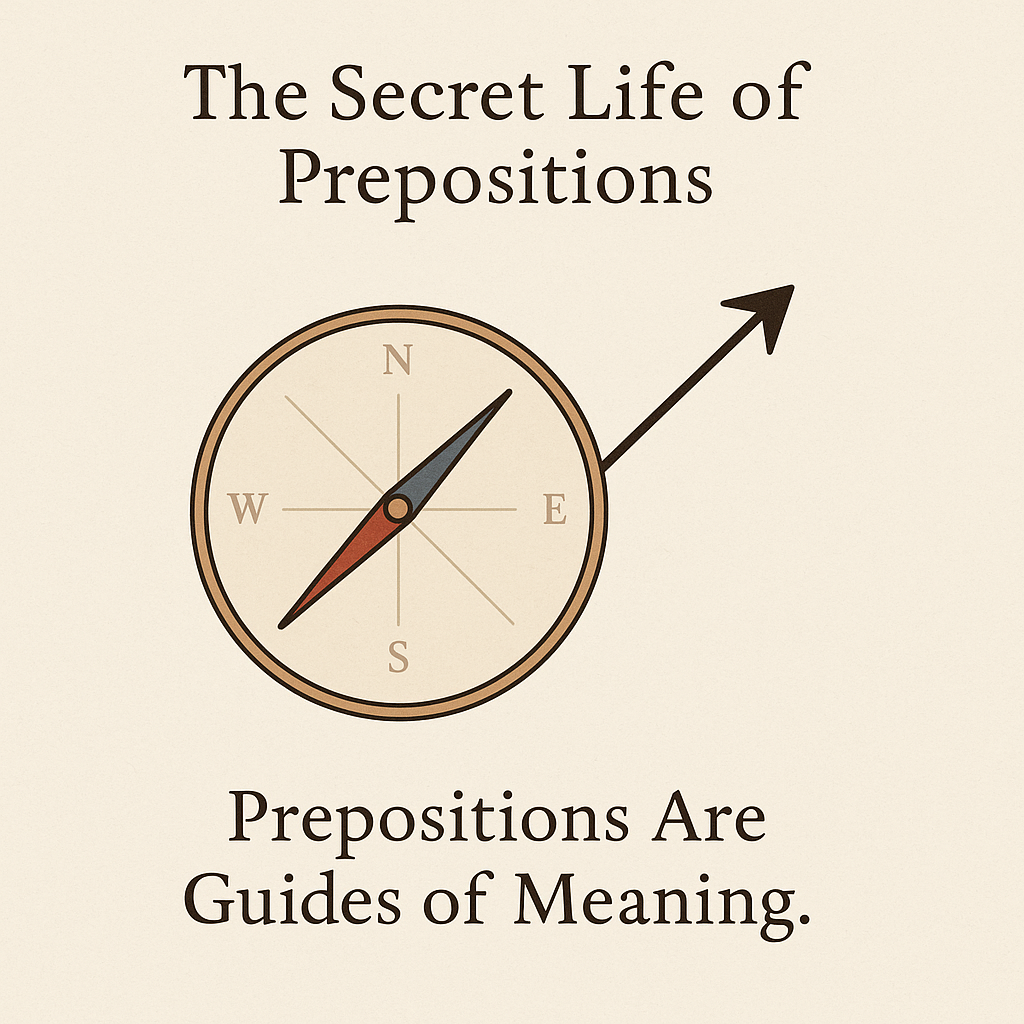
🌿 The Secret Life of Prepositions
— Small Words, Big Movements —
✍️ by Michelle Kim (MisoEnglish)
“Prepositions don’t sit still. They move meaning through space, time, and thought.” 🌱
“전치사는 가만히 있는 단어가 아니다. 의미를 공간과 시간, 그리고 생각 속에서 ‘움직이게’ 하는 단어다.” 🌱
🌊 1. The Quiet Architects of English
Prepositions are often called “small words,”
but they are the invisible architects of English sentences.
They don’t add decoration — they build relationships.
전치사는 흔히 ‘작은 단어’로 불리지만,
사실은 영어 문장의 보이지 않는 건축가입니다.
그들은 꾸미지 않고, 연결합니다.
전치사는 문장 속 관계와 방향의 구조를 설계합니다.
on, in, at, by, for, with — they are not accessories.
They are bridges. 🌉
on, in, at, by, for, with — 전치사는 장식이 아니라 다리입니다.
🪶 2. The Worldview Behind Prepositions
In Korean, we often describe relations emotionally or situationally.
But English expresses them spatially — through position, movement, and distance.
한국어는 관계를 주로 상황이나 감정으로 표현합니다.
반면 영어는 공간적 사고(Spatial Thinking)로 관계를 설명합니다.
For example:
I’m in the room.
I’m at the station.
I’m on the train.
To a Korean speaker, all mean “~에 있다.”
But to an English mind, each paints a different relationship between space and self.
한국어로는 모두 “~에 있다”이지만,
영어에서는 각각 공간과 나의 관계가 다릅니다.
- in → inside a boundary (내부에 포함됨)
- at → point of contact (지점에서 맞닿음)
- on → surface of connection (표면에 닿음)
💡 Prepositions don’t show location — they show relationship.
💡 전치사는 위치를 말하지 않고, 관계를 그린다.
⚡ 3. Prepositions Show Energy, Not Place
A preposition tells us how energy moves in a sentence.
Think of “on” as energy resting, “in” as energy surrounded,
“to” as energy flowing.
전치사는 문장에서 에너지가 어떻게 움직이는가를 보여줍니다.
“on”은 머무름, “in”은 포용, “to”는 흐름을 뜻합니다.
I’m on the sofa. (resting energy)
I’m in trouble. (enclosed by emotion)
I’m going to the park. (energy moving outward)
이 세 문장은 단순히 위치를 말하는 게 아니라,
‘움직임의 방향’과 ‘감정의 관계’를 표현합니다.
🌿 Each preposition is a tiny compass of meaning.
🌿 전치사 하나하나가 의미의 나침반이다.
(A) when they stand with a noun, they build a relationship.
(B) when the noun disappears, they become a particle and complete movement.
전치사의 에너지는 두 방식으로 드러납니다.
(A) 명사와 함께 있을 땐 ‘관계’를 만들고,
(B) 명사가 사라지면 particle(부사/소사)이 되어 ‘동작의 결과’를 완성합니다.
💫 4. Why Koreans Struggle with Prepositions
Korean expresses relationships through context and particles like “~에, ~에서, ~으로.”
So English prepositions often feel unnecessary or interchangeable.
한국어는 문맥과 조사를 통해 관계를 표현하기 때문에,
영어의 전치사가 필요 이상으로 많거나 헷갈리는 것처럼 느껴집니다.
But in English, a preposition is not optional —
it defines the connection itself.
Without it, the picture collapses.
하지만 영어에서는 전치사가 관계 자체를 형성하는 단어입니다.
전치사가 빠지면, 문장의 의미 구조가 무너집니다.
❌ I depend you.
✅ I depend on you.
The word “on” is not decoration — it’s the bridge of dependency.
“on”은 꾸밈이 아니라 ‘의존의 다리’입니다.
☁️ 5. How to Learn Prepositions Deeply
Don’t memorize them by translation.
Instead, visualize and feel them.
번역으로 외우지 말고, 그림으로 느끼세요.
| Preposition | Image | Feeling | Example | Extra (non-physical) |
|---|---|---|---|---|
| in | inside a circle | surrounded, contained | in love, in the room | in trouble, in silence |
| on | touching a surface | supported, connected | on the wall, on duty | on sale, on hold |
| at | a single point | specific, focused | at the door, at school | at risk, at peace |
| to | arrow moving forward | direction, intention | go to work, talk to him | to the limit, to perfection |
| by | side of a line | proximity, agency | by the window, written by her | by chance, by mistake |
🎨 See the movement, not the meaning.
🎨 뜻이 아니라 움직임을 보라.
🌸 6. Practice: Turn Grammar into Imagination
Close your grammar book for a moment.
Draw small circles, arrows, and lines —
show where “in,” “on,” and “at” belong.
잠시 문법책을 덮고,
종이에 원과 화살표를 그려보세요.
“in, on, at”이 어디에 놓이는지 ‘그림으로’ 보세요.
That’s how prepositions reveal their real life —
not as words, but as movements of thought.
그 순간, 전치사는 단어가 아니라
생각의 움직임으로 살아납니다. 🌿
When you meet a preposition, ask yourself:
“Is it building a relationship, or completing energy as a particle?”
전치사를 볼 때마다 이렇게만 물어보세요.
“지금 이 전치사는 관계를 만들고 있나, 에너지를 완성하고 있나?”
✨ Final Thought
Prepositions may be small,
but they are the strings that hold the English world together.
전치사는 작지만,
영어 세계를 연결하는 보이지 않는 실입니다.
They teach us that language isn’t just about words —
it’s about where things exist, how they move, and how they relate.
언어는 단어의 집합이 아니라,
존재와 움직임, 관계의 구조입니다.
💭 Don’t study prepositions — feel how they connect the world.
💭 전치사를 외우지 말고, 세상을 연결하는 방식을 느껴보세요. 🌿
If you want to see how prepositions become particles
and complete movement in real sentences, continue here:
전치사가 particle이 되어 동작을 완성하는 원리를
실전 메커니즘으로 더 깊게 보고 싶다면 아래 글로 이어서 보세요.
→ 전치사가 혼자 서면 부사(Particle)가 된다: 353
→ 전치사 vs 부사 vs 구동사: 354
🌿 The Secret Life of Prepositions
— Small Words, Big Movements —
✍️ by Michelle Kim (MisoEnglish)
“Prepositions don’t sit still.
They move meaning through space, time, and thought.” 🌱
“전치사는 가만히 있는 단어가 아니다.
의미를 공간과 시간, 그리고 생각 속에서 ‘움직이게’ 하는 단어다.” 🌱
🌊 1. The Quiet Architects of English
Prepositions are often called “small words,”
but they are the invisible architects of English sentences.
They don’t add decoration — they build relationships.
전치사는 흔히 ‘작은 단어’로 불리지만,
사실은 영어 문장의 보이지 않는 건축가입니다.
그들은 꾸미지 않고, 연결합니다.
전치사는 문장 속 관계와 방향의 구조를 설계합니다.
on, in, at, by, for, with — they are not accessories.
They are bridges. 🌉
on, in, at, by, for, with — 전치사는 장식이 아니라 다리입니다.
🪶 2. The Worldview Behind Prepositions
In Korean, we often describe relations emotionally or situationally.
But English expresses them spatially — through position, movement, and distance.
한국어는 관계를 주로 상황이나 감정으로 표현합니다.
반면 영어는 공간적 사고(Spatial Thinking) 로 관계를 설명합니다.
For example:
I’m in the room.
I’m at the station.
I’m on the train.
To a Korean speaker, all mean “~에 있다.”
But to an English mind, each paints a different relationship between space and self.
한국어로는 모두 “~에 있다”이지만,
영어에서는 각각 공간과 나의 관계가 다릅니다.
- in → inside a boundary (내부에 포함됨)
- at → point of contact (지점에서 맞닿음)
- on → surface of connection (표면에 닿음)
💡 Prepositions don’t show location — they show relationship.
💡 전치사는 위치를 말하지 않고, 관계를 그린다.
⚡ 3. Prepositions Show Energy, Not Place
A preposition tells us how energy moves in a sentence.
Think of “on” as energy resting, “in” as energy surrounded, “to” as energy flowing.
전치사는 문장에서 에너지가 어떻게 움직이는가를 보여줍니다.
“on”은 머무름, “in”은 포용, “to”는 흐름을 뜻합니다.
I’m on the sofa. (resting energy)
I’m in trouble. (enclosed by emotion)
I’m going to the park. (energy moving outward)
이 세 문장은 단순히 위치를 말하는 게 아니라,
‘움직임의 방향’과 ‘감정의 관계’를 표현합니다.
🌿 Each preposition is a tiny compass of meaning.
🌿 전치사 하나하나가 의미의 나침반이다.
💫 4. Why Koreans Struggle with Prepositions
Korean expresses relationships through context and particles like “~에, ~에서, ~으로.”
So English prepositions often feel unnecessary or interchangeable.
한국어는 문맥과 조사를 통해 관계를 표현하기 때문에,
영어의 전치사가 필요 이상으로 많거나 헷갈리는 것처럼 느껴집니다.
But in English, a preposition is not optional —
it defines the connection itself.
Without it, the picture collapses.
하지만 영어에서는 전치사가 관계 자체를 형성하는 단어입니다.
전치사가 빠지면, 문장의 의미 구조가 무너집니다.
❌ I depend you.
✅ I depend on you.
The word “on” is not decoration — it’s the bridge of dependency.
“on”은 꾸밈이 아니라 ‘의존의 다리’입니다.
☁️ 5. How to Learn Prepositions Deeply
Don’t memorize them by translation.
Instead, visualize and feel them.
번역으로 외우지 말고, 그림으로 느끼세요.
| in | inside a circle | surrounded, contained | in love, in the room |
| on | touching a surface | supported, connected | on the wall, on duty |
| at | a single point | specific, focused | at the door, at school |
| to | arrow moving forward | direction, intention | go to work, talk to him |
| by | side of a line | proximity, agency | by the window, written by her |
🎨 See the movement, not the meaning.
🎨 뜻이 아니라 움직임을 보라.
🌸 6. Practice: Turn Grammar into Imagination
Close your grammar book for a moment.
Draw small circles, arrows, and lines —
show where “in,” “on,” and “at” belong.
잠시 문법책을 덮고,
종이에 원과 화살표를 그려보세요.
“in, on, at”이 어디에 놓이는지 ‘그림으로’ 보세요.
That’s how prepositions reveal their real life —
not as words, but as movements of thought.
그 순간, 전치사는 단어가 아니라
생각의 움직임으로 살아납니다. 🌿
✨ Final Thought
Prepositions may be small,
but they are the strings that hold the English world together.
전치사는 작지만,
영어 세계를 연결하는 보이지 않는 실입니다.
They teach us that language isn’t just about words —
it’s about where things exist, how they move, and how they relate.
언어는 단어의 집합이 아니라,
존재와 움직임, 관계의 구조입니다.
💭 Don’t study prepositions — feel how they connect the world.
💭 전치사를 외우지 말고, 세상을 연결하는 방식을 느껴보세요. 🌿
© MisoEnglish / Michelle Kim. This is original content written by the author. Unauthorized reproduction or full reposting is prohibited. You may quote short parts only with clear credit and a link to the original post.
이 글은 작성자가 직접 집필한 오리지널 콘텐츠입니다. 전체 복제·무단 재게시를 금하며, 일부 인용 시에는 반드시 출처(MisoEnglish)와 링크를 남겨 주세요.
'English Mechanism' 카테고리의 다른 글
| Idiom, Collocation, Phrasal Verb — 헷갈리는 세 표현의 차이 (0) | 2025.11.04 |
|---|---|
| 영어 시제: 영어는 시간축 위에 점을 찍는 언어 (0) | 2025.11.03 |
| 자동사는 왜 목적어가 없나? -The Hidden Logic of Verbs (0) | 2025.11.03 |
| 영어 단어를 잘 기억하려면 (0) | 2025.11.03 |
| 🎶 When Grammar Starts to Sing (0) | 2025.11.02 |


