
- 분류 전체보기 (580)

| 일 | 월 | 화 | 수 | 목 | 금 | 토 |
|---|---|---|---|---|---|---|
| 1 | 2 | 3 | 4 | 5 | 6 | |
| 7 | 8 | 9 | 10 | 11 | 12 | 13 |
| 14 | 15 | 16 | 17 | 18 | 19 | 20 |
| 21 | 22 | 23 | 24 | 25 | 26 | 27 |
| 28 | 29 | 30 | 31 |
- FareRules
- GrammarWithSoul
- 언어의철학 #의미론 #화용론 #언어와사고 #언어의미학 #MisoEnglish #TheLanguageBeyondGrammar #영문학심화
- 영어공부
- ticketing
- English for Korean Learners
- 영어접속사
- English in English
- 영어문법
- 영어표현력
- 생활영어
- 영어를살다
- 영어표현
- misoenglish
- MichelleKim
- Basic English Verbs
- 영어시제
- 영문법
- 🌿 English with Heart
- everyday English
- 감성영어
- booking
- English Speaking Practice
- 영어발음
- 느리지만단단하게
- 영어회화
- 영어공부법
- AirlineOpsEnglish
- pnr
- SlowBlooms
- Today
- Total
MisoEnglish
자동사는 왜 목적어가 없나? -The Hidden Logic of Verbs 본문
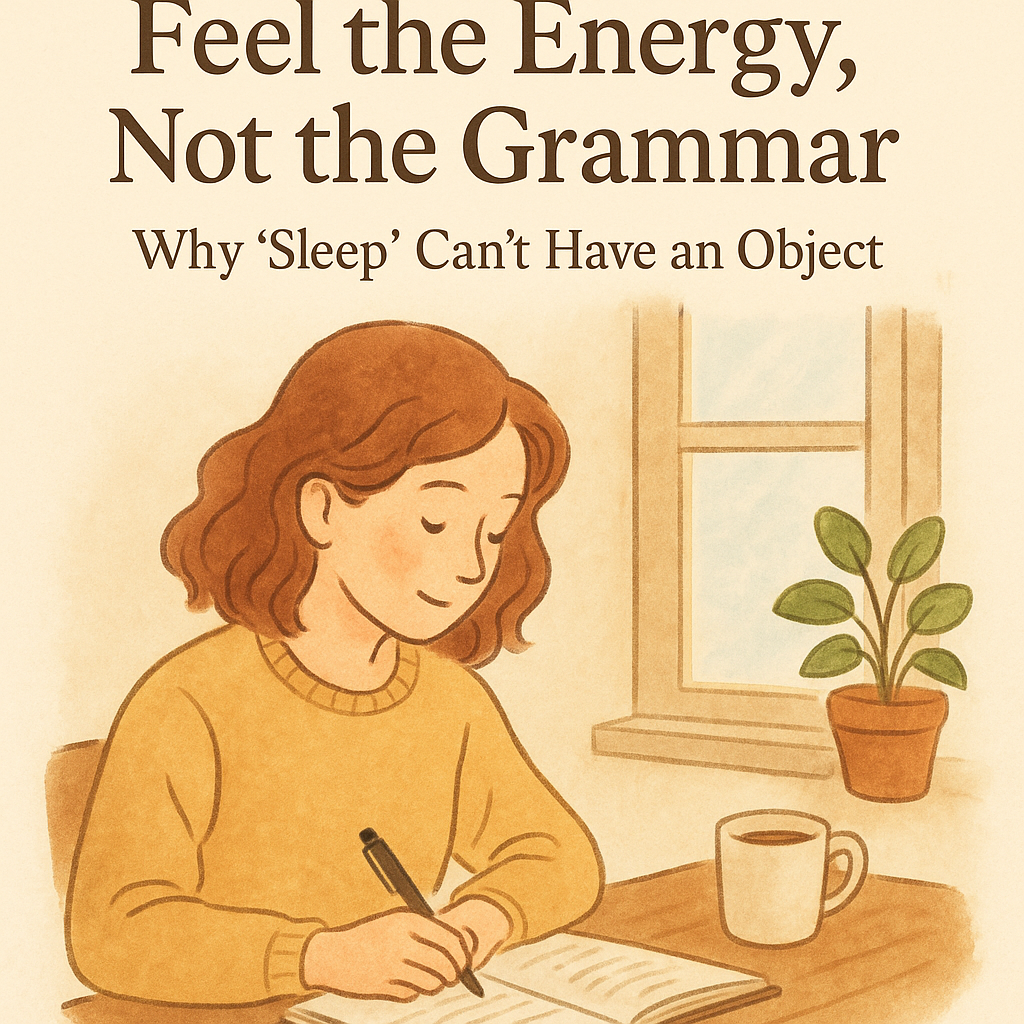
The Hidden Logic of Verbs
— Why “Sleep” Can’t Have an Object —
✍️ by Michelle Kim (MisoEnglish)
“Grammar is not just a rule — it’s the shape of thought.” 🌱
“문법은 규칙이 아니라, 사고의 모양이다.” 🌱
Many Korean learners struggle with the difference between transitive and intransitive verbs.
We tend to think, “Why can’t sleep have an object?”
The answer lies not in grammar, but in the way English and Korean think differently about action.
많은 한국 학습자들이 자동사와 타동사의 차이에서 어려움을 느낍니다.
“왜 sleep은 목적어를 못 가지지?” 하고 묻죠.
그 이유는 문법이 아니라, 행동을 바라보는 사고방식의 차이에 있습니다.
⚡ 1. English Is an Energy System
In English, every verb carries energy.
That energy either flows outward to another thing (transitive),
or stays within the subject itself (intransitive).
영어의 동사는 각각 에너지를 지니고 있습니다.
그 에너지가 밖으로 향하면 타동사,
자기 안에서 끝나면 자동사가 됩니다.
🔹 I make coffee. → Energy → coffee.
🔹 I sleep. → Energy stops here.
🔹 I make coffee. → 에너지가 ‘커피’로 향함
🔹 I sleep. → 에너지가 ‘나’ 안에서 멈춤
Korean focuses on the situation, not the direction of energy.
That’s why “나는 잔다” and “나는 커피를 만든다” feel structurally similar in Korean —
but in English, the inner logic is entirely different.
한국어는 동작의 방향보다 ‘상황’을 더 중시합니다.
그래서 “나는 잔다”와 “나는 커피를 만든다”가 문장 구조상 비슷해 보이지만,
영어에서는 행동의 에너지 화살표가 완전히 다릅니다.
🧭 2. Why Koreans Add Prepositions Unnecessarily
In Korean, particles like ~에게, ~으로, ~를 complete the meaning of verbs.
So when speaking English, many learners unconsciously try to “attach” prepositions to complete the sentence.
한국어에서는 ‘~에게, ~을, ~로’ 같은 조사가 동사의 의미를 완성합니다.
그래서 영어를 말할 때, 무의식적으로 전치사를 덧붙이려 합니다.
❌ He explained me the rule.
✅ He explained the rule to me.
In Korean logic, “누구에게 설명하다” feels natural —
so learners think “to” is necessary.
But English verbs already include that direction inside their logic.
한국어 사고에서는 “누구에게 설명하다”가 자연스럽기 때문에
“to”를 꼭 써야 할 것 같지만,
영어의 explain 은 이미 그 ‘방향성’을 내포하고 있습니다.
💡 The problem is not vocabulary — it’s perspective.
💡 문제는 단어가 아니라 사고의 구조입니다.
🌀 3. Feel the Verb’s Flow, Don’t Memorize the Category
You don’t need to memorize “this is transitive, that is intransitive.”
Instead, ask:
“Does the energy stop inside the subject, or flow out to something else?”
“자동사인지 타동사인지”를 외우려 하지 마세요.
대신 이렇게 스스로에게 물어보세요.
“이 동작의 에너지는 내 안에서 멈추는가, 아니면 밖으로 흘러가는가?”
| sleep | Intransitive | I sleep early. | Energy ends in self |
| go | Intransitive | I go home. | Direction, not object |
| make | Transitive | I make coffee. | Energy → coffee |
| send | Transitive | I send an email. | Energy → email |
| sleep | 자동사 | I sleep early. | 에너지가 주어 안에서 끝남 |
| go | 자동사 | I go home. | 방향은 있으나 목적어는 아님 |
| make | 타동사 | I make coffee. | 에너지가 대상에 닿음 |
| send | 타동사 | I send an email. | 동작이 외부로 향함 |
🌿 Intransitive verbs end where they begin.
Transitive verbs reach beyond the self.
🌿 자동사는 자기 안에서 끝나고,
타동사는 자신을 넘어 닿는다.
💫 4. Why Logic Matters for Adult Learners
Children imitate and absorb; adults analyze and understand.
We need logic to reshape instinct.
Once you understand the reason behind the rule,
your brain accepts it as truth — not as something to memorize.
아이들은 흉내로 배우지만, 성인은 논리로 이해해야 합니다.
이유를 알면 뇌는 그것을 규칙이 아니라 현상으로 받아들입니다.
그래서 성인에게는 “문법의 감정”보다 “문법의 논리”가 필요합니다.
✨ Understanding replaces memorization.
And logic builds confidence.
✨ 이해가 암기를 대신하고, 논리가 자신감을 만듭니다.
🌈 5. Practice: Trace the Energy
Close your eyes for a moment and feel the direction of each action:
I sleep. (inside)
I open the window. (outward)
I smile. (inside, emotion)
I write a letter. (outward, object)
잠시 눈을 감고, 행동의 흐름을 느껴보세요.
I sleep. (내 안에서 멈춤)
I open the window. (밖으로 향함)
I smile. (감정 안에서 끝남)
I write a letter. (대상에 닿음)
Once you “feel” it, you no longer need to ask —
your intuition will choose the right form naturally.
이 감각이 생기면, 더 이상 “자동사일까?” 고민하지 않아도 됩니다.
당신의 뇌가 이미 ‘에너지의 방향’을 알고 있으니까요.
✨ Final Thought
Korean verbs describe states; English verbs describe energy.
Once you understand where that energy flows,
grammar rules dissolve, and meaning becomes movement.
한국어는 ‘상태’를 말하지만,
영어는 ‘에너지의 방향’을 말합니다.
그 흐름을 이해하면 문법은 규칙이 아니라 자연의 감각이 됩니다.
💭 Don’t memorize verbs — feel their direction.
💭 동사를 외우지 말고, 그 에너지를 느끼세요. 🌿
© MisoEnglish / Michelle Kim. This is original content written by the author. Unauthorized reproduction or full reposting is prohibited. You may quote short parts only with clear credit and a link to the original post.
이 글은 작성자가 직접 집필한 오리지널 콘텐츠입니다. 전체 복제·무단 재게시를 금하며, 일부 인용 시에는 반드시 출처(MisoEnglish)와 링크를 남겨 주세요.
'English Mechanism' 카테고리의 다른 글
| 영어 시제: 영어는 시간축 위에 점을 찍는 언어 (0) | 2025.11.03 |
|---|---|
| 전치사는 의미의 나침반이다 (The Secret Life of Prepositions) (0) | 2025.11.03 |
| 영어 단어를 잘 기억하려면 (0) | 2025.11.03 |
| 🎶 When Grammar Starts to Sing (0) | 2025.11.02 |
| 🎵 리듬은 단어보다 먼저 도착한다 (0) | 2025.11.02 |


