
- 분류 전체보기 (580)

| 일 | 월 | 화 | 수 | 목 | 금 | 토 |
|---|---|---|---|---|---|---|
| 1 | 2 | 3 | 4 | 5 | 6 | |
| 7 | 8 | 9 | 10 | 11 | 12 | 13 |
| 14 | 15 | 16 | 17 | 18 | 19 | 20 |
| 21 | 22 | 23 | 24 | 25 | 26 | 27 |
| 28 | 29 | 30 | 31 |
- GrammarWithSoul
- 영어발음
- 🌿 English with Heart
- 영어시제
- MichelleKim
- FareRules
- 영어회화
- pnr
- 느리지만단단하게
- AirlineOpsEnglish
- Basic English Verbs
- 생활영어
- English Speaking Practice
- English in English
- 영어표현
- 영어공부법
- 감성영어
- misoenglish
- 영어접속사
- 영어표현력
- everyday English
- English for Korean Learners
- SlowBlooms
- ticketing
- 영문법
- 영어문법
- booking
- 영어공부
- 언어의철학 #의미론 #화용론 #언어와사고 #언어의미학 #MisoEnglish #TheLanguageBeyondGrammar #영문학심화
- 영어를살다
- Today
- Total
MisoEnglish
영어 시제: 영어는 시간축 위에 점을 찍는 언어 본문
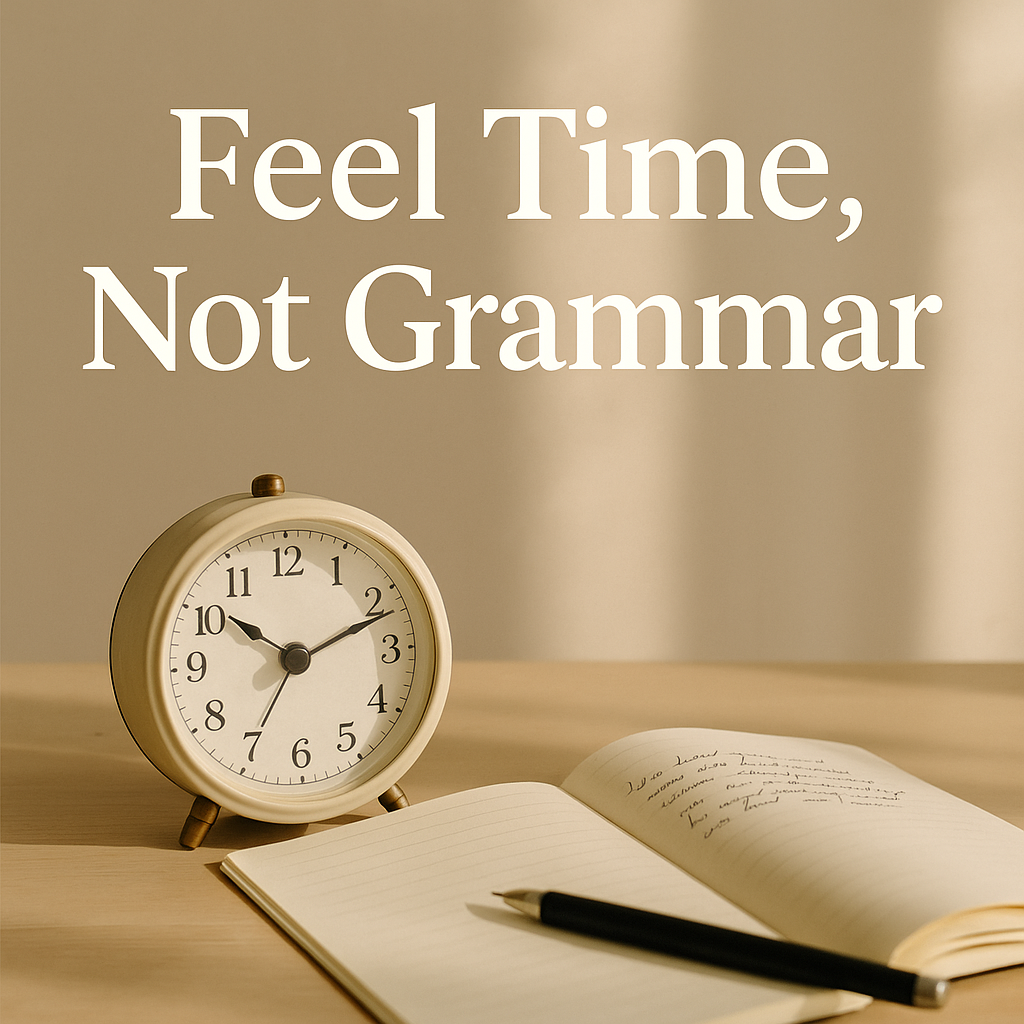
🌿 The Soul of Tense — Time You Can Feel
✍️ by Michelle Kim (MisoEnglish)
“Time in English is not measured.
It’s felt.” ⏳
영어의 시간은 측정되는 것이 아니라,
‘느껴지는 것’이다.
🕰️ 1. Time as a Living Sense
When we talk about tense, we usually think of it as grammar —
a system of rules for verbs.
But in truth, tense is not about rules.
It’s about how a language feels the flow of time.
한국어는 시간을 사건의 맥락으로 인식하지만,
영어는 시간을 사건의 위치로 인식합니다.
즉, 한국어는 “지금”을 중심으로 이야기를 풀어가는 언어,
영어는 “시간축 위에 점을 찍는 언어”예요.
Korean: “어제 영화 봤어.” (단순한 사실 진술)
English: “I watched a movie yesterday.”
→ 영어는 과거의 위치에 ‘나의 행동’을 배치합니다.
💡 영어의 시제는 “시간을 구분하는 문법”이 아니라
시간 위에서 자신을 위치시키는 사고의 지도입니다.
🌅 2. The Three Rooms of English Time
Think of English time as a house with three rooms:
Past, Present, and Future.
Every sentence must choose a room —
you can’t just float in the hallway.
영어의 문장은 반드시
‘과거 / 현재 / 미래’ 중 한 방을 선택해야 합니다.
그 방 안에서 행동이 일어나고, 감정이 머물죠.
| 🕰️ Past | Memory | I loved it. |
| ☀️ Present | Reality | I love it. |
| 🌙 Future | Expectation | I will love it. |
Korean can live between rooms —
it flows with context, without tense boundaries.
But English demands a decision.
💭 Every English sentence lives somewhere in time.
🌿 3. Time Is Energy, Not Calendar
Tense is not a calendar mark —
it’s the energy of how reality moves.
- Past tense holds stillness. (완료된 에너지)
- Present tense holds presence. (지금의 흐름)
- Future tense holds intention. (아직 도착하지 않은 움직임)
“I am learning English.”
→ not about the date — it’s about the motion of growth.
💡 영어에서 ‘-ing’는 진행이 아니라 ‘삶의 에너지’입니다.
‘하고 있는 중’은 단순한 상태가 아니라, 살아 있는 시간이에요.
💫 4. Why Koreans Struggle with English Tense
Because Korean doesn’t require you to “locate” an event in time.
We rely on adverbs — 어제, 오늘, 내일 — instead of verb forms.
So when we learn English,
we think we can just “add the right word,”
but what we really need is to shift perspective.
한국어: “나는 내일 간다.”
영어: “I will go tomorrow.”
→ 영어는 “내일”보다 will에 초점을 둡니다.
*“의지와 예견의 에너지”*를 표현하는 것이죠.
💭 You’re not just saying when — you’re saying how you exist in time.
✍️ 5. Feel Time, Don’t Translate It
To master English tense,
stop memorizing verb forms — and start feeling time.
- When you use past, imagine a memory behind you.
- When you use present, feel yourself inside the moment.
- When you use future, see the energy reaching forward.
Grammar is logic.
Tense is emotion. 🌿
💡 영어의 시제를 배우는 것은
단어를 외우는 게 아니라 시간을 감각적으로 재배치하는 일이에요.
🌸 Final Thought
Tense is the soul of English because it gives life to motion.
Without it, time is flat;
with it, time breathes.
“The past whispers,
the present speaks,
the future waits.” 🌿
So don’t just study tense —
live inside it.
© MisoEnglish / Michelle Kim. This is original content written by the author. Unauthorized reproduction or full reposting is prohibited. You may quote short parts only with clear credit and a link to the original post.
이 글은 작성자가 직접 집필한 오리지널 콘텐츠입니다. 전체 복제·무단 재게시를 금하며, 일부 인용 시에는 반드시 출처(MisoEnglish)와 링크를 남겨 주세요.
'English Mechanism' 카테고리의 다른 글
| 구동사 시리즈 #1 — GIVE (0) | 2025.11.04 |
|---|---|
| Idiom, Collocation, Phrasal Verb — 헷갈리는 세 표현의 차이 (0) | 2025.11.04 |
| 전치사는 의미의 나침반이다 (The Secret Life of Prepositions) (0) | 2025.11.03 |
| 자동사는 왜 목적어가 없나? -The Hidden Logic of Verbs (0) | 2025.11.03 |
| 영어 단어를 잘 기억하려면 (0) | 2025.11.03 |


