
- 분류 전체보기 (1053)

- Linguistics (고급 영어학) (10)
- Stylistics (6)
- Etymology & Word Building (15)
- Philosophy Meets Grammar (6)
- Collection of Famous Quotes (22)
- English Mechanism (276)
- The Language Beyond Grammar (274)
- Living English (81)
- Miso’s Life Notes (18)
- My English Journey and Refl.. (16)
- Philosophy (132)
- Video Clip (16)
- Airline English (항공 영어) (47)
- Creative Corner (35)
- Sally & Sia (1)
| 일 | 월 | 화 | 수 | 목 | 금 | 토 |
|---|---|---|---|---|---|---|
| 1 | 2 | 3 | 4 | |||
| 5 | 6 | 7 | 8 | 9 | 10 | 11 |
| 12 | 13 | 14 | 15 | 16 | 17 | 18 |
| 19 | 20 | 21 | 22 | 23 | 24 | 25 |
| 26 | 27 | 28 | 29 | 30 |
- MisoEnglish#유교철학 #Confucianism #성리학 #NeoConfucianism #인의예지 #Virtue #맹자 #Mencius #실학 #KoreanScholarship
- MisoEnglish#한국철학 #KoreanPhilosophy #홍익인간 #Hongik #화랑도 #Hwarang #단군 #Dangun #풍류도 #ThreeKingdoms#동양철학
- 영어접속사
- Basic English Verbs
- pnr
- MisoEnglish#철학입문 #Philosophy #심리철학 #PhilosophyOfMind #철학공부 #의식 #마음 #PhilosophyForBeginners #교육콘텐츠 #철학시리즈
- 🌿 English with Heart
- ticketing
- EnglishWriting #AcademicWriting #Grammar #EnglishLanguage #EssayWriting #ParagraphStructure #SentenceStructure #BusinessEnglish #EnglishTips #WritingSkills #Linguistics #ESL
- 감성영어
- misoenglish
- MisoEnglish#철학입문 #Philosophy #윤리학 #Ethics #도덕철학 #철학공부 #칸트 #공리주의 #교육콘텐츠 #철학시리즈
- 동양정치철학 #시리즈완결 #아시아적가치 #동서양비교 #유교 #민주주의 #정치사상 #인문학 #비교철학 #글로벌정치 #문화다양성 #2500년철학사
- 영어문법
- MisoEnglish#철학입문 #Philosophy #정치철학 #PoliticalPhilosophy #철학공부 #정의론 #자유주의 #PhilosophyForBeginners #교육콘텐츠 #철학시리즈
- 영어회화
- 영문법
- English Speaking Practice
- MisoEnglish#도교철학 #Taoism #도덕경 #TaoTeChing #무위자연 #WuWei #노자 #Laozi #장자 #YinYang
- 영어공부
- MisoEnglish#철학입문 #Philosophy #과학철학 #PhilosophyOfScience #철학공부 #포퓨퍼 #쿠hn #과학방법론 #교육콘텐츠 #철학시리즈
- 인도철학 #동양철학 #인문학 #요가 #명상 #힌두교 #불교 #간디 #타고르 #정통6파 #철학공부 #마음공부 #MisoEnglish #인문학영어
- AirlineOpsEnglish
- MisoEnglish#철학입문 #Philosophy #종교철학 #PhilosophyOfReligion #철학공부 #신존재증명 #악의문제 #PhilosophyForBeginners #교육콘텐츠 #철학시리즈
- MisoEnglish#철학입문 #Philosophy #형이상학 #Metaphysics #철학공부 #존재론 #실재론 #PhilosophyForBeginners #교육콘텐츠 #철학시리즈
- English for Korean Learners
- English in English
- everyday English
- MisoEnglish#불교철학 #BuddhismPhilosophy #사성제 #FourNobleTruths #공사상 #Emptiness #명상 #Mindfulness #열반 #EasternWisdom
- 영국사 #영국역사 #세계사 #역사연재 #브리튼에서영국까지
- Today
- Total
MisoEnglish
18편. 저무는 영웅들의 시대 — 촉과 오의 쇠퇴, 삼국의 황혼 본문
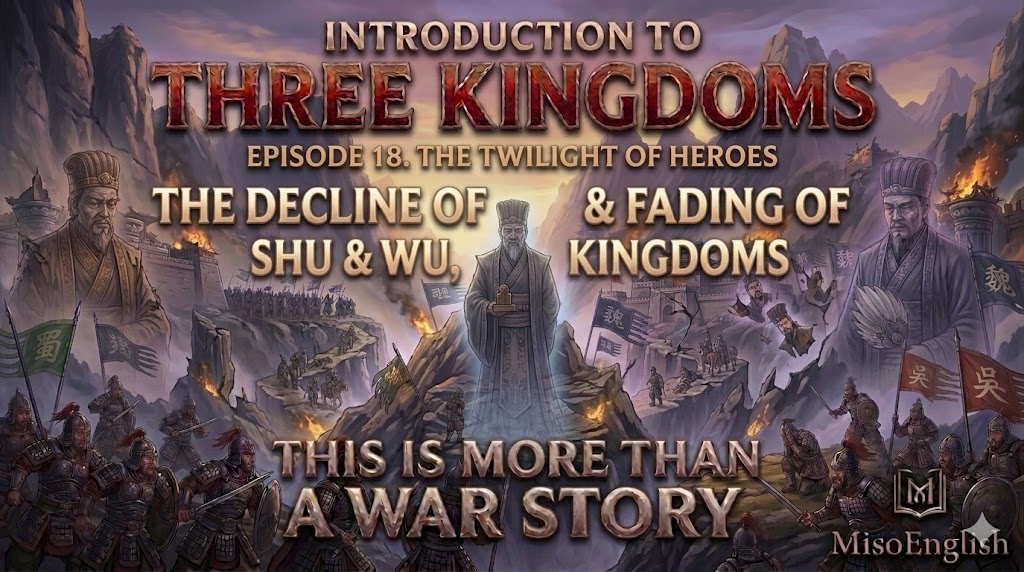
18편. 저무는 영웅들의 시대 — 촉과 오의 쇠퇴, 삼국의 황혼
삼국지의 마지막 장이 넘어가고 있어요. 제갈량이 오장원에서 쓰러지고, 사마의가 위나라 권력을 손에 넣은 뒤 — 촉한과 오나라는 서서히 내리막길을 걷기 시작합니다. 화려했던 영웅들의 시대가 저물고, 무대 위에 남은 건 그 영웅들의 그림자를 이어받은 2세대, 3세대들이었어요. 하지만 그림자는 아무리 길어도 실체가 될 수 없었습니다. 삼국의 황혼이 시작됩니다.
제갈량 없는 촉한 — 강유의 외로운 싸움
제갈량이 죽은 후 촉한을 이끈 인물은 **강유(姜維)**였어요. 원래 위나라 장수였다가 제갈량에게 귀순한 강유는, 스승의 뜻을 이어 북벌을 계속했습니다. 무려 11번의 북벌을 시도했어요. 제갈량의 5번도 대단하다고 했는데, 강유는 그보다 더 많이 나갔죠.
하지만 강유의 북벌은 제갈량의 북벌과는 달랐어요. 제갈량은 북벌을 하면서도 촉한의 내정을 함께 챙겼거든요. 강유는 군사에만 집중하다 보니 내정이 흔들렸어요. 백성들은 지쳐갔고, 군량 조달은 갈수록 힘들어졌습니다.
결정적으로 강유의 발목을 잡은 건 내부의 적이었어요. 황제 유선의 총애를 받던 환관 **황호(黃皓)**가 권력을 휘두르며 강유를 견제했거든요. 황호는 강유를 제거하려 했고, 강유는 목숨이 위태로워 아예 변방에 나가 둔전을 일구며 스스로를 지켜야 했어요.
촉한 말기의 황제 유선은 어떤 인물이었을까요? 역사에서 유선은 **"어리석은 황제"**의 대명사로 불려요. 제갈량이 살아 있을 때는 그나마 나라가 굴러갔지만, 제갈량이 죽고 나서는 황호 같은 간신에게 놀아났습니다. 나라가 위태로울 때도 향락에 빠져 있었고, 신하들의 간언은 귀담아듣지 않았어요.
촉한의 멸망 — 아두의 항복
263년, 위나라 실권자 **사마소(司馬昭)**가 마침내 촉한 정벌을 결정합니다. 총사령관은 **등애(鄧艾)**와 **종회(鍾會)**였어요. 위나라의 대군이 세 방향에서 동시에 촉한을 압박했습니다.
강유는 **검각(劍閣)**이라는 천혜의 요새에서 종회의 대군을 막아냈어요. 검각은 워낙 험준해서 정면 돌파가 불가능한 곳이었거든요. 종회는 꼼짝도 못 했습니다.
그런데 등애가 상식을 뛰어넘는 행동을 했어요. 사람이 다닐 수 없다고 알려진 **음평(陰平)**의 험로를 넘기로 한 거예요. 산악 지대를 넘고, 절벽을 타고, 담요에 몸을 말아 비탈을 굴러 내려오면서 — 등애의 군대는 기적처럼 촉한의 심장부 성도(成都) 근처에 나타났습니다.
촉한은 완전히 허를 찔렸어요. 강유는 검각에서 종회를 막고 있었고, 성도를 지킬 병력은 없었습니다. 황제 유선은 신하들과 상의 끝에 항복을 결정했어요. 나라를 위해 끝까지 싸우자는 신하도 있었지만, 유선은 듣지 않았습니다.
263년, 촉한은 멸망했어요. 건국 43년 만이었습니다.
유선이 위나라로 끌려가 연회에 참석했을 때, 사마소가 물었어요.
"촉이 그립지 않소?"
유선은 웃으며 답했습니다.
"이곳이 즐거워 촉이 생각나지 않습니다(此間樂, 不思蜀)."
이 말에서 나온 사자성어가 낙불사촉(樂不思蜀) — 즐거워서 고향을 생각하지 않는다는 뜻이에요. 망국의 황제가 아무렇지 않게 이런 말을 했다는 게 어이없기도 하고, 측은하기도 해요. 옆에 있던 신하 **극정(郤正)**이 귀띔해줬다는 설도 있지만 — 어쨌든 이 한마디가 유선이라는 인물을 완벽하게 설명해줍니다.
강유의 마지막 도박
촉한이 항복했지만, 강유는 포기하지 않았어요. 그는 종회에게 접근해 귀를 속삭였습니다.
"위나라에서 사마소의 권력이 너무 강해졌습니다. 당신도 곧 제거될 거예요. 우리가 손을 잡고 사마소를 치고, 촉한을 다시 세웁시다."
종회는 솔깃했어요. 실제로 종회는 촉 땅에서 독립을 꿈꾸고 있었거든요. 두 사람은 비밀리에 거사를 모의했습니다.
하지만 계획은 새어나갔어요. 위나라 병사들이 반란을 일으켜 종회를 죽였고, 강유도 그 혼란 속에서 목숨을 잃었습니다. 강유는 죽으면서도 칼을 뽑아 싸웠다고 해요. 끝까지 싸운 거죠.
강유의 죽음으로 촉한의 마지막 불꽃도 완전히 꺼졌습니다.
손권 없는 오나라 — 내부에서 무너지다
오나라의 쇠퇴는 촉한과는 다른 방식이었어요. 외부의 적이 아니라 내부의 권력 다툼이 오나라를 갉아먹었습니다.
손권은 말년에 판단력이 흐려졌어요. 후계자 문제를 제대로 정리하지 못하면서, 아들들 사이의 권력 다툼이 심해졌습니다. 손권이 죽고 나서 오나라는 황제가 수시로 바뀌고, 권신들이 날뛰는 혼란에 빠졌어요.
손량(孫亮), 손휴(孫休), 손호(孫皓) — 손권 이후의 황제들은 하나같이 문제가 많았어요. 특히 마지막 황제 **손호(孫皓)**는 잔혹하고 포악한 통치로 민심을 완전히 잃었습니다. 신하들을 함부로 처형하고, 사치와 향락에 빠졌으며, 충언을 하는 신하는 죽이거나 눈을 파냈어요.
오나라 내부는 이미 썩을 대로 썩어 있었습니다. 버티고 있던 건 지리적 이점과 양쯔강의 천혜의 방어선뿐이었죠.
삼국의 황혼
촉한이 263년에 멸망하고, 위나라도 265년에 사마염에 의해 사실상 무너졌어요. 이제 남은 건 오나라뿐이었습니다. 하지만 오나라도 시간문제였어요. 손호의 폭정으로 민심은 떠났고, 군사력은 약해졌으며, 나라를 지킬 의지도 흔들렸습니다.
삼국지의 영웅들이 꿈꿨던 세상 — 조조의 통일, 유비의 한나라 회복, 손권의 강남 제국 — 그 어느 것도 이루어지지 않았어요. 대신 삼국 모두가 사마씨의 손에 넘어가는 역설적인 결말이 기다리고 있었습니다.
역사는 때로 영웅들이 원했던 방향이 아닌, 전혀 다른 곳으로 흘러가기도 하죠.
맺음말
촉한은 263년에, 위나라는 265년에 역사 속으로 사라졌어요. 마지막으로 남은 오나라도 이제 카운트다운이 시작됐습니다. 삼국지의 마지막 페이지가 넘어가고 있어요.
다음 편 예고: 사마씨의 진나라 창업과 오나라의 최후 — 100년 가까운 삼국의 싸움이 마침내 하나로 합쳐지는 순간. 삼국지의 대단원을 19편에서 만나요!
Episode 18. The Twilight of Heroes — The Decline of Shu and Wu, and the Fading of the Three Kingdoms
The final pages of the Three Kingdoms are turning. After Zhuge Liang fell at Wuzhang Plains and Sima Yi seized control of Wei — Shu Han and Wu began their long, slow descent. The age of the great heroes was ending. What remained on the stage were second and third-generation figures trying to carry legacies that were already too heavy to hold. A shadow, no matter how long, can never become the thing that cast it. The twilight of the Three Kingdoms had arrived.
Shu Han Without Zhuge Liang — Jiang Wei's Lonely War
After Zhuge Liang's death, the man who took up his banner was Jiang Wei (姜維) — the former Wei officer who had defected to Shu after being moved by Zhuge Liang's character. He honored his teacher's legacy by continuing the Northern Expeditions. Eleven times in total. Zhuge Liang's five campaigns were already considered extraordinary — Jiang Wei went more than twice as many times.
But Jiang Wei's expeditions were different from Zhuge Liang's in one critical way. Zhuge Liang had managed both the military campaigns and the internal administration of Shu Han simultaneously. Jiang Wei was a soldier, not a statesman. While he was focused on the frontier, the government back home was drifting. The people were exhausted. Supply chains were fraying.
His most damaging obstacle, though, was internal. A eunuch named Huang Hao (黃皓) had captured the affections of Emperor Liu Shan and was wielding real power behind the scenes — constantly working to undermine Jiang Wei. Things got so dangerous that Jiang Wei eventually stationed himself permanently at a frontier outpost just to stay out of Huang Hao's reach.
As for Liu Shan himself — history has not been kind to him. He is remembered as the archetypal weak ruler: indulgent where Zhuge Liang had been disciplined, easily manipulated where Zhuge Liang had been clear-eyed. Shu Han had been held together by one extraordinary man, and when that man was gone, the seams showed immediately.
The Fall of Shu Han — A Dou Surrenders
In 263 AD, Sima Zhao (司馬昭) — by now the dominant power in Wei — decided the time had come to finish Shu Han. He sent two commanders: Deng Ai (鄧艾) and Zhong Hui (鍾會). Wei's armies pushed in from three directions simultaneously.
Jiang Wei raced to hold Jianmen Pass (劍閣) — a natural fortress so formidably steep that Zhong Hui's massive army couldn't force its way through. The defense held. Zhong Hui was stuck.
Then Deng Ai did something that shouldn't have been possible. He took his army through Yinping (陰平) — a route through mountain terrain so treacherous it was considered impassable. His men climbed cliffs, traversed glaciers, and reportedly wrapped themselves in felt blankets to roll down icy slopes. Somehow, they came out the other side — materializing near the Shu capital Chengdu (成都) like an apparition.
Shu Han had no answer for this. Jiang Wei was defending the wrong door. The capital was unguarded. Liu Shan consulted his officials and surrendered.
In 263 AD, Shu Han ceased to exist — 43 years after its founding.
When Liu Shan was brought to a banquet in Wei, Sima Zhao asked him:
"Do you miss Shu?"
Liu Shan smiled and replied:
"I am so happy here that I don't think of Shu at all (此間樂,不思蜀)."
This exchange produced the Chinese idiom lè bù sī Shǔ (樂不思蜀) — so content that one forgets home entirely. Whether Liu Shan was being genuine, strategic, or had simply taken coaching from an advisor standing nearby, this one line has defined his legacy across seventeen centuries. It tells you everything.
Jiang Wei's Last Gamble
Even after Liu Shan's surrender, Jiang Wei wasn't done. He approached Zhong Hui with a proposal whispered in private:
"Sima Zhao's power in Wei has grown too great. You'll be next on his list. Let's join forces, kill Sima Zhao, and restore Shu Han together."
Zhong Hui was tempted — he had his own ambitions for independence in the Shu territories. The two men began plotting in secret. But the plan leaked. Wei soldiers mutinied, killed Zhong Hui, and Jiang Wei died in the chaos — reportedly still fighting, sword drawn, until the end.
With Jiang Wei gone, the last ember of Shu Han was extinguished.
Wu Without Sun Quan — Rotting From the Inside
Wu's decline took a different form. It wasn't primarily an external enemy that undid it — it was internal collapse. The power struggles, the succession crises, and eventually a ruler so cruel that his own people stopped wanting the kingdom to survive.
Sun Quan's final years were marked by deteriorating judgment and a catastrophic failure to resolve the question of succession. After his death, the Wu throne changed hands repeatedly amid intrigue and violence. Sun Liang (孫亮), Sun Xiu (孫休), Sun Hao (孫皓) — each of Sun Quan's successors came with their own problems. The last of them, Sun Hao (孫皓), was by any measure one of the worst rulers of the era — executing ministers on a whim, indulging in extravagant luxury, and reportedly gouging out the eyes of officials who dared speak honestly to him.
By the time Wu's end came, the kingdom had been hollowed out from within. What kept it standing wasn't strength — it was geography. The Yangtze River was still a formidable barrier. But barriers only hold as long as the people behind them have the will to defend them.
The Twilight
Shu Han fell in 263 AD. Wei — transformed by Sima Yi's coup and its aftermath — effectively ceased to exist as a Cao family kingdom in 265 AD, when Sima Yan forced the last Wei emperor to abdicate. Only Wu remained.
But none of the three kingdoms had achieved what their founders dreamed of. Not Cao Cao's unified empire. Not Liu Bei's restored Han. Not Sun Quan's enduring southern dynasty. Instead, all three were absorbed — one way or another — into something none of them had imagined: the Sima family's new order.
History doesn't always flow in the direction the heroes intended.
Closing
Shu Han was gone in 263. Wei in all but name by 265. Wu was living on borrowed time, the Yangtze its last line of defense. The Three Kingdoms were collapsing into one — and the man holding the net to catch them all was Sima Yan, grandson of the man who had outlasted everyone.
Next episode preview: Sima Yan founds the Jin Dynasty — and Wu makes its last stand. The century-long drama of the Three Kingdoms reaches its conclusion. The final chapter arrives in Episode 19!
⚠️ 저작권 안내
본 블로그(MisoEnglish · slowblooms.tistory.com)의 모든 콘텐츠는 저작권법의 보호를 받습니다. 글, 예시 문장, 분석 내용 등 블로그에 게시된 모든 창작물은 저작자의 동의 없이 무단으로 복사, 복제, 배포, 2차 가공하는 행위를 금지합니다. 출처를 밝히지 않은 전재, SNS·커뮤니티·타 블로그 등에의 무단 게시, 상업적 이용은 모두 금지되며, 무단 불펌 적발 시 저작권법에 따라 법적 조치가 취해질 수 있습니다. 콘텐츠 사용 문의는 slowblooms.tistory.com으로 연락 주세요.
© MisoEnglish · slowblooms.tistory.com. All rights reserved.
━━━━━━━━━━━━━━━━━━━━━━━━━━━━━━━━
⚠️ Copyright Notice
All content published on this blog (MisoEnglish · slowblooms.tistory.com) is protected by copyright law. Copying, reproducing, distributing, or adapting any written posts, example sentences, or analyses without the explicit consent of the author is strictly prohibited. Unauthorised reposting on other blogs, social media, online communities, or any public platform — with or without modification — is not permitted, and may result in legal action under applicable copyright law. For content licensing enquiries, please contact us via slowblooms.tistory.com.
© MisoEnglish · slowblooms.tistory.com. All rights reserved.
'The Language Beyond Grammar' 카테고리의 다른 글
| 20편. 1,800년을 건너온 이야기 — 삼국지가 남긴 인물들, 전략, 그리고 오늘의 의미 (0) | 2026.03.07 |
|---|---|
| 19편. 천하는 하나로 — 사마씨의 진나라 창업과 삼국의 종말 (0) | 2026.03.07 |
| 17편. 인내가 천재를 이기다 — 사마의의 부상과 위나라 권력 이동 (0) | 2026.03.07 |
| 16편. 끝없는 길 — 제갈량의 북벌과 오장원의 별 (0) | 2026.03.06 |
| 15편. 무너지는 삼국의 균형 — 관우의 최후와 연쇄적인 비극 (1) | 2026.03.06 |


