
- 분류 전체보기 (1053)

- Linguistics (고급 영어학) (10)
- Stylistics (6)
- Etymology & Word Building (15)
- Philosophy Meets Grammar (6)
- Collection of Famous Quotes (22)
- English Mechanism (276)
- The Language Beyond Grammar (274)
- Living English (81)
- Miso’s Life Notes (18)
- My English Journey and Refl.. (16)
- Philosophy (132)
- Video Clip (16)
- Airline English (항공 영어) (47)
- Creative Corner (35)
- Sally & Sia (1)
| 일 | 월 | 화 | 수 | 목 | 금 | 토 |
|---|---|---|---|---|---|---|
| 1 | 2 | 3 | 4 | |||
| 5 | 6 | 7 | 8 | 9 | 10 | 11 |
| 12 | 13 | 14 | 15 | 16 | 17 | 18 |
| 19 | 20 | 21 | 22 | 23 | 24 | 25 |
| 26 | 27 | 28 | 29 | 30 |
- MisoEnglish#한국철학 #KoreanPhilosophy #홍익인간 #Hongik #화랑도 #Hwarang #단군 #Dangun #풍류도 #ThreeKingdoms#동양철학
- misoenglish
- 🌿 English with Heart
- English Speaking Practice
- AirlineOpsEnglish
- MisoEnglish#철학입문 #Philosophy #종교철학 #PhilosophyOfReligion #철학공부 #신존재증명 #악의문제 #PhilosophyForBeginners #교육콘텐츠 #철학시리즈
- ticketing
- 영어접속사
- MisoEnglish#철학입문 #Philosophy #윤리학 #Ethics #도덕철학 #철학공부 #칸트 #공리주의 #교육콘텐츠 #철학시리즈
- 영어문법
- English in English
- English for Korean Learners
- MisoEnglish#도교철학 #Taoism #도덕경 #TaoTeChing #무위자연 #WuWei #노자 #Laozi #장자 #YinYang
- 영국사 #영국역사 #세계사 #역사연재 #브리튼에서영국까지
- EnglishWriting #AcademicWriting #Grammar #EnglishLanguage #EssayWriting #ParagraphStructure #SentenceStructure #BusinessEnglish #EnglishTips #WritingSkills #Linguistics #ESL
- MisoEnglish#철학입문 #Philosophy #과학철학 #PhilosophyOfScience #철학공부 #포퓨퍼 #쿠hn #과학방법론 #교육콘텐츠 #철학시리즈
- MisoEnglish#불교철학 #BuddhismPhilosophy #사성제 #FourNobleTruths #공사상 #Emptiness #명상 #Mindfulness #열반 #EasternWisdom
- 영어회화
- everyday English
- Basic English Verbs
- 영문법
- MisoEnglish#철학입문 #Philosophy #형이상학 #Metaphysics #철학공부 #존재론 #실재론 #PhilosophyForBeginners #교육콘텐츠 #철학시리즈
- MisoEnglish#철학입문 #Philosophy #정치철학 #PoliticalPhilosophy #철학공부 #정의론 #자유주의 #PhilosophyForBeginners #교육콘텐츠 #철학시리즈
- 인도철학 #동양철학 #인문학 #요가 #명상 #힌두교 #불교 #간디 #타고르 #정통6파 #철학공부 #마음공부 #MisoEnglish #인문학영어
- 동양정치철학 #시리즈완결 #아시아적가치 #동서양비교 #유교 #민주주의 #정치사상 #인문학 #비교철학 #글로벌정치 #문화다양성 #2500년철학사
- 감성영어
- pnr
- MisoEnglish#유교철학 #Confucianism #성리학 #NeoConfucianism #인의예지 #Virtue #맹자 #Mencius #실학 #KoreanScholarship
- MisoEnglish#철학입문 #Philosophy #심리철학 #PhilosophyOfMind #철학공부 #의식 #마음 #PhilosophyForBeginners #교육콘텐츠 #철학시리즈
- 영어공부
- Today
- Total
MisoEnglish
14편. 줄타기의 달인 — 손권의 선택, 위와의 동맹 혹은 대립 본문
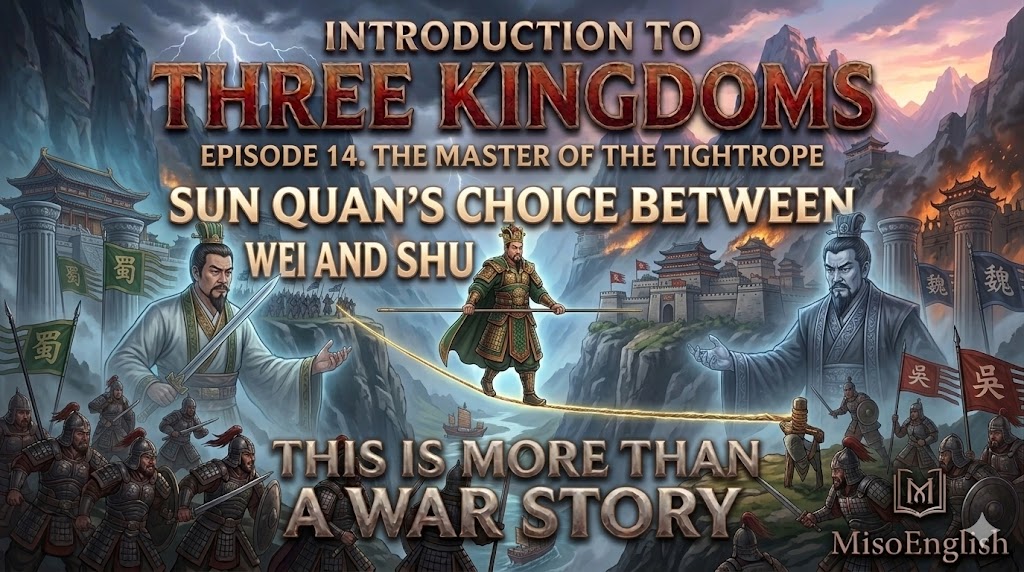
14편. 줄타기의 달인 — 손권의 선택, 위와의 동맹 혹은 대립
삼국지에서 가장 영리한 외교관을 꼽으라면 단연 **손권(孫權)**이에요. 조조는 힘으로 밀어붙였고, 유비는 명분으로 밀어붙였는데 — 손권은 달랐어요. 그는 철저하게 실리를 따졌습니다. 위와 촉 사이에서 줄을 타며, 때로는 손을 잡고 때로는 등을 돌리면서 오나라를 가장 오래 유지시킨 인물이에요. 손권의 외교는 화려하진 않았지만, 그 어떤 전략보다 효과적이었습니다.
적벽 이후 손권의 딜레마
적벽대전에서 조조를 물리친 손권은 강동을 굳혔어요. 하지만 기쁨도 잠깐, 손권 앞에는 복잡한 현실이 펼쳐졌습니다. 북쪽에는 여전히 강대한 조조가 버티고 있었고, 서쪽에서는 유비가 빠르게 세력을 키우고 있었어요. 두 강대국 사이에 낀 오나라 — 손권은 어느 쪽과 손을 잡아야 살아남을 수 있을지 항상 계산해야 했습니다.
손권의 기본 전략은 간단했어요.
"조조가 강하면 유비와 손잡고, 유비가 강하면 조조와 손잡는다."
천하 균형을 유지하면서 오나라의 생존을 보장하는 방식이었죠. 냉정하게 들리지만, 이게 손권이 삼국 중 가장 오래 살아남은 비결이었어요.
손권과 유비 — 동맹과 갈등 사이
적벽대전 직후 손권과 유비는 동맹 관계였어요. 공동의 적 조조가 있었으니까요. 손권은 심지어 여동생을 유비에게 시집보내며 동맹을 강화했죠. 하지만 이 결혼은 정략적인 면이 강했고, 두 사람의 관계는 늘 팽팽한 긴장감이 흘렀어요.
결정적인 균열은 형주 문제였어요. 손권은 유비에게 빌려준 형주를 돌려달라고 계속 요구했지만, 유비는 차일피일 미뤘죠. 손권의 인내심은 한계에 달했어요. 결국 손권은 **여몽(呂蒙)**을 보내 형주를 기습해 빼앗았고, 관우가 목숨을 잃게 됩니다.
유비가 복수를 위해 대군을 이끌고 쳐들어오자 — 손권은 잠깐 조조에게 신하를 칭하는 굴욕을 감수하면서까지 위와의 관계를 안정시켰어요. 오나라가 위와 촉 양쪽에서 동시에 공격받는 최악의 상황을 피하기 위해서였죠. 그리고 **이릉대전(夷陵之戰)**에서 유비의 대군을 물리쳤습니다.
이릉대전 — 육손의 기적
222년, 유비는 관우의 복수를 위해 70만 대군을 이끌고 오나라를 공격합니다. 손권은 뜻밖의 카드를 꺼내들었어요. 당시 30대 초반의 젊은 장수 **육손(陸遜)**을 총사령관으로 임명한 거예요. 유비 진영에서는 코웃음을 쳤어요. "저런 젊은이가 무슨 대장군이냐"고요.
육손은 서두르지 않았어요. 유비군이 험준한 산악 지대로 길게 늘어서자, 그는 무려 반년 가까이 기다렸습니다. 그리고 여름이 깊어지자 움직였어요. 유비군이 더위에 지쳐 강가와 숲속에 진영을 옮겨놓은 틈을 타, **화공(火攻)**을 감행했습니다.
수십 개의 진영이 순식간에 불바다가 됐어요. 유비의 대군은 무너졌고, 유비는 간신히 목숨만 건져 백제성으로 달아났습니다. 이릉대전은 촉한에게 씻을 수 없는 타격이었어요. 유비는 이 패배의 충격을 이기지 못하고 백제성에서 눈을 감았습니다.
손권의 위나라 신하 자처 — 굴욕인가, 전략인가
유비가 쳐들어오는 동안, 손권은 조비에게 신하를 칭했어요. 오나라 왕으로 봉해달라고 요청한 거죠. 신하들 중 일부는 반발했어요. "어떻게 그런 굴욕을 감수할 수 있습니까?" 하지만 손권의 생각은 달랐어요.
"지금은 때가 아니다. 살아남는 게 먼저다."
이릉대전에서 유비를 물리치고 나자, 손권은 태도를 바꿨어요. 조비가 약속을 어기고 오나라를 압박하자, 손권은 다시 촉한과 손을 잡았습니다. 제갈량도 오나라와의 동맹이 필요했거든요. 북벌을 하려면 동쪽이 안정돼야 했으니까요.
이렇게 손권은 위와 촉 사이를 오가며 오나라의 이익을 최대화했어요. 조조도, 유비도, 조비도, 제갈량도 — 손권만큼 냉정하게 상황을 읽은 인물은 없었습니다.
손권, 마침내 황제를 선포하다
229년, 손권은 드디어 황제를 선포합니다. 나라 이름은 오(吳). 이제 위·촉·오 세 나라가 모두 황제를 가진 정식 국가가 됐어요. 삼국정립(三國鼎立) — 세 나라가 솥발처럼 서로를 떠받치는 구도가 완성된 거죠.
손권은 황제가 된 후에도 기본 전략을 바꾸지 않았어요. 오나라의 경제력을 키우고, 강남 지역을 개발하며, 해상 무역을 장려했습니다. 군사적 정복보다 내실을 다지는 방향이었죠. 덕분에 오나라는 삼국 중 가장 오래 — 280년까지 — 존속했어요.
손권이라는 인물
손권을 단순히 기회주의자로 보면 안 돼요. 그는 형과 아버지가 이룬 것을 지키고 발전시켜야 한다는 무거운 짐을 평생 짊어졌어요. 조조나 유비처럼 화려한 영웅담은 없지만, 삼국 중 가장 현실적이고 지속 가능한 나라를 만든 인물이 손권이었습니다.
조조가 이런 말을 남겼다고 하죠.
"아들을 낳으려면 손권 같은 아들을 낳아야 한다."
적에게서 이런 평가를 받은 인물 — 그게 손권이에요.
맺음말
손권이 오나라를 굳건히 다지는 동안, 촉한에서는 제갈량이 끝없는 북벌을 이어가고 있었어요. 그리고 그 북벌의 최대 장애물은 언제나 한 사람이었습니다 — 사마의(司馬懿). 제갈량의 천재성에 맞선 사마의의 인내, 그리고 위나라 권력의 서서히 이동하는 이야기가 다음을 기다립니다.
다음 편 예고: 관우의 죽음, 장비의 최후, 그리고 유비의 이릉대전 패배까지 — 촉한의 균형이 한순간에 무너지는 비극을 15편에서 만나요!
Episode 14. The Master of the Tightrope — Sun Quan's Choice Between Wei and Shu
If you had to name the shrewdest diplomat in the Three Kingdoms, it would be Sun Quan (孫權), and it wouldn't be particularly close. Cao Cao pushed through strength. Liu Bei pushed through moral authority. Sun Quan was different. He was guided entirely by pragmatism. Swinging between Wei and Shu as the situation demanded — sometimes clasping their hands, sometimes stabbing their backs — he kept Wu alive longer than either of the other two kingdoms. His diplomacy was never glamorous. It was just effective.
Sun Quan's Dilemma After Red Cliffs
After driving Cao Cao off the Yangtze, Sun Quan had secured Jiangdong. But the celebration was brief. To the north, Cao Cao remained enormously powerful. To the west, Liu Bei was growing faster than anyone had expected. Squeezed between two expanding powers, Sun Quan had to constantly calculate which alignment would keep Wu alive.
His operating principle was simple:
"When Cao Cao is stronger, align with Liu Bei. When Liu Bei is stronger, align with Cao Cao."
Keep the balance. Prevent either rival from becoming dominant enough to swallow Wu whole. It sounds cold — but it's precisely why Wu outlasted both of its rivals.
Sun Quan and Liu Bei — Alliance and Fracture
Right after Red Cliffs, Sun Quan and Liu Bei were genuine allies. They had a common enemy in Cao Cao, and Sun Quan even gave his sister to Liu Bei in marriage to cement the bond. But the marriage was more political than warm, and the relationship was always underpinned by tension.
The breaking point was Jing Province. Sun Quan kept asking for it back. Liu Bei kept finding reasons to delay. When Sun Quan's patience finally ran out, he sent Lü Meng (呂蒙) to take it by force — and Guan Yu lost his life in the aftermath.
When Liu Bei came roaring back with a massive revenge army, Sun Quan made a calculated humiliation: he submitted to Cao Pi, accepted the title of King of Wu as a vassal, and stabilized his northern border while he dealt with Liu Bei to the west. He was not going to fight two wars at once. Not if he could help it.
The Battle of Yiling — Lu Xun's Miracle
In 222 AD, Liu Bei led what accounts describe as 700,000 men into Wu territory — driven entirely by grief and rage over Guan Yu's death. Sun Quan's response was to appoint a general that nobody took seriously: Lu Xun (陸遜), a scholar-commander in his early thirties. Liu Bei's camp practically laughed. A bookish young man as supreme commander?
Lu Xun didn't move. He waited. For nearly half a year, he absorbed Liu Bei's pressure without committing to a decisive engagement, while Liu Bei's long supply lines stretched thin and his troops wilted in the summer heat. When Liu Bei's forces relocated their camps into the forests and along the riverbanks to escape the temperature, Lu Xun finally struck — with fire.
Dozens of camps went up in flames simultaneously. Liu Bei's great army disintegrated. He barely escaped with his life and fled to White Emperor City. The Battle of Yiling was a blow that Shu Han never fully recovered from — and it was the defeat that broke Liu Bei's health and spirit.
Submitting to Wei — Humiliation or Strategy?
While Liu Bei was bearing down on him, Sun Quan had accepted vassal status under Cao Pi. Some of his own officials were appalled. "How can you accept such humiliation?" Sun Quan's answer was characteristic:
"Now is not the time. Surviving comes first."
Once Liu Bei was crushed at Yiling and the threat from the west was gone, Sun Quan's tone toward Wei changed quickly. When Cao Pi broke his promises and began pressuring Wu, Sun Quan pivoted back toward Shu Han. Zhuge Liang needed the alliance too — he couldn't launch his Northern Expeditions with Wu threatening him from the east.
Sun Quan had played both sides and come out ahead. Neither Cao Cao, nor Liu Bei, nor Cao Pi, nor Zhuge Liang read the situation with the same cold clarity that Sun Quan consistently did.
Sun Quan Finally Declares Himself Emperor
In 229 AD, Sun Quan proclaimed himself emperor of Wu (吳). All three kingdoms now had emperors of their own. The configuration historians call Three Kingdoms Standing Like a Tripod (三國鼎立) — three states holding each other in balance like the three legs of a cauldron — was now fully realized.
Even after becoming emperor, Sun Quan didn't abandon what had made Wu durable. He invested in developing the Yangtze Delta, promoted maritime trade, and focused on building economic strength rather than chasing military glory. Wu was, in many ways, the most internally healthy of the three kingdoms — which is why it was also the last to fall, surviving until 280 AD.
Who Was Sun Quan, Really?
It's too easy to dismiss Sun Quan as an opportunist. He carried a heavy inheritance — everything his father and brother had built — and spent his life making sure it wasn't squandered. He didn't have Cao Cao's battlefield brilliance or Liu Bei's magnetic charisma. What he had was judgment, patience, and an almost preternatural ability to see situations clearly.
Cao Cao, the man who rarely praised anyone, once said:
"If I am to have a son, let him be like Sun Quan."
Getting that from your most formidable enemy — that's the measure of the man.
Closing
While Sun Quan was consolidating Wu with his characteristic steadiness, Zhuge Liang was spending himself on one Northern Expedition after another. And standing in his way every time — patient, immovable, infuriating — was one man. Sima Yi (司馬懿). The story of genius versus endurance, and the slow shift of power inside Wei, is coming up next.
Next episode preview: Guan Yu's death, Zhang Fei's end, and the catastrophe of Yiling — the moment Shu Han's golden age collapsed in a single season. The heartbreak arrives in Episode 15!
⚠️ 저작권 안내
본 블로그(MisoEnglish · slowblooms.tistory.com)의 모든 콘텐츠는 저작권법의 보호를 받습니다. 글, 예시 문장, 분석 내용 등 블로그에 게시된 모든 창작물은 저작자의 동의 없이 무단으로 복사, 복제, 배포, 2차 가공하는 행위를 금지합니다. 출처를 밝히지 않은 전재, SNS·커뮤니티·타 블로그 등에의 무단 게시, 상업적 이용은 모두 금지되며, 무단 불펌 적발 시 저작권법에 따라 법적 조치가 취해질 수 있습니다. 콘텐츠 사용 문의는 slowblooms.tistory.com으로 연락 주세요.
© MisoEnglish · slowblooms.tistory.com. All rights reserved.
━━━━━━━━━━━━━━━━━━━━━━━━━━━━━━━━
⚠️ Copyright Notice
All content published on this blog (MisoEnglish · slowblooms.tistory.com) is protected by copyright law. Copying, reproducing, distributing, or adapting any written posts, example sentences, or analyses without the explicit consent of the author is strictly prohibited. Unauthorised reposting on other blogs, social media, online communities, or any public platform — with or without modification — is not permitted, and may result in legal action under applicable copyright law. For content licensing enquiries, please contact us via slowblooms.tistory.com.
© MisoEnglish · slowblooms.tistory.com. All rights reserved.
'The Language Beyond Grammar' 카테고리의 다른 글
| 16편. 끝없는 길 — 제갈량의 북벌과 오장원의 별 (0) | 2026.03.06 |
|---|---|
| 15편. 무너지는 삼국의 균형 — 관우의 최후와 연쇄적인 비극 (1) | 2026.03.06 |
| 13편. 한나라의 불꽃을 다시 — 촉한 건국과 제갈량의 출사표 (0) | 2026.03.06 |
| 12편. 천하의 목줄을 잡아라 — 한중 쟁탈전과 조조·유비의 정면 충돌 (0) | 2026.03.06 |
| 11편. 서쪽으로 간 유비 — 익주 입성과 촉한의 기반 형성 (0) | 2026.03.05 |


