
- 분류 전체보기 (580)

| 일 | 월 | 화 | 수 | 목 | 금 | 토 |
|---|---|---|---|---|---|---|
| 1 | 2 | 3 | 4 | 5 | 6 | |
| 7 | 8 | 9 | 10 | 11 | 12 | 13 |
| 14 | 15 | 16 | 17 | 18 | 19 | 20 |
| 21 | 22 | 23 | 24 | 25 | 26 | 27 |
| 28 | 29 | 30 | 31 |
- English Speaking Practice
- GrammarWithSoul
- Basic English Verbs
- ticketing
- 생활영어
- 영어표현력
- 영어접속사
- AirlineOpsEnglish
- English in English
- 영어문법
- 영어회화
- 언어의철학 #의미론 #화용론 #언어와사고 #언어의미학 #MisoEnglish #TheLanguageBeyondGrammar #영문학심화
- 영어공부법
- pnr
- 영어를살다
- 감성영어
- 느리지만단단하게
- everyday English
- 영어공부
- misoenglish
- 🌿 English with Heart
- booking
- FareRules
- 영어표현
- 영어시제
- English for Korean Learners
- 영문법
- 영어발음
- SlowBlooms
- MichelleKim
- Today
- Total
MisoEnglish
Chapter 5. BE in Expressions — 일상 속의 살아있는 BE 본문
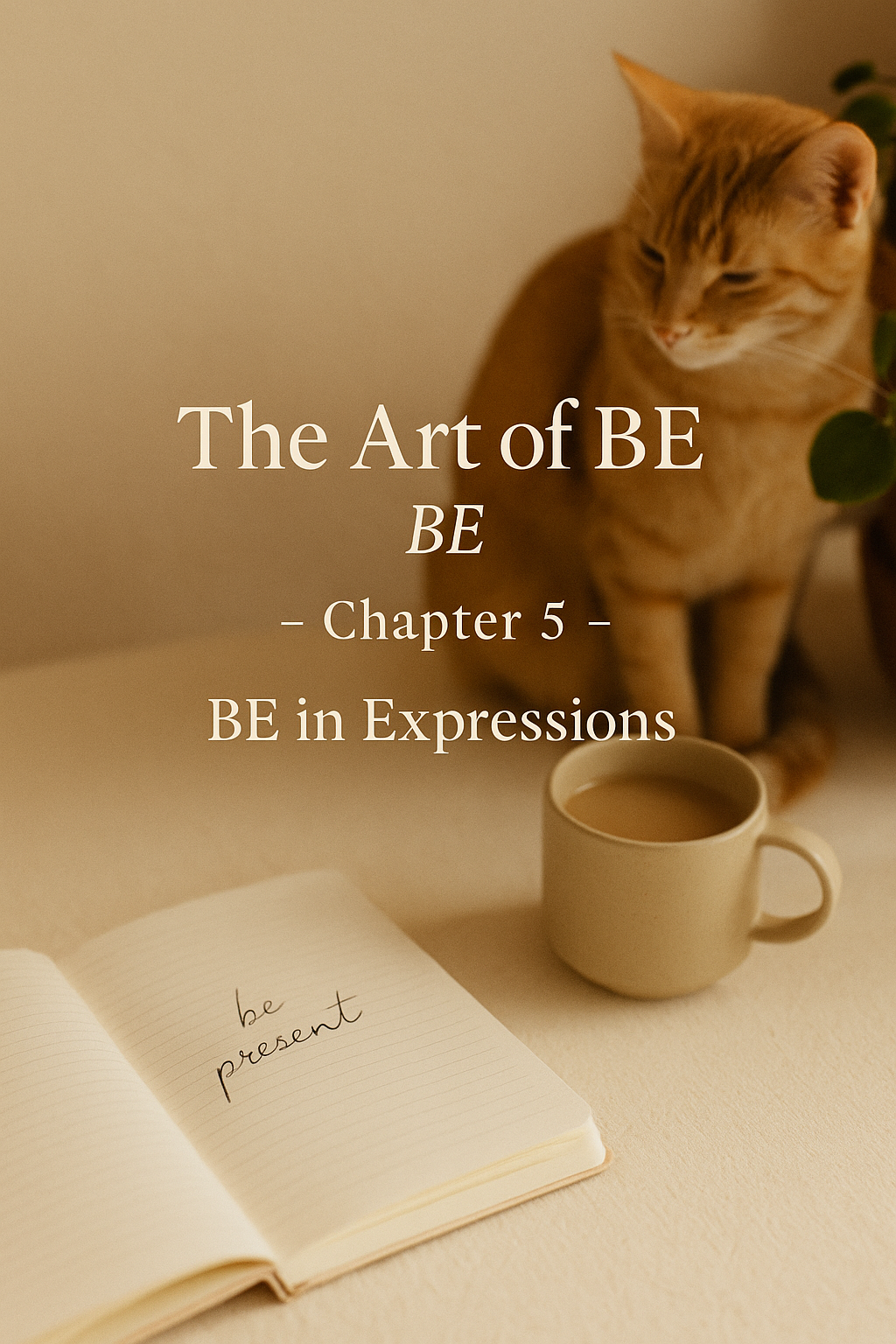
The Art of BE — 존재의 언어 배우기
Chapter 5. BE in Expressions — 일상 속의 살아있는 BE
BE is not just grammar — it’s a way of being.
The verb BE quietly appears everywhere in English.
Not to explain rules,
but to express attitude, kindness, and life itself.
be동사는 문법이 아니라 “태도”의 언어입니다.
영어 속에서 be는 “어떻게 존재할 것인가”를 말해줍니다.
🪞 1. Be yourself — 너 자신이 되어라
Be yourself; everyone else is already taken. — Oscar Wilde
This is perhaps the most beautiful use of “be.”
It’s not about changing who you are,
but about accepting who you are.
💬 “Be yourself”는 자기 수용의 언어입니다.
“다른 누구처럼 되려 하지 말고,
지금의 너로 존재해라.”
I am who I am. — 나는 나다.
be동사의 가장 순수한 형태이자,
존재의 선언이에요.
2. Be kind — 친절해라
Be kind, for everyone you meet is fighting a hard battle. — Plato
“Be kind” uses the simplest grammar,
but it carries the deepest wisdom.
It’s not an order — it’s a reminder.
💬 be + 형용사는 “그 상태로 존재하라”는 뜻입니다.
친절하라, 부드럽게 살아라,
존재 자체가 따뜻함이 되라.
Be calm. Be gentle. Be kind.
이런 말들은 문법이 아니라 삶의 자세입니다.
3. Be able to — 할 수 있다
You are able to do more than you think.
“Be able to” means ability,
but it also means faith in your own potential.
💬 Be able to는 가능성의 언어입니다.
“너는 할 수 있다.”
그 말 속엔 “너의 존재에는 힘이 있다”는 믿음이 담겨 있어요.
4. Be going to — ~할 예정이다 / ~하려 한다
I am going to try again. — 나는 다시 시도할 것이다.
We are going to make it. — 우리는 해낼 것이다.
Here, “be” meets “going,”
and suddenly existence starts moving forward.
It’s the language of intention.
💬 “Be going to”는 존재가 움직이는 시점입니다.
머무는 be에서, 앞으로 나아가는 be로.지금의 나는 곧 미래의 나로 이어집니다.
5. Be supposed to — ~하기로 되어 있다 / 기대되다
You are supposed to be here. — 너는 여기에 있어야 해.
It was supposed to rain. — 비가 올 예정이었다.
This phrase carries expectation and obligation,
but sometimes, it also whispers disappointment or hope.
💬 “Be supposed to”는 세상의 약속 같은 표현입니다.
규칙과 기대 속에서 존재가 어떻게 위치하는지를 보여주죠.
6. Be in — 참여하다, 포함되다, 연결되다
Are you in? — 너 참여할래?
I’m in. — 나 할게.
Short but powerful —
to say I’m in is to say I belong.
💬 “I’m in.”은 단순히 “나도!”가 아니라,
“나는 이 안에 속해 있다.”
즉, 연결된 존재로서의 be입니다.
✨ Closing Reflection
So many English expressions begin with be —
not because of grammar,
but because “be” is the word of life itself.
be동사는 존재의 모든 장면을 품고 있습니다.
나로 있는 법, 나답게 사는 법,
그리고 세상과 연결되는 법까지.
When you say
Be kind. Be patient. Be yourself.
you’re not just speaking English —
you’re learning how to live.
© MisoEnglish / Michelle Kim.
This is original content written by the author.
Unauthorized reproduction or full reposting is prohibited.
You may quote short parts only with clear credit and a link to the original post.
이 글은 작성자가 직접 집필한 오리지널 콘텐츠입니다.
전체 복제·무단 재게시를 금하며,
일부 인용 시에는 반드시 출처(MisoEnglish)와 링크를 남겨 주세요.
'English Mechanism' 카테고리의 다른 글
| Transition Words for Every Situation - 트랜지션 단어로 문장 연결하기 (0) | 2025.10.22 |
|---|---|
| Next-Level Grammar: Mastering Modals and Conditionals (0) | 2025.10.21 |
| Chapter 4. BE in Tenses — 시간 속의 존재 (0) | 2025.10.20 |
| Chapter 3. BE + Complement — 존재의 그림 완성하기 (0) | 2025.10.20 |
| Chapter 2. Forms of BE — 변화하는 존재의 형태 (0) | 2025.10.20 |


