
- 분류 전체보기 (580)

| 일 | 월 | 화 | 수 | 목 | 금 | 토 |
|---|---|---|---|---|---|---|
| 1 | 2 | 3 | 4 | 5 | 6 | |
| 7 | 8 | 9 | 10 | 11 | 12 | 13 |
| 14 | 15 | 16 | 17 | 18 | 19 | 20 |
| 21 | 22 | 23 | 24 | 25 | 26 | 27 |
| 28 | 29 | 30 | 31 |
- 느리지만단단하게
- English in English
- 영어발음
- everyday English
- 영어시제
- 영어접속사
- English for Korean Learners
- 영어공부
- 감성영어
- FareRules
- 영문법
- ticketing
- misoenglish
- 언어의철학 #의미론 #화용론 #언어와사고 #언어의미학 #MisoEnglish #TheLanguageBeyondGrammar #영문학심화
- MichelleKim
- 영어회화
- 🌿 English with Heart
- pnr
- Basic English Verbs
- 영어문법
- SlowBlooms
- booking
- AirlineOpsEnglish
- 영어표현력
- English Speaking Practice
- 생활영어
- 영어표현
- GrammarWithSoul
- 영어공부법
- 영어를살다
- Today
- Total
MisoEnglish
Next-Level Grammar: Mastering Modals and Conditionals 본문
Next-Level Grammar: Mastering Modals and Conditionals
slowblooms 2025. 10. 21. 05:13Introduction:
At the C1/C2 level, correct grammar is assumed—but precise grammar is the goal. Modals (like would, might, should) and Conditionals are the tools we use to navigate the complex nuances of reality, possibility, and regret.
Simply put, choosing between "I could have gone" and "I should have gone" is the difference between stating a past possibility and expressing past regret.
This deep dive breaks down 50 key uses, moving past the basic rules to focus on the advanced combinations, particularly the confusing past perfect modals and mixed conditional structures that are essential for high-level fluency.
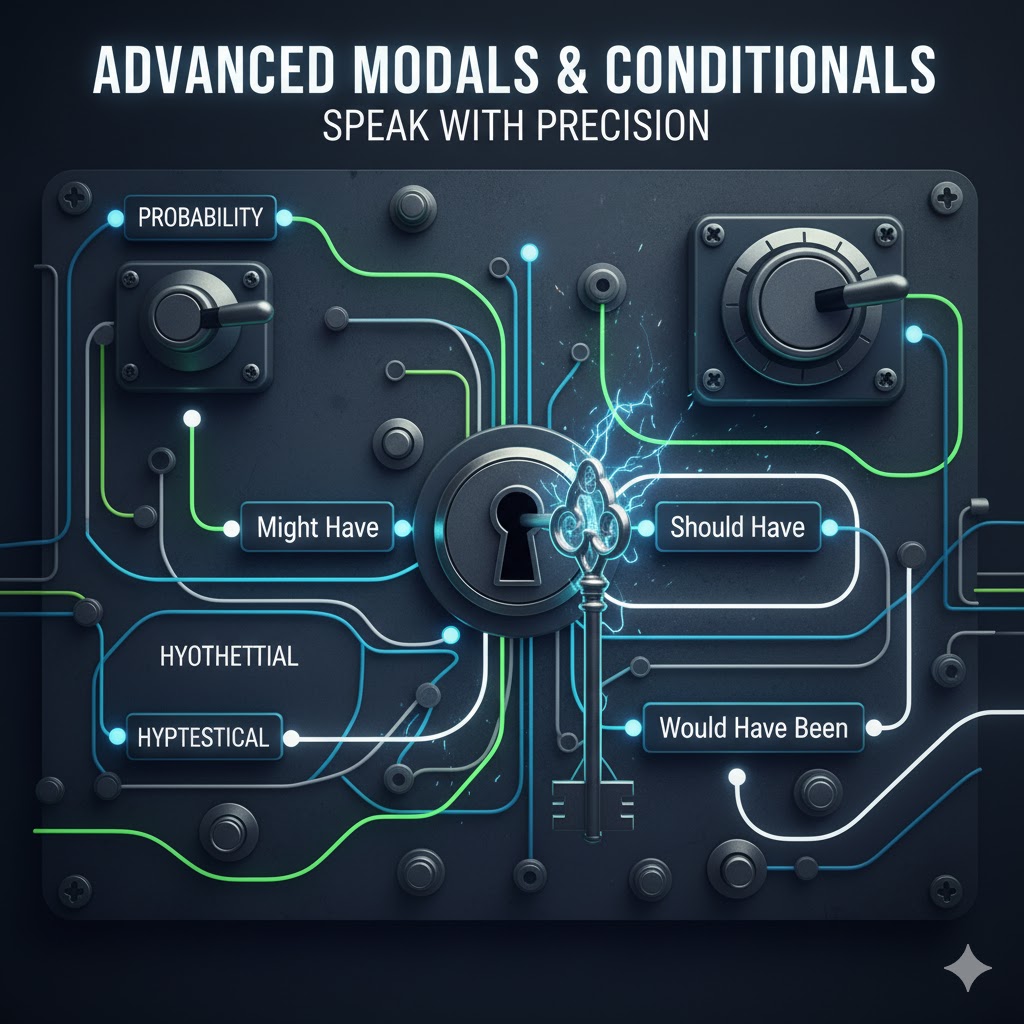
The 50 Advanced Structures
Section 1: Perfect Modals (Regret, Speculation, Certainty in the Past) (20 Examples)
These forms use the structure: Modal + Have + Past Participle.
| # | Structure | Function | Example Usage |
| 1. | Should have | Regret/Mistake about a past action. | I should have saved more money last year. |
| 2. | Shouldn't have | Relief that a bad thing didn't happen (or regret that you did something). | You shouldn't have left without saying goodbye. |
| 3. | Could have | Past Ability/Possibility that was not realized. | We could have won the game, but we played badly. |
| 4. | Couldn't have | Certainty that something was impossible in the past. | They couldn't have seen us; we were too far away. |
| 5. | Would have | Result of an unrealized hypothetical situation (in the main clause of a Third Conditional). | I would have called if I hadn't lost my phone. |
| 6. | Wouldn't have | Negative result of an unrealized hypothetical situation. | She wouldn't have taken the job if she knew the truth. |
| 7. | Must have | Strong Logical Deduction about a past event. | The door is unlocked; someone must have forgotten to close it. |
| 8. | Can't have | Strong Belief that something didn't happen (Past impossibility). | He can't have finished the project already; it's too big. |
| 9. | Might have | Weak Probability/Speculation about a past action. | They might have missed the train due to the traffic. |
| 10. | May have | Neutral Probability about a past action (similar to might have). | The package may have arrived yesterday. |
| 11. | Ought to have | Strong Moral Obligation/Regret (Formal version of should have). | We ought to have told her the news sooner. |
| 12. | Needn't have | Unnecessary action that was performed. | You needn't have bought so much food; we already ordered pizza. |
| 13. | Will have (+ P.P.) | Future Perfect (Action completed before a future time). | By next week, I will have completed the report. |
| 14. | To be supposed to have | Expected but unfulfilled past action. | He was supposed to have sent the email this morning. |
| 15. | Used to | Past habit or state (not a perfect modal, but often confused with them). | We used to go skiing every winter. |
| 16. | Had to | Past necessity (used instead of must have for obligation). | Because of the delay, we had to wait for hours. |
| 17. | Might have been doing | Past continuous speculation. | She might have been waiting for us when we arrived. |
| 18. | Could have been | Past speculative state. | That accident could have been much worse. |
| 19. | Must have been | Certainty about a past state/feeling. | He must have been joking when he said that. |
| 20. | Should have been | Regret about a past state (was expected, didn't happen). | The party should have been a success. |
Section 2: Advanced Conditional Forms (20 Examples)
Moving beyond basic 1st/2nd/3rd conditionals into complex uses and substitutions.
| # | Conditional Type | Structure | Function | Example Usage |
| 21. | Zero Conditional | If + Present Simple, Present Simple | General truths or inevitable results. | If you heat water to $100^{\circ}C$, it boils. |
| 22. | First Conditional | If + Present Simple, Will/Can/May + Verb | Real and probable future result. | If it rains tomorrow, we will cancel the picnic. |
| 23. | Second Conditional | If + Past Simple, Would/Could/Might + Verb | Unreal or unlikely present/future situation. | If I had a million dollars, I would travel the world. |
| 24. | Third Conditional | If + Past Perfect, Would/Could/Might have + P.P. | Unreal past situation and its unreal past result (regret/analysis). | If she had studied harder, she would have passed the exam. |
| 25. | Mixed Conditional (Type 3/2) | If + Past Perfect, Would/Could/Might + Verb | Unreal past condition affecting a present result. | If I had taken that job, I would be rich now. |
| 26. | Mixed Conditional (Type 2/3) | If + Past Simple, Would/Could/Might have + P.P. | Unreal present condition affecting a past result. | If I were better at coding, I would have applied for that tech job. |
| 27. | Inverted Conditional (2nd) | Were to + Subject + Verb... | More formal/less likely Second Conditional. | Were I to win the lottery, I would retire immediately. |
| 28. | Inverted Conditional (3rd) | Had + Subject + P.P.... | Formal/emphasized Third Conditional. | Had I known about the issue, I would have addressed it. |
| 29. | Inverted Conditional (1st) | Should + Subject + Verb... | Formal/emphasized First Conditional. | Should you need assistance, please contact the front desk. |
| 30. | Conditional with 'Unless' | Unless + Positive verb, ... | Substitute for "If...not." | Unless it stops raining, we can't go out. |
| 31. | Conditional with 'As long as' | As long as + Present Simple, ... | Focuses on a necessary condition. | You can borrow the car as long as you fill up the tank. |
| 32. | Conditional with 'Provided that' | Provided that + Present Simple, ... | Formal way of setting a condition. | The contract is valid, provided that both parties sign. |
| 33. | Conditional with 'But for' | But for + Noun, Would/Could/Might have + P.P. | Means "if not for" (often used in past/regret). | But for the quick actions of the crew, the ship would have sunk. |
| 34. | Imperative Conditional | If + Present Simple, Imperative | Instruction or suggestion. | If you feel tired, take a break! |
| 35. | Conditional with Progressive | If + Present Progressive, ... | Condition is ongoing action. | If it is raining outside, we'll stay in. |
| 36. | Conditional with Modals | If + Present Simple, Modal + Verb | Expressing varying degrees of certainty in the result. | If he calls, you should tell him I'm busy. |
| 37. | Conditional with Phrasals | If + Phrasal Verb, ... | Condition using a phrasal verb. | If we run into problems, we'll call you. |
| 38. | Past Habit (Would) | Would + Verb | Habitual past action (non-conditional context). | Every summer, we would visit the beach. |
| 39. | Will (Certainty) | Will + Verb | Expressing high certainty about the present/future. | Don't worry, she will be here soon. |
| 40. | Might/Could (Polite Request) | Might/Could + Subject + Verb | More polite/tentative way of asking. | Could you possibly help me with this box? |
Section 3: Modals in Passive Voice & Reported Speech (10 Examples)
The most complex forms, combining modals with other structures.
| # | Structure | Function | Example Usage |
| 41. | Modal Passive | Modal + Be + P.P. | Expressing permission/ability in passive voice. |
| 42. | Perfect Modal Passive | Modal + Have Been + P.P. | Speculation/Regret about a passive past action. |
| 43. | Reported Speech (Will → Would) | Reporting a future statement. | He said he would call me later. |
| 44. | Reported Speech (Can → Could) | Reporting present ability/request. | She asked if she could borrow the car. |
| 45. | Reported Speech (May → Might) | Reporting possibility. | They guessed it might rain later that evening. |
| 46. | Modal Continuous | Modal + Be + V-ing | Speculation about an action happening now. |
| 47. | Perfect Modal Continuous | Modal + Have Been + V-ing | Speculation about a past, ongoing action. |
| 48. | Had better | Strong advice/Warning (more immediate than should). | We had better leave now, or we'll miss the flight. |
| 49. | Zero Conditional with Passive | If + Present Simple Passive, Present Simple Passive | General truth in the passive voice. |
| 50. | Hypothetical Passive | Second Conditional with Passive. | Imaginary passive result. |
'English Mechanism' 카테고리의 다른 글
| 🌿 트랜지션(Transition) 단어 연습하기 (0) | 2025.10.22 |
|---|---|
| Transition Words for Every Situation - 트랜지션 단어로 문장 연결하기 (0) | 2025.10.22 |
| Chapter 5. BE in Expressions — 일상 속의 살아있는 BE (0) | 2025.10.20 |
| Chapter 4. BE in Tenses — 시간 속의 존재 (0) | 2025.10.20 |
| Chapter 3. BE + Complement — 존재의 그림 완성하기 (0) | 2025.10.20 |


