
- 분류 전체보기 (1053)

- Linguistics (고급 영어학) (10)
- Stylistics (6)
- Etymology & Word Building (15)
- Philosophy Meets Grammar (6)
- Collection of Famous Quotes (22)
- English Mechanism (276)
- The Language Beyond Grammar (274)
- Living English (81)
- Miso’s Life Notes (18)
- My English Journey and Refl.. (16)
- Philosophy (132)
- Video Clip (16)
- Airline English (항공 영어) (47)
- Creative Corner (35)
- Sally & Sia (1)
| 일 | 월 | 화 | 수 | 목 | 금 | 토 |
|---|---|---|---|---|---|---|
| 1 | 2 | 3 | 4 | |||
| 5 | 6 | 7 | 8 | 9 | 10 | 11 |
| 12 | 13 | 14 | 15 | 16 | 17 | 18 |
| 19 | 20 | 21 | 22 | 23 | 24 | 25 |
| 26 | 27 | 28 | 29 | 30 |
- 영어공부
- 감성영어
- 동양정치철학 #시리즈완결 #아시아적가치 #동서양비교 #유교 #민주주의 #정치사상 #인문학 #비교철학 #글로벌정치 #문화다양성 #2500년철학사
- 인도철학 #동양철학 #인문학 #요가 #명상 #힌두교 #불교 #간디 #타고르 #정통6파 #철학공부 #마음공부 #MisoEnglish #인문학영어
- English Speaking Practice
- Basic English Verbs
- English for Korean Learners
- MisoEnglish#철학입문 #Philosophy #심리철학 #PhilosophyOfMind #철학공부 #의식 #마음 #PhilosophyForBeginners #교육콘텐츠 #철학시리즈
- 영문법
- MisoEnglish#철학입문 #Philosophy #과학철학 #PhilosophyOfScience #철학공부 #포퓨퍼 #쿠hn #과학방법론 #교육콘텐츠 #철학시리즈
- AirlineOpsEnglish
- MisoEnglish#유교철학 #Confucianism #성리학 #NeoConfucianism #인의예지 #Virtue #맹자 #Mencius #실학 #KoreanScholarship
- everyday English
- MisoEnglish#한국철학 #KoreanPhilosophy #홍익인간 #Hongik #화랑도 #Hwarang #단군 #Dangun #풍류도 #ThreeKingdoms#동양철학
- 영어문법
- MisoEnglish#철학입문 #Philosophy #종교철학 #PhilosophyOfReligion #철학공부 #신존재증명 #악의문제 #PhilosophyForBeginners #교육콘텐츠 #철학시리즈
- ticketing
- English in English
- MisoEnglish#도교철학 #Taoism #도덕경 #TaoTeChing #무위자연 #WuWei #노자 #Laozi #장자 #YinYang
- pnr
- 영국사 #영국역사 #세계사 #역사연재 #브리튼에서영국까지
- EnglishWriting #AcademicWriting #Grammar #EnglishLanguage #EssayWriting #ParagraphStructure #SentenceStructure #BusinessEnglish #EnglishTips #WritingSkills #Linguistics #ESL
- misoenglish
- 🌿 English with Heart
- 영어회화
- 영어접속사
- MisoEnglish#불교철학 #BuddhismPhilosophy #사성제 #FourNobleTruths #공사상 #Emptiness #명상 #Mindfulness #열반 #EasternWisdom
- MisoEnglish#철학입문 #Philosophy #정치철학 #PoliticalPhilosophy #철학공부 #정의론 #자유주의 #PhilosophyForBeginners #교육콘텐츠 #철학시리즈
- MisoEnglish#철학입문 #Philosophy #윤리학 #Ethics #도덕철학 #철학공부 #칸트 #공리주의 #교육콘텐츠 #철학시리즈
- MisoEnglish#철학입문 #Philosophy #형이상학 #Metaphysics #철학공부 #존재론 #실재론 #PhilosophyForBeginners #교육콘텐츠 #철학시리즈
- Today
- Total
MisoEnglish
윤리학 입문 (1) - 아리스토텔레스: 덕 윤리학과 좋은 삶 본문
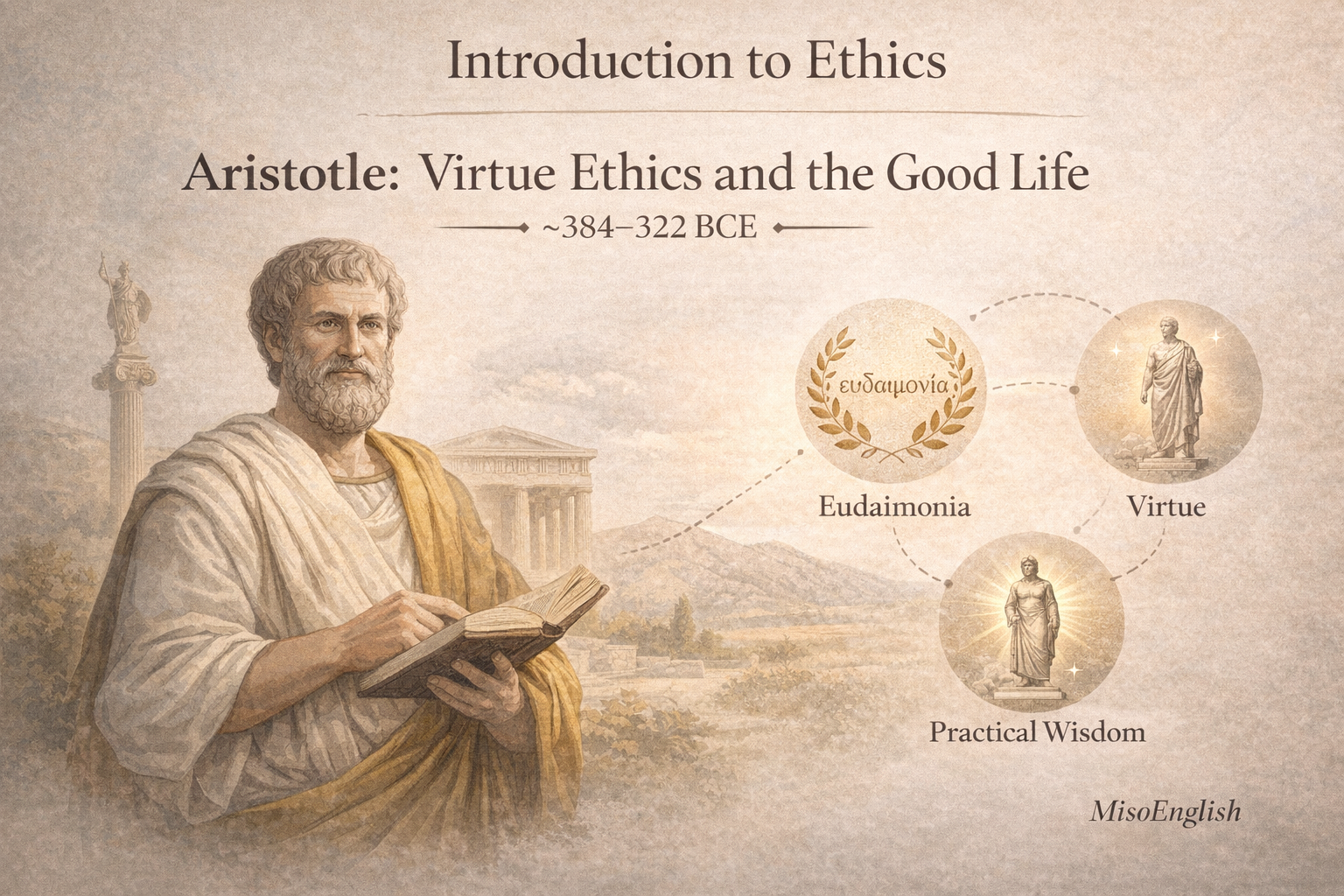
Introduction to Ethics (1)
- Aristotle: Virtue Ethics and the Good Life
Welcome to our new series on ethics! After exploring language and meaning, we now turn to perhaps the most fundamental philosophical question: How should we live? We begin with Aristotle (384-322 BCE), whose virtue ethics has shaped Western moral thought for over 2,000 years and remains vitally relevant today.
The Philosopher of Human Flourishing
Aristotle was a student of Plato and tutor to Alexander the Great. Unlike his teacher Plato, who focused on abstract Forms, Aristotle grounded philosophy in empirical observation and practical wisdom. His Nicomachean Ethics is one of the most influential works in moral philosophy.
Aristotle's approach to ethics:
- Teleological - everything aims at some end/goal (telos)
- Character-based - focuses on virtues, not rules or consequences
- Naturalistic - based on human nature and function
- Practical - aimed at living well, not just knowing what's good
- Holistic - considers the whole life, not isolated acts
His question: What is the highest good for human beings?
Eudaimonia: The Ultimate Goal
What is Eudaimonia?
Eudaimonia (εὐδαιμονία) is often translated as "happiness," but this is misleading.
Better translations:
- Human flourishing
- Living well
- Thriving
- The good life
Key features:
1. It's the highest good: Everything else we pursue for the sake of something else, but eudaimonia is pursued for its own sake.
- We pursue health for happiness
- We pursue wealth for happiness
- We pursue honor for happiness
- But we pursue happiness for itself—it's the final end
2. It's self-sufficient: Eudaimonia is complete in itself—it lacks nothing.
3. It's activity, not a state: Not a feeling or passive condition, but an active exercise of our capacities.
4. It requires a complete life: "One swallow does not make a spring, nor does one fine day. Similarly, one day or a brief period of happiness does not make a person blessed and happy."
You can't judge if someone achieved eudaimonia until their whole life is considered.
The Function Argument
How do we achieve eudaimonia?
Aristotle's answer: By fulfilling our function (ergon) as human beings.
The argument:
1. Everything has a function:
- A knife's function: to cut well
- An eye's function: to see well
- A musician's function: to play music well
2. A thing is good when it performs its function well:
- A good knife cuts well
- A good eye sees well
- A good musician plays well
3. Human beings have a function too:
Question: What is distinctively human?
Not:
- Nutrition and growth (shared with plants)
- Perception and sensation (shared with animals)
But:
- Rational activity - the exercise of reason
4. Therefore: The human good = excellent exercise of reason throughout a complete life
Eudaimonia = Activity of the soul in accordance with virtue (excellence)
Virtue (Arete)
What is Virtue?
Arete (ἀρετή) = excellence, virtue
Not moral virtue in our modern sense, but excellence of character and intellect.
Two types of virtue:
1. Intellectual Virtues (Virtues of Thought)
These are developed through teaching and learning.
Theoretical wisdom (sophia):
- Understanding of eternal truths
- Philosophical/scientific knowledge
- Grasping first principles
Practical wisdom (phronesis):
- Knowledge of how to live well
- Good deliberation about what's good for humans
- Most important for ethics!
Technical knowledge (techne):
- Skill in making/producing things
- Craft knowledge
2. Moral Virtues (Virtues of Character)
These are developed through habit and practice.
Examples:
- Courage
- Temperance
- Generosity
- Magnificence
- Pride (proper self-regard)
- Good temper
- Truthfulness
- Wit
- Friendliness
- Justice
Key point: Virtues are habits (hexis)—stable dispositions acquired through repeated action.
You don't become virtuous by understanding virtue intellectually. You become virtuous by practicing virtuous actions until they become second nature.
The Doctrine of the Mean
Aristotle's famous principle: Virtue is a mean between two extremes.
The Basic Idea
Each virtue is a middle point between two vices:
- One vice of excess
- One vice of deficiency
The Formula:
Virtue = The mean relative to us, determined by reason (practical wisdom)
Classic Examples
Courage:
- Excess: Rashness (too much boldness)
- Mean: COURAGE (right amount of boldness)
- Deficiency: Cowardice (too little boldness)
Temperance (regarding bodily pleasures):
- Excess: Self-indulgence (too much pleasure-seeking)
- Mean: TEMPERANCE (appropriate enjoyment)
- Deficiency: Insensibility (too little enjoyment)
Generosity (regarding money):
- Excess: Prodigality/Wastefulness (giving too much)
- Mean: GENEROSITY (giving the right amount)
- Deficiency: Stinginess (giving too little)
Proper Pride (regarding honor):
- Excess: Vanity (thinking too highly of oneself)
- Mean: PROPER PRIDE (accurate self-assessment)
- Deficiency: Undue humility (thinking too little of oneself)
Good Temper (regarding anger):
- Excess: Irascibility (getting angry too easily)
- Mean: GOOD TEMPER (anger at the right things, in the right way)
- Deficiency: Apathy (never getting angry)
Important Qualifications
1. The mean is relative to the individual:
What's moderate for one person may be extreme for another.
Example:
- Olympic athlete needs more food than office worker
- Same amount of food would be deficient for athlete, excessive for worker
2. The mean is determined by practical wisdom:
Not a mathematical average! Requires judgment about:
- The situation
- The people involved
- The circumstances
- The appropriate response
3. Some actions have no mean:
Certain things are always wrong:
- Murder
- Theft
- Adultery
- Spite
- Shamelessness
These are intrinsically vicious—there's no right amount.
4. The mean is difficult to hit:
"It is easy to get angry—anyone can do that. But to be angry with the right person, to the right extent, at the right time, for the right reason, and in the right way—that is not easy."
Practical Wisdom (Phronesis)
The Most Important Virtue
Phronesis (φρόνησις) = practical wisdom, prudence
Definition: The intellectual virtue of making good judgments about what's good for human life.
Key Features
1. It's about particulars: Not abstract knowledge, but wisdom about this situation, here and now.
2. It requires experience: Can't be learned from books alone—needs life experience.
Young people can be mathematicians but not wise (phronesis) because wisdom requires accumulated experience.
3. It's deliberative: Good at deliberating about what conduces to the good life.
4. It's unified with moral virtue:
You can't have moral virtue without practical wisdom:
- Virtuous action requires knowing what to do in each situation
- This knowledge is phronesis
You can't have practical wisdom without moral virtue:
- To deliberate well about the good, you must already care about the good
- This requires virtuous character
Result: Genuine virtue requires both good character and practical wisdom working together.
Practical Wisdom vs. Cleverness
Cleverness = skill at achieving your goals (whatever they are)
Practical wisdom = skill at achieving good goals
- A clever criminal achieves his bad ends efficiently
- A wise person pursues genuinely good ends
Practical wisdom includes both:
- Right goals (from virtue)
- Right means (from intelligence)
Voluntary Action and Responsibility
For Aristotle, ethics requires voluntariness—we can only be held responsible for voluntary actions.
What Makes Action Voluntary?
Voluntary action:
- Originates in the agent
- Agent knows the relevant circumstances
Involuntary action:
- Done under compulsion (external force)
- Done in ignorance (of relevant facts)
Mixed Actions
Some actions are partially voluntary:
Example: Throwing cargo overboard in a storm
- Generally speaking, we don't want to do it
- But in these circumstances, it's chosen voluntarily
- Verdict: Voluntary (though painful)
Responsibility for Character
Objection: "But I didn't choose my character—how am I responsible?"
Aristotle's response:
1. We form our character through repeated actions:
- By doing just acts, we become just
- By doing temperate acts, we become temperate
- Character is the accumulated result of our choices
2. We're responsible for becoming the kind of person we are:
- At first, we could have acted differently
- After habit formation, character becomes stable
- But we're still responsible because we formed it through voluntary actions
Analogy: Someone who ruins their health through drinking is responsible for their poor health, even if they now can't easily recover. They voluntarily formed the habit that ruined their health.
Friendship (Philia)
Aristotle devotes significant attention to philia (friendship/love)—a crucial component of the good life.
Three Types of Friendship
1. Friendship based on utility:
- Friends are useful to each other
- Example: Business partnerships
- Limited: Ends when the utility ends
2. Friendship based on pleasure:
- Friends enjoy each other's company
- Example: Young people's friendships
- Limited: Ends when the pleasure ends
3. Friendship based on virtue (complete friendship):
- Friends love each other for who they are
- Wish good for each other for the other's sake
- Mutual admiration of character
Only virtue-friendship is:
- Lasting (doesn't depend on changing circumstances)
- Complete (includes utility and pleasure too)
- Rare ("Few people are capable of it")
Why Friendship is Essential
1. It's intrinsically valuable: No one would choose to live without friends, even if they had all other goods.
2. It helps us be virtuous:
- Friends help each other act rightly
- Good friends make us better people
- "A friend is another self"—helps us see ourselves clearly
3. It's part of eudaimonia: The good life necessarily involves friendship. Even a perfectly virtuous person needs friends to exercise virtue toward.
4. Self-love properly understood: The virtuous person's relationship to self is like relationship to a friend:
- Wishes good for self
- Enjoys own company
- Has inner harmony
Proper self-love isn't selfishness—it's loving the rational, virtuous part of yourself.
Contemplation: The Highest Activity
The Contemplative Life
In Book X, Aristotle argues that the highest form of eudaimonia is theoria (θεωρία)—contemplation, philosophical study.
Why?
1. It exercises our highest capacity: Rational contemplation is most distinctively human.
2. It's most self-sufficient: Doesn't require external goods as much as other activities.
3. It's pursued for its own sake: Not for any external benefit.
4. It's most continuous: We can contemplate more continuously than we can perform other activities.
5. It's most pleasant: Philosophy offers the purest, most stable pleasures.
6. It's most divine: The gods contemplate—when we contemplate, we're most godlike.
Two Lives?
This seems to conflict with Aristotle's earlier emphasis on moral virtue and practical life.
Two interpretations:
1. Contemplation is supreme: The philosophical life is the absolute best life. Moral virtue is secondary but still valuable.
2. Both are necessary: Complete eudaimonia requires both:
- Contemplative activity (highest)
- Moral virtue and practical activity (necessary)
Most scholars favor interpretation #2: The best life combines philosophical contemplation with virtuous practical activity.
Justice: The Complete Virtue
Aristotle analyzes justice (dikaiosyne) extensively.
Two Senses of Justice
1. General justice: Complete virtue in relation to others—obeying laws, being fair in all dealings.
"Justice in this sense is complete virtue."
2. Particular justice: Fairness in specific transactions and distributions.
Types of Particular Justice
Distributive Justice: Fair distribution of goods, honors, resources.
Principle: According to merit/desert
- Each person should receive in proportion to their contribution
- Equal treatment of equals, unequal treatment of unequals
Example: Dividing profits among business partners according to their investment.
Rectificatory Justice: Correcting wrongs, restoring equilibrium.
Principle: Restore equality
- Compensation for harms
- Punishment for crimes
- Make the injured party whole
Example: If I damage your property, I owe you compensation.
Criticisms and Challenges
1. Is There Really a Human Function?
Objection: Maybe humans don't have a single function. We're too diverse, our lives too varied.
Response: Aristotle might argue our shared rationality gives us a common nature, even if we express it differently.
2. The Doctrine of the Mean is Vague
Objection: "Find the mean" doesn't give concrete guidance. How do I know what's moderate?
Response: Aristotle admits this is difficult—ethics isn't like mathematics. But that's the nature of practical reasoning.
3. Moral Luck
Objection: Eudaimonia seems to require external goods (health, wealth, friends, beauty). But these depend on luck, not virtue.
Can we really be happy if we're ugly, poor, sick, and friendless—even if virtuous?
Aristotle's ambiguous answer:
- Virtue is most important
- But external goods matter too
- The virtuous person bears misfortune nobly
- But great misfortunes can prevent complete eudaimonia
4. Who Determines Virtue?
Objection: Different cultures have different ideas of virtue. Who's right?
Response: Aristotle would say: the practically wise person determines it. But this seems circular.
5. Elitism and Exclusion
Problems:
- Aristotle thought women were naturally inferior
- Believed some people were "natural slaves"
- Restricted full virtue to free Greek males
Modern response: We can accept his ethical framework while rejecting his prejudices. The theory doesn't require these exclusions.
Aristotle vs. Other Ethical Theories
Aristotle vs. Kant (Deontology)
Kant:
- Focus on duty and rules
- Right action follows universal principles
- Motivation matters most (good will)
Aristotle:
- Focus on character and virtues
- Right action requires practical wisdom and judgment
- Being a good person matters most
Aristotle vs. Utilitarianism
Utilitarianism:
- Focus on consequences
- Maximize overall happiness/pleasure
- Act-by-act calculation
Aristotle:
- Focus on character
- Achieve eudaimonia (not pleasure)
- Holistic: whole life, not isolated acts
What Makes Aristotle Distinctive?
Agent-centered, not act-centered: Primary question: "What kind of person should I be?" not "What should I do?"
Virtue, not rules: Ethics is about developing good character, not following rules.
Practical wisdom, not algorithms: Moral knowledge requires judgment, experience, and wisdom—not just applying principles.
Modern Virtue Ethics Revival
20th Century Return
After centuries of neglect, virtue ethics was revived by:
Elizabeth Anscombe (1958): "Modern Moral Philosophy"
- Criticized rule-based ethics
- Called for return to virtue concepts
Philippa Foot (1978): "Virtues and Vices"
- Naturalistic virtue ethics
- Virtues as what humans need to flourish
Alasdair MacIntyre (1981): After Virtue
- Narrative approach to virtue
- Communities and practices essential
Rosalind Hursthouse (1999): On Virtue Ethics
- Systematic development of virtue ethics
- Shows it can handle modern moral problems
Contemporary Applications
In professional ethics:
- Medical ethics: virtuous physician
- Business ethics: character of leaders
- Teaching: virtues of educators
In moral psychology:
- Character development
- Moral education
- Role of emotions in ethics
In applied ethics:
- Environmental virtue ethics
- Bioethics
- Technology ethics
Conclusion
Aristotle's virtue ethics offers a rich, nuanced approach to living well:
Key insights:
1. Ethics is about flourishing, not just following rules The goal is eudaimonia—living an excellent human life.
2. Character matters most Develop virtues through habit and practice until they become second nature.
3. Practical wisdom is essential Good judgment about particular situations—can't be reduced to rules.
4. The mean between extremes Virtue lies in the middle—not too much, not too little, but just right.
5. Humans are social Friendship and community are essential to the good life.
6. Ethics requires practice You learn to be good by practicing good actions, not just studying ethics.
His enduring question:
"How should we live?"
Not "What rules should we follow?" but "What kind of person should I become?"
This shift from acts to character, from rules to wisdom, from isolation to community makes Aristotelian virtue ethics powerfully relevant today.
In our next post, we'll explore Kant's deontological ethics—a radically different approach based on duty, universal rules, and the categorical imperative. Where Aristotle emphasizes character and consequences, Kant emphasizes motivation and moral law!
References
- Aristotle, Nicomachean Ethics (translated by Terence Irwin or Roger Crisp)
- Rosalind Hursthouse, On Virtue Ethics (1999)
- Alasdair MacIntyre, After Virtue (1981)
- Sarah Broadie, Ethics with Aristotle (1991)
Next Post Preview Introduction to Ethics (2) - Immanuel Kant: Duty, the Categorical Imperative, and Deontology
Do you think ethics is about character or rules? Can we really find a "mean" between extremes? What virtues do you think are most important today? Share your thoughts!
윤리학 입문 (1) - 아리스토텔레스: 덕 윤리학과 좋은 삶
새로운 윤리학 시리즈에 오신 걸 환영합니다! 언어와 의미를 탐구한 후, 이제 아마도 가장 근본적인 철학적 질문으로 돌아갑니다: 우리는 어떻게 살아야 하는가? 우리는 아리스토텔레스(기원전 384-322)로 시작합니다. 그의 덕 윤리학은 2,000년 이상 서양 도덕 사상을 형성했고 오늘날에도 여전히 매우 관련성이 있습니다.
인간 번영의 철학자
아리스토텔레스는 플라톤의 제자이자 알렉산더 대왕의 스승이었습니다. 추상적 형상(Forms)에 집중한 스승 플라톤과 달리, 아리스토텔레스는 경험적 관찰과 실천적 지혜에 철학을 근거했습니다. 그의 『니코마코스 윤리학』은 도덕철학에서 가장 영향력 있는 저작 중 하나입니다.
아리스토텔레스의 윤리학 접근:
- 목적론적 - 모든 것은 어떤 목적/목표(텔로스)를 향한다
- 성품 기반 - 규칙이나 결과가 아니라 덕에 집중
- 자연주의적 - 인간 본성과 기능에 기반
- 실천적 - 선이 무엇인지 아는 것이 아니라 잘 사는 것을 목표로
- 전체론적 - 고립된 행위가 아니라 전체 삶을 고려
그의 질문: 인간에게 최고선은 무엇인가?
에우다이모니아: 궁극적 목표
에우다이모니아란 무엇인가?
에우다이모니아 (εὐδαιμονία)는 종종 "행복"으로 번역되지만, 이것은 오해의 소지가 있습니다.
더 나은 번역들:
- 인간 번영
- 잘 사는 것
- 번성
- 좋은 삶
핵심 특징:
1. 최고선이다: 우리는 다른 모든 것을 다른 무언가를 위해 추구하지만, 에우다이모니아는 그 자체를 위해 추구됩니다.
- 우리는 행복을 위해 건강을 추구한다
- 우리는 행복을 위해 부를 추구한다
- 우리는 행복을 위해 명예를 추구한다
- 하지만 우리는 행복을 그 자체를 위해 추구한다—그것이 최종 목적이다
2. 자족적이다: 에우다이모니아는 그 자체로 완전하다—아무것도 부족하지 않다.
3. 상태가 아니라 활동이다: 감정이나 수동적 조건이 아니라, 우리 역량의 능동적 발휘이다.
4. 완전한 삶을 필요로 한다: "한 마리 제비가 봄을 만들지 않고, 하루의 좋은 날씨도 마찬가지다. 마찬가지로, 하루나 짧은 기간의 행복이 사람을 축복받고 행복하게 만들지 않는다."
전체 삶을 고려할 때까지 누군가가 에우다이모니아를 달성했는지 판단할 수 없습니다.
기능 논증
어떻게 에우다이모니아를 달성하는가?
아리스토텔레스의 답: 인간으로서 우리의 기능(에르곤)을 수행함으로써.
논증:
1. 모든 것은 기능을 갖는다:
- 칼의 기능: 잘 자르기
- 눈의 기능: 잘 보기
- 음악가의 기능: 음악을 잘 연주하기
2. 사물은 그것의 기능을 잘 수행할 때 좋다:
- 좋은 칼은 잘 자른다
- 좋은 눈은 잘 본다
- 좋은 음악가는 잘 연주한다
3. 인간도 기능을 갖는다:
질문: 무엇이 독특하게 인간적인가?
아니다:
- 영양과 성장 (식물과 공유)
- 지각과 감각 (동물과 공유)
그러나:
- 이성적 활동 - 이성의 발휘
4. 따라서: 인간의 선 = 완전한 삶 동안 이성의 탁월한 발휘
에우다이모니아 = 덕(탁월성)에 따른 영혼의 활동
덕 (아레테)
덕이란 무엇인가?
아레테 (ἀρετή) = 탁월성, 덕
우리의 현대적 의미의 도덕적 덕이 아니라, 성품과 지성의 탁월성.
두 가지 유형의 덕:
1. 지적 덕 (사고의 덕)
이것들은 가르침과 학습을 통해 발달됩니다.
이론적 지혜 (소피아):
- 영원한 진리의 이해
- 철학적/과학적 지식
- 제일 원리 파악
실천적 지혜 (프로네시스):
- 잘 사는 방법에 대한 지식
- 인간에게 좋은 것에 대한 좋은 숙고
- 윤리학에 가장 중요!
기술적 지식 (테크네):
- 사물을 만들고/생산하는 기술
- 공예 지식
2. 도덕적 덕 (성품의 덕)
이것들은 습관과 실천을 통해 발달됩니다.
예시들:
- 용기
- 절제
- 관대함
- 장엄함
- 자긍심 (적절한 자기 존중)
- 온화함
- 진실함
- 재치
- 친절함
- 정의
핵심 요점: 덕은 습관(헥시스)입니다—반복된 행동을 통해 습득된 안정적 성향.
지적으로 덕을 이해함으로써 유덕해지지 않습니다. 덕스러운 행동이 제2의 천성이 될 때까지 실천함으로써 유덕해집니다.
중용의 교리
아리스토텔레스의 유명한 원리: 덕은 두 극단 사이의 중간이다.
기본 아이디어
각 덕은 두 악덕 사이의 중간점입니다:
- 과도의 한 악덕
- 부족의 한 악덕
공식:
덕 = 우리에게 상대적인 중간, 이성(실천적 지혜)에 의해 결정됨
고전적 예시들
용기:
- 과도: 무모함 (너무 많은 대담함)
- 중간: 용기 (적절한 양의 대담함)
- 부족: 비겁함 (너무 적은 대담함)
절제 (육체적 쾌락에 관하여):
- 과도: 방종 (너무 많은 쾌락 추구)
- 중간: 절제 (적절한 향유)
- 부족: 무감각 (너무 적은 향유)
관대함 (돈에 관하여):
- 과도: 낭비 (너무 많이 주기)
- 중간: 관대함 (적절한 양을 주기)
- 부족: 인색함 (너무 적게 주기)
적절한 자긍심 (명예에 관하여):
- 과도: 허영심 (자신을 너무 높게 생각)
- 중간: 적절한 자긍심 (정확한 자기 평가)
- 부족: 부당한 겸손 (자신을 너무 낮게 생각)
온화함 (분노에 관하여):
- 과도: 성마름 (너무 쉽게 화냄)
- 중간: 온화함 (옳은 것에, 옳은 방식으로 화냄)
- 부족: 무관심 (결코 화내지 않음)
중요한 한정들
1. 중간은 개인에 상대적이다:
한 사람에게 적당한 것이 다른 사람에게는 극단적일 수 있습니다.
예시:
- 올림픽 선수는 사무실 직원보다 더 많은 음식이 필요하다
- 같은 양의 음식이 선수에게는 부족하고, 직원에게는 과도할 것이다
2. 중간은 실천적 지혜에 의해 결정된다:
수학적 평균이 아니다! 다음에 대한 판단을 필요로 한다:
- 상황
- 관련된 사람들
- 환경
- 적절한 반응
3. 어떤 행동은 중간이 없다:
특정 것들은 항상 잘못이다:
- 살인
- 도둑질
- 간통
- 악의
- 파렴치
이것들은 본질적으로 악덕이다—올바른 양이 없다.
4. 중간을 맞추기는 어렵다:
"화를 내는 것은 쉽다—누구나 할 수 있다. 하지만 올바른 사람에게, 올바른 정도로, 올바른 시간에, 올바른 이유로, 올바른 방식으로 화를 내는 것—그것은 쉽지 않다."
실천적 지혜 (프로네시스)
가장 중요한 덕
프로네시스 (φρόνησις) = 실천적 지혜, 신중함
정의: 인간 삶에 좋은 것에 대해 좋은 판단을 하는 지적 덕.
핵심 특징들
1. 개별자에 관한 것이다: 추상적 지식이 아니라, 지금, 여기, 이 상황에 대한 지혜.
2. 경험을 필요로 한다: 책만으로는 배울 수 없다—삶의 경험이 필요하다.
젊은이들은 수학자가 될 수 있지만 지혜롭지(프로네시스) 못하다 왜냐하면 지혜는 축적된 경험을 필요로 하기 때문이다.
3. 숙고적이다: 좋은 삶에 이르게 하는 것에 대해 잘 숙고한다.
4. 도덕적 덕과 통일된다:
실천적 지혜 없이는 도덕적 덕을 가질 수 없다:
- 덕스러운 행동은 각 상황에서 무엇을 할지 아는 것을 필요로 한다
- 이 지식이 프로네시스다
도덕적 덕 없이는 실천적 지혜를 가질 수 없다:
- 선에 대해 잘 숙고하려면, 이미 선을 돌봐야 한다
- 이것은 덕스러운 성품을 필요로 한다
결과: 진정한 덕은 좋은 성품과 실천적 지혜가 함께 작동하는 것을 필요로 한다.
실천적 지혜 vs. 영리함
영리함 = 당신의 목표를 달성하는 기술 (그것이 무엇이든)
실천적 지혜 = 좋은 목표를 달성하는 기술
- 영리한 범죄자는 그의 나쁜 목적을 효율적으로 달성한다
- 지혜로운 사람은 진정으로 좋은 목적을 추구한다
실천적 지혜는 둘 다를 포함한다:
- 올바른 목표 (덕으로부터)
- 올바른 수단 (지성으로부터)
자발적 행위와 책임
아리스토텔레스에게, 윤리학은 자발성을 필요로 한다—우리는 자발적 행위에 대해서만 책임질 수 있다.
무엇이 행위를 자발적으로 만드는가?
자발적 행위:
- 행위자에게서 기원한다
- 행위자가 관련 환경을 안다
비자발적 행위:
- 강제 하에 행해진다 (외부 힘)
- 무지 중에 행해진다 (관련 사실의)
혼합 행위
어떤 행위는 부분적으로 자발적이다:
예시: 폭풍 속에서 화물을 바다에 던지기
- 일반적으로 말하면, 우리는 그것을 하고 싶지 않다
- 하지만 이런 환경에서는, 자발적으로 선택된다
- 판결: 자발적 (비록 고통스럽지만)
성품에 대한 책임
반론: "하지만 나는 내 성품을 선택하지 않았다—어떻게 책임이 있는가?"
아리스토텔레스의 응답:
1. 우리는 반복된 행동을 통해 성품을 형성한다:
- 정의로운 행위를 함으로써, 우리는 정의롭게 된다
- 절제된 행위를 함으로써, 우리는 절제하게 된다
- 성품은 우리 선택의 축적된 결과다
2. 우리가 되는 종류의 사람에 대해 책임이 있다:
- 처음에는, 우리는 다르게 행동할 수 있었다
- 습관 형성 후에는, 성품이 안정적이 된다
- 하지만 우리는 여전히 책임이 있다 왜냐하면 자발적 행동을 통해 그것을 형성했기 때문이다
비유: 술을 마셔서 건강을 망친 사람은 지금 쉽게 회복할 수 없더라도 그들의 나쁜 건강에 책임이 있다. 그들은 건강을 망친 습관을 자발적으로 형성했다.
우정 (필리아)
아리스토텔레스는 필리아(우정/사랑)에 상당한 주의를 기울인다—좋은 삶의 중요한 구성 요소.
세 가지 유형의 우정
1. 유용성에 기반한 우정:
- 친구들은 서로에게 유용하다
- 예시: 사업 파트너십
- 제한적: 유용성이 끝나면 끝난다
2. 쾌락에 기반한 우정:
- 친구들은 서로의 동반을 즐긴다
- 예시: 젊은이들의 우정
- 제한적: 쾌락이 끝나면 끝난다
3. 덕에 기반한 우정 (완전한 우정):
- 친구들은 서로를 그 자체로 사랑한다
- 다른 사람을 위해 다른 사람에게 좋은 것을 바란다
- 성품에 대한 상호 존경
덕-우정만이:
- 지속적이다 (변하는 환경에 의존하지 않음)
- 완전하다 (유용성과 쾌락도 포함함)
- 드물다 ("소수의 사람들이 그것을 할 수 있다")
왜 우정이 필수적인가
1. 본질적으로 가치 있다: 다른 모든 선을 가졌더라도, 친구 없이 살기를 선택하는 사람은 없을 것이다.
2. 덕스럽게 되도록 돕는다:
- 친구들은 서로 올바르게 행동하도록 돕는다
- 좋은 친구들은 우리를 더 나은 사람으로 만든다
- "친구는 또 다른 자아다"—우리 자신을 명확히 보도록 돕는다
3. 에우다이모니아의 일부다: 좋은 삶은 필연적으로 우정을 포함한다. 완벽하게 덕스러운 사람조차 덕을 발휘할 친구가 필요하다.
4. 적절하게 이해된 자기애: 덕스러운 사람의 자신과의 관계는 친구와의 관계와 같다:
- 자신에게 좋은 것을 바란다
- 자신의 동반을 즐긴다
- 내적 조화를 갖는다
적절한 자기애는 이기주의가 아니다—그것은 자신의 이성적이고 덕스러운 부분을 사랑하는 것이다.
관조: 가장 높은 활동
관조적 삶
제10권에서, 아리스토텔레스는 에우다이모니아의 가장 높은 형태는 테오리아 (θεωρία)—관조, 철학적 연구—라고 주장합니다.
왜?
1. 가장 높은 역량을 발휘한다: 이성적 관조가 가장 독특하게 인간적이다.
2. 가장 자족적이다: 다른 활동만큼 외부 재화를 필요로 하지 않는다.
3. 그 자체를 위해 추구된다: 외부 이익을 위한 것이 아니다.
4. 가장 지속적이다: 우리는 다른 활동을 수행하는 것보다 더 지속적으로 관조할 수 있다.
5. 가장 즐겁다: 철학은 가장 순수하고 안정적인 쾌락을 제공한다.
6. 가장 신적이다: 신들은 관조한다—우리가 관조할 때, 우리는 가장 신과 같다.
두 가지 삶?
이것은 아리스토텔레스의 도덕적 덕과 실천적 삶에 대한 이전 강조와 충돌하는 것 같습니다.
두 가지 해석:
1. 관조가 최고다: 철학적 삶이 절대적으로 최선의 삶이다. 도덕적 덕은 부차적이지만 여전히 가치 있다.
2. 둘 다 필요하다: 완전한 에우다이모니아는 둘 다를 필요로 한다:
- 관조적 활동 (가장 높은)
- 도덕적 덕과 실천적 활동 (필요한)
대부분의 학자들은 해석 #2를 선호한다: 최선의 삶은 철학적 관조와 덕스러운 실천적 활동을 결합한다.
정의: 완전한 덕
아리스토텔레스는 정의 (디카이오쉬네)를 광범위하게 분석합니다.
정의의 두 가지 의미
1. 일반 정의: 다른 사람들과의 관계에서 완전한 덕—법을 따르고, 모든 거래에서 공정하기.
"이런 의미의 정의는 완전한 덕이다."
2. 특수 정의: 특정 거래와 분배에서의 공정성.
특수 정의의 유형들
분배 정의: 재화, 명예, 자원의 공정한 분배.
원리: 공로/자격에 따라
- 각 사람은 그들의 기여에 비례해서 받아야 한다
- 동등한 자의 동등한 대우, 불평등한 자의 불평등한 대우
예시: 사업 파트너들 사이에서 그들의 투자에 따라 이익 분배하기.
교정 정의: 잘못을 바로잡고, 균형을 회복하기.
원리: 평등 회복
- 해에 대한 보상
- 범죄에 대한 처벌
- 피해 당사자를 온전하게 만들기
예시: 내가 당신의 재산을 손상시키면, 나는 당신에게 보상을 빚진다.
비판들과 도전들
1. 정말로 인간 기능이 있는가?
반론: 아마도 인간은 단일 기능을 갖지 않는다. 우리는 너무 다양하고, 우리의 삶은 너무 다양하다.
응답: 아리스토텔레스는 우리의 공유된 이성성이 우리에게 공통 본성을 준다고 주장할 수 있다, 비록 우리가 그것을 다르게 표현하더라도.
2. 중용의 교리는 모호하다
반론: "중간을 찾아라"는 구체적인 지침을 주지 않는다. 무엇이 적당한지 어떻게 아는가?
응답: 아리스토텔레스는 이것이 어렵다는 것을 인정한다—윤리학은 수학과 같지 않다. 하지만 그것이 실천적 추론의 본성이다.
3. 도덕적 운
반론: 에우다이모니아는 외부 재화(건강, 부, 친구, 아름다움)를 필요로 하는 것 같다. 하지만 이것들은 덕이 아니라 운에 달려 있다.
우리가 추하고, 가난하고, 병들고, 친구 없이—비록 덕스럽더라도—정말로 행복할 수 있는가?
아리스토텔레스의 애매한 답:
- 덕이 가장 중요하다
- 하지만 외부 재화도 중요하다
- 덕스러운 사람은 불행을 고귀하게 견딘다
- 하지만 큰 불행은 완전한 에우다이모니아를 방해할 수 있다
4. 누가 덕을 결정하는가?
반론: 다른 문화는 덕에 대한 다른 아이디어를 갖는다. 누가 옳은가?
응답: 아리스토텔레스는 말할 것이다: 실천적으로 지혜로운 사람이 그것을 결정한다. 하지만 이것은 순환적으로 보인다.
5. 엘리트주의와 배제
문제들:
- 아리스토텔레스는 여성이 자연적으로 열등하다고 생각했다
- 어떤 사람들은 "자연적 노예"라고 믿었다
- 완전한 덕을 자유 그리스 남성으로 제한했다
현대적 응답: 우리는 그의 편견을 거부하면서 그의 윤리 틀을 받아들일 수 있다. 이론은 이런 배제를 필요로 하지 않는다.
아리스토텔레스 vs. 다른 윤리 이론들
아리스토텔레스 vs. 칸트 (의무론)
칸트:
- 의무와 규칙에 집중
- 올바른 행위는 보편 원리를 따른다
- 동기가 가장 중요 (선의지)
아리스토텔레스:
- 성품과 덕에 집중
- 올바른 행위는 실천적 지혜와 판단을 필요로 한다
- 좋은 사람이 되는 것이 가장 중요
아리스토텔레스 vs. 공리주의
공리주의:
- 결과에 집중
- 전체 행복/쾌락 최대화
- 행위별 계산
아리스토텔레스:
- 성품에 집중
- 에우다이모니아 달성 (쾌락이 아님)
- 전체론적: 전체 삶, 고립된 행위가 아님
무엇이 아리스토텔레스를 독특하게 만드는가?
행위 중심이 아니라 행위자 중심: 주요 질문: "어떤 종류의 사람이 되어야 하는가?" "무엇을 해야 하는가?"가 아니라
규칙이 아니라 덕: 윤리학은 규칙을 따르는 것이 아니라 좋은 성품을 개발하는 것에 관한 것이다.
알고리즘이 아니라 실천적 지혜: 도덕적 지식은 단지 원리를 적용하는 것이 아니라 판단, 경험, 그리고 지혜를 필요로 한다.
현대 덕 윤리학 부활
20세기 회귀
수세기의 무시 후에, 덕 윤리학은 다음에 의해 부활되었다:
엘리자베스 앤스컴 (1958): "현대 도덕철학"
- 규칙 기반 윤리학 비판
- 덕 개념으로의 회귀 요구
필리파 풋 (1978): "덕과 악덕"
- 자연주의적 덕 윤리학
- 인간이 번성하는 데 필요한 것으로서의 덕
앨러스데어 매킨타이어 (1981): 『덕의 상실 이후』
- 덕에 대한 서사적 접근
- 공동체와 실천이 필수적
로잘린드 허스트하우스 (1999): 『덕 윤리학에 대하여』
- 덕 윤리학의 체계적 발전
- 현대 도덕 문제들을 다룰 수 있음을 보여줌
현대 응용들
전문 윤리학에서:
- 의료 윤리: 덕스러운 의사
- 경영 윤리: 리더의 성품
- 교육: 교육자의 덕
도덕 심리학에서:
- 성품 발달
- 도덕 교육
- 윤리학에서 감정의 역할
응용 윤리학에서:
- 환경 덕 윤리학
- 생명윤리학
- 기술 윤리학
마치며
아리스토텔레스의 덕 윤리학은 잘 사는 것에 대한 풍부하고 미묘한 접근을 제공합니다:
핵심 통찰들:
1. 윤리학은 단지 규칙을 따르는 것이 아니라 번영에 관한 것이다 목표는 에우다이모니아—탁월한 인간 삶을 사는 것이다.
2. 성품이 가장 중요하다 덕을 제2의 천성이 될 때까지 습관과 실천을 통해 개발하라.
3. 실천적 지혜가 필수적이다 특정 상황에 대한 좋은 판단—규칙으로 환원될 수 없다.
4. 극단 사이의 중간 덕은 중간에 있다—너무 많지도, 너무 적지도 않고, 딱 적당하게.
5. 인간은 사회적이다 우정과 공동체는 좋은 삶에 필수적이다.
6. 윤리학은 실천을 필요로 한다 당신은 윤리학을 공부하는 것이 아니라 좋은 행동을 실천함으로써 좋아지는 법을 배운다.
그의 지속적인 질문:
"우리는 어떻게 살아야 하는가?"
"어떤 규칙을 따라야 하는가?"가 아니라 "나는 어떤 종류의 사람이 되어야 하는가?"
행위에서 성품으로, 규칙에서 지혜로, 고립에서 공동체로의 이 전환은 아리스토텔레스 덕 윤리학을 오늘날 강력하게 관련성 있게 만듭니다.
다음 포스팅에서는 칸트의 의무론적 윤리학을 탐구하겠습니다—의무, 보편 규칙, 그리고 정언명령에 기반한 근본적으로 다른 접근. 아리스토텔레스가 성품과 결과를 강조하는 곳에서, 칸트는 동기와 도덕 법칙을 강조합니다!
참고문헌
- 아리스토텔레스, 『니코마코스 윤리학』 (테렌스 어윈 또는 로저 크리스프 번역)
- 로잘린드 허스트하우스, 『덕 윤리학에 대하여』 (1999)
- 앨러스데어 매킨타이어, 『덕의 상실 이후』 (1981)
- 사라 브로디, 『아리스토텔레스와 함께하는 윤리학』 (1991)
다음 글 예고 윤리학 입문 (2) - 임마누엘 칸트: 의무, 정언명령, 그리고 의무론
윤리학이 성품에 관한 것이라고 생각하시나요 아니면 규칙에 관한 것이라고 생각하시나요? 우리가 정말로 극단 사이의 "중간"을 찾을 수 있을까요? 오늘날 가장 중요하다고 생각하는 덕은 무엇인가요? 생각을 공유해주세요!
[ MisoEnglish 저작권 안내 ] 본 블로그의 모든 게시물은 저작권법의 보호를 받으며, 무단 도용 및 배포 시 사전 고지 없이 법적 조치를 취할 수 있습니다. All posts are protected under copyright law. Unauthorized use may result in legal action.
Copyright 2026. MisoEnglish. All rights reserved.
'Philosophy > Ethics' 카테고리의 다른 글
| 윤리학 입문 (6) - 로버트 노직: 자유지상주의, 권리, 그리고 최소 국가 (0) | 2026.01.23 |
|---|---|
| 윤리학 입문 (5) - 존 롤스: 공정으로서의 정의와 원초적 입장 (0) | 2026.01.23 |
| 윤리학 입문 (4) - 데이비드 흄: 도덕 감정, 공감, 그리고 이성의 한계 (1) | 2026.01.23 |
| 윤리학 입문 (3) - 밀 & 벤담: 공리주의와 최대 행복 원리 (1) | 2026.01.23 |
| 윤리학 입문 (2) - 임마누엘 칸트: 의무, 정언명령, 그리고 의무론 (0) | 2026.01.22 |


