
- 분류 전체보기 (575)

| 일 | 월 | 화 | 수 | 목 | 금 | 토 |
|---|---|---|---|---|---|---|
| 1 | 2 | 3 | 4 | 5 | 6 | |
| 7 | 8 | 9 | 10 | 11 | 12 | 13 |
| 14 | 15 | 16 | 17 | 18 | 19 | 20 |
| 21 | 22 | 23 | 24 | 25 | 26 | 27 |
| 28 | 29 | 30 | 31 |
- 영어철학
- FareRules
- Basic English Verbs
- 영문법
- AirlineOpsEnglish
- 영어시제
- 느리지만단단하게
- 영어회화
- 언어의철학 #의미론 #화용론 #언어와사고 #언어의미학 #MisoEnglish #TheLanguageBeyondGrammar #영문학심화
- English for Korean Learners
- 영어공부법
- English Speaking Practice
- ticketing
- 영어표현력
- everyday English
- English in English
- 감성영어
- EnglishTense
- SlowBlooms
- 영어문법
- pnr
- booking
- 영어발음
- 영어접속사
- misoenglish
- 영어공부
- 🌿 English with Heart
- MichelleKim
- 영어를살다
- GrammarWithSoul
- Today
- Total
MisoEnglish
Ready-Made Memory Hooks: FANBOYS 본문
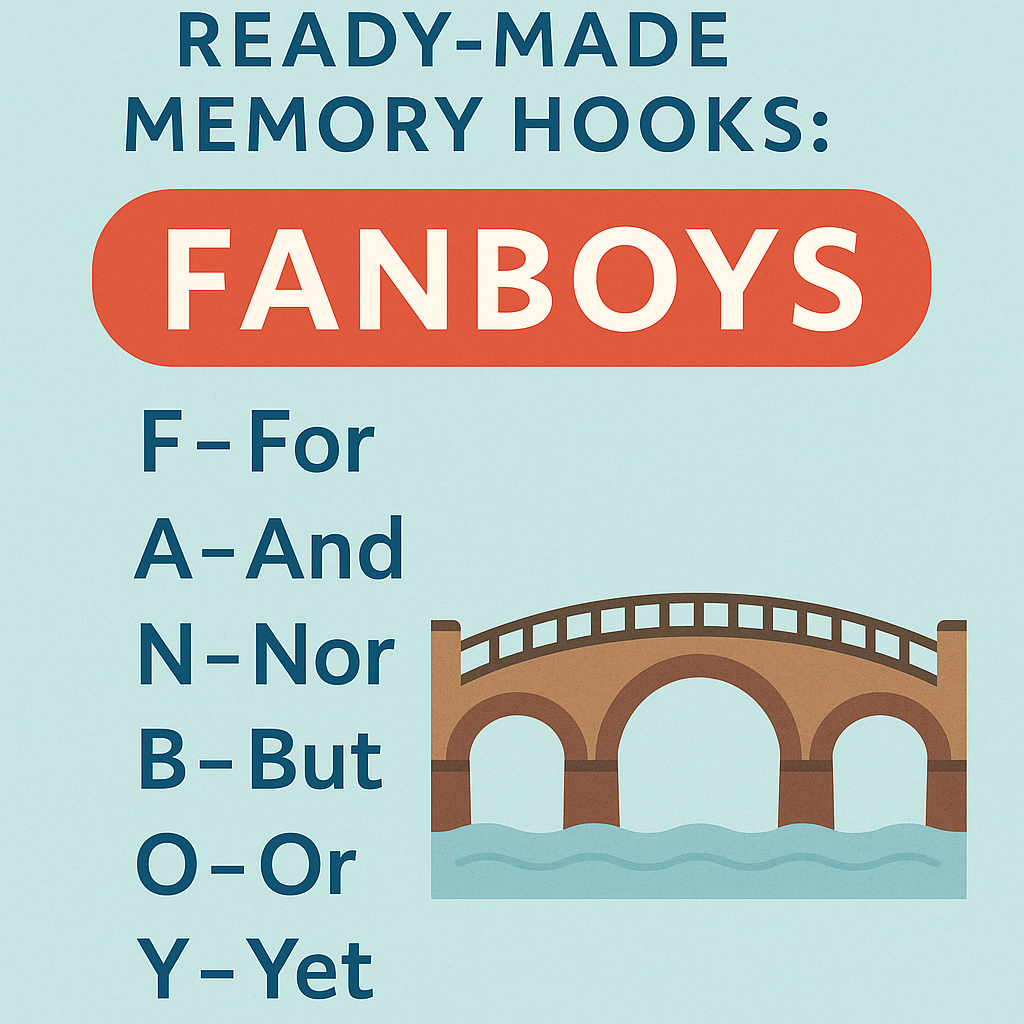
1. FANBOYS – Coordinating Conjunctions (you already have this)
You know this one, but here’s a clean version you can paste into your book:
Memory Hook: FANBOYS (Coordinating Conjunctions)
These little words connect two equal ideas (two full sentences or two similar parts):
For, And, Nor, But, Or, Yet, So
- I was tired, so I went to bed.
- She is smart, but she is shy.
You can call this box in your book:
🌟 Memory Hook 1: FANBOYS – The Seven “Bridge Words”
2. SVOPT – Basic English Word Order (Sentence Train)
For Korean learners especially, word order is huge.
Memory Hook: SVOPT – The English Sentence Train
Subject → Verb → Object → Place → Time
Like train cars in order:
- S: I
- V: ate
- O: breakfast
- P: at home
- T: this morning.
I ate breakfast at home this morning.
You can show it as a train:
[S] – [V] – [O] – [P] – [T]
And note: English is flexible, but this is the “default rail”. If learners memorize SVOPT, their sentences already sound much more natural.
3. A–O–I Ladder – Prepositions of Time & Place (at / on / in)
Everybody struggles with at / on / in. A tiny “ladder” idea helps.
Memory Hook: the A–O–I Ladder (Small → Medium → Big)
- at = a point (small)
- on = a line/surface (medium)
- in = an area/container (big)
You can apply the same idea to time and place:
Time
- at a clock time or point:
- at 3:00, at noon, at night
- on a day or date:
- on Monday, on July 3rd
- in a longer period:
- in July, in 2025, in winter
Place
- at a point:
- at the bus stop, at the door
- on a surface:
- on the table, on the wall
- in an area/container:
- in the room, in New York, in the box
You can title it:
🌟 Memory Hook 2: The A–O–I Ladder — at / on / in
4. SAND – Choosing Articles (a/an, the, or no article)
Articles are painful. Let’s give learners a nice decision word: SAND.
Memory Hook: SAND for Articles
Think of four basic ideas when choosing an article:
- S – Specific → the
- We both know which one → the book on the table.
- A – Any one → a / an
- First mention, any one of many → a book, an orange.
- N – Not countable or general plural → Ø (no article)
- talking about things in general →
- Books are expensive. / Water is important.
- D – Don’t use an article with most names
- I live in Ø New Jersey. She works at Ø Google.
Give a simple decision line in the book:
SAND Check:
Is it Specific? → use the
Is it Any one singular thing? → a / an
Is it a general plural or uncountable? → Ø
Is it a name (person/city/company)? → Ø
5. BATS WEFI – Common Subordinating Conjunctions
Like FANBOYS, but for common subordinating conjunctions (for complex sentences).
Memory Hook: BATS WEFI (Subordinating Conjunctions)
A useful bundle of very common words that start dependent clauses:
Because
Although / As
Though
Since
When / While / Where
Even though / Even if
For (formal “because”)
If
Example:
- Because it was raining, we stayed home.
- When I arrived, she was cooking.
- We stayed home because it was raining.
You can introduce it like:
🌟 Memory Hook 3: BATS WEFI – The “Why/When” Words for Complex Sentences
6. 3T Map – Simple Tenses (Today / Then / Tomorrow)
A super simple “feeling map” for tense — perfect for your style.
Memory Hook: The 3T Map of Time
- Today → Present Simple
- I work. / She works.
- Then → Past Simple
- I worked yesterday.
- Tomorrow → Future Simple
- I will work tomorrow.
You can draw a simple timeline:
Then ←—— Today ——→ Tomorrow
Past Simple – Present Simple – Future Simple
This matches your “Grammar in Feeling” approach: time as a line with emotional “distance.”
7. POP Rule – Phrasal Verbs with Pronouns
You’re doing a lot with phrasal verbs, so give them a small “cute” rule.
Memory Hook: POP Rule (Pronoun in the Middle)
For separable phrasal verbs, when the object is a pronoun, it must sit in the middle:
Pronoun
Only
in the
Pocket (between verb + particle)
- ✅ turn it off
- ❌ turn off it
- ✅ take them off
- ❌ take off them
You can title it:
🌟 Memory Hook 4: POP Rule – Put the Pronoun in the Pocket
How You Can Use These in Your Book
You can:
- Put one Memory Hook box in (almost) every key chapter.
- Repeat them visually:
- side margin icons
- little diagrams (train, ladder, SAND, timeline)
- Make a one-page “Memory Hook Summary” at the end of the book:
- FANBOYS
- SVOPT
- A–O–I Ladder
- SAND
- BATS WEFI
- 3T Map
- POP Rule
© MisoEnglish / Michelle Kim. This is original content written by the author. Unauthorized reproduction or full reposting is prohibited. You may quote short parts only with clear credit and a link to the original post.
이 글은 작성자가 직접 집필한 오리지널 콘텐츠입니다. 전체 복제·무단 재게시를 금하며, 일부 인용 시에는 반드시 출처(MisoEnglish)와 링크를 남겨 주세요.
'English Mechanism' 카테고리의 다른 글
| 접속사란 무엇인가? (0) | 2025.11.14 |
|---|---|
| What Are Causative Verbs(사역동사)? (0) | 2025.11.10 |
| What Is an Acronym? (0) | 2025.11.10 |
| 번역 없이 곧바로 영어로 느끼는 6단계 루틴 (Think in English) (0) | 2025.11.09 |
| "한국어 문장을 영어로 바꾼다면?"로 제발 영어 학습 하지 마세요. (0) | 2025.11.09 |


