
- 분류 전체보기 (575)

| 일 | 월 | 화 | 수 | 목 | 금 | 토 |
|---|---|---|---|---|---|---|
| 1 | 2 | 3 | 4 | 5 | 6 | |
| 7 | 8 | 9 | 10 | 11 | 12 | 13 |
| 14 | 15 | 16 | 17 | 18 | 19 | 20 |
| 21 | 22 | 23 | 24 | 25 | 26 | 27 |
| 28 | 29 | 30 | 31 |
- 영어접속사
- English Speaking Practice
- 영문법
- 언어의철학 #의미론 #화용론 #언어와사고 #언어의미학 #MisoEnglish #TheLanguageBeyondGrammar #영문학심화
- 영어시제
- 영어공부
- SlowBlooms
- English for Korean Learners
- GrammarWithSoul
- misoenglish
- 영어문법
- everyday English
- EnglishTense
- 영어발음
- booking
- 영어를살다
- 영어철학
- English in English
- FareRules
- 영어회화
- 영어공부법
- MichelleKim
- 감성영어
- ticketing
- 🌿 English with Heart
- AirlineOpsEnglish
- 느리지만단단하게
- pnr
- 영어표현력
- Basic English Verbs
- Today
- Total
MisoEnglish
What Are Causative Verbs(사역동사)? 본문
💡 What Are Causative Verbs?
Causative verbs are verbs that show that one person causes another person to do something — or causes something to happen.
In other words, instead of doing the action yourself, you cause someone else (or something) to do it.
🧩 Common Causative Verbs
| make | to force someone to do something | The teacher made the students stay late. |
| have | to ask, arrange, or tell someone to do something | I had my hair cut yesterday. |
| let | to allow someone to do something | My mom let me go out with my friends. |
| get | to persuade or convince someone to do something | I got my brother to help me with homework. |
| help | to assist someone in doing something | She helped me (to) finish the report. |
🧠 Structure
1️⃣ Make / Let / Have
Subject + make/let/have + person + verb (base form)
- She made me cry.
- He let me borrow his car.
- The teacher had the students write an essay.
❗Note: The verb after them has no “to.”
2️⃣ Get
Subject + get + person + to + verb
- I got my son to clean his room.
- She got her assistant to call the client.
3️⃣ Have (object + past participle)
When we talk about services (someone does something for you):
Subject + have + object + past participle
- I had my car washed.
- She had her nails done.
✨ Quick Comparison
| I made him clean the room. | I forced him to clean it. |
| I had him clean the room. | I told him to clean it. |
| I got him to clean the room. | I persuaded him to clean it. |
| I let him clean the room. | I allowed him to clean it. |
✨왜 한국어 번역은 사역동사로 했을까요?
💡 1️⃣ ‘사역(使役)’의 한자 의미
- 使(사) → “시키다, 하게 하다”
- 役(역) → “일하다, 행동하다”
즉, **사역(使役)**은 “누군가에게 일을 시키다” 또는 “어떤 일을 하게 만들다”라는 뜻이에요.
그래서 영어의 cause someone to do something과 거의 일치합니다.
🔸 영어에서 causatie는 "cause = 원인이 되는, 하게 하는"
🔸 한국어에서 사역은 “시켜서 하게 하는”
두 단어가 모두 “직접 하지 않고, 다른 사람을 시켜서 하게 만드는 동작”이라는 개념을 공유하죠.
🧩 2️⃣ 개념 대응: 영어 vs. 한국어
| Causative verb | 사역동사 | 어떤 일이 일어나도록 ‘원인’을 제공하는 동사 |
| Cause | 시키다 / 하게 하다 | ‘A가 B에게 C를 하게 만든다’ |
| Example | 예시 | She made him cry. → 그녀는 그에게 울게 했다. |
그래서 영어의 causative가 “원인(원동력)”이라는 뜻을 지니지만,
한국어로는 그 ‘원인 제공’을 행동으로 표현할 때 “시키다”라는 개념으로 바꾸어 설명한 거예요.
🧠 3️⃣ 왜 ‘원인동사’가 아니라 ‘사역동사’일까?
언뜻 보면 causative니까 “원인동사”로 번역해도 될 것 같지만,
‘원인’이라는 말은 너무 추상적이에요.
언어적으로는 A가 B에게 C를 하게 시킨다라는 구체적인 행위 관계를 표현해야 하기 때문에,
‘사역(시키다)’이라는 말이 더 정확하고 직관적입니다.
🔹 “cause someone to do” = “누군가에게 ~하도록 시키다”
🔹 그래서 “causative verb” = “시키는 동사” → 사역동사
🌿 예문으로 비교
| She made him clean the room. | 그녀는 그에게 방을 청소하게 했다. |
| I had my hair cut. | 나는 머리를 자르게 했다. |
| They let me go. | 그들은 나를 가게 허락했다. |
| I got him to help me. | 나는 그에게 도와달라고 했다 / 도와주게 했다. |
여기서 전부 “시키다 / 하게 하다 / 허락하다”의 의미로 해석되죠.
바로 이 ‘시키다’의 개념이 **사역(使役)**이에요.
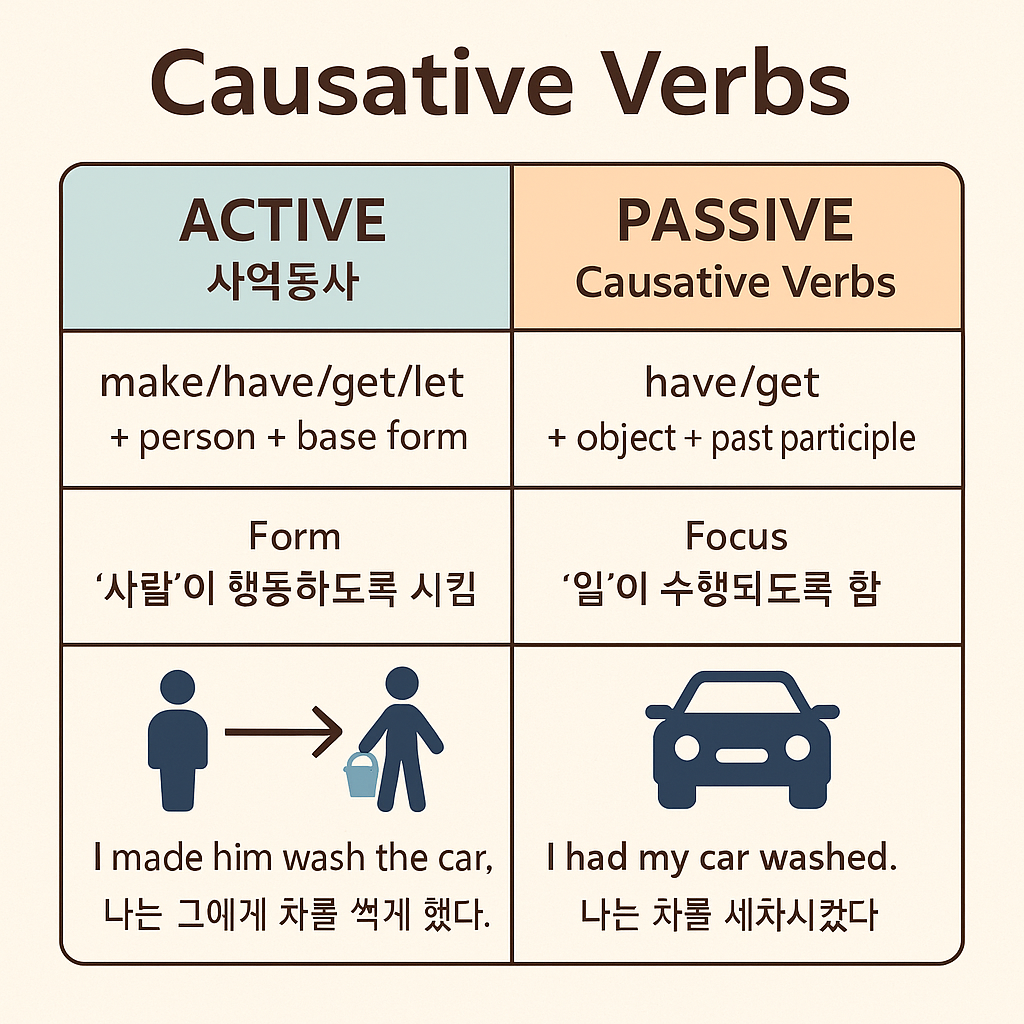
💡 사역동사 vs. 수동 사역 구조 비교
| 의미 | “~하게 하다 / 시키다 / 허락하다” | “~을 (누군가에게) 당하게 하다 / 맡기다” |
| 형태 | make / have / get / let + 사람 + 동사원형(to부정사) | have / get + 목적어 + 과거분사(p.p.) |
| 초점 | ‘사람’이 행동하도록 시킴 | ‘일’이 수행되도록 함 (행위자보다 결과 중심) |
| 예문 1 | I made him wash the car. → 나는 그에게 차를 씻게 했다. |
I had my car washed. → 나는 차를 세차시켰다. |
| 예문 2 | She let her son go out. → 그녀는 아들에게 나가게 허락했다. |
She got her nails done. → 그녀는 손톱을 손질받았다. |
| 예문 3 | They had the students write an essay. → 그들은 학생들에게 에세이를 쓰게 했다. |
They had their essay typed. → 그들은 에세이를 타이핑하게 했다. |
🧩 핵심 차이 요약
| 누가 행동하나? | 사람이 직접 행동함 | 다른 사람이 대신 행동함 |
| 중요한 건? | “사람을 시킨다” | “일이 되게 만든다” |
| 대표 구문 | make/let/have/get + 사람 + 동사원형 | have/get + 사물 + p.p. |
| 예문 | I made him cook. (그를 요리하게 했다) |
I had the meal cooked. (요리를 하게 했다) |
🌿 한눈에 감 잡는 문장 변화
| 직접 사역 | I made him wash my car. | 나는 그에게 차를 씻게 했다. |
| 간접 사역 | I got him to wash my car. | 나는 그에게 차를 씻어 달라고 부탁했다. |
| 수동 사역 | I had my car washed. | 나는 차를 세차시켰다. (누군가에게 맡겨서) |
✨ 기억 포인트
💬 make / let / have / get 은 모두 “causative verbs”지만,
👉 ‘사람을 시키는지’, ‘일을 시키는지’에 따라 구조가 달라집니다.
© MisoEnglish / Michelle Kim. This is original content written by the author. Unauthorized reproduction or full reposting is prohibited. You may quote short parts only with clear credit and a link to the original post.
이 글은 작성자가 직접 집필한 오리지널 콘텐츠입니다. 전체 복제·무단 재게시를 금하며, 일부 인용 시에는 반드시 출처(MisoEnglish)와 링크를 남겨 주세요.
'English Mechanism' 카테고리의 다른 글
| 등위접속사 (coordinating conjunction) (0) | 2025.11.14 |
|---|---|
| 접속사란 무엇인가? (0) | 2025.11.14 |
| Ready-Made Memory Hooks: FANBOYS (0) | 2025.11.10 |
| What Is an Acronym? (0) | 2025.11.10 |
| 번역 없이 곧바로 영어로 느끼는 6단계 루틴 (Think in English) (0) | 2025.11.09 |


