
- 분류 전체보기 (1053)

- Linguistics (고급 영어학) (10)
- Stylistics (6)
- Etymology & Word Building (15)
- Philosophy Meets Grammar (6)
- Collection of Famous Quotes (22)
- English Mechanism (276)
- The Language Beyond Grammar (274)
- Living English (81)
- Miso’s Life Notes (18)
- My English Journey and Refl.. (16)
- Philosophy (132)
- Video Clip (16)
- Airline English (항공 영어) (47)
- Creative Corner (35)
- Sally & Sia (1)
| 일 | 월 | 화 | 수 | 목 | 금 | 토 |
|---|---|---|---|---|---|---|
| 1 | 2 | 3 | 4 | |||
| 5 | 6 | 7 | 8 | 9 | 10 | 11 |
| 12 | 13 | 14 | 15 | 16 | 17 | 18 |
| 19 | 20 | 21 | 22 | 23 | 24 | 25 |
| 26 | 27 | 28 | 29 | 30 |
- MisoEnglish#철학입문 #Philosophy #윤리학 #Ethics #도덕철학 #철학공부 #칸트 #공리주의 #교육콘텐츠 #철학시리즈
- MisoEnglish#유교철학 #Confucianism #성리학 #NeoConfucianism #인의예지 #Virtue #맹자 #Mencius #실학 #KoreanScholarship
- 감성영어
- misoenglish
- MisoEnglish#철학입문 #Philosophy #심리철학 #PhilosophyOfMind #철학공부 #의식 #마음 #PhilosophyForBeginners #교육콘텐츠 #철학시리즈
- English for Korean Learners
- English in English
- 🌿 English with Heart
- 영어회화
- MisoEnglish#철학입문 #Philosophy #과학철학 #PhilosophyOfScience #철학공부 #포퓨퍼 #쿠hn #과학방법론 #교육콘텐츠 #철학시리즈
- AirlineOpsEnglish
- MisoEnglish#불교철학 #BuddhismPhilosophy #사성제 #FourNobleTruths #공사상 #Emptiness #명상 #Mindfulness #열반 #EasternWisdom
- MisoEnglish#도교철학 #Taoism #도덕경 #TaoTeChing #무위자연 #WuWei #노자 #Laozi #장자 #YinYang
- 영어공부
- Basic English Verbs
- English Speaking Practice
- MisoEnglish#철학입문 #Philosophy #종교철학 #PhilosophyOfReligion #철학공부 #신존재증명 #악의문제 #PhilosophyForBeginners #교육콘텐츠 #철학시리즈
- MisoEnglish#한국철학 #KoreanPhilosophy #홍익인간 #Hongik #화랑도 #Hwarang #단군 #Dangun #풍류도 #ThreeKingdoms#동양철학
- ticketing
- EnglishWriting #AcademicWriting #Grammar #EnglishLanguage #EssayWriting #ParagraphStructure #SentenceStructure #BusinessEnglish #EnglishTips #WritingSkills #Linguistics #ESL
- 느리지만단단하게
- MisoEnglish#철학입문 #Philosophy #형이상학 #Metaphysics #철학공부 #존재론 #실재론 #PhilosophyForBeginners #교육콘텐츠 #철학시리즈
- 인도철학 #동양철학 #인문학 #요가 #명상 #힌두교 #불교 #간디 #타고르 #정통6파 #철학공부 #마음공부 #MisoEnglish #인문학영어
- 동양정치철학 #시리즈완결 #아시아적가치 #동서양비교 #유교 #민주주의 #정치사상 #인문학 #비교철학 #글로벌정치 #문화다양성 #2500년철학사
- 영어접속사
- everyday English
- MisoEnglish#철학입문 #Philosophy #정치철학 #PoliticalPhilosophy #철학공부 #정의론 #자유주의 #PhilosophyForBeginners #교육콘텐츠 #철학시리즈
- 영어문법
- pnr
- 영문법
- Today
- Total
MisoEnglish
시즌 2 — 인물 심층편 1편. 조조, 난세의 진짜 얼굴 본문
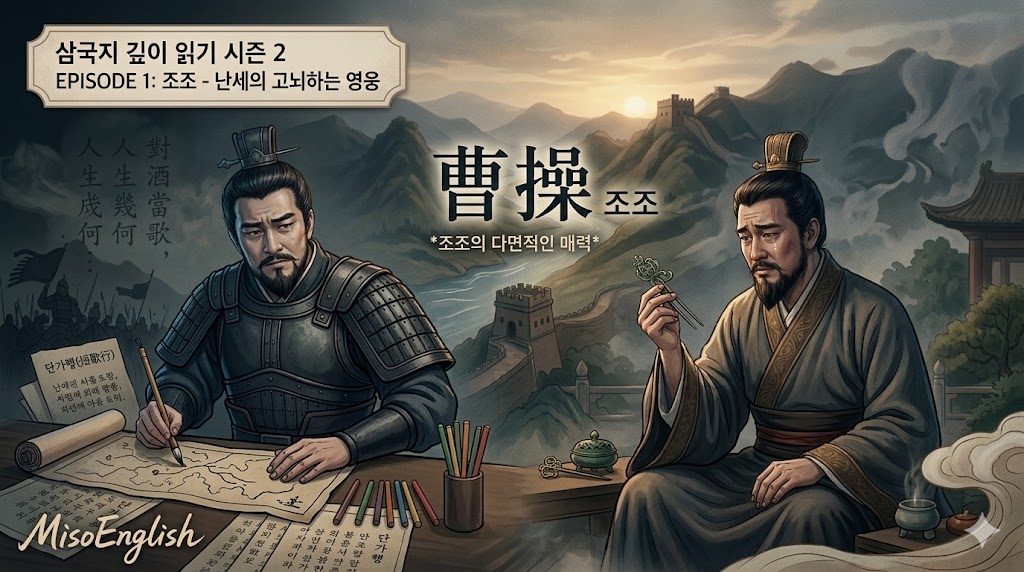
시즌 2 — 인물 심층편
1편. 조조, 난세의 진짜 얼굴
삼국지에서 가장 많이 오해받는 인물이 누구냐고 물으면, 저는 주저 없이 조조라고 말할 거예요.
드라마에서는 항상 하얀 얼굴에 눈을 가늘게 뜨고 음모를 꾸미는 악당으로 나오죠. 유비는 착한 사람, 조조는 나쁜 사람. 어릴 때부터 그렇게 굳어져 있어요.
그런데 조조를 제대로 들여다보면, 생각보다 훨씬 복잡하고 매력적인 사람이에요.
오늘은 조조의 진짜 얼굴을 찾아가 볼게요.
조조는 왜 악당이 됐을까
먼저 이 질문부터 해야 해요.
조조가 나쁜 사람으로 굳어진 건 사실 삼국지연의 때문이에요. 나관중이 유비를 주인공으로 삼다 보니, 자연스럽게 조조가 악당 역할을 맡게 된 거죠.
그런데 나관중이 살던 시대가 원나라 말기였어요. 이민족의 지배를 받던 한족 입장에서, 한나라 황실의 후손 유비가 영웅으로 보였던 거예요. 조조는 그 반대편에 세워진 거고요.
한마디로 조조는 시대의 희생양이기도 했어요.
조조의 어린 시절
조조는 155년에 태어났어요.
아버지 조숭은 환관의 양아들이었어요. 아무리 돈이 많아도 환관 집안이라는 꼬리표는 당시 사회에서 치명적이었죠. 명문가 자제들은 조조를 은근히 무시했어요.
그런데 조조는 굴하지 않았어요.
오히려 더 열심히 했어요. 책을 읽고, 병법을 공부하고, 사냥을 즐기며 몸을 단련했죠.
어릴 때부터 남달랐던 건 눈치예요. 상황을 빠르게 읽고, 사람의 마음을 꿰뚫어 보는 능력이 있었어요.
숙부가 조조의 방탕함을 아버지에게 일러바치곤 했어요. 그러자 조조는 숙부를 만날 때마다 입을 비틀고 쓰러지는 연기를 했어요. 숙부가 놀라 아버지에게 달려가면 조조는 멀쩡하게 일어났죠.
"아까는 왜 그랬느냐?"
"저는 갑자기 중풍 기운이 있어서요."
아버지는 그 뒤로 숙부의 말을 믿지 않았어요.
어린 조조의 영리함이 느껴지는 장면이죠. 😄
원칙주의자 조조
조조가 젊은 관리 시절, 낙양 북부위라는 직책을 맡았어요.
당시 관리들은 권력자 앞에서는 굽실거리고, 힘없는 백성들에게는 강했어요. 그게 당연한 분위기였죠.
그런데 조조는 달랐어요.
부임하자마자 오색 곤장 열 개를 만들어 문 앞에 세워뒀어요. 법을 어기는 자는 누구든 가리지 않겠다는 선언이었죠.
얼마 뒤 황제가 총애하는 환관 건석의 숙부가 야간 통행금지를 어겼어요.
조조는 곤장을 쳐서 죽였어요.
낙양이 발칵 뒤집혔어요. 누구도 감히 못 건드리는 사람을 건드렸으니까요.
조조는 당연히 미운털이 박혔어요. 한직으로 밀려났죠.
그런데 이 사건 하나가 조조의 이름을 세상에 알렸어요. 원칙을 지키는 사람이라는 이름으로요.
조조의 인재 사랑
조조가 다른 군벌들과 가장 크게 달랐던 점은 인재를 보는 눈이었어요.
출신을 따지지 않았어요.
적군 출신이어도, 죄인이어도, 환관 집안이어도 능력만 있으면 받아들였죠. 당시로서는 파격적인 일이었어요.
조조가 직접 내린 명령이 있어요.
"덕행이 없어도 재능이 있는 자를 추천하라. 나는 그 재능을 쓸 것이다."
덕보다 능력을 우선하겠다는 선언이었어요. 지금 들어도 파격적인 말이죠.
이 한마디가 천하의 인재들을 조조 곁으로 불러 모았어요. 순욱, 곽가, 정욱, 허저, 장료. 쟁쟁한 인물들이 조조의 깃발 아래 모였죠.
조조의 눈물
조조가 냉혹하기만 한 사람이었을까요?
그렇지 않아요.
조조가 가장 아끼던 참모 곽가가 젊은 나이에 세상을 떠났을 때, 조조는 크게 울었어요.
"다른 사람들은 나이가 있으니 괜찮지만, 봉효(곽가의 자)는 너무 젊었는데."
적벽대전에서 대패하고 도망치면서 조조는 크게 웃었어요. 부하들이 영문을 몰라 하자 말했죠.
"곽가가 살아있었다면 이런 일은 없었을 텐데."
웃으면서 우는 장면이었어요.
조조도 그리워하는 사람이 있었고, 후회하는 순간이 있었어요.
조조의 시
조조는 뛰어난 시인이었어요.
전장을 누비면서도 시를 썼어요. 그 시들이 지금도 중국 문학사에 길이 남아있죠.
가장 유명한 구절이에요.
"술이 있으니 마땅히 노래해야지. 인생이 얼마나 되겠는가. 마치 아침 이슬과 같이, 지나간 날들이 너무도 많구나."
천하를 호령하던 사람이 쓴 시치고는 너무 인간적이지 않나요.
권력도, 명예도, 승리도 결국 덧없다는 걸 조조 스스로 알고 있었던 거예요.
조조의 유언
220년, 조조가 세상을 떠나기 전 유언을 남겼어요.
거창한 말이 없었어요.
"내 첩들이 구리 작대기 비녀 만드는 것을 업으로 삼게 해주고, 평소 좋아하던 향을 나눠주어라. 각 방에서 지내게 하되 외롭지 않게 해달라."
천하를 호령하던 사람의 마지막 걱정이 곁에 있던 사람들이었어요.
그리고 한마디 더 남겼어요.
"내 무덤에는 금은보화를 넣지 말고, 화려하게 꾸미지 마라."
평생 실용을 추구했던 조조다운 마지막이었어요.
조조, 다시 보기
조조는 나쁜 사람이었을까요?
꼭 그렇지만은 않아요.
잔인한 면도 있었고, 의심이 많았고, 목적을 위해서라면 수단을 가리지 않았어요.
그런데 동시에 원칙을 지켰고, 인재를 아꼈고, 시를 사랑했고, 곁에 있는 사람들을 챙겼어요.
완벽한 영웅도 아니고, 완벽한 악당도 아니었어요.
그냥 인간이었어요. 야망이 크고, 능력이 뛰어나고, 때로는 잔인하고, 때로는 눈물을 흘리는.
어쩌면 그게 조조가 1,800년이 지난 지금도 가장 많이 이야기되는 이유일 거예요.
완벽하지 않은 사람이 가장 인간적으로 느껴지니까요.
다음 편에서는 유비 이야기예요. 짚신을 팔던 청년이 어떻게 황제가 됐는지, 그 파란만장한 인생을 따라가 볼게요.
시즌 2 — 2편: 유비, 짚신 장수에서 황제까지
Season 2 — Character Deep Dives
Episode 1: Cao Cao — The Real Face of a Turbulent Age
If you ask who is the most misunderstood figure in Romance of the Three Kingdoms, I'd say Cao Cao without hesitation.
In dramas, he's always the pale-faced villain — eyes narrowed, scheming in the shadows. Liu Bei is the good guy, Cao Cao is the bad guy. That image has been locked in since childhood.
But look closely at Cao Cao, and you'll find someone far more complex — and far more fascinating.
Today, we go looking for his real face.
Why Did Cao Cao Become the Villain?
We have to start here.
The reason Cao Cao became cemented as the bad guy is, frankly, Romance of the Three Kingdoms itself. Because Luo Guanzhong chose Liu Bei as his hero, Cao Cao naturally inherited the villain's role.
But consider when Luo Guanzhong was writing — the dying years of the Yuan Dynasty, when the Han Chinese were living under foreign rule. Of course a descendant of the Han imperial family looked like a hero. And of course someone had to stand on the opposite side.
In many ways, Cao Cao was a victim of his era.
Cao Cao's Childhood
Cao Cao was born in 155 AD.
His father, Cao Song, was the adopted son of a eunuch. No matter how wealthy the family was, that label was socially devastating at the time. Sons of noble families quietly looked down on Cao Cao.
But he didn't fold.
He read voraciously, studied military strategy, hunted to train his body — and from an early age, his sharpest gift was reading people and situations.
There's a telling story from his youth. His uncle kept reporting Cao Cao's supposed wild behavior to his father. So Cao Cao hatched a plan — every time he saw his uncle coming, he'd twist his mouth and collapse to the ground in a dramatic fit. His uncle would rush to tell his father. By the time he arrived, Cao Cao would be perfectly fine.
"What happened to you earlier?" "I suddenly felt a stroke coming on."
After that, his father stopped believing his uncle's reports.
Even as a boy, Cao Cao was playing the game. 😄
Cao Cao the Principled
As a young official, Cao Cao was appointed Chief of Police of Northern Luoyang.
At the time, officials routinely bowed to the powerful and bullied the weak. That was just how things worked.
Cao Cao did things differently.
The moment he took office, he had ten colorful clubs erected at the gate — a public declaration that the law applied to everyone, no exceptions.
Not long after, the uncle of Jian Shuo — a eunuch personally favored by the Emperor — violated the nighttime curfew.
Cao Cao had him beaten to death.
Luoyang erupted. No one dared touch someone under that kind of protection. Cao Cao was pushed to a minor post as punishment.
But that single act spread his name across the land — as a man who kept his principles.
Cao Cao and His Talent for Talent
What set Cao Cao apart from every other warlord of his era was how he saw people.
He didn't care about your background.
Former enemies, convicted criminals, sons of eunuchs — if you had ability, he wanted you. That was genuinely radical for the time.
He issued a direct order:
"Recommend those with talent, even if they lack virtue. I will put their talent to use."
Ability over character. Even today, that's a bold stance.
That declaration drew the greatest minds of the age to his banner — Xun Yu, Guo Jia, Cheng Yu, Xu Zhu, Zhang Liao. Under Cao Cao's flag, exceptional people gathered.
Cao Cao's Tears
Was Cao Cao purely cold-blooded?
No.
When his most beloved advisor Guo Jia died young, Cao Cao wept openly.
"The others are older — they'll be alright. But Fengxiao was still so young."
After his devastating defeat at the Battle of Red Cliffs, while fleeing, Cao Cao suddenly burst out laughing. His men had no idea why.
"If Guo Jia were still alive, this never would have happened."
He was laughing and grieving at the same time.
Cao Cao had people he missed. Moments he regretted.
Cao Cao the Poet
Cao Cao was a remarkable poet.
He wrote verse even amid campaigns. Those poems still stand as classics in Chinese literary history.
His most famous lines:
"With wine before me, I ought to sing — for how long is a man's life? Like the morning dew, so many days have already passed."
For someone who commanded an empire, those are startlingly human words.
Cao Cao knew it himself — that power, glory, and victory are ultimately fleeting.
Cao Cao's Last Words
In 220 AD, as he lay dying, Cao Cao left behind a final message.
No grand declarations.
"Let my concubines make their living crafting bronze hairpins. Divide among them the incense I was fond of. Give each a room of her own, and see that they are not lonely."
The man who commanded the realm spent his final thoughts on the people at his side.
And one more instruction:
"Put no gold or silver in my tomb. Do not make it grand."
A fitting end for a man who lived by practicality.
Cao Cao, Reconsidered
Was Cao Cao a bad person?
Not exactly.
He had a cruel streak. He was deeply suspicious. When he wanted something, he could be ruthless about how he got it.
But he also kept his principles. He cherished talent. He loved poetry. He looked after the people around him.
He was no perfect hero. But no perfect villain either.
He was simply human — ambitious, gifted, sometimes brutal, sometimes moved to tears.
Maybe that's exactly why, 1,800 years later, Cao Cao is still the most talked-about figure from that era.
Because an imperfect person feels the most real.
Next episode: Liu Bei — from sandal peddler to emperor. We'll follow the extraordinary arc of a man who started with nothing.
Season 2 — Episode 2: Liu Bei, From Straw Sandals to the Dragon Throne
⚠️ 저작권 안내
본 블로그(MisoEnglish · slowblooms.tistory.com)의 모든 콘텐츠는 저작권법의 보호를 받습니다. 글, 예시 문장, 분석 내용 등 블로그에 게시된 모든 창작물은 저작자의 동의 없이 무단으로 복사, 복제, 배포, 2차 가공하는 행위를 금지합니다. 출처를 밝히지 않은 전재, SNS·커뮤니티·타 블로그 등에의 무단 게시, 상업적 이용은 모두 금지되며, 무단 불펌 적발 시 저작권법에 따라 법적 조치가 취해질 수 있습니다. 콘텐츠 사용 문의는 slowblooms.tistory.com으로 연락 주세요.
© MisoEnglish · slowblooms.tistory.com. All rights reserved.
━━━━━━━━━━━━━━━━━━━━━━━━━━━━━━━━
⚠️ Copyright Notice
All content published on this blog (MisoEnglish · slowblooms.tistory.com) is protected by copyright law. Copying, reproducing, distributing, or adapting any written posts, example sentences, or analyses without the explicit consent of the author is strictly prohibited. Unauthorised reposting on other blogs, social media, online communities, or any public platform — with or without modification — is not permitted, and may result in legal action under applicable copyright law. For content licensing enquiries, please contact us via slowblooms.tistory.com.
© MisoEnglish · slowblooms.tistory.com. All rights reserved.
'The Language Beyond Grammar' 카테고리의 다른 글
| 시즌 2 — 인물 심층편 3편. 제갈량, 완벽한 인간의 외로움 (0) | 2026.03.08 |
|---|---|
| 시즌 2 — 인물 심층편 2편. 유비, 짚신 장수에서 황제까지 (0) | 2026.03.08 |
| 에필로그. 이야기가 끝난 자리에 — 삼국지를 덮으며 (1) | 2026.03.07 |
| 20편. 1,800년을 건너온 이야기 — 삼국지가 남긴 인물들, 전략, 그리고 오늘의 의미 (0) | 2026.03.07 |
| 19편. 천하는 하나로 — 사마씨의 진나라 창업과 삼국의 종말 (0) | 2026.03.07 |


