
- 분류 전체보기 (1053)

- Linguistics (고급 영어학) (10)
- Stylistics (6)
- Etymology & Word Building (15)
- Philosophy Meets Grammar (6)
- Collection of Famous Quotes (22)
- English Mechanism (276)
- The Language Beyond Grammar (274)
- Living English (81)
- Miso’s Life Notes (18)
- My English Journey and Refl.. (16)
- Philosophy (132)
- Video Clip (16)
- Airline English (항공 영어) (47)
- Creative Corner (35)
- Sally & Sia (1)
| 일 | 월 | 화 | 수 | 목 | 금 | 토 |
|---|---|---|---|---|---|---|
| 1 | 2 | 3 | 4 | |||
| 5 | 6 | 7 | 8 | 9 | 10 | 11 |
| 12 | 13 | 14 | 15 | 16 | 17 | 18 |
| 19 | 20 | 21 | 22 | 23 | 24 | 25 |
| 26 | 27 | 28 | 29 | 30 |
- pnr
- 감성영어
- MisoEnglish#철학입문 #Philosophy #정치철학 #PoliticalPhilosophy #철학공부 #정의론 #자유주의 #PhilosophyForBeginners #교육콘텐츠 #철학시리즈
- 🌿 English with Heart
- misoenglish
- 동양정치철학 #시리즈완결 #아시아적가치 #동서양비교 #유교 #민주주의 #정치사상 #인문학 #비교철학 #글로벌정치 #문화다양성 #2500년철학사
- MisoEnglish#철학입문 #Philosophy #윤리학 #Ethics #도덕철학 #철학공부 #칸트 #공리주의 #교육콘텐츠 #철학시리즈
- ticketing
- English Speaking Practice
- MisoEnglish#철학입문 #Philosophy #과학철학 #PhilosophyOfScience #철학공부 #포퓨퍼 #쿠hn #과학방법론 #교육콘텐츠 #철학시리즈
- MisoEnglish#도교철학 #Taoism #도덕경 #TaoTeChing #무위자연 #WuWei #노자 #Laozi #장자 #YinYang
- MisoEnglish#한국철학 #KoreanPhilosophy #홍익인간 #Hongik #화랑도 #Hwarang #단군 #Dangun #풍류도 #ThreeKingdoms#동양철학
- 영어공부
- MisoEnglish#철학입문 #Philosophy #형이상학 #Metaphysics #철학공부 #존재론 #실재론 #PhilosophyForBeginners #교육콘텐츠 #철학시리즈
- Basic English Verbs
- AirlineOpsEnglish
- MisoEnglish#철학입문 #Philosophy #종교철학 #PhilosophyOfReligion #철학공부 #신존재증명 #악의문제 #PhilosophyForBeginners #교육콘텐츠 #철학시리즈
- MisoEnglish#유교철학 #Confucianism #성리학 #NeoConfucianism #인의예지 #Virtue #맹자 #Mencius #실학 #KoreanScholarship
- 인도철학 #동양철학 #인문학 #요가 #명상 #힌두교 #불교 #간디 #타고르 #정통6파 #철학공부 #마음공부 #MisoEnglish #인문학영어
- 영어문법
- 영문법
- everyday English
- 영어회화
- 영국사 #영국역사 #세계사 #역사연재 #브리튼에서영국까지
- MisoEnglish#불교철학 #BuddhismPhilosophy #사성제 #FourNobleTruths #공사상 #Emptiness #명상 #Mindfulness #열반 #EasternWisdom
- 영어접속사
- MisoEnglish#철학입문 #Philosophy #심리철학 #PhilosophyOfMind #철학공부 #의식 #마음 #PhilosophyForBeginners #교육콘텐츠 #철학시리즈
- English in English
- English for Korean Learners
- EnglishWriting #AcademicWriting #Grammar #EnglishLanguage #EssayWriting #ParagraphStructure #SentenceStructure #BusinessEnglish #EnglishTips #WritingSkills #Linguistics #ESL
- Today
- Total
MisoEnglish
시즌 2 — 인물 심층편 3편. 제갈량, 완벽한 인간의 외로움 본문
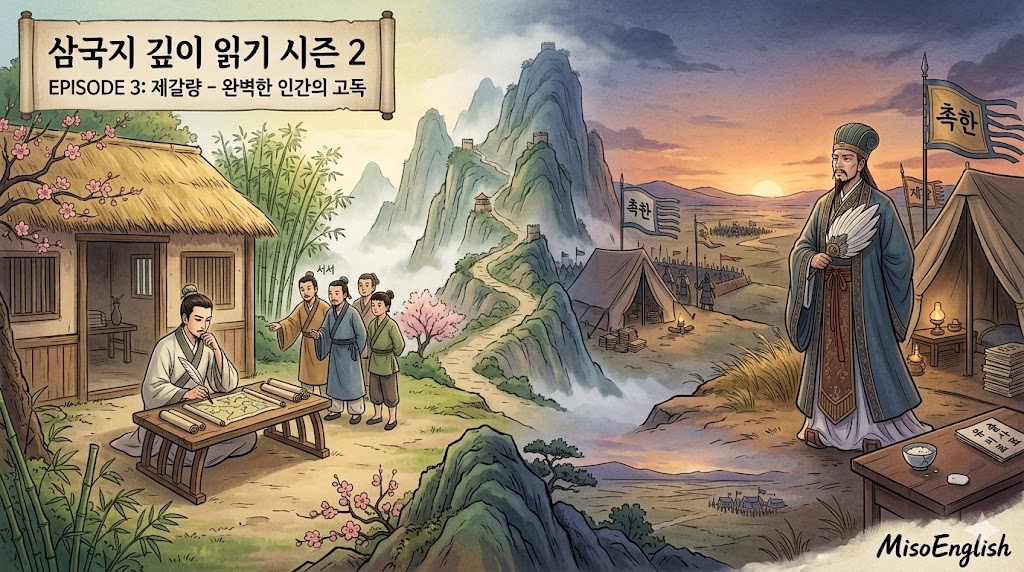
시즌 2 — 인물 심층편 3편. 제갈량, 완벽한 인간의 외로움
전략가, 정치가, 발명가, 외교관. 못 하는 게 없었어요. 심지어 기상까지 읽었다고 하죠. 그래서 사람들은 제갈량을 거의 신처럼 이야기해요.
그런데 저는 제갈량을 생각할 때마다 한 가지가 마음에 걸려요.
이 완벽한 사람은, 과연 행복했을까요.
초야에 묻힌 청년
제갈량은 181년에 태어났어요.
어릴 때 부모를 잃고 숙부 손에서 자랐어요. 숙부마저 일찍 세상을 떠나자, 스무 살 안팎의 제갈량은 형주 땅 융중이라는 곳에 작은 집을 짓고 홀로 살았어요.
농사를 짓고, 책을 읽고, 천하의 흐름을 관찰했어요.
그가 즐겨 비교한 인물이 관중과 악의였어요. 관중은 제나라를 패자로 만든 재상이고, 악의는 연나라의 명장이에요. 쉽게 말하면 "나는 나라를 바꿀 수 있는 사람"이라는 자의식이 있었던 거예요.
주변 사람들은 그 말을 믿지 않았어요. 딱 한 사람, 친구 서서만이 말했어요. "저 친구, 진짜일지도 몰라."
그 서서가 나중에 유비 곁에서 제갈량을 추천하게 돼요. 역사의 인연은 이렇게 이어지기도 해요.
삼고초려 — 기다림의 의미
유비가 제갈량을 찾아온 건 제갈량 나이 스물일곱 때예요. 그것도 세 번이나 찾아왔어요.
당시 유비는 나이 마흔일곱. 이미 수십 년을 전장에서 보낸 사람이에요. 그런 사람이 스물일곱 청년의 초가집 앞에서 기다렸어요.
첫 번째 방문, 없었어요. 두 번째 방문, 없었어요. 세 번째 방문, 드디어 만났어요.
여기서 잠깐 생각해볼 게 있어요. 제갈량이 정말 몰랐을까요, 유비가 찾아온다는 걸. 융중은 작은 고을이에요. 천하의 유비가 찾아온다는 소식이 안 들렸을 리 없어요. 일부러 자리를 피했다는 해석도 있어요. 상대가 진짜로 자신을 원하는지 시험했다는 거죠.
세 번을 기다리게 한 것도, 세 번을 찾아온 것도, 어쩌면 둘 다 계산이었을 거예요. 그리고 그 계산이 맞아떨어졌어요.
제갈량이 유비에게 내놓은 것이 천하삼분지계예요. 조조는 이미 북방을 장악했으니 정면 대결은 무리다. 손권은 강동을 굳건히 지키고 있으니 동맹 대상이다. 형주와 익주를 차지해 기반을 다지고, 때를 기다려 천하를 도모하라.
스물일곱 청년의 입에서 나온 말이라고 믿기 어려울 만큼 정확한 분석이었어요. 유비는 그 자리에서 말했어요.
"내가 공명을 얻은 것은 물고기가 물을 얻은 것과 같다."
수어지교. 지금도 쓰이는 말이 여기서 나왔어요.
적벽대전의 진짜 외교관
제갈량의 첫 번째 진짜 시험은 적벽대전 직전이었어요.
208년, 조조의 80만 대군이 남하하자 유비는 사실상 도망치는 신세였어요. 병력은 수천, 땅도 없었어요. 이 상황에서 제갈량이 직접 강동으로 건너가 손권을 설득하겠다고 나섰어요.
강동에는 항복을 주장하는 신하들이 가득했어요. 조조의 대군 앞에서 싸우자고 주장하는 게 오히려 이상해 보이는 분위기였어요.
제갈량은 손권 앞에서 직접 그 분위기를 역이용했어요.
"조조에게 항복하시면 편합니다. 그런데 항복하면 장군은 어떻게 됩니까? 땅과 병사를 내주고 조조의 신하로 사는 거예요. 지금 강동의 지세, 수군의 강함, 이것이 조조의 약점을 찌를 수 있는 기회입니다."
손권의 마음이 흔들렸어요. 그리고 주유가 가세하면서 결전이 결정됐죠.
제갈량이 동남풍을 빌었다는 이야기는 아마 과장이거나 상징일 거예요. 실제로는 계절과 지형에 대한 철저한 분석이 있었을 거예요. 그게 제갈량이었어요. 신기에 가까워 보이는 판단 뒤에는 항상 치밀한 계산이 있었어요.
적벽대전의 승리는 주유의 전술과 황개의 고육지계가 핵심이었지만, 그 판을 만든 외교는 제갈량이었어요.
완벽한 참모의 무게
제갈량은 유비의 곁에서 모든 걸 했어요.
전략을 짰고, 외교를 했고, 군량을 조달했고, 법을 정비했어요. 그런데 한 가지 이상한 점이 있어요.
유비가 살아있는 동안, 제갈량은 전선에 거의 나가지 않았어요. 전략은 제갈량이 짰지만, 실제 전투는 관우, 장비, 조자룡이 했어요.
왜일까요.
유비에게는 이미 뛰어난 장수들이 있었어요. 제갈량의 자리는 싸우는 것보다 전체를 보는 것이었어요. 그리고 유비는 제갈량을 절대로 전선에서 잃고 싶지 않았을 거예요.
그런데 이게 제갈량에게는 또 다른 외로움이었을 거예요. 전장에서 직접 싸우는 장수들과 달리, 제갈량은 항상 뒤에서 계산하고 조율하는 사람이었어요. 승리는 장수들의 것이 되고, 실패는 전략가의 책임이 됐어요. 그 자리가 얼마나 고독한 자리인지는 해본 사람만 알 거예요.
제갈량은 없어서는 안 되는 사람이었어요. 그 무게가 평생 그의 어깨 위에 있었어요.
유선 — 제갈량의 진짜 짐
유비의 아들 유선은 역사에서 꽤 가혹하게 평가받아요. 무능하고 나약했다고요.
그런데 조금 다르게 볼 수도 있어요. 유선은 제갈량이 살아있는 동안 그의 말을 거의 그대로 따랐어요. 제갈량을 신뢰했기 때문이기도 하지만, 어쩌면 아버지 유비로부터 "제갈량을 아버지처럼 모셔라"는 말을 들었기 때문이기도 해요.
문제는 그 신뢰가 제갈량에게 엄청난 부담이었다는 거예요.
실질적으로 촉한을 이끄는 사람이 자신인데, 황제는 따로 있어요. 모든 결정을 혼자 내리지만 그 결정의 책임은 황제의 이름으로 가요. 제갈량은 평생 그 경계 위에서 살았어요.
출사표에 이런 구절이 있어요.
"신은 성도에 밭 열다섯 이랑과 뽕나무 팔백 그루가 있으니, 자손이 먹고살기에 넉넉합니다. 신이 밖에서 일하는 동안 달리 재산을 늘리지 않겠으며, 죽는 날 남는 재물이 없도록 하겠습니다."
승상의 자리에 있으면서 사유재산을 불리지 않겠다는 선언이에요. 이 한 줄이 제갈량이 어떤 사람이었는지를 말해줘요.
그리고 실제로 그랬어요. 제갈량이 죽었을 때 그의 재산은 그 말과 정확히 일치했어요.
북벌 — 알면서도 간 길
유비가 죽고 몇 년 뒤, 제갈량은 북벌을 준비했어요.
위나라를 치러 나가기 전, 제갈량은 유선에게 출사표를 올렸어요.
"신은 본래 포의로 남양에서 밭을 갈았습니다. 난세에 목숨을 보전하기를 바랐을 뿐, 제후에게 이름을 알리려 하지 않았습니다. 선제께서 신을 미천하게 여기지 않으시고 세 번이나 찾아오셨습니다…"
이 글을 읽으면 제갈량이 단순한 전략가가 아니었다는 걸 느낄 수 있어요. 유비에 대한 감사, 촉한에 대한 책임감, 그리고 이 싸움이 얼마나 무모한지 알면서도 나가야 한다는 각오.
사실 냉정하게 보면 북벌의 승산은 높지 않았어요.
촉한의 인구는 위나라의 5분의 1도 안 됐어요. 국력 차이가 너무 컸어요. 산을 넘어 싸우러 나가는 쪽이 항상 불리해요. 군량 보급이 문제였고, 한 번 물러나면 다시 나올 힘을 모아야 했어요.
그럼에도 제갈량이 북벌을 감행한 데는 이유가 있어요.
첫째, 공격하지 않으면 결국 위나라가 더 강해지고 촉한은 더 약해져요. 지키는 것만으로는 살아남기 어려웠어요. 둘째, 유비와의 약속이었어요. 한나라를 다시 세운다는 그 약속. 제갈량에게 그것은 선택이 아니라 의무였어요.
중국에서는 지금도 출사표를 읽으며 울지 않으면 충신이 아니라는 말이 있어요.
사마의 — 제갈량의 진짜 맞수
북벌에서 제갈량의 가장 큰 적은 위나라의 사마의였어요.
두 사람은 묘하게 닮아 있었어요. 둘 다 전략가였고, 둘 다 신중했고, 둘 다 군주보다 훨씬 뛰어났어요.
그런데 싸우는 방식이 달랐어요.
제갈량은 완벽한 준비 위에서 싸웠어요. 군량이 충분해야 했고, 지형이 유리해야 했고, 모든 변수를 미리 계산해야 했어요.
사마의는 버텼어요. 싸우지 않고 지켰어요. 제갈량이 지쳐 물러나길 기다렸어요.
위나라의 입장에서는 지키기만 해도 이기는 싸움이었어요. 제갈량이 아무리 잘 싸워도, 돌아가면 다시 쳐야 했고, 그때마다 군량이 떨어졌어요.
한번은 제갈량이 사마의에게 여자 옷을 보낸 일이 있어요. 전장에서 싸우지 않고 숨어 있는 걸 비웃은 거예요. 사마의는 그 옷을 받아들고 웃으며 말했어요. "제갈량은 나를 화나게 해서 무리하게 출전하도록 만들려는 거지."
그리고 끝까지 나오지 않았어요.
사마의는 제갈량을 가장 잘 알았고, 그래서 가장 무서워했어요. 제갈량이 죽은 뒤 그의 진영을 살펴본 사마의는 이렇게 말했어요.
"천하의 기재(奇才)로다."
적이 남긴 최고의 헌사였어요.
혼자 지탱한 나라
북벌은 다섯 번이나 이어졌어요. 매번 군량 문제, 인재 부족, 내부 갈등에 시달렸어요. 제갈량은 그 모든 것을 혼자 짊어졌어요.
밥은 제대로 먹고 있는지 걱정하는 부하에게 제갈량이 한 말이 있어요.
"하루에 쌀 서 홉 이상은 먹지 못한다. 일은 스무 근 이상이 된다."
거의 먹지 못하면서, 하루 종일 일했어요.
부하들이 간단한 일도 직접 처리하려는 제갈량에게 말했어요. "승상, 저희에게 맡기십시오."
제갈량은 고개를 저었어요. "선제께서 내게 맡기신 일인데, 함부로 다른 사람에게 넘길 수 없다."
이 완벽주의가 제갈량의 강점이었지만 동시에 약점이기도 했어요. 모든 걸 혼자 쥐고 있었기 때문에, 제갈량이 죽은 뒤 촉한에는 그를 이을 만한 인재가 없었어요. 권한을 나눠주고, 사람을 키웠다면 달랐을지도 몰라요. 하지만 제갈량은 그렇게 하지 못했어요. 혹은 그렇게 하기 어려운 상황이었어요. 믿을 만한 사람이 너무 없었으니까요.
오장원 — 마지막 날들
234년, 제갈량은 다섯 번째 북벌을 이끌고 오장원에 진을 쳤어요.
사마의는 이번에도 싸우지 않았어요. 높은 곳에 진을 치고 버텼어요.
제갈량은 이미 몸이 많이 상해 있었어요. 다섯 번의 북벌, 수십 년의 과로, 거의 먹지 못하는 생활이 그의 몸을 갉아먹고 있었어요.
사마의가 제갈량의 사자에게 넌지시 물었어요.
"승상은 요즘 잘 드시고 잘 쉬시오?"
사자가 솔직하게 대답했어요. "승상께서는 새벽부터 밤까지 직접 일하십니다. 하루에 드시는 건 서 홉이 되지 않습니다."
사마의가 조용히 말했어요.
"그렇다면 오래가지 못하겠군."
전쟁이 아니라 시간을 기다렸어요. 그리고 그 계산이 맞았어요.
오장원의 밤, 제갈량은 별을 보았다고 해요. 자신의 별이 흐릿해지는 걸 봤다고요. 그게 사실인지 아닌지는 알 수 없어요. 하지만 제갈량 자신은 이미 알고 있었을 거예요. 몸이 버텨주지 않는다는 걸.
그 해 가을, 제갈량은 오장원에서 세상을 떠났어요. 나이 쉰넷이었어요. 마지막까지 진영을 떠나지 않았어요. 진중에서 눈을 감았어요.
죽기 전 제갈량은 자신의 뒤를 이을 순서까지 정해놓았어요. 장완, 비의. 촉한이 조금이라도 더 버틸 수 있도록. 마지막 순간까지 계산하는 사람이었어요.
제갈량, 다시 보기
제갈량은 완벽한 사람이었을까요.
전략가로서는 거의 그랬어요. 하지만 북벌은 결국 성공하지 못했어요. 촉한은 제갈량이 죽고 나서도 수십 년을 버텼지만, 결국 263년 위나라에 멸망했어요. 제갈량이 원했던 한나라의 부흥은 이루어지지 않았어요.
그걸 알면서도 나간 거예요. 이길 수 없다는 걸 알면서도.
왜였을까요.
유비가 세 번이나 찾아온 날, 그 초가집에서 마음을 열었던 순간부터 제갈량은 이미 그 길 위에 있었던 거예요. 충성이라는 이름으로, 책임이라는 이름으로, 끝까지.
완벽한 사람의 가장 인간적인 면은 어쩌면 그 외로움이었을 거예요. 아무도 대신할 수 없었고, 아무에게도 기댈 수 없었던. 이길 수 없다는 걸 알면서도 멈출 수 없었던.
그 외로움을 안고, 제갈량은 평생을 살았어요.
다음 편에서는 관우 이야기예요. 어떻게 한 무장이 신이 되었는지, 그 놀라운 이야기를 해볼게요.
시즌 2 — 4편: 관우, 신이 된 사나이
Season 2 — Character Deep Dive,
Episode 3: Zhuge Liang, The Loneliness of a Perfect Man
If you had to name the most perfect figure in all of Romance of the Three Kingdoms, most people would say Zhuge Liang.
Strategist, statesman, inventor, diplomat. There was nothing he couldn't do. He could even read the weather, or so the stories go. People speak of him almost like a god.
But whenever I think about Zhuge Liang, one question stays with me.
This perfect man — was he ever truly happy?
The Young Man Who Buried Himself in the Countryside
Zhuge Liang was born in 181 AD.
He lost both parents young and was raised by his uncle. When his uncle died early as well, Zhuge Liang — barely into his twenties — built a small house in a place called Longzhong in Jing Province and lived there alone.
He farmed. He read. He watched the movements of the world.
The figures he most often compared himself to were Guan Zhong and Yue Yi — Guan Zhong, the chancellor who made the state of Qi the dominant power of his era, and Yue Yi, the brilliant general of Yan. In other words, Zhuge Liang saw himself, even then, as someone who could change the fate of a nation.
The people around him didn't believe it.
One friend did. Xu Shu said quietly: "That one — he might actually mean it."
It was that same Xu Shu who would later serve Liu Bei and recommend Zhuge Liang to him. History has a way of threading people together like that.
The Three Visits — What the Waiting Really Meant
Liu Bei came to find Zhuge Liang when Zhuge Liang was twenty-seven. And he came three times.
Liu Bei was forty-seven. A man who had spent decades on battlefields and in flight. And yet he stood outside a young man's thatched cottage and waited.
First visit — not there. Second visit — not there. Third visit — finally, a meeting.
Here it's worth pausing. Did Zhuge Liang really not know Liu Bei was coming? Longzhong was a small place. The news that Liu Bei himself was making the journey would not have been hard to hear. Some historians believe Zhuge Liang deliberately made himself absent — testing whether the man truly wanted him, or was simply going through the motions.
Perhaps both men were calculating. And perhaps both calculations were correct.
What Zhuge Liang laid out that day was the Longzhong Plan — the blueprint for dividing the realm into three. Cao Cao already held the north; a direct confrontation would be suicidal. Sun Quan held the Jiangdong region securely; he was a potential ally. Take Jing Province, then Yi Province, build a foundation, and wait for the right moment.
It was a breathtaking analysis from a twenty-seven-year-old who had never held office.
Liu Bei said on the spot: "Having Kongming is like a fish finding water."
The phrase that came from that moment — shuyu zhijiao, the bond of fish and water — is still used in Chinese today.
The Real Diplomat of the Battle of Red Cliffs
Zhuge Liang's first true test came just before the Battle of Red Cliffs.
In 208 AD, Cao Cao's enormous army swept southward. Liu Bei was essentially in flight — a few thousand soldiers, no territory, no leverage. In that moment, Zhuge Liang volunteered to cross into Jiangdong alone and persuade Sun Quan to fight.
Sun Quan's court was full of voices urging surrender. Standing in front of Cao Cao's forces and arguing for war looked almost irrational.
Zhuge Liang turned that atmosphere against itself.
"Surrendering to Cao Cao is certainly the easier path," he told Sun Quan. "But what happens to you afterward? You hand over your land, your army, your independence. You become his subject. You have the terrain, you have the water forces, you have everything needed to strike at his weakness. This is not a moment to give in. This is the moment."
Sun Quan wavered. Then Zhou Yu added his voice, and the decision was made.
The story of Zhuge Liang summoning the southeastern wind by prayer is almost certainly legend — or at minimum, symbolic. What was real was his precise analysis of seasons, geography, and the psychological state of both camps. That was always the truth behind Zhuge Liang's seemingly miraculous judgments: not magic, but calculation so thorough it looked like magic.
The victory at Red Cliffs belonged to Zhou Yu's tactics and Huang Gai's sacrifice. But the alliance that made it possible was Zhuge Liang's work.
The Weight of Being Indispensable
For the rest of Liu Bei's life, Zhuge Liang did everything.
Strategy, diplomacy, logistics, law. And yet there is something curious: during Liu Bei's lifetime, Zhuge Liang almost never went to the front lines. The plans were his, but the fighting belonged to Guan Yu, Zhang Fei, and Zhao Yun.
Why?
Liu Bei had exceptional generals. Zhuge Liang's role was to see the whole picture, not to be one piece of it. And Liu Bei almost certainly could not afford to lose him in the field.
But consider what that meant for Zhuge Liang. The commanders who fought earned their victories in plain sight. Zhuge Liang worked in the background — calculating, coordinating, bearing responsibility for failures and sharing credit for successes. It is one of the loneliest positions imaginable. To be the one person the entire structure depends on, and yet to be the one person who cannot be seen to fail.
He was indispensable. And that indispensability was a weight he carried every day.
Liu Shan — The True Burden
Liu Bei's son, Liu Shan, has not been treated kindly by history. Weak, passive, unfit to rule — that is the general verdict.
But there is another way to see him. During Zhuge Liang's lifetime, Liu Shan followed his counsel almost without question. Partly that was trust. Partly it was because Liu Bei had told him before dying: "Serve Zhuge Liang as you would serve a father."
The problem was that this placed everything on Zhuge Liang's shoulders.
He was the one making every real decision. He was carrying the full weight of the state. Yet the authority nominally belonged to someone else, and every outcome — success or failure — had to be navigated within that delicate arrangement.
In the Memorial on Departing for War — the Chu Shi Biao — Zhuge Liang wrote:
"I have fifteen mu of farmland in Chengdu and eight hundred mulberry trees. My descendants will have enough to live on. While I serve away from home, I will acquire no additional wealth, and when I die, there will be nothing left over."
A declaration from the most powerful man in Shu Han that he would not enrich himself.
And when he died, his estate matched those words exactly.
The Northern Expeditions — Walking a Road He Knew Led Nowhere
After Liu Bei's death, Zhuge Liang turned his attention north.
Before departing on the first campaign against Wei, he submitted the Chu Shi Biao to Liu Shan.
"I was originally a commoner, farming in Nanyang. In turbulent times I sought only to preserve my life, with no ambition to make my name known among the lords. But the late emperor did not consider me beneath him and came to visit me three times..."
Reading those words, it becomes clear that Zhuge Liang was never simply a strategist. There is gratitude for Liu Bei, a felt responsibility toward Shu Han, and beneath it all, a quiet acknowledgment that this campaign may be unwinnable — and the resolve to go anyway.
Looked at coldly, the odds were never good.
Shu Han's population was less than a fifth of Wei's. The resource gap was vast. The attacking force always faces disadvantages in the mountains, always struggles with supply lines, always has to rebuild after each retreat. Every single expedition ran into the same walls.
And yet Zhuge Liang went five times.
There were reasons. Staying defensive meant watching Wei grow stronger and Shu Han grow weaker — survival through passivity was not really survival. And there was the promise made to Liu Bei. The restoration of Han. For Zhuge Liang, that was not ambition. It was obligation.
In China, there is still a saying: a man who reads the Chu Shi Biao without weeping is not a loyal person.
Sima Yi — The One Who Understood Him Best
The greatest obstacle Zhuge Liang faced in the Northern Expeditions was Sima Yi of Wei.
The two men were strangely alike. Both strategists. Both careful. Both far more capable than the rulers they served.
But they fought differently.
Zhuge Liang needed everything to be right before he moved — sufficient supplies, favorable terrain, every variable accounted for. His preparations were flawless. His execution was precise.
Sima Yi waited. He fortified high ground and refused to engage. He understood that from Wei's position, simply not losing was winning. No matter how brilliantly Zhuge Liang fought, he always had to go home eventually. And when he did, Sima Yi just waited for the next time.
Once, Zhuge Liang sent Sima Yi a set of women's clothes — a public insult, implying that a man who hid behind his walls instead of fighting was no soldier at all. Sima Yi received the gift, laughed, and told his officers: "He's trying to provoke me into charging out. I won't give him that."
And he didn't move.
Sima Yi feared Zhuge Liang more than anyone. He also understood him better than anyone. After Zhuge Liang died and Sima Yi walked through his abandoned camp, he said:
"A remarkable talent. Truly one of a kind."
The highest praise — from an enemy.
A Nation Held Together by One Pair of Hands
Five expeditions. Each one plagued by supply shortages, a thin bench of capable officers, and internal tensions that never fully resolved. Zhuge Liang carried all of it himself.
When a subordinate worried that he wasn't eating properly, Zhuge Liang replied:
"I cannot eat more than three sheng of rice in a day. But the work I carry amounts to more than twenty jin."
Almost nothing in his stomach. Everything on his shoulders.
When his staff urged him to delegate simpler tasks, he shook his head. "The late emperor entrusted these matters to me. I cannot carelessly hand them to someone else."
This was his great strength — and also, perhaps, his great mistake.
Because Zhuge Liang controlled everything, there was no one ready to replace him when he was gone. No one had been given the space to grow into those responsibilities. After his death, Shu Han had capable administrators, but no one of his caliber. If he had loosened his grip, cultivated successors with real authority — things might have gone differently. But the circumstances made it nearly impossible. There simply weren't enough people he could trust.
Wuzhang Plains — The Last Days
In 234 AD, Zhuge Liang led the fifth expedition and made camp at the Wuzhang Plains.
Sima Yi refused to fight. He took the high ground and held it. He was waiting, as he always waited.
Zhuge Liang's body was already failing him.
Five campaigns, decades of overwork, the sleepless nights and insufficient meals — it had all accumulated. His subordinates could see it. His enemies could calculate it.
Sima Yi asked Zhuge Liang's envoy, in passing: "How is the Chancellor eating these days? Is he resting well?"
The envoy answered honestly. "The Chancellor rises before dawn and works past nightfall. He eats less than three sheng of rice a day."
Sima Yi said quietly: "Then he won't last long."
There is a story that on one of those last nights at Wuzhang, Zhuge Liang went outside and looked at the stars — and saw his own star dimming. Whether that happened or not, no one can say. But Zhuge Liang himself must have known. His body was telling him what the stars may or may not have confirmed.
That autumn, he died at Wuzhang Plains. He was fifty-four years old. He never left the camp. He closed his eyes in the field, as a soldier.
Before the end, he had already arranged the order of succession — Jiang Wan, then Fei Yi. Planning for a future he would not see, so that Shu Han might hold on a little longer. Calculating to the last breath.
Zhuge Liang, Reconsidered
Was Zhuge Liang a perfect man?
As a strategist, he came close. But the Northern Expeditions ultimately failed. Shu Han survived his death by several decades, but fell to Wei in 263 AD. The restoration of Han that Zhuge Liang devoted his life to never came.
He knew it might not. He went anyway.
Why?
From the moment Liu Bei came for the third time and Zhuge Liang opened the door of that thatched cottage, he was already on that road. Loyalty. Responsibility. The promise made to a man who came three times to find him. There was no way off the road once he had stepped onto it.
The most human thing about this near-perfect man may have been exactly that loneliness. No one could take his place. No one could share the weight. He knew the destination might not be reachable — and could not stop walking toward it.
That is the loneliness Zhuge Liang carried for the rest of his life.
Next episode: Guan Yu — how a single warrior became a god. That remarkable story is next.
Season 2 — Episode 4: Guan Yu, The Man Who Became a God
⚠️ 저작권 안내
본 블로그(MisoEnglish · slowblooms.tistory.com)의 모든 콘텐츠는 저작권법의 보호를 받습니다. 글, 예시 문장, 분석 내용 등 블로그에 게시된 모든 창작물은 저작자의 동의 없이 무단으로 복사, 복제, 배포, 2차 가공하는 행위를 금지합니다. 출처를 밝히지 않은 전재, SNS·커뮤니티·타 블로그 등에의 무단 게시, 상업적 이용은 모두 금지되며, 무단 불펌 적발 시 저작권법에 따라 법적 조치가 취해질 수 있습니다. 콘텐츠 사용 문의는 slowblooms.tistory.com으로 연락 주세요.
© MisoEnglish · slowblooms.tistory.com. All rights reserved.
━━━━━━━━━━━━━━━━━━━━━━━━━━━━━━━━
⚠️ Copyright Notice
All content published on this blog (MisoEnglish · slowblooms.tistory.com) is protected by copyright law. Copying, reproducing, distributing, or adapting any written posts, example sentences, or analyses without the explicit consent of the author is strictly prohibited. Unauthorised reposting on other blogs, social media, online communities, or any public platform — with or without modification — is not permitted, and may result in legal action under applicable copyright law. For content licensing enquiries, please contact us via slowblooms.tistory.com.
© MisoEnglish · slowblooms.tistory.com. All rights reserved.
'The Language Beyond Grammar' 카테고리의 다른 글
| 시즌 2 — 인물 심층편 5편. 장비, 가장 오해받는 영웅 (0) | 2026.03.08 |
|---|---|
| 시즌 2 — 인물 심층편 4편. 관우, 신이 된 사나이 (1) | 2026.03.08 |
| 시즌 2 — 인물 심층편 2편. 유비, 짚신 장수에서 황제까지 (0) | 2026.03.08 |
| 시즌 2 — 인물 심층편 1편. 조조, 난세의 진짜 얼굴 (0) | 2026.03.08 |
| 에필로그. 이야기가 끝난 자리에 — 삼국지를 덮으며 (1) | 2026.03.07 |


