
- 분류 전체보기 (1053)

- Linguistics (고급 영어학) (10)
- Stylistics (6)
- Etymology & Word Building (15)
- Philosophy Meets Grammar (6)
- Collection of Famous Quotes (22)
- English Mechanism (276)
- The Language Beyond Grammar (274)
- Living English (81)
- Miso’s Life Notes (18)
- My English Journey and Refl.. (16)
- Philosophy (132)
- Video Clip (16)
- Airline English (항공 영어) (47)
- Creative Corner (35)
- Sally & Sia (1)
| 일 | 월 | 화 | 수 | 목 | 금 | 토 |
|---|---|---|---|---|---|---|
| 1 | 2 | 3 | 4 | |||
| 5 | 6 | 7 | 8 | 9 | 10 | 11 |
| 12 | 13 | 14 | 15 | 16 | 17 | 18 |
| 19 | 20 | 21 | 22 | 23 | 24 | 25 |
| 26 | 27 | 28 | 29 | 30 |
- English Speaking Practice
- MisoEnglish#한국철학 #KoreanPhilosophy #홍익인간 #Hongik #화랑도 #Hwarang #단군 #Dangun #풍류도 #ThreeKingdoms#동양철학
- ticketing
- MisoEnglish#철학입문 #Philosophy #윤리학 #Ethics #도덕철학 #철학공부 #칸트 #공리주의 #교육콘텐츠 #철학시리즈
- MisoEnglish#도교철학 #Taoism #도덕경 #TaoTeChing #무위자연 #WuWei #노자 #Laozi #장자 #YinYang
- 인도철학 #동양철학 #인문학 #요가 #명상 #힌두교 #불교 #간디 #타고르 #정통6파 #철학공부 #마음공부 #MisoEnglish #인문학영어
- MisoEnglish#철학입문 #Philosophy #심리철학 #PhilosophyOfMind #철학공부 #의식 #마음 #PhilosophyForBeginners #교육콘텐츠 #철학시리즈
- MisoEnglish#유교철학 #Confucianism #성리학 #NeoConfucianism #인의예지 #Virtue #맹자 #Mencius #실학 #KoreanScholarship
- English for Korean Learners
- MisoEnglish#철학입문 #Philosophy #종교철학 #PhilosophyOfReligion #철학공부 #신존재증명 #악의문제 #PhilosophyForBeginners #교육콘텐츠 #철학시리즈
- EnglishWriting #AcademicWriting #Grammar #EnglishLanguage #EssayWriting #ParagraphStructure #SentenceStructure #BusinessEnglish #EnglishTips #WritingSkills #Linguistics #ESL
- 영어회화
- 영문법
- pnr
- MisoEnglish#철학입문 #Philosophy #형이상학 #Metaphysics #철학공부 #존재론 #실재론 #PhilosophyForBeginners #교육콘텐츠 #철학시리즈
- MisoEnglish#철학입문 #Philosophy #정치철학 #PoliticalPhilosophy #철학공부 #정의론 #자유주의 #PhilosophyForBeginners #교육콘텐츠 #철학시리즈
- MisoEnglish#불교철학 #BuddhismPhilosophy #사성제 #FourNobleTruths #공사상 #Emptiness #명상 #Mindfulness #열반 #EasternWisdom
- everyday English
- 동양정치철학 #시리즈완결 #아시아적가치 #동서양비교 #유교 #민주주의 #정치사상 #인문학 #비교철학 #글로벌정치 #문화다양성 #2500년철학사
- 영어접속사
- 🌿 English with Heart
- Basic English Verbs
- 영어공부
- 느리지만단단하게
- 감성영어
- MisoEnglish#철학입문 #Philosophy #과학철학 #PhilosophyOfScience #철학공부 #포퓨퍼 #쿠hn #과학방법론 #교육콘텐츠 #철학시리즈
- 영어문법
- misoenglish
- English in English
- AirlineOpsEnglish
- Today
- Total
MisoEnglish
시즌 2 — 인물 심층편 4편. 관우, 신이 된 사나이 본문
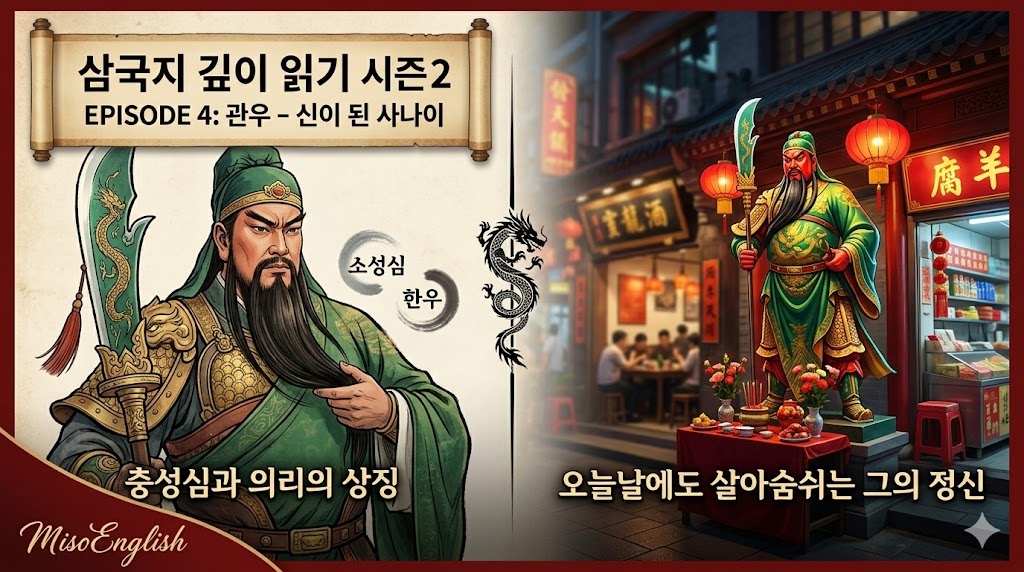
시즌 2 — 인물 심층편 4편. 관우, 신이 된 사나이
국지 인물 중에서 죽은 뒤에도 가장 큰 영향을 남긴 사람을 꼽으라면, 저는 관우라고 말할 거예요.
조조도, 유비도, 제갈량도 아니에요. 관우예요.
지금도 중국 전역의 상점과 식당에 관우의 상이 놓여있어요. 경찰서에도, 조직폭력배 아지트에도, 심지어 사찰에도요. 한 무장이 어떻게 신이 됐을까요. 오늘은 그 이야기예요.
관우는 어떤 사람이었나
관우는 160년경 하동군에서 태어났어요.
젊은 시절 고향에서 사람을 죽이고 도망쳤다는 이야기가 있어요. 억울한 사람을 위해 악인을 처단했다는 설도 있고, 정확한 기록은 없어요. 어쨌든 떠돌다가 탁군에서 유비와 장비를 만났어요.
그리고 도원결의. 세 사람은 의형제를 맺었어요. 유비가 맏형, 관우가 둘째, 장비가 셋째였어요.
삼국지연의는 관우의 외모를 이렇게 묘사해요. 키가 아홉 자, 수염이 두 자, 얼굴은 무르익은 대추처럼 붉고, 눈썹은 누에처럼 짙고, 눈은 봉황의 눈이었다고요. 청룡언월도를 들고 적토마를 탔다고 하죠.
과장이 섞여 있을 거예요. 하지만 당대 최고의 무장 중 하나였던 건 분명해요. 정사 삼국지에서 진수는 관우와 장비를 나란히 "만인지적(萬人之敵)"이라고 불렀어요. 만 명을 혼자 상대할 수 있는 용사. 그 평가는 과장이 아니었어요.
조조와 관우 — 역사상 가장 유명한 주종 관계
관우를 이야기할 때 빠질 수 없는 장면이 있어요.
하비성 전투에서 유비가 패하고 형제들이 뿔뿔이 흩어졌어요. 관우는 유비의 두 부인을 홀로 지키고 있었어요. 싸워서 이길 수 없는 상황이었어요. 결국 관우는 부인들을 지키기 위해 조조에게 항복했어요.
단, 조건을 달았어요.
"한 황실에 항복하는 것이지 조조에게 항복하는 것이 아니다. 유 황숙의 행방을 알게 되면 반드시 찾아갈 것이다."
조조는 그 조건을 받아들였어요. 왜냐고요? 관우가 갖고 싶었으니까요.
조조는 관우를 얻기 위해 모든 걸 했어요. 며칠마다 선물을 보냈어요. 잔치를 열었어요. 한수정후라는 작위를 내렸어요. 그리고 천하의 명마 적토마를 선물했어요.
관우가 적토마를 받고 크게 기뻐하자, 조조의 신하들이 의아해했어요. 다른 건 다 무덤덤하더니 말 선물에 왜 저렇게 좋아하냐고요. 관우가 말했어요.
"이 말은 하루에 천 리를 달린다고 합니다. 유 황숙의 소식을 알게 되면 하루 만에 달려갈 수 있으니 기쁜 거요."
조조는 그 말을 듣고 후회했다고 해요. 관우의 마음을 얻으려고 준 선물이 오히려 유비를 빨리 찾아가겠다는 뜻이었으니까요.
결국 유비의 소식을 듣자, 관우는 조조가 준 모든 것을 돌려놓고 홀연히 떠났어요. 봉금화하(封金掛印). 황금을 봉하고 인끈을 걸어 두었다는 말이 여기서 나왔어요.
조조는 막지 않았어요.
"의로운 사람이다. 보내주어라."
적군도 그 의리에 고개를 숙인 거예요.
이 장면이 중요한 이유가 있어요. 관우는 조조에게 신세를 졌어요. 그걸 잊지 않았어요. 그리고 나중에 화용도에서 그 빚을 갚았어요. 받은 것은 반드시 돌려주는 사람. 그게 관우였어요.
안량의 죽음 — 조조를 위한 마지막 선물
유비의 소식을 들은 관우가 떠나기 직전, 조조에게 마지막 선물을 남겼어요.
당시 원소의 맹장 안량이 백마에서 조조군을 압박하고 있었어요. 아무도 안량을 당해내지 못하는 상황이었죠.
관우가 나섰어요.
만군 중에 뛰어들어 안량의 머리를 베어 돌아왔어요. 눈 깜짝할 사이에요.
조조의 장수들이 경악했어요. 관우는 그 공으로 한수정후에 봉해졌어요.
그리고 바로 다음 날 떠났어요.
조조의 은혜에 보답하고, 의리를 지키고, 유비에게로 돌아갔어요. 관우다운 마무리였어요.
화용도 — 의리의 완성
적벽대전 이후 도망치는 조조를 관우가 화용도 길목에서 막았어요.
조조는 관우 앞에서 말했어요. 하비성에서 자신이 베풀었던 호의를 이야기했어요.
관우는 망설였어요. 그리고 결국 길을 열어줬어요.
군사적으로는 최악의 선택이었어요. 제갈량은 이걸 예상하고 일부러 관우를 배치했다는 이야기도 있어요. 관우가 조조를 놓아줄 걸 알면서, 그렇게 함으로써 천하의 균형을 유지하려 했다는 거죠.
사실인지 아닌지는 알 수 없어요. 하지만 한 가지는 분명해요.
관우는 조조에게 은혜를 입었고, 그 은혜를 갚았어요. 자신에게 불리한 선택이어도요. 그게 관우였어요.
번성 전투 — 천하를 울린 승리
건안 24년, 관우는 형주에서 위나라를 향해 출병했어요.
번성 전투. 관우는 위나라 장수 우금의 군대 칠군을 수공으로 전멸시키고 우금을 생포했어요. 적장 방덕은 끝까지 싸우다 포로가 됐어요.
방덕 이야기는 따로 할 만해요. 방덕은 관우 앞에서 무릎을 꿇지 않았어요. "나는 위나라 장수다. 어찌 항복하겠느냐"며 끝까지 버텼어요. 관우는 그 기개를 아꼈지만, 결국 처형할 수밖에 없었어요.
이 승리 하나로 조조의 위나라가 흔들릴 정도였어요. 화북 일대의 도적 떼들이 관우의 이름을 내걸고 일어날 정도였으니까요. 조조가 도읍을 옮기는 것까지 고려했다는 기록이 있어요.
관우의 이름이 천하를 울린 순간이었어요.
그런데 바로 이 순간, 관우의 가장 큰 약점이 드러났어요.
오만이었어요.
손권이 관우에게 혼담을 넣었어요. 자기 아들과 관우의 딸을 혼인시키자는 제안이었어요. 동맹을 다지려는 손권 나름의 외교였죠.
관우는 거절했어요. 그것도 아주 모욕적으로요.
"호녀(虎女)를 어찌 견자(犬子)에게 시집보내겠느냐."
호랑이의 딸을 개의 아들에게 줄 수 없다는 말이었어요.
손권이 이 말을 듣고 분노했어요. 그리고 움직이기 시작했어요.
배신과 죽음 — 오만의 대가
관우가 번성에서 위나라와 싸우는 동안, 손권은 육손과 여몽을 보내 형주를 기습했어요.
여몽은 치밀했어요. 병사들에게 민간인의 재산에 손대지 말라고 엄명을 내렸어요. 형주의 백성들이 크게 동요하지 않도록요. 그리고 관우의 부하들에게 편지를 보냈어요. 가족이 형주에서 잘 지내고 있다고, 안심하라고요.
그 전략이 먹혔어요. 관우의 부하들이 하나둘 무너졌어요. 싸우기도 전에 마음이 떠난 거예요.
위나라도 서황을 보내 정면 공격에 나섰어요. 관우는 앞뒤로 적을 맞이하게 됐어요.
형주로 물러나려 했지만 이미 손권의 손에 넘어간 뒤였어요. 남은 병력은 거의 없었어요. 관우는 맥성으로 도망쳤다가 결국 사로잡혔어요.
손권은 항복을 권유했어요.
관우는 거절했어요.
219년, 관우는 처형됐어요. 나이 예순 가까이였어요.
천하를 울리던 무장의 최후치고는 너무나 허망했어요.
돌아보면 이 비극은 예고된 것이었어요. 제갈량이 형주를 맡기면서 신신당부했던 말이 있어요. "동화(東和)하고 북거(北拒)하라." 동쪽 손권과는 화친하고, 북쪽 위나라를 막으라는 뜻이었어요.
관우는 그 절반만 했어요.
조조의 마지막 예우
손권은 관우의 머리를 조조에게 보냈어요. 관우의 죽음에 대한 책임을 조조에게 넘기려는 계산이었어요. 유비의 복수심이 조조를 향하도록요.
그런데 조조는 관우의 머리에 제를 올렸어요. 제후의 예로 장사를 지내줬어요.
평생 곁에 두고 싶었지만 끝내 뜻을 이루지 못한 사람에 대한 마지막 예의였어요. 조조도, 어쩌면 관우를 진심으로 아꼈던 거예요.
손권의 계산은 빗나갔어요. 유비의 분노는 손권을 향했어요. 그게 이릉대전으로 이어졌죠.
어떻게 신이 됐을까
관우가 죽고 나서 이야기가 시작돼요.
처음에는 형주 지역에서 관우를 모시는 사당이 생겼어요. 백성들이 관우의 의리와 용맹을 기리기 시작했죠. 그게 점점 퍼졌어요.
수나라, 당나라를 거치면서 국가에서 관우에게 작위를 내리기 시작했어요. 송나라 때는 왕의 칭호를 받았고, 명나라 때는 황제의 칭호를 받았어요. 청나라 때는 관우를 군신(軍神)으로 공식 지정했어요.
한 무장이 정식으로 신이 된 거예요.
왜였을까요.
관우가 상징하는 게 의리, 충성, 신의였기 때문이에요. 어느 시대든 사람들이 가장 원하고, 가장 믿고 싶었던 가치들이에요.
장사하는 사람에게는 신의를 지키는 신. 군인에게는 용맹의 신. 의형제를 맺은 사람들에게는 의리의 신. 법을 집행하는 사람들에게는 정의의 신.
관우는 모든 사람이 원하는 가치의 상징이 됐어요. 그래서 경찰서에도, 조직폭력배 아지트에도 같은 관우상이 놓여있는 거예요. 서로 다른 사람들이 같은 신을 모시면서, 각자 자기에게 필요한 가치를 빌고 있는 거죠.
관우, 다시 보기
관우는 완벽한 사람이었을까요.
아니에요.
번성 전투에서 승기를 잡고도 손권을 지나치게 무시했어요. 동맹 관계를 소홀히 했어요. 그 오만함이 결국 자신의 죽음을 불렀어요.
교만이 관우의 그림자였어요.
그런데 그 교만조차 관우다웠어요. 한 번도 자신의 가치를 굽히지 않았으니까요. 조조의 호의도 거절하고, 조조의 적도 살려줬어요. 자신에게 불리한 선택이어도 의리를 먼저 택했어요.
그 일관성이 사람들의 마음을 움직였어요. 죽고 나서도, 수백 년이 지나도.
신이 된 건 화려한 승리 때문이 아니었어요.
끝까지 자신의 가치를 지킨 사람이었기 때문이에요.
다음 편에서는 장비 이야기예요. 삼국지에서 가장 오해받는 영웅, 장비의 진짜 얼굴을 찾아갈게요.
시즌 2 — 5편: 장비, 가장 오해받는 영웅
Season 2 — Character Deep Dive,
Episode 4: Guan Yu, The Man Who Became a God
If you had to name the figure from Romance of the Three Kingdoms who left the greatest mark even after death, I'd say Guan Yu.
Not Cao Cao. Not Liu Bei. Not Zhuge Liang.
Guan Yu.
To this day, statues of Guan Yu stand in shops and restaurants across China. In police stations. In the hideouts of criminal gangs. Even in Buddhist temples. How did a single warrior become a god? That's today's story.
Who Was Guan Yu?
Guan Yu was born around 160 AD in Hedong Commandery.
Stories say he killed a man in his hometown as a young man and fled. Some accounts say he was defending the innocent against a local tyrant — the historical record is thin either way. He drifted until he found Liu Bei and Zhang Fei in Zhuo Commandery.
Then came the Oath of the Peach Garden. The three men swore brotherhood. Liu Bei the eldest, Guan Yu the second, Zhang Fei the youngest.
Romance of the Three Kingdoms paints his appearance in vivid strokes — nine chi tall, a two-chi beard, a face as red as a ripe date, eyebrows dark as silkworms, eyes like a phoenix. He carried the Green Dragon Crescent Blade and rode the legendary warhorse Red Hare.
There may be embellishment in the details. But that he was among the greatest warriors of his era is not in dispute. In the official Records of the Three Kingdoms, the historian Chen Shou placed Guan Yu and Zhang Fei side by side and called them both wanren zhi di — warriors capable of standing against ten thousand men. That was not a casual compliment.
Guan Yu and Cao Cao — History's Most Famous Bond Between Enemies
There is a scene you cannot skip when talking about Guan Yu.
At the Battle of Xiapi, Liu Bei was defeated and the brothers scattered. Guan Yu was left alone, protecting Liu Bei's two wives. He could not win. He could not run. So he surrendered to Cao Cao — but on his own terms.
He made three conditions. He was surrendering to the Han emperor, not to Cao Cao personally. The two ladies were to be treated with full respect. And the moment he learned where Liu Bei was, he would leave.
Cao Cao accepted. Because he wanted Guan Yu that badly.
What followed was one of the most determined courtships in Chinese history. Cao Cao hosted him with lavish banquets, sent gifts every few days, granted him the title of Han Shou Ting Hou, and finally presented him with Red Hare — the most celebrated warhorse in the realm.
When Guan Yu received Red Hare, he was visibly overjoyed — more moved than by anything else Cao Cao had given him. His officers were puzzled. Everything else he had accepted with quiet indifference. Why the horse?
Guan Yu explained: "This horse can cover a thousand li in a single day. The moment I learn where Lord Liu Bei is, I can reach him by nightfall."
Cao Cao reportedly regretted giving it.
When word of Liu Bei's location finally came, Guan Yu returned every gift, left every honor behind, and walked away. Feng jin gua yin — sealing the gold and hanging up the seal. The phrase was born here.
Cao Cao did not stop him.
"He is a man of honor. Let him go."
An enemy bowed to that loyalty.
This matters beyond the drama of the moment. Guan Yu had received real kindness from Cao Cao. He did not forget it. And he would repay it — years later, at Huarong Pass, in the most consequential act of mercy in the entire story.
The Death of Yan Liang — A Farewell Gift to Cao Cao
Just before Guan Yu left, he gave Cao Cao one last thing.
Yuan Shao's fierce general Yan Liang was pressing Cao Cao's forces hard at Baima. No one could stop him.
Guan Yu stepped forward.
He rode into the mass of enemy soldiers, cut off Yan Liang's head, and rode back out. In an instant.
Cao Cao's officers were stunned. It was the act that earned Guan Yu the title of Han Shou Ting Hou.
And the very next day, he was gone.
He had repaid his debt. He had honored his promise. He had done it on his own terms, in his own time. That was Guan Yu's way of saying goodbye.
Huarong Pass — Loyalty Returned
After the Battle of Red Cliffs, Cao Cao was fleeing in defeat — and Guan Yu was waiting at Huarong Pass.
Cao Cao spoke of the kindness he had once shown. Guan Yu wavered. Then he stepped aside and let Cao Cao through.
There is a theory that Zhuge Liang placed Guan Yu there deliberately, knowing he would do exactly this — that by letting Cao Cao live, the balance of power between Wei, Wu, and Shu would be preserved. Whether Zhuge Liang calculated it that way or not, the outcome served that purpose.
But what the scene really shows is something simpler. Guan Yu owed Cao Cao a debt. And he paid it. Even at personal cost, even in defiance of military logic, even knowing the consequences.
That was the code Guan Yu lived by — and that code never bent, not once in his entire life.
The Battle of Fancheng — The Height of Glory
In the twenty-fourth year of Jian'an, Guan Yu marched north from Jing Province against Wei.
At the Battle of Fancheng, he used flood tactics to annihilate the seven armies of Wei's general Yu Jin, capturing Yu Jin himself. The enemy commander Pang De fought to the last and was taken prisoner rather than surrender.
Pang De's story is worth a moment. Even in captivity, he refused to kneel. "I am a general of Wei," he said. "I will not bow." Guan Yu respected that defiance — but had no choice but to execute him.
The victory sent shockwaves across the north. Bandit groups across the Huabei plain rose up invoking Guan Yu's name. Cao Cao considered relocating his capital. Historical records say the name of Guan Yu shook the entire realm in those weeks.
It was the peak of Guan Yu's life.
And it was precisely at this peak that his greatest flaw revealed itself.
Earlier, Sun Quan had sent a proposal — his son would marry Guan Yu's daughter, cementing the alliance between Wu and Shu. It was a sincere diplomatic gesture.
Guan Yu refused. And not quietly.
"Would you have a tiger's daughter marry a dog's son?"
Sun Quan received those words and said nothing. Then he began to move.
Betrayal and Death — The Price of Arrogance
While Guan Yu was pressing Wei at Fancheng, Sun Quan dispatched Lu Meng and Lu Xun to strike Jing Province from behind.
Lu Meng was methodical. He ordered his soldiers to leave civilian property untouched. He sent messages to the families of Guan Yu's troops in Jing Province, reassuring them that their loved ones were safe. He wanted the province to fall without a fight — and it did. Guan Yu's men began abandoning their posts one by one, their hearts already gone before a single battle was fought.
Wei pressed from the front with Xu Huang. Guan Yu found himself surrounded — Jing Province lost behind him, Wei advancing before him, his army dissolving around him.
He retreated toward Jing Province, but it was already in Sun Quan's hands. With almost nothing left, he fled to Maicheng — and was captured there.
Sun Quan offered him the chance to surrender.
Guan Yu refused.
In 219 AD, Guan Yu was executed. He was nearly sixty years old.
For a warrior who had shaken all of China, the end was shockingly abrupt.
Looking back, the tragedy had been building for a long time. Zhuge Liang's parting instruction when Guan Yu took charge of Jing Province had been precise: dong he, bei ju — make peace with the east, resist the north. Alliance with Sun Quan was not optional. It was the foundation everything else depended on.
Guan Yu had only done half of that.
Cao Cao's Final Tribute
Sun Quan sent Guan Yu's head to Cao Cao. It was a calculated move — to direct Liu Bei's fury toward Wei rather than Wu.
Cao Cao saw through it. He received Guan Yu's head, held a ceremony of mourning, and buried him with the full rites of a lord.
The man he had wanted by his side for a lifetime. The man who had walked away and never come back. Cao Cao gave him the honors he had always deserved.
Sun Quan's calculation failed. Liu Bei's rage fell on Wu, not Wei. That led to the Battle of Yiling — and the campaign that would eventually break Liu Bei.
How a Warrior Became a God
The story of Guan Yu's divinity begins after his death.
First came the local shrines in Jing Province, where the people had known him. Gradually the reverence spread. By the Sui and Tang dynasties, the state was granting him official titles. By the Song dynasty, he held the rank of king. By the Ming dynasty, he had received the title of emperor. Under the Qing, he was formally designated the God of War — guanshen, the divine warrior.
A human being had been officially elevated to the status of a god.
Why?
Because of what Guan Yu represented. Loyalty. Honor. Keeping your word no matter the cost. In every era, those are the values people most want to believe in — and most want to find in others.
For merchants, he is the god of integrity in business. For soldiers, the god of valor in battle. For sworn brothers, the god of brotherhood. For those who uphold the law, the god of justice.
That is why the same statue stands in a police station and in a gangster's hideout. Two groups of people with nothing else in common, both invoking the same figure — each asking for the particular version of honor they need.
Guan Yu, Reconsidered
Was Guan Yu a perfect man?
No.
At the height of his victory at Fancheng, he dismissed Sun Quan with contempt and destroyed the alliance that Zhuge Liang had built his entire strategy around. That arrogance brought about his own death and the loss of Jing Province — one of the most consequential mistakes in Shu Han's history.
Pride was the shadow that followed Guan Yu everywhere.
And yet even that pride was, in a strange way, consistent with who he was. He never bent his values for convenience. He refused Cao Cao's generosity and then repaid Cao Cao's kindness. He let an enemy go because a debt was a debt. He faced execution rather than surrender.
That consistency is what people remembered. Not the victories, not the defeats — the consistency.
He did not become a god because he always won. He became a god because he never stopped being himself.
Whatever history has piled on top of him since, that is the truth underneath.
Next episode: Zhang Fei — the most misunderstood hero in all of Romance of the Three Kingdoms. We'll find out who he really was.
Season 2 — Episode 5: Zhang Fei, The Most Misunderstood Hero
⚠️ 저작권 안내
본 블로그(MisoEnglish · slowblooms.tistory.com)의 모든 콘텐츠는 저작권법의 보호를 받습니다. 글, 예시 문장, 분석 내용 등 블로그에 게시된 모든 창작물은 저작자의 동의 없이 무단으로 복사, 복제, 배포, 2차 가공하는 행위를 금지합니다. 출처를 밝히지 않은 전재, SNS·커뮤니티·타 블로그 등에의 무단 게시, 상업적 이용은 모두 금지되며, 무단 불펌 적발 시 저작권법에 따라 법적 조치가 취해질 수 있습니다. 콘텐츠 사용 문의는 slowblooms.tistory.com으로 연락 주세요.
© MisoEnglish · slowblooms.tistory.com. All rights reserved.
━━━━━━━━━━━━━━━━━━━━━━━━━━━━━━━━
⚠️ Copyright Notice
All content published on this blog (MisoEnglish · slowblooms.tistory.com) is protected by copyright law. Copying, reproducing, distributing, or adapting any written posts, example sentences, or analyses without the explicit consent of the author is strictly prohibited. Unauthorised reposting on other blogs, social media, online communities, or any public platform — with or without modification — is not permitted, and may result in legal action under applicable copyright law. For content licensing enquiries, please contact us via slowblooms.tistory.com.
© MisoEnglish · slowblooms.tistory.com. All rights reserved.
'The Language Beyond Grammar' 카테고리의 다른 글
| 시즌 2 — 인물 심층편 6편. 조자룡, 평생 충성의 의미 (0) | 2026.03.09 |
|---|---|
| 시즌 2 — 인물 심층편 5편. 장비, 가장 오해받는 영웅 (0) | 2026.03.08 |
| 시즌 2 — 인물 심층편 3편. 제갈량, 완벽한 인간의 외로움 (0) | 2026.03.08 |
| 시즌 2 — 인물 심층편 2편. 유비, 짚신 장수에서 황제까지 (0) | 2026.03.08 |
| 시즌 2 — 인물 심층편 1편. 조조, 난세의 진짜 얼굴 (0) | 2026.03.08 |


