
- 분류 전체보기 (1053)

- Linguistics (고급 영어학) (10)
- Stylistics (6)
- Etymology & Word Building (15)
- Philosophy Meets Grammar (6)
- Collection of Famous Quotes (22)
- English Mechanism (276)
- The Language Beyond Grammar (274)
- Living English (81)
- Miso’s Life Notes (18)
- My English Journey and Refl.. (16)
- Philosophy (132)
- Video Clip (16)
- Airline English (항공 영어) (47)
- Creative Corner (35)
- Sally & Sia (1)
| 일 | 월 | 화 | 수 | 목 | 금 | 토 |
|---|---|---|---|---|---|---|
| 1 | 2 | 3 | 4 | |||
| 5 | 6 | 7 | 8 | 9 | 10 | 11 |
| 12 | 13 | 14 | 15 | 16 | 17 | 18 |
| 19 | 20 | 21 | 22 | 23 | 24 | 25 |
| 26 | 27 | 28 | 29 | 30 |
- Basic English Verbs
- MisoEnglish#철학입문 #Philosophy #심리철학 #PhilosophyOfMind #철학공부 #의식 #마음 #PhilosophyForBeginners #교육콘텐츠 #철학시리즈
- 영문법
- 영어문법
- MisoEnglish#도교철학 #Taoism #도덕경 #TaoTeChing #무위자연 #WuWei #노자 #Laozi #장자 #YinYang
- 인도철학 #동양철학 #인문학 #요가 #명상 #힌두교 #불교 #간디 #타고르 #정통6파 #철학공부 #마음공부 #MisoEnglish #인문학영어
- MisoEnglish#철학입문 #Philosophy #윤리학 #Ethics #도덕철학 #철학공부 #칸트 #공리주의 #교육콘텐츠 #철학시리즈
- 🌿 English with Heart
- English for Korean Learners
- everyday English
- 영어접속사
- English in English
- pnr
- MisoEnglish#불교철학 #BuddhismPhilosophy #사성제 #FourNobleTruths #공사상 #Emptiness #명상 #Mindfulness #열반 #EasternWisdom
- 동양정치철학 #시리즈완결 #아시아적가치 #동서양비교 #유교 #민주주의 #정치사상 #인문학 #비교철학 #글로벌정치 #문화다양성 #2500년철학사
- MisoEnglish#철학입문 #Philosophy #형이상학 #Metaphysics #철학공부 #존재론 #실재론 #PhilosophyForBeginners #교육콘텐츠 #철학시리즈
- 감성영어
- AirlineOpsEnglish
- 영어공부
- MisoEnglish#철학입문 #Philosophy #종교철학 #PhilosophyOfReligion #철학공부 #신존재증명 #악의문제 #PhilosophyForBeginners #교육콘텐츠 #철학시리즈
- 영어회화
- ticketing
- MisoEnglish#유교철학 #Confucianism #성리학 #NeoConfucianism #인의예지 #Virtue #맹자 #Mencius #실학 #KoreanScholarship
- misoenglish
- MisoEnglish#한국철학 #KoreanPhilosophy #홍익인간 #Hongik #화랑도 #Hwarang #단군 #Dangun #풍류도 #ThreeKingdoms#동양철학
- English Speaking Practice
- MisoEnglish#철학입문 #Philosophy #과학철학 #PhilosophyOfScience #철학공부 #포퓨퍼 #쿠hn #과학방법론 #교육콘텐츠 #철학시리즈
- EnglishWriting #AcademicWriting #Grammar #EnglishLanguage #EssayWriting #ParagraphStructure #SentenceStructure #BusinessEnglish #EnglishTips #WritingSkills #Linguistics #ESL
- MisoEnglish#철학입문 #Philosophy #정치철학 #PoliticalPhilosophy #철학공부 #정의론 #자유주의 #PhilosophyForBeginners #교육콘텐츠 #철학시리즈
- 영국사 #영국역사 #세계사 #역사연재 #브리튼에서영국까지
- Today
- Total
MisoEnglish
10편. 모두가 탐낸 땅 — 형주를 둘러싼 싸움과 관우의 활약 본문
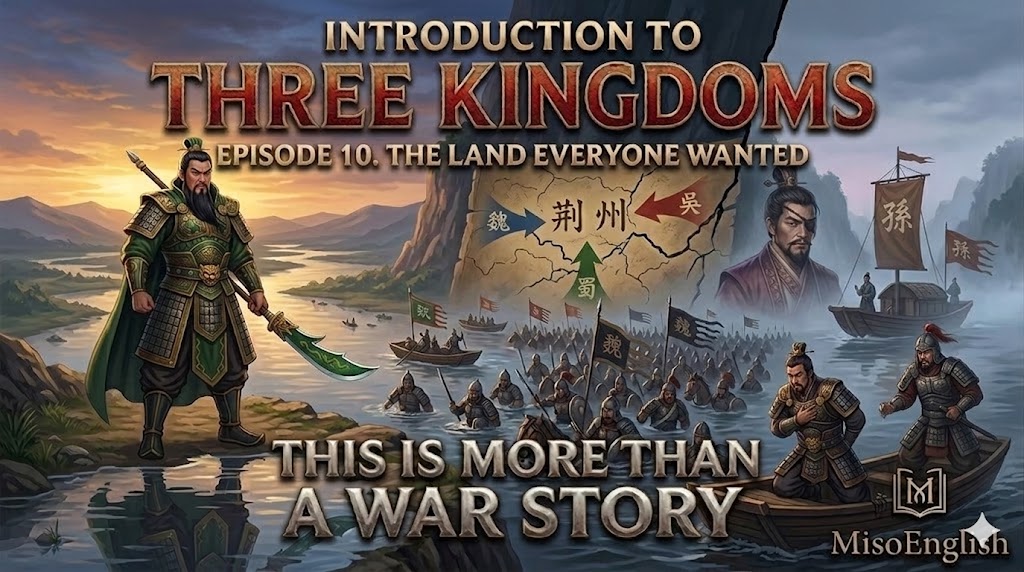
10편. 모두가 탐낸 땅 — 형주를 둘러싼 싸움과 관우의 활약
적벽대전 이후 삼국의 구도가 굳어지면서, 세 세력의 시선이 한 곳으로 쏠립니다. 바로 **형주(荊州)**예요. 형주는 단순한 땅이 아니었어요. 북쪽으로는 조조의 위나라와 맞닿고, 동쪽으로는 손권의 강동과 연결되며, 서쪽으로는 촉(蜀) 땅으로 이어지는 천하의 교차로였거든요. 이 땅을 누가 차지하느냐에 따라 삼국의 세력 균형이 완전히 달라질 수 있었어요. 그래서 조조도, 손권도, 유비도 형주를 포기할 수 없었습니다.
유비, 형주를 빌리다
적벽대전 이후 유비는 제갈량의 기민한 전략 덕분에 형주의 일부를 차지하게 됩니다. 그런데 손권 입장에서는 억울한 면이 있었어요. 적벽대전에서 실질적으로 싸운 건 손권의 군대였는데, 전과를 유비가 더 많이 챙긴 것처럼 보였거든요.
결국 손권은 유비에게 형주를 빌려준다는 형식을 취합니다. 유비는 "익주를 얻으면 반드시 돌려주겠다"고 약속했죠. 하지만 이 약속은 나중에 엄청난 갈등의 씨앗이 됩니다. 빌린 땅을 돌려달라는 손권과, 아직 돌려줄 수 없다는 유비 사이의 긴장은 두 세력 관계의 핵심 갈등이 되거든요.
형주를 지키는 임무는 **관우(關羽)**에게 맡겨졌어요. 유비가 서쪽 익주를 향해 떠나면서, 형주라는 중요한 땅의 수비를 가장 믿는 의형제에게 맡긴 거였죠.
관우, 형주의 수호자가 되다
관우는 형주에서 단순히 수비만 한 게 아니었어요. 그는 탁월한 행정력으로 형주를 안정적으로 다스렸고, 백성들의 신망을 얻었습니다. 무장으로서뿐 아니라 통치자로서도 능력을 발휘한 거예요.
그리고 219년, 관우는 형주에서 북쪽으로 출병합니다. 조조의 영토를 향해 직접 공격을 감행한 거예요. 이 전투에서 관우는 눈부신 활약을 펼칩니다.
수엄칠군 — 관우의 최고 전성기
관우가 이끄는 군대는 조조의 장수 **우금(于禁)**이 이끄는 7군(軍)과 맞닥뜨립니다. 무려 3만이 넘는 병력이었어요. 정면 승부로는 이기기 어려운 상황이었죠.
그런데 관우는 하늘의 도움을 받았어요. 때마침 한수(漢水)가 범람하면서 우금의 군대가 물에 잠겨버린 거예요. 관우는 배를 이용해 수장된 조조군을 공격합니다. 우금은 항복했고, 또 다른 조조의 장수 **방덕(龐德)**은 끝까지 싸우다 포로가 됐어요. 방덕은 항복을 거부하고 결국 처형됩니다.
이 전투를 수엄칠군(水淹七軍) — 물로 7군을 잠기게 했다는 뜻이에요. 관우의 위명이 천하를 뒤흔든 순간이었습니다. 조조는 관우의 기세에 눌려 수도를 옮길까 고민했다는 기록도 있어요.
조조와 손권, 손을 잡다
관우의 기세가 너무 강해지자, 조조와 손권이 은밀히 손을 잡습니다. 두 숙적이 공동의 적 앞에서 협력하기로 한 거예요.
손권은 형주를 돌려받을 기회를 노리고 있었어요. 유비와의 동맹보다 형주 탈환이 더 급했던 거죠. 손권은 부하 **여몽(呂蒙)**에게 형주 기습을 명령합니다. 여몽은 천재적인 전략가였어요. 그는 병을 핑계로 전선에서 물러난 척하며 관우의 경계심을 낮춘 다음, 병사들을 상인으로 위장시켜 배에 태워 형주로 잠입합니다.
관우가 북쪽에서 조조와 싸우는 동안, 뒤에서 형주가 통째로 손권의 손에 넘어간 거예요.
관우의 고립
형주를 잃었다는 소식을 들은 관우는 즉시 남쪽으로 군대를 돌렸어요. 하지만 상황은 이미 돌이킬 수 없었습니다. 형주의 병사들은 가족이 손권군에게 잡혀있다는 소식에 하나둘 떠나갔어요. 관우의 군대는 급격히 무너졌고, 관우는 점점 고립돼 갔습니다.
유비에게 지원을 요청했지만, 유비는 아직 익주를 안정시키는 데 바빴고, 연락도 제대로 닿지 않았어요. 관우는 혼자였습니다.
맺음말
천하무적이라 불리던 관우가 형주에서 고립되어 쓰러져가고 있어요. 조조도 손권도 아닌, 고립과 배신이 관우를 무너뜨리고 있었습니다. 삼국지에서 가장 비극적인 장면이 다가오고 있어요.
다음 편 예고: 관우의 최후와 삼국 균형의 붕괴 — 한 영웅의 죽음이 어떻게 삼국 전체를 뒤흔들었는지, 그리고 유비와 장비가 어떤 선택을 했는지. 15편에서 자세히 다루기 전에, 먼저 익주 입성과 촉한의 기반을 살펴볼 11편에서 만나요!
Episode 10. The Land Everyone Wanted — The Battle for Jing Province and Guan Yu's Finest Hour
After Red Cliffs, the three powers settled into their positions — and all three of them found their eyes drawn to the same place. Jing Province (荊州). This wasn't just any piece of land. It bordered Cao Cao's territory to the north, connected to Sun Quan's Jiangdong to the east, and opened the road west into the Shu heartland. It was the crossroads of the known world — whoever held it held enormous leverage over the other two. Cao Cao wanted it. Sun Quan wanted it back. And Liu Bei needed it to survive. Nobody was willing to let it go.
Liu Bei Borrows Jing Province
After Red Cliffs, Liu Bei — guided by Zhuge Liang's sharp maneuvering — managed to secure a portion of Jing Province for himself. Sun Quan was not entirely happy about this. His forces had done the bulk of the fighting at Red Cliffs, and yet Liu Bei seemed to be walking away with a disproportionate share of the gains.
The arrangement they settled on was that Liu Bei would borrow Jing Province. He promised to return it once he had secured Yi Province to the west. That promise became one of the most consequential debts in the Three Kingdoms — Sun Quan would keep demanding repayment, Liu Bei would keep finding reasons to delay, and the tension between the two allies would never fully go away.
The man Liu Bei left to hold Jing Province while he moved west was Guan Yu (關羽). He trusted no one more with something this important.
Guan Yu, Guardian of Jing Province
Guan Yu didn't just defend Jing Province — he governed it. He ran the administration with a steady hand, earned the respect of the local population, and proved himself as capable in peacetime as on the battlefield.
Then in 219 AD, he went on the offensive. He led his forces north, directly into Cao Cao's territory — and what followed became his greatest moment as a general.
Drowning Seven Armies — Guan Yu at His Peak
Guan Yu's advance brought him face to face with Yu Jin (于禁), one of Cao Cao's most trusted commanders, leading a force of seven armies — more than 30,000 men. A straight fight would have been extremely difficult.
Then the Han River flooded. Yu Jin's armies, camped on low ground, were suddenly submerged. Guan Yu launched his forces by boat, striking the waterlogged enemy from above. Yu Jin surrendered. Another of Cao Cao's generals, the fierce Pang De (龐德), refused to yield and fought to the last — he was captured and later executed for refusing to submit.
This engagement became known as "Drowning the Seven Armies" (水淹七軍) — one of the most celebrated military victories in the Three Kingdoms era. Guan Yu's reputation exploded across the land. Cao Cao is recorded to have seriously considered relocating his capital to escape the pressure of Guan Yu's advance.
Cao Cao and Sun Quan Make a Deal
Guan Yu's momentum was becoming a problem for both of them. And so two rivals who had been enemies since Red Cliffs quietly reached an understanding: they would work together to bring him down.
Sun Quan had never stopped wanting Jing Province back. The alliance with Liu Bei mattered less to him than reclaiming what he felt was his. He ordered his brilliant general Lü Meng (呂蒙) to take it.
Lü Meng's plan was a masterpiece of deception. He pretended to fall ill and withdrew from his command — lulling Guan Yu into lowering his guard. Then he disguised his soldiers as merchants, loaded them onto trading vessels, and slipped them into Jing Province's ports without raising any alarm.
While Guan Yu was locked in battle to the north, Jing Province fell behind him without a single major engagement.
Guan Yu's Isolation
When the news reached Guan Yu, he immediately turned his army south. But it was already too late. His soldiers began melting away — word had spread that their families back in Jing Province were now under Sun Quan's control, and men started slipping off to be with them. The army that had drowned seven of Cao Cao's forces just weeks earlier disintegrated around him.
He sent word to Liu Bei asking for reinforcements. But Liu Bei was still consolidating Yi Province, communications were unreliable, and help never came. Guan Yu was alone.
Closing
The man once called unrivaled under heaven was now isolated, his forces crumbling, the land he had guarded slipping away. It wasn't Cao Cao or Sun Quan who brought Guan Yu down in the end — it was encirclement, betrayal, and abandonment. The most heartbreaking chapter in the Three Kingdoms story is almost here.
Next episode preview: Before we get to Guan Yu's final stand, we head west — to follow Liu Bei's conquest of Yi Province and the building of the kingdom that would become Shu Han. The foundation of the third kingdom takes shape in Episode 11!
⚠️ 저작권 안내
본 블로그(MisoEnglish · slowblooms.tistory.com)의 모든 콘텐츠는 저작권법의 보호를 받습니다. 글, 예시 문장, 분석 내용 등 블로그에 게시된 모든 창작물은 저작자의 동의 없이 무단으로 복사, 복제, 배포, 2차 가공하는 행위를 금지합니다. 출처를 밝히지 않은 전재, SNS·커뮤니티·타 블로그 등에의 무단 게시, 상업적 이용은 모두 금지되며, 무단 불펌 적발 시 저작권법에 따라 법적 조치가 취해질 수 있습니다. 콘텐츠 사용 문의는 slowblooms.tistory.com으로 연락 주세요.
© MisoEnglish · slowblooms.tistory.com. All rights reserved.
━━━━━━━━━━━━━━━━━━━━━━━━━━━━━━━━
⚠️ Copyright Notice
All content published on this blog (MisoEnglish · slowblooms.tistory.com) is protected by copyright law. Copying, reproducing, distributing, or adapting any written posts, example sentences, or analyses without the explicit consent of the author is strictly prohibited. Unauthorised reposting on other blogs, social media, online communities, or any public platform — with or without modification — is not permitted, and may result in legal action under applicable copyright law. For content licensing enquiries, please contact us via slowblooms.tistory.com.
© MisoEnglish · slowblooms.tistory.com. All rights reserved.
'The Language Beyond Grammar' 카테고리의 다른 글
| 12편. 천하의 목줄을 잡아라 — 한중 쟁탈전과 조조·유비의 정면 충돌 (0) | 2026.03.06 |
|---|---|
| 11편. 서쪽으로 간 유비 — 익주 입성과 촉한의 기반 형성 (0) | 2026.03.05 |
| 9편. 천하를 바꾼 하룻밤의 불꽃 — 적벽대전, 삼국 분열의 시작 (0) | 2026.03.05 |
| 8편. 같은 하늘 아래 살 수 없는 두 사람 — 유비와 조조, 서로 다른 길 (0) | 2026.03.05 |
| 7편. 열 배의 적을 이긴 남자 — 관도대전, 조조가 북방을 장악하다 (0) | 2026.03.05 |


