
- 분류 전체보기 (575)

| 일 | 월 | 화 | 수 | 목 | 금 | 토 |
|---|---|---|---|---|---|---|
| 1 | 2 | 3 | 4 | 5 | 6 | |
| 7 | 8 | 9 | 10 | 11 | 12 | 13 |
| 14 | 15 | 16 | 17 | 18 | 19 | 20 |
| 21 | 22 | 23 | 24 | 25 | 26 | 27 |
| 28 | 29 | 30 | 31 |
- English for Korean Learners
- 영어접속사
- ticketing
- English Speaking Practice
- 감성영어
- misoenglish
- 언어의철학 #의미론 #화용론 #언어와사고 #언어의미학 #MisoEnglish #TheLanguageBeyondGrammar #영문학심화
- SlowBlooms
- Basic English Verbs
- FareRules
- 영어문법
- AirlineOpsEnglish
- 영어발음
- 영어를살다
- pnr
- EnglishTense
- everyday English
- 영어철학
- 영문법
- 영어회화
- GrammarWithSoul
- 영어공부법
- 영어공부
- MichelleKim
- 영어시제
- booking
- 느리지만단단하게
- 영어표현력
- English in English
- 🌿 English with Heart
- Today
- Total
MisoEnglish
영어 문장의 구조 이해 로드맵 본문
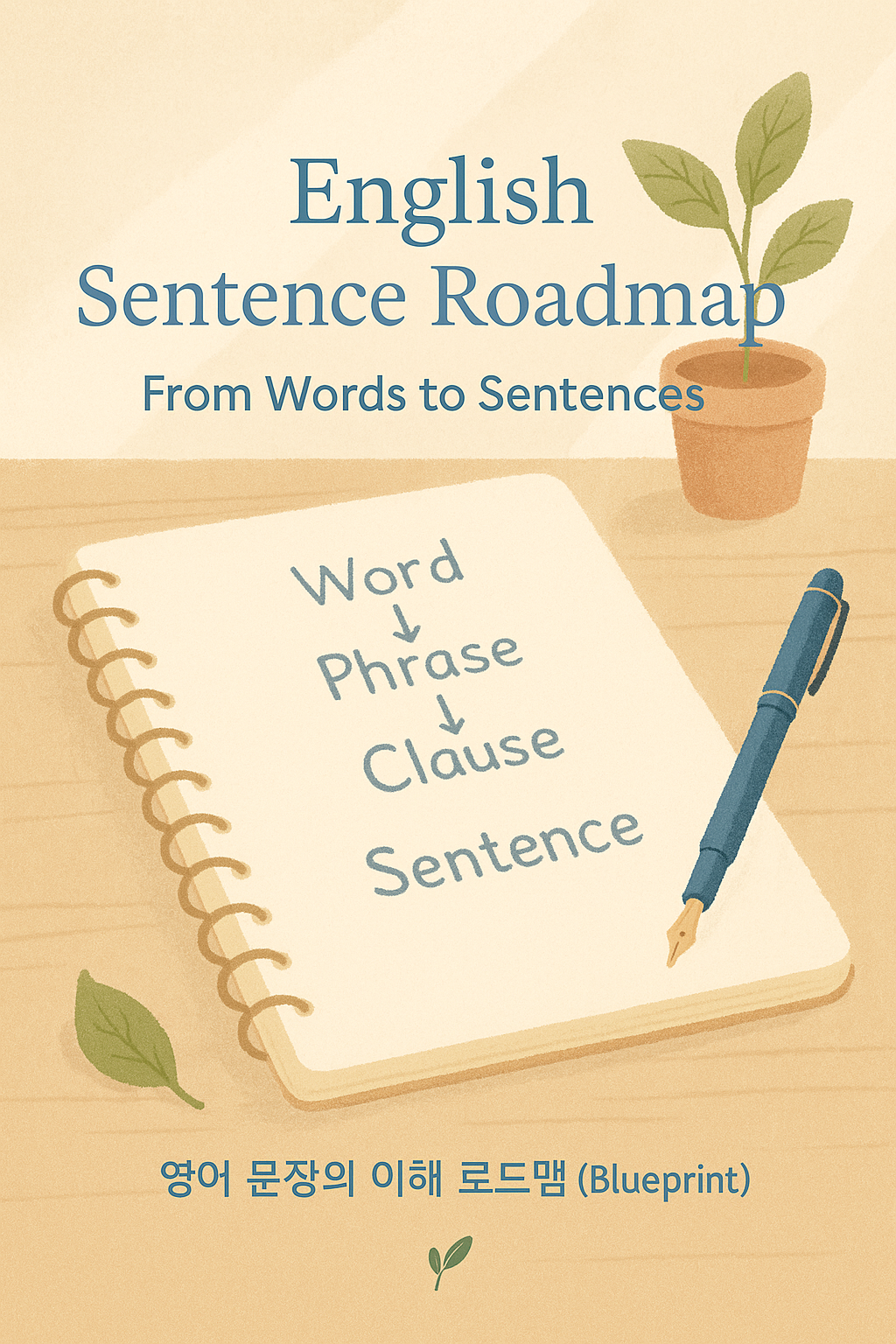
English Sentence Blueprint
From Words to Sentences — How Every Sentence Grows from Its Verb
Intro
English is not just a collection of words — it’s a structure of thought.
Every sentence, no matter how simple or complex, is built around one heartbeat: the verb.
When you truly understand how a verb functions — how it connects the subject, brings action, and completes meaning —
you begin to see English, not just memorize it.
This blueprint is a map from the smallest unit — a single word — to the complete structure of a sentence.
By following it step by step, you’ll discover how every phrase, clause, and pattern grows naturally from its verb.
Once you understand the verb, the sentence begins to breathe.
인트로
영어는 단어들의 단순한 나열이 아니라, ‘생각의 구조(structure of thought)’ 입니다.
아무리 단순하거나 복잡한 문장이라도, 그 중심에는 동사(verb) 라는 심장이 뛰고 있습니다.
동사가 주어와 연결되고, 행동을 이끌고, 의미를 완성하는 방식을 이해하는 순간,
우리는 단순히 영어를 ‘외우는 것’이 아니라 ‘보게(sees)’ 됩니다.
이 블루프린트는 ‘단어(word)’에서 시작해 ‘문장(sentence)’으로 완성되는 여정을 보여줍니다.
단계별로 따라가다 보면, 구(phrase), 절(clause), 그리고 문형(pattern)까지
모든 것이 어떻게 동사로부터 자연스럽게 자라나는지 깨닫게 될 것입니다.
동사를 이해하는 순간, 문장은 비로소 숨을 쉰다.
영어 문장의 구조 이해 로드맵
Part 1 – From Words to Sentences
How English Sentences Are Built — From the Smallest Units to Complete Thoughts
(영어 문장은 이렇게 만들어진다 – 단어에서 완전한 생각까지)
Ⅰ. Word — The Smallest Building Block
Every English sentence begins with words.
Each word belongs to a part of speech, and every part plays a different role in a sentence.
| Noun | Names a person, place, thing, or idea | book, teacher, happiness |
| Pronoun | Replaces a noun | he, she, it |
| Verb | Shows an action or a state of being | run, be, exist |
| Adjective | Describes a noun | happy, tall |
| Adverb | Describes a verb, adjective, or sentence | quickly, very, well |
| Preposition | Shows a relationship between words | in, on, at |
| Conjunction | Connects words or clauses | and, but, because |
| Interjection | Expresses emotion or reaction | oh!, wow! |
Ⅰ. 단어 (Word):
영어의 가장 작은 의미 단위. 문장을 이루는 최소 구성요소입니다.
| 명사 (noun) | 사람·사물·장소·생각 이름 | book, happiness |
| 대명사 (pronoun) | 명사 대신 사용 | he, she, it |
| 동사 (verb) | 행동·상태 표현 | run, be |
| 형용사 (adjective) | 명사 수식 | happy, tall |
| 부사 (adverb) | 동사·형용사·문장 수식 | quickly, very |
| 전치사 (preposition) | 명사 앞에서 관계 표시 | in, on, at |
| 접속사 (conjunction) | 단어·절 연결 | and, but, because |
| 감탄사 (interjection) | 감정 표현 | oh!, wow! |
💡 핵심:
모든 문장은 단어(word) 에서 시작됩니다.
각 단어는 품사(part of speech) 에 따라 문장에서의 역할이 달라집니다.
예를 들어, 명사는 이름을 나타내고, 동사는 행동이나 상태를, 형용사는 명사를 꾸며줍니다.
Ⅱ. Phrase — A Group of Words Without a Subject and a Verb
A phrase is a group of words that works as one part of speech,
but it doesn’t have a subject–verb structure.
Example:
- in the morning (prepositional phrase)
- the tall man (noun phrase)
- running fast (verb phrase)
Ⅱ. 구 (Phrase):
하나 이상의 단어가 모여 하나의 품사처럼 기능하는 단위.
주어나 동사 역할은 못 하지만, 문장 안에서 보조 역할을 합니다.
| 명사구 (noun phrase) | 명사 중심 | 주어·목적어 등 | The tall man is my teacher. |
| 동사구 (verb phrase) | 동사 중심 | 동사 부분 | She is running. |
| 형용사구 (adjective phrase) | 형용사 중심 | 명사 수식 | a girl full of energy |
| 부사구 (adverb phrase) | 부사 중심 | 동사 수식 | He runs with great speed. |
| 전치사구 (prepositional phrase) | 전치사 + 명사 | 장소·시간·방법 표현 | The book is on the table. |
💡 핵심:
“구”는 주어 + 동사 구조가 없는 단위입니다.
즉, 하나의 품사(명사·형용사·부사 등) 역할만 하는 의미 덩어리예요.
Ⅲ. Clause — A Mini Sentence Inside a Sentence
A clause contains both a subject and a verb.
It can stand alone or depend on another clause.
Example:
- Independent clause: I like coffee.
- Dependent clause: because I’m tired
Ⅲ. 절 (Clause)
주어(S) + 동사(V) 를 포함한 덩어리로,
하나의 문장처럼 보이지만 문장 속에서 부분 역할을 합니다.
| 독립절 (Independent clause) | 완전한 문장으로 존재 가능 | I study English every day. |
| 종속절 (Dependent clause) | 혼자 문장으로 불가, 주절에 종속 | Because I was tired, I went home. |
기능별 예시:
- 명사절: I know that she is kind.
- 형용사절: The man who is sitting there is my father.
- 부사절: When I arrived, she was sleeping.
💡 핵심:
‘절(clause)’은 주어와 동사를 모두 포함한 덩어리입니다.
독립절은 하나의 문장으로 설 수 있지만,
종속절은 주절에 의미적으로 기대어야 완전해집니다.
Ⅳ. Sentence — A Complete Thought
A sentence expresses a complete idea.
It can have one clause or several.
| Simple | One independent clause | I love cats. |
| Compound | Two or more independent clauses | I love cats, and I have two. |
| Complex | Independent + dependent clause | I love cats because they are cute. |
| Compound-Complex | Both compound and complex | I love cats, and I think they make people happy because they are affectionate. |
Ⅳ. 문장 (Sentence):
하나 이상의 절(clause)이 모여 완전한 생각을 표현한 단위입니다.
| 단문 (Simple) | 주절 1개 | I like coffee. |
| 중문 (Compound) | 주절 2개 이상 + 등위접속사 | I like coffee, and I drink it every morning. |
| 복문 (Complex) | 주절 + 종속절 | I drink coffee because I need energy. |
| 복합문 (Compound-Complex) | 중문 + 복문 결합 | I like coffee, and I drink it every morning because it wakes me up. |
💡 핵심:
‘문장(sentence)’은 완전한 생각을 표현합니다.
단문·중문·복문·복합문은 절의 개수와 관계로 구분됩니다
그 중심에는 항상 동사(verb) 가 존재합니다.
Ⅴ. Sentence Patterns — The Verb Is the Core
The structure of an English sentence depends on its verb.
The verb decides what other parts are needed.
| 1 | SV | She lives in New York. |
| 2 | SVC | He became a teacher. |
| 3 | SVO | I like coffee. |
| 4 | SVOO | She gave me a gift. |
| 5 | SVOC | They made him captain. |
Ⅴ. 문장의 형식 (Sentence Patterns):
문장 내부 구조를 결정짓는 것은 언제나 동사(verb) 입니다.
따라서 문형은 “동사가 어떤 성분을 필요로 하는가”에 따라 달라집니다.
| ① 1형식 (SV) | 주어 + 동사 | go, live, sleep | She lives in New York. |
| ② 2형식 (SVC) | 주어 + 동사 + 보어 | be, become, seem | He is happy. |
| ③ 3형식 (SVO) | 주어 + 동사 + 목적어 | like, eat, see | I like coffee. |
| ④ 4형식 (SVOO) | 주어 + 동사 + 간·직목 | give, send, tell | She gave me a gift. |
| ⑤ 5형식 (SVOC) | 주어 + 동사 + 목적어 + 목적보어 | make, find, call | They made him captain. |
💡 핵심 정리:
🔹 단어(word) → 구(phrase) → 절(clause) → 문장(sentence) → 문형(pattern)
🔹 문장이 커질수록 중심은 변하지 않습니다.
👉 모든 문장의 중심은 동사(verb) 입니다.
🔹 영어 문장의 형태는 동사(verb) 가 결정합니다.
🔹 동사가 무엇을 필요로 하느냐에 따라 문형이 달라집니다.
✨ Closing
Key Takeaway
Every English sentence grows from its verb.
The verb is not just an action — it’s the heart of the sentence.
모든 영어 문장은 동사에서 출발합니다.
동사는 단순한 행동이 아니라 문장의 심장입니다.
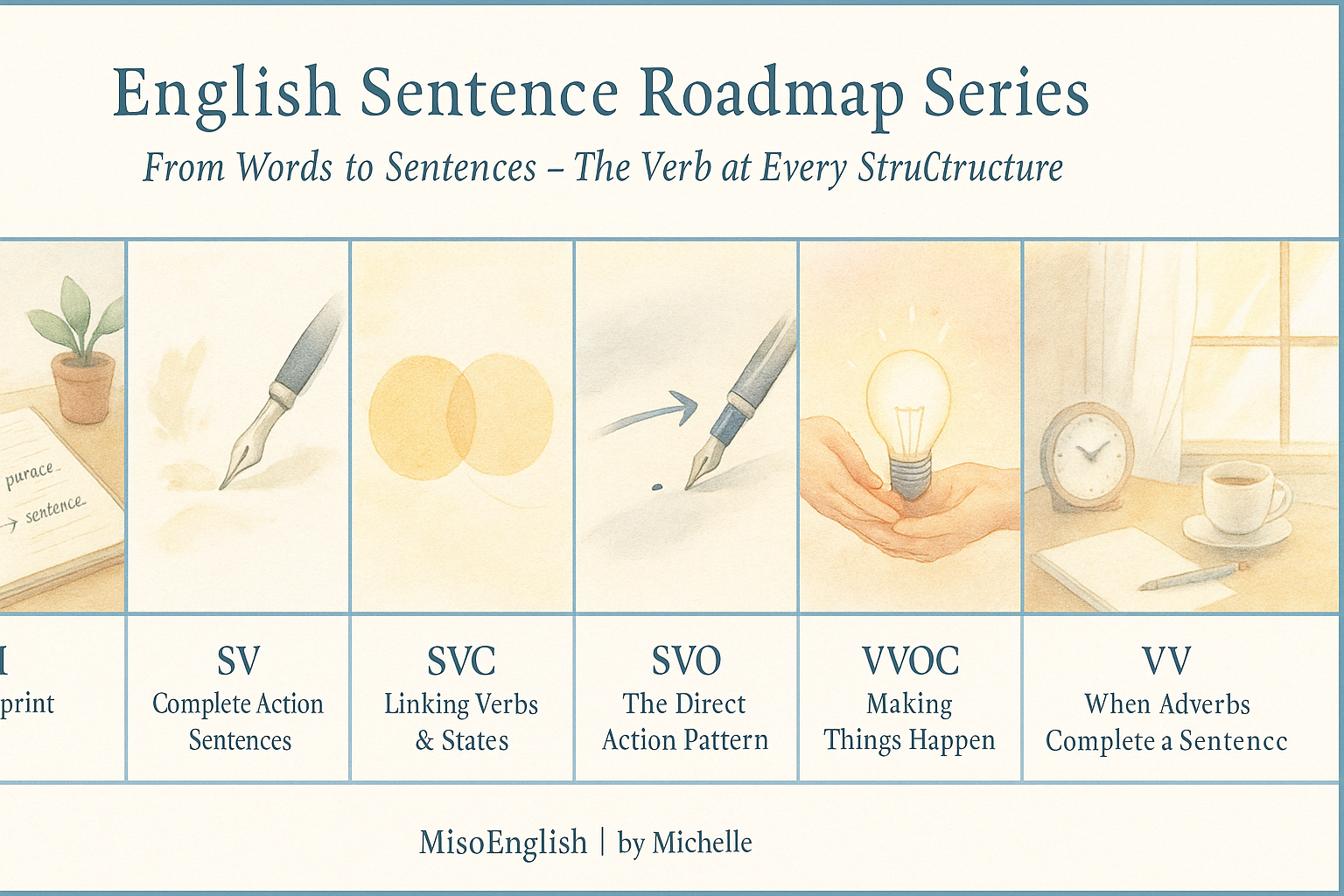
Next: [Part 2 – 1형식 문장 (SV): Complete Action Sentences →]
(The first step toward understanding how a sentence stands on its own.)
© MisoEnglish / Michelle Kim.
This is original content written by the author.
Unauthorized reproduction or full reposting is prohibited.
You may quote short parts only with clear credit and a link to the original post.
이 글은 작성자가 직접 집필한 오리지널 콘텐츠입니다.
전체 복제·무단 재게시를 금하며,
일부 인용 시에는 반드시 출처(MisoEnglish)와 링크를 남겨 주세요.
'English Mechanism' 카테고리의 다른 글
| Part 3 – 2형식 문장 (SVC) - 주어의 상태와 변화를 보여주는 문장 (0) | 2025.10.31 |
|---|---|
| Part 2 – 1형식 문장 (SV) - 동사 하나로 완전해지는 문장 (0) | 2025.10.31 |
| 🌱 Living in Tense — 시제를 느끼며 배우는 영어 (0) | 2025.10.22 |
| 🧭 The Blueprint of Time — 영어 시제의 지도를 그리다 (0) | 2025.10.22 |
| ⚙️ The Mechanism of Time — 영어 시제는 어떻게 작동하는가 (0) | 2025.10.22 |


