

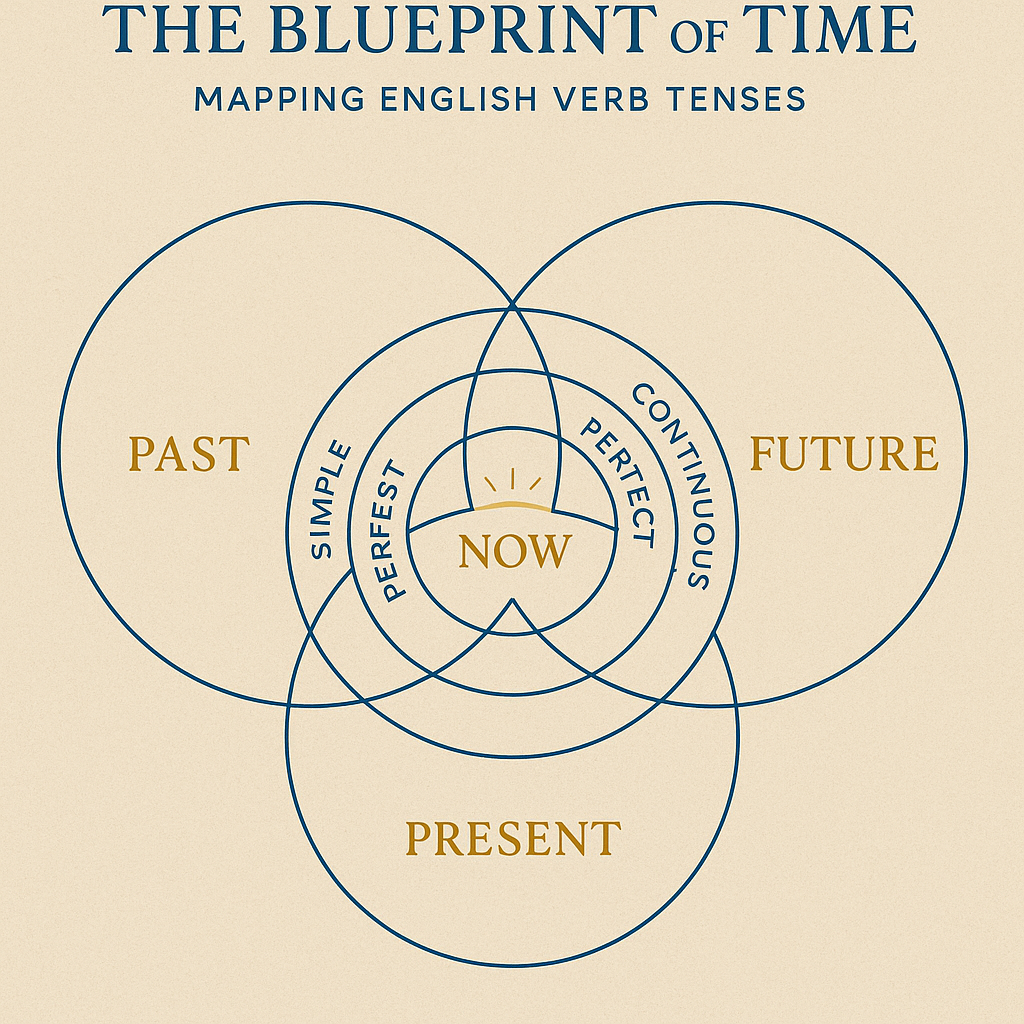
🧭 The Blueprint of Time — Mapping English Verb Tenses
The Flow of Time in English · Series #3 · By Michelle (Misook) Kim
If the Mechanism of Time shows how English tenses move, the Blueprint of Time shows how they all connect. Together, they form the living map of English — 12 paths through time.
1) The Concept of a “Tense Blueprint”
A blueprint is a map — a way to see the structure behind complexity. In English, tenses form a matrix of three time frames (Past, Present, Future) and four aspects (Simple, Continuous, Perfect, Perfect Continuous).
🌿 To learn tenses is to learn how English perceives time itself.
2) The Tense Blueprint (12 Tenses Overview)
Think of this as a 3×4 grid — a map of time where each box shows how an action relates to “now.”
| Simple | Continuous | Perfect | Perfect Continuous | |
|---|---|---|---|---|
| Past | I studied | I was studying | I had studied | I had been studying |
| Present | I study | I am studying | I have studied | I have been studying |
| Future | I will study | I will be studying | I will have studied | I will have been studying |
“Twelve doors — one rhythm of time.”
3) Reading the Blueprint
- Simple: snapshot of time — fact or routine
- Continuous: movement in progress — energy of the moment
- Perfect: connection — result or relevance to now
- Perfect Continuous: flow with connection — effort or duration
💬 Perfect means connected, not perfect.
4) Reflection — Seeing Time as a Circle
English time is not linear. It moves in circles — memory feeds the present, and intention shapes the future. When we speak in English, we are constantly shifting gears through these circles.
That’s why mastering tenses isn’t memorizing rules — it’s feeling time move through language.
🌱 Tense is the rhythm of human experience.
Next in the Series
#4 Living in Tense — Learning to Feel Time in English (마지막 글에서는 시제를 감각적으로 익히는 연습법과 “시간의 리듬”을 다룹니다.)


