

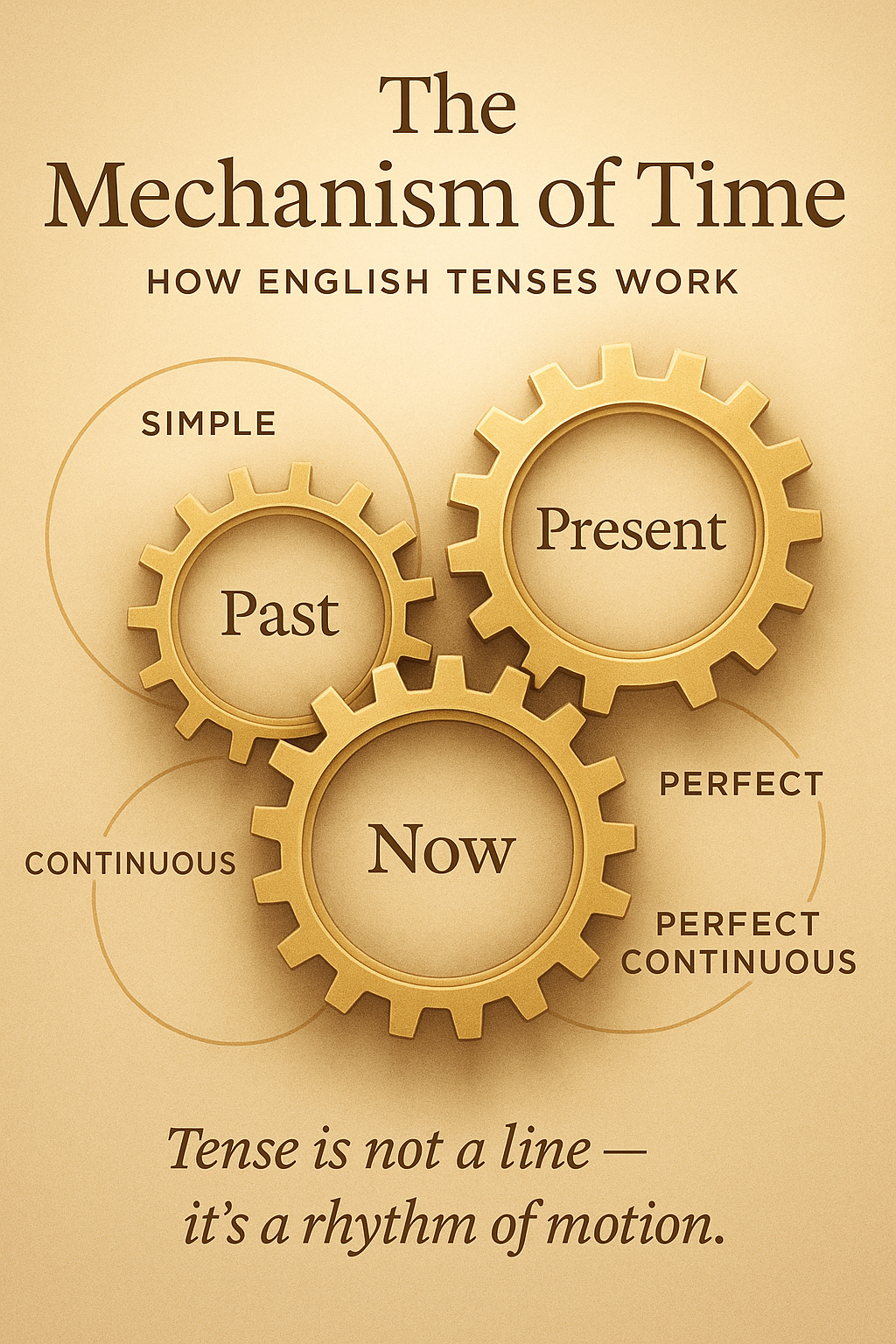
⚙️ The Mechanism of Time — How English Tenses Work
The Flow of Time in English · Series #2 · By Michelle (Misook) Kim
Every verb is a small machine that moves meaning through time. Understanding tense is learning how English thinks about time.
1) The Core Mechanism
English organizes time through verbs. Each tense acts like a gear that connects past, present, and future. These gears don’t turn separately — they mesh, influencing each other’s motion.
💬 Every verb is a clock that tells you when life happens.
2) The Three Time Frames
- Past — where memory lives.
- Present — where life happens now.
- Future — where imagination begins.
Think of them not as separate points, but as a flow of energy. English verbs carry that flow — connecting what was, what is, and what will be.
3) The Four Aspects of Tense
Each time frame has four “aspects,” or ways of viewing the same moment:
- Simple — a single action or fact (I study)
- Continuous — an ongoing action (I’m studying)
- Perfect — a completed or connected action (I’ve studied)
- Perfect Continuous — continuous + connected (I’ve been studying)
These four aspects give English its dynamic heartbeat. When combined with Past, Present, and Future, they create a living 12-tense system.
4) Visual Thinking — The Gear System of Time
Imagine three large gears labeled “Past,” “Present,” and “Future.” Between them run smaller cogs: Simple, Continuous, Perfect, and Perfect Continuous. As one gear turns, others move too — showing that English time is connected, not isolated.
🌿 Tense is not a line — it’s a rhythm of motion.
5) Practice Idea — Feel the Shift
- Pick one verb (ex: learn).
- Say it in 12 forms: I learn / I am learning / I have learned / I have been learning...
- Listen how each version changes your sense of time.
이렇게 반복하면 문법이 아니라 “시간의 감각”이 몸에 익습니다.
Next in the Series
#3 The Blueprint of Time — Mapping English Verb Tenses (다음 글에서는 시제 시스템을 시각적으로 정리한 도식과 함께 다룹니다.)


