
- 분류 전체보기 (580)

| 일 | 월 | 화 | 수 | 목 | 금 | 토 |
|---|---|---|---|---|---|---|
| 1 | 2 | 3 | 4 | 5 | 6 | |
| 7 | 8 | 9 | 10 | 11 | 12 | 13 |
| 14 | 15 | 16 | 17 | 18 | 19 | 20 |
| 21 | 22 | 23 | 24 | 25 | 26 | 27 |
| 28 | 29 | 30 | 31 |
- SlowBlooms
- 영문법
- 영어접속사
- English for Korean Learners
- 🌿 English with Heart
- 영어발음
- English in English
- ticketing
- 느리지만단단하게
- MichelleKim
- FareRules
- 영어를살다
- Basic English Verbs
- AirlineOpsEnglish
- everyday English
- 영어공부
- 영어표현력
- 영어시제
- booking
- misoenglish
- English Speaking Practice
- 영어문법
- 영어회화
- 영어표현
- GrammarWithSoul
- 생활영어
- 감성영어
- 영어공부법
- 언어의철학 #의미론 #화용론 #언어와사고 #언어의미학 #MisoEnglish #TheLanguageBeyondGrammar #영문학심화
- pnr
- Today
- Total
MisoEnglish
💼 숫자에서 언어로 - 회계가 내게 가르쳐준 영어의 구조화 본문
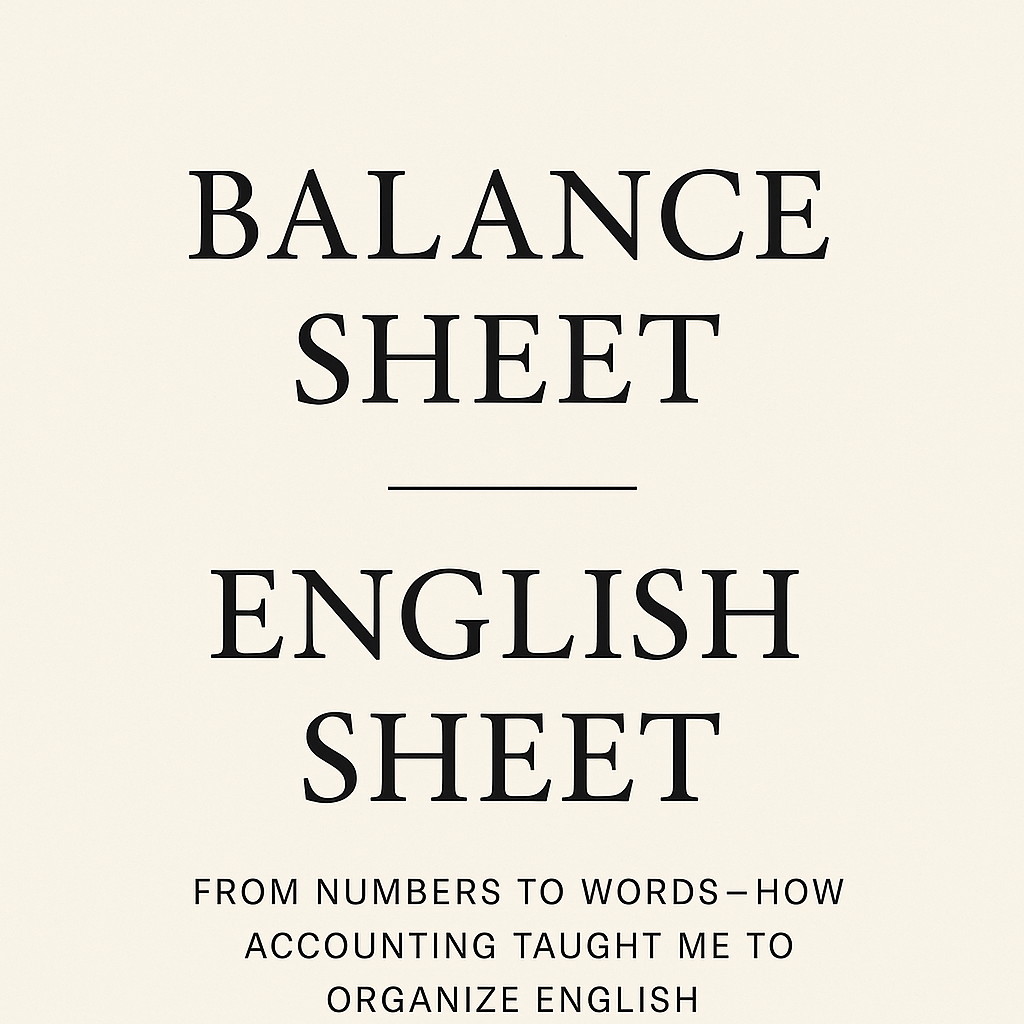
💼 From Numbers to Words — How Accounting Taught Me to Organize English
(숫자에서 언어로 — 회계가 내게 가르쳐준 영어의 구조화)
🌿 Introduction
For many years, I worked in accounting — a world where everything must be categorized, balanced, and precise.
Every number had its rightful place, and every line had meaning.
If even one thing was misplaced, the entire balance would collapse.
Back then, I didn’t realize that this mindset — the need to understand through structure — would one day shape the way I study and teach English.
“Structure creates clarity, and clarity brings confidence.” 🌱
⚙️ From Ledgers to Language
When I began studying English seriously, I often felt lost.
Grammar, pronunciation, tenses — everything seemed scattered.
But then I realized: language, like accounting, also has a system of order.
Every sentence is a record of meaning.
Every word belongs to a category — a function — just like entries in a balance sheet.
Understanding this gave me peace.
I stopped memorizing and started classifying:
verbs as movement, tenses as time flow, pronunciation as sound mechanics.
Suddenly, English made sense.
“Once I found the pattern, English stopped being chaos.”
🧭 The Blueprint of Thought
Accounting trained me to see invisible patterns —
not just numbers, but the logic behind them.
Now, when I learn or write about English,
I can see its “blueprint” — how grammar connects to feeling,
how sound connects to thought,
how writing connects to emotion.
In both accounting and language, structure brings clarity.
And once the structure is clear, creativity naturally flows.
🌸 Conclusion
Maybe that’s why I built MisoEnglish the way I did —
like a living system of categories:
Living English, Mechanism, Blueprint, Writing, and Soft Tools.
Because I believe English isn’t chaos; it’s a form of balance —
a dialogue between logic and life, structure and soul.
“I used to balance numbers.
Now, I balance words — and they finally feel alive.” 🌿
숫자에서 언어로 — 회계가 내게 가르쳐준 영어의 구조화
오랫동안 저는 회계 일을 했습니다.
그 세계는 모든 것이 정확히 구분되고, 균형 잡혀야 하는 곳이었죠.
모든 숫자는 제자리를 가져야 하고, 한 줄 한 줄에 의미가 있었습니다.
단 하나라도 틀어지면 전체의 균형이 무너졌습니다.
그땐 몰랐습니다.
그 질서감, 구조로 이해하려는 습관이
나중에 영어를 배우고 가르치는 방식까지 바꿀 줄은요.
영어 공부를 본격적으로 시작했을 때,
저는 종종 길을 잃은 기분이었습니다.
문법, 발음, 시제 — 모든 게 흩어져 보였죠.
그런데 문득 깨달았습니다.
언어도 회계처럼 **‘질서의 체계’**가 있다는 것을요.
문장은 ‘의미의 기록’이고,
단어는 각각의 기능을 가진 항목처럼 분류됩니다.
이걸 깨닫자 혼란이 사라지고, 마음이 정리되었어요.
그때부터 저는 외우지 않고 ‘분류하기’를 시작했습니다.
동사는 움직임으로, 시제는 시간의 흐름으로,
발음은 소리의 메커니즘으로.
그제야 영어가 살아 움직이기 시작했죠.
회계는 눈에 보이지 않는 패턴을 읽는 훈련이었습니다.
이제 저는 언어에서도 그 패턴을 읽습니다.
문법이 감정과 연결되는 방식,
소리가 생각과 이어지는 방식,
글쓰기가 감정의 리듬으로 흘러가는 방식.
회계든 영어든 결국 구조가 명료함을 만들고,
명료함은 창의성을 불러옵니다.
그래서 저는 MisoEnglish를
하나의 살아있는 시스템으로 만들고 싶었습니다.
Living English, Mechanism, Blueprint, Writing, Soft Tools.
영어는 혼돈이 아니라,
논리와 감성의 균형 속에서 피어나는 언어이니까요.
“예전엔 숫자의 균형을 맞췄습니다.
이제는 단어의 균형을 맞춥니다.
그리고 그제야 언어가 살아 있음을 느낍니다.” 🌿
© MisoEnglish / Michelle Kim.
This is original content written by the author.
Unauthorized reproduction or full reposting is prohibited.
You may quote short parts only with clear credit and a link to the original post.
이 글은 작성자가 직접 집필한 오리지널 콘텐츠입니다.
전체 복제·무단 재게시를 금하며,
일부 인용 시에는 반드시 출처(MisoEnglish)와 링크를 남겨 주세요.
'My English Journey and Reflection' 카테고리의 다른 글
| 동기의 신화 (0) | 2025.10.28 |
|---|---|
| 동기가 사라질 때, 꾸준함이 시작된다 (0) | 2025.10.28 |
| 🚍 “Good bye?” or just “Bye?” — A Morning Scene from My Commute (0) | 2025.10.21 |
| Better late than never — 늦더라도, 안 하는 것보다 낫다 (0) | 2025.10.18 |
| 🍎 A Crunchy Apple — 사과도 ‘Crunchy’할 수 있을까? (0) | 2025.10.18 |


