
- 분류 전체보기 (580)

| 일 | 월 | 화 | 수 | 목 | 금 | 토 |
|---|---|---|---|---|---|---|
| 1 | 2 | 3 | 4 | 5 | 6 | |
| 7 | 8 | 9 | 10 | 11 | 12 | 13 |
| 14 | 15 | 16 | 17 | 18 | 19 | 20 |
| 21 | 22 | 23 | 24 | 25 | 26 | 27 |
| 28 | 29 | 30 | 31 |
- GrammarWithSoul
- 🌿 English with Heart
- AirlineOpsEnglish
- everyday English
- 영어문법
- booking
- English Speaking Practice
- 영어공부법
- ticketing
- 영어발음
- pnr
- 영어시제
- 영문법
- 느리지만단단하게
- 영어공부
- English for Korean Learners
- 영어회화
- 영어표현력
- SlowBlooms
- English in English
- misoenglish
- 생활영어
- Basic English Verbs
- 감성영어
- 언어의철학 #의미론 #화용론 #언어와사고 #언어의미학 #MisoEnglish #TheLanguageBeyondGrammar #영문학심화
- FareRules
- 영어접속사
- 영어표현
- 영어를살다
- MichelleKim
- Today
- Total
MisoEnglish
🚍 “Good bye?” or just “Bye?” — A Morning Scene from My Commute 본문
🚍 “Good bye?” or just “Bye?” — A Morning Scene from My Commute
slowblooms 2025. 10. 21. 11:02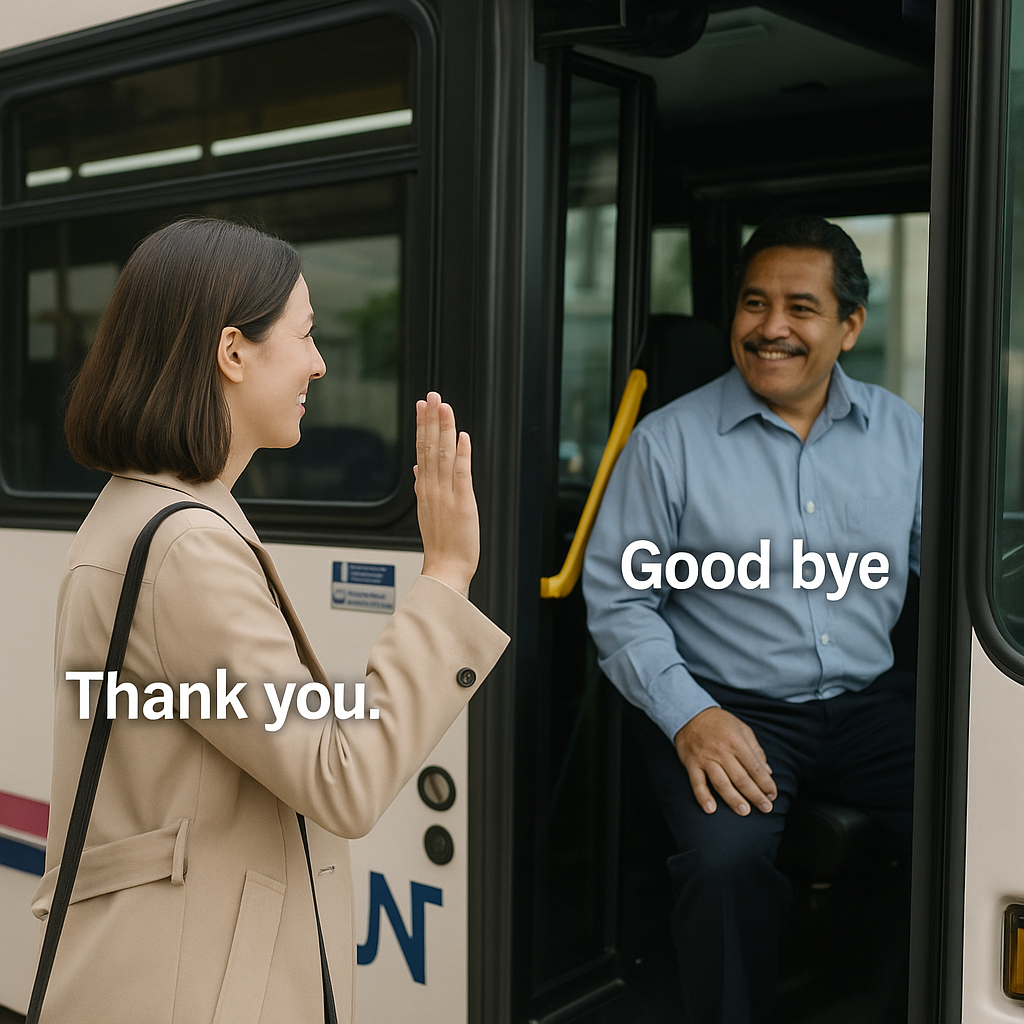
🌿 [Everyday English, Everyday Growth]
🚍 “Good bye?” or just “Bye?” — A Morning Scene from My Commute
Every weekday morning, I take a New Jersey Transit bus from my home in New Jersey to New York City.
Usually, I catch the bus around 9:35 to 9:40 a.m., and it’s become a small but comforting routine in my day.
When the bus arrives at the Port Authority Bus Terminal, I always say a simple “Thank you” to the driver before getting off.
And every time — without fail — the driver replies, “Good bye.”
He seems to be a Latin American immigrant, always polite and gentle.
But somehow, hearing “Good bye” every morning feels a little too formal — almost like we won’t see each other again.
I’ve thought about telling him, “You can just say ‘Bye!’ or ‘Bye-bye!’”
but I don’t want to sound rude or make him feel uncomfortable.
After all, he’s someone I see nearly every day.
💬 So, is “Good bye” wrong in this case?
Not at all.
“Good bye” is perfectly correct English — but it’s more formal and final.
We usually say it when parting for a longer time or in a serious situation.
In daily encounters — like leaving a bus, a store, or an office —
“Bye” or “Bye-bye” sounds much more natural and friendly.
🌎 Why might he say “Good bye”?
If he’s from a Latin background, it’s likely influenced by Spanish expressions like “Adiós”,
which carry warmth and formality at the same time.
So for him, “Good bye” might simply mean, “Have a nice day!” — nothing too serious.
It’s his way of being polite and kind.
☕ How can I respond naturally?
You don’t need to correct him at all —
just shift the tone naturally by saying something like:
- “Thank you! Have a good one!”
- “Thanks! See you tomorrow!”
- “Thank you! Take care!”
- “Thanks! Have a great day!”
When you respond in this way, he’ll likely match your tone next time —
and your morning exchange will feel even warmer.
🌤️ Small Moments, Big Warmth
Sometimes, the most ordinary moments —
a short “thank you,” a simple smile, a brief goodbye —
carry the greatest warmth in our daily life.
It reminds me that language isn’t just about grammar;
it’s about connection — even on a bus ride to work.
🌿 매일 아침 버스 안에서 배우는 영어 인사 이야기
평일이면 매일 아침, 저는 뉴저지 집 앞에서 뉴욕으로 가는 버스를 탑니다.
보통 아침 9시 35분에서 40분 사이, 늘 같은 노선을 타죠.
이제는 그 버스와 버스 기사님, 그리고 출근길의 공기가 익숙해졌습니다.
뉴욕 포트 오쏘리티 버스 터미널에 도착해 내릴 때면,
저는 항상 “Thank you.” 하고 감사 인사를 건넵니다.
그럴 때마다 기사님은 어김없이 **“Good bye.”**라고 대답하시죠.
그분은 아마도 라틴계 이민자 같아요.
항상 친절하고 미소가 따뜻한 분인데,
매일 듣는 “Good bye”가 왠지 조금은 격식 있고 멀게 느껴졌어요.
그래서 “그냥 ‘Bye!’ 혹은 ‘Bye-bye!’라고 해도 돼요.”라고
말해주고 싶었지만, 혹시나 마음이 상할까 망설였죠.
💬 ‘Good bye’는 틀린 표현일까?
아니요, 전혀 아닙니다.
“Good bye”는 정확한 표현이지만,
조금 더 공식적이고 이별의 느낌이 강한 표현이에요.
일상적인 상황 — 예를 들어 버스에서 내릴 때, 가게를 나올 때,
회사에서 동료와 잠시 헤어질 때 — 에는
“Bye” 혹은 **“Bye-bye”**가 훨씬 자연스럽고 따뜻하게 들립니다.
🌎 기사님이 ‘Good bye’를 쓰는 이유
그분이 라틴계라면, 모국어인 스페인어의 “Adiós” 영향이 있을 거예요.
그 말은 격식도 있지만, 동시에 정중하고 다정한 인사이기도 하죠.
그래서 그분에게 “Good bye”는 단순히
“좋은 하루 보내세요” 정도의 의미일 수도 있어요.
즉, 진심 어린 친절의 표현인 거죠.
☕ 자연스럽게 대화를 이어가고 싶다면?
굳이 “그건 좀 어색해요”라고 고칠 필요는 없어요.
대신, 당신이 먼저 자연스럽게 분위기를 바꿔보면 됩니다.
예를 들어 이렇게요:
- “Thank you! Have a good one!”
- “Thanks! See you tomorrow!”
- “Thank you! Take care!”
- “Thanks! Have a great day!”
이렇게 가볍고 따뜻한 인사를 건네면,
그분도 어느새 “Good bye” 대신
“Bye!”나 “You too!”로 맞춰주실 거예요.
🌤️ 작지만 따뜻한 순간
하루를 시작하며 주고받는 짧은 인사,
그 속에는 언어 이상의 마음이 담겨 있죠.
“Thank you.” 한마디, “Bye.” 한마디가
서로의 하루를 조금 더 따뜻하게 만들어줍니다.
영어는 문법 이전에 사람과 사람을 잇는 다리라는 걸,
매일 아침 버스 안에서 다시 느낍니다.
🌿 오늘의 작은 영어 이야기 – 언어보다 마음이 먼저 닿을 때, 그게 진짜 소통이 아닐까요?
매일의 Good bye가 하루의 작은 행복이 되길. 🌿
© MisoEnglish / Michelle Kim.
This is original content written by the author.
Unauthorized reproduction or full reposting is prohibited.
You may quote short parts only with clear credit and a link to the original post.
이 글은 작성자가 직접 집필한 오리지널 콘텐츠입니다.
전체 복제·무단 재게시를 금하며,
일부 인용 시에는 반드시 출처(MisoEnglish)와 링크를 남겨 주세요.
'My English Journey and Reflection' 카테고리의 다른 글
| 동기가 사라질 때, 꾸준함이 시작된다 (0) | 2025.10.28 |
|---|---|
| 💼 숫자에서 언어로 - 회계가 내게 가르쳐준 영어의 구조화 (0) | 2025.10.22 |
| Better late than never — 늦더라도, 안 하는 것보다 낫다 (0) | 2025.10.18 |
| 🍎 A Crunchy Apple — 사과도 ‘Crunchy’할 수 있을까? (0) | 2025.10.18 |
| 🎵 A…meriCA~no? (0) | 2025.10.18 |


