
- 분류 전체보기 (1048)

- Linguistics (고급 영어학) (10)
- Stylistics (6)
- Etymology & Word Building (15)
- Philosophy Meets Grammar (6)
- Collection of Famous Quotes (22)
- English Mechanism (276)
- The Language Beyond Grammar (269)
- Living English (81)
- Miso’s Life Notes (18)
- My English Journey and Refl.. (16)
- Philosophy (132)
- Video Clip (16)
- Airline English (항공 영어) (47)
- Creative Corner (35)
- Sally & Sia (1)
| 일 | 월 | 화 | 수 | 목 | 금 | 토 |
|---|---|---|---|---|---|---|
| 1 | 2 | 3 | 4 | |||
| 5 | 6 | 7 | 8 | 9 | 10 | 11 |
| 12 | 13 | 14 | 15 | 16 | 17 | 18 |
| 19 | 20 | 21 | 22 | 23 | 24 | 25 |
| 26 | 27 | 28 | 29 | 30 |
- 느리지만단단하게
- misoenglish
- Basic English Verbs
- 인도철학 #동양철학 #인문학 #요가 #명상 #힌두교 #불교 #간디 #타고르 #정통6파 #철학공부 #마음공부 #MisoEnglish #인문학영어
- MisoEnglish#철학입문 #Philosophy #심리철학 #PhilosophyOfMind #철학공부 #의식 #마음 #PhilosophyForBeginners #교육콘텐츠 #철학시리즈
- 동양정치철학 #시리즈완결 #아시아적가치 #동서양비교 #유교 #민주주의 #정치사상 #인문학 #비교철학 #글로벌정치 #문화다양성 #2500년철학사
- AirlineOpsEnglish
- MisoEnglish#도교철학 #Taoism #도덕경 #TaoTeChing #무위자연 #WuWei #노자 #Laozi #장자 #YinYang
- 🌿 English with Heart
- MisoEnglish#철학입문 #Philosophy #과학철학 #PhilosophyOfScience #철학공부 #포퓨퍼 #쿠hn #과학방법론 #교육콘텐츠 #철학시리즈
- MisoEnglish#불교철학 #BuddhismPhilosophy #사성제 #FourNobleTruths #공사상 #Emptiness #명상 #Mindfulness #열반 #EasternWisdom
- English Speaking Practice
- English in English
- 감성영어
- 영어문법
- pnr
- MisoEnglish#철학입문 #Philosophy #종교철학 #PhilosophyOfReligion #철학공부 #신존재증명 #악의문제 #PhilosophyForBeginners #교육콘텐츠 #철학시리즈
- 영어공부
- 영어접속사
- everyday English
- MisoEnglish#철학입문 #Philosophy #윤리학 #Ethics #도덕철학 #철학공부 #칸트 #공리주의 #교육콘텐츠 #철학시리즈
- EnglishWriting #AcademicWriting #Grammar #EnglishLanguage #EssayWriting #ParagraphStructure #SentenceStructure #BusinessEnglish #EnglishTips #WritingSkills #Linguistics #ESL
- 영어회화
- MisoEnglish#철학입문 #Philosophy #정치철학 #PoliticalPhilosophy #철학공부 #정의론 #자유주의 #PhilosophyForBeginners #교육콘텐츠 #철학시리즈
- English for Korean Learners
- MisoEnglish#철학입문 #Philosophy #형이상학 #Metaphysics #철학공부 #존재론 #실재론 #PhilosophyForBeginners #교육콘텐츠 #철학시리즈
- MisoEnglish#유교철학 #Confucianism #성리학 #NeoConfucianism #인의예지 #Virtue #맹자 #Mencius #실학 #KoreanScholarship
- ticketing
- MisoEnglish#한국철학 #KoreanPhilosophy #홍익인간 #Hongik #화랑도 #Hwarang #단군 #Dangun #풍류도 #ThreeKingdoms#동양철학
- 영문법
- Today
- Total
MisoEnglish
시즌 2 — 인물 심층편 9편. 주유, 하늘이 아낀 천재 본문
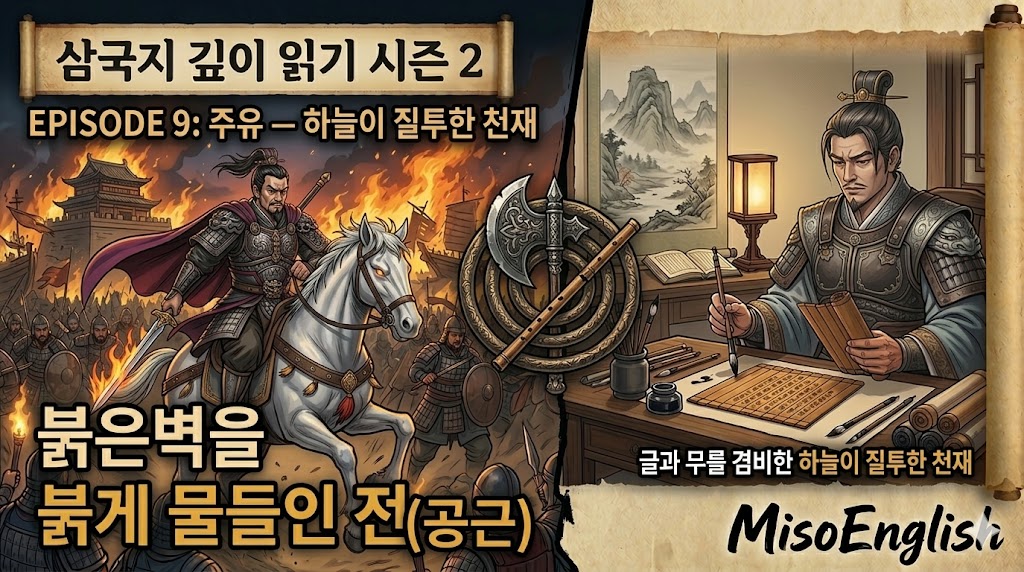
시즌 2 — 인물 심층편 9편. 주유, 하늘이 아낀 천재
삼국지에서 가장 안타까운 인물이 누구냐고 물으면, 저는 주유라고 말할 거예요.
조조는 천하를 호령했어요. 유비는 황제가 됐어요. 사마의는 끝까지 살아남았어요.
그런데 주유는 서른여섯에 세상을 떠났어요. 그것도 천하를 바꾼 적벽대전의 주인공이 서른여섯이었어요.
하늘이 너무 일찍 데려간 사람. 오늘은 그 이야기예요.
주유는 어떤 사람이었나
주유는 175년, 여강군에서 태어났어요.
집안이 좋았어요. 외모도 빼어났어요. 음악에 조예가 깊어서, 연주 중에 누군가 틀리면 주유가 귀신같이 알아채고 고개를 돌렸다는 이야기가 있어요. 여기서 나온 말이 곡유착, 주랑고(曲有誤, 周郞顧)예요. 곡이 틀리면 주랑이 돌아본다는 뜻이에요.
이 일화가 흥미로운 건, 음악을 감상하는 자리에서도 주유는 완전히 꺼지지 않았다는 거예요. 몸은 연회에 있어도, 귀는 항상 열려 있었어요. 긴장을 풀 줄 모르는 사람이었는지, 아니면 그 정도로 감각이 예민한 사람이었는지. 어느 쪽이든 범상치 않아요.
무예도 뛰어났고, 병법도 통달했어요. 그러니까 주유는 문무를 겸비한 데다 외모까지 준수했어요. 당시 사람들이 주유를 주랑이라 불렀어요. 랑은 젊고 멋진 남자를 뜻해요.
정사 삼국지에서 진수는 주유를 이렇게 평했어요. "성품이 넓고 도량이 컸으며, 웅장한 계략을 갖춘 사람이었다." 삼국지연의가 만들어낸 소심한 주유와는 전혀 다른 평가예요.
그런 주유가 손책을 만났어요.
손책과 주유 — 진짜 동지
주유와 손책의 우정은 삼국지에서 손꼽히는 아름다운 관계예요.
두 사람은 어릴 때부터 친구였어요. 나이도 같았어요. 함께 공부하고, 함께 꿈을 키웠어요.
주유가 손책을 처음 만난 건 손책이 아버지 손견을 잃고 세력을 일으키려 하던 시절이에요. 손책에게는 명성도, 병력도 부족했어요. 주유는 그럼에도 손책에게 자기 집을 내줬어요. 말 그대로 집을 내어준 거예요. 그 정도의 믿음이었어요.
손책이 강동을 평정할 때 주유는 곁에서 함께 싸웠어요. 그냥 신하가 아니었어요. 진짜 동지였어요.
손책이 말했어요. "공근이 없었다면 나는 강동을 가질 수 없었을 것이다."
그런데 손책이 일찍 세상을 떠났어요. 자객에게 습격당한 뒤 병을 얻어 스물여섯에 죽었어요.
손책의 죽음이 주유에게 어떤 충격이었을지는 짐작하기도 어려워요. 어릴 때부터 같은 꿈을 꾼 사람, 자기 집을 내어줄 만큼 믿었던 사람이 스물여섯에 사라진 거니까요. 주유도 같은 나이였어요.
죽기 전 손책이 주유에게 말했어요. "내 아우 손권을 부탁하오."
주유는 그 부탁을 받았어요. 그리고 평생 지켰어요.
손권과 주유 — 무릎을 꿇은 이유
손권은 형 손책과 달리 처음에는 위태로운 자리였어요.
열여덟 어린 나이에 강동을 물려받았어요. 신하들이 복종할지도 불분명했어요. 손책이 카리스마로 장악했던 자리를, 아직 검증되지 않은 열여덟 살이 이어받은 거예요.
주유가 먼저 무릎을 꿇었어요.
신하의 예로 손권을 섬겼어요. 이 행동 하나가 강동의 분위기를 바꿨어요. 주유 같은 사람이 굽히는데 다른 신하들이 나설 수 없었어요.
이게 쉬운 결정이었을까요. 생각해볼 필요가 있어요.
주유의 능력은 손권보다 훨씬 높았어요. 나이도 위였어요. 원한다면 강동에서 다른 선택을 할 수도 있었어요. 하지만 주유는 그 길을 택하지 않았어요. 손책과의 약속이 있었고, 무엇보다 주유 자신이 그런 사람이었어요.
충성은 의무가 아니라 선택이었어요. 그리고 주유는 그 선택을 끝까지 지켰어요.
손권이 나중에 말했어요. "공근이 없었다면 나는 오늘이 없었을 것이다."
적벽대전 전야 — 혼자 맞선 사람
조조가 대군을 이끌고 남하했어요.
유표가 죽고 형주가 사실상 조조의 손에 넘어갔어요. 다음 목표는 강동이었어요.
조조의 군대가 얼마나 됐을까요. 조조는 손권에게 편지를 보냈어요. "나는 지금 수군 팔십만을 훈련시켜 오후와 강동에서 사냥을 즐기고자 한다." 실제 숫자는 과장이지만, 위협의 의도는 분명했어요.
강동의 신하들은 두 패로 갈렸어요. 항복파와 항전파였어요.
항복파의 논리는 간단했어요. 조조의 군대는 너무 크다. 우리가 이길 수 없다. 항복해서 자리를 보전하자.
장소 같은 중신들이 항복을 권했어요. 명분도 있었어요. 조조는 이미 한나라 황제의 이름으로 움직이고 있었어요. 저항하면 역적이 되는 구도였어요.
당시 분위기는 항복파가 우세했어요.
그때 주유가 손권 앞에 섰어요.
"신이 한 말씀 올리겠습니다."
주유는 조목조목 따졌어요. 조조의 군대는 북방 출신이라 수전에 약하다. 지금은 겨울이라 말에게 먹일 풀도 부족하다. 전염병도 돌고 있다. 형주의 수군을 흡수했다지만 그들의 마음은 조조에게 없다. 겉으로는 백만이지만 실제 전투력은 그에 못 미친다.
"저에게 정병 삼만을 주십시오. 반드시 조조를 물리치겠습니다."
이 연설이 중요한 건, 주유 혼자였기 때문이에요. 노숙도 함께 항전을 주장했지만, 중론은 여전히 항복 쪽이었어요. 주유는 그 분위기를 뒤집은 거예요.
손권은 주유에게 군권을 맡겼어요.
황개와 고육지계 — 살을 내주고 뼈를 취하다
적벽대전은 계략의 전쟁이었어요.
조조는 북방의 군대를 배에 태워 남하했어요. 북방 병사들은 물에 익숙하지 않았어요. 배멀미를 줄이기 위해 배들을 쇠사슬로 연결했어요. 안정적이었지만, 한 배에 불이 붙으면 전체로 번진다는 약점이 생겼어요.
주유의 참모 황개가 그걸 봤어요.
황개가 고육지계를 건의했어요. 자신이 일부러 벌을 받고 조조에게 투항하는 척 넘어가서 화공을 쓰겠다는 계략이었어요. 실제로 맞아야 했어요. 조조의 첩자들이 지켜보고 있을 테니까요.
주유가 받아들였어요.
황개는 정말로 매를 맞았어요. 공개적으로. 등이 갈라지는 혹독한 형벌이었어요. 황개는 신음 소리 하나 내지 않았다고 해요.
그리고 조조에게 투항 의사를 전했어요. "주유는 독단적이고 포악하다. 내가 강동의 군량과 병력을 이끌고 투항하겠다."
조조는 믿었어요. 직접 매를 맞은 사람의 말이었으니까요.
겨울바람이 방향을 바꿨어요. 동남풍이 불었어요.
이 동남풍에 대해서 삼국지연의는 제갈량이 제단을 쌓고 바람을 불러왔다고 썼어요. 실제로는 주유가 기상을 읽은 것이었어요. 겨울에도 적벽 부근의 지형과 기후 조건이 맞으면 동남풍이 부는 날이 있어요. 주유는 그걸 알고 있었어요.
황개의 배가 조조의 함대를 향해 돌진했어요. 불이 붙었어요.
조조의 함대가 불타는 적벽의 강물 위에서 무너졌어요.
천하의 흐름이 그날 밤 바뀌었어요. 삼국이 정립되는 결정적인 순간이었어요. 그리고 그 중심에 서른네 살의 주유가 있었어요.
주유의 그늘, 제갈량 — 소설이 만든 오해
여기서 잠깐 짚어야 할 게 있어요.
삼국지연의에서 주유는 제갈량에게 계속 당하는 사람으로 나와요. 동풍을 부른 것도 제갈량, 조조를 화용도에서 살려준 것도 제갈량의 계략, 주유가 꾸민 일마다 제갈량이 한 발 앞서 있어요.
그리고 그 유명한 말. "하늘은 왜 유량(주유)을 낳고 또 공명(제갈량)을 낳았는가."
이 말은 정사에 없어요. 삼국지연의에서 만들어진 장면이에요.
정사 삼국지를 보면 주유와 제갈량이 직접 대결한 기록은 거의 없어요. 적벽대전에서 제갈량의 역할은 주로 외교였어요. 손권을 설득해 동맹을 이끌어낸 것. 실제 전투를 지휘한 건 주유였어요.
오히려 정사에서 주유는 제갈량을 경계하긴 했어요. 손권에게 이런 말을 했다는 기록이 있어요. "제갈량은 뛰어난 인물입니다. 강동에 붙들어두면 좋겠지만, 그렇지 않다면 차라리 없애는 게 낫습니다."
이건 질투가 아니에요. 냉정한 전략적 판단이에요. 뛰어난 인물이 적의 편에 있으면 위험하다는 거예요.
삼국지연의가 유비와 제갈량을 중심에 놓다 보니, 주유의 공이 상대적으로 희석됐어요. 주유는 제갈량에게 진 게 아니에요. 소설 속에서 그렇게 그려진 거예요.
남군 전투와 마지막 꿈
적벽대전 이후 주유는 남군을 공략했어요.
조인이 지키는 남군은 쉽게 무너지지 않았어요. 전투가 길어졌어요. 주유는 직접 전선에 나갔어요.
그 전투에서 화살에 맞았어요. 오른쪽 옆구리를 관통하는 깊은 상처였어요. 주위에서 후퇴를 권했어요.
주유는 듣지 않았어요.
오히려 상처를 감싸고 진영을 순시했어요. 부하들이 보는 앞에서. 주장이 쓰러지면 병사들의 사기가 꺾인다는 걸 알았으니까요. 조인도 그 모습을 보고 선뜻 나서지 못했어요.
남군을 차지한 뒤, 주유의 머릿속에는 더 큰 그림이 있었어요.
익주를 취하고, 한중을 장악하고, 마초와 연합해 조조를 치겠다는 계획이었어요.
이 계획이 실현됐다면 어떻게 됐을까요. 익주는 나중에 유비가 차지했어요. 만약 주유가 먼저 익주를 가져갔다면, 유비는 발붙일 곳이 없었어요. 삼국의 구도 자체가 달라졌을 거예요.
손권에게 그 계획을 올렸어요. 손권이 허락했어요.
주유는 출정을 준비했어요. 그런데 떠나지 못했어요.
서른여섯
210년, 주유는 출정을 앞두고 세상을 떠났어요. 나이 서른여섯이었어요.
화살을 맞은 상처가 악화됐다고도 하고, 오랜 전쟁으로 몸이 상했다고도 해요. 정확한 이유는 역사에 남아있지 않아요.
생각해보면 주유는 쉰 적이 없었어요. 손책을 도와 강동을 평정했고, 손책이 죽자 손권을 세웠고, 적벽에서 조조를 막았고, 남군에서 화살을 맞고도 버텼어요. 그 몸이 서른여섯에 더는 버티지 못한 거예요.
죽기 전 주유가 손권에게 마지막 글을 올렸어요.
"신은 불행히 병에 걸려 하늘의 명을 거스를 수 없게 됐습니다. 아직 해야 할 일을 다 마치지 못했는데 이리 되어 애통할 따름입니다. 노숙이 신의 자리를 대신할 수 있을 것입니다."
마지막 순간에도 손권 걱정이었어요. 자기 후임을 추천하면서 눈을 감았어요.
이 편지가 주유라는 사람을 보여줘요. 죽어가면서도 자기 이야기가 아니라 남겨질 사람 이야기를 했어요. 손책의 부탁을 받아 평생 지킨 사람이, 마지막 숨을 쉬면서도 그 부탁에서 벗어나지 않았어요.
손권이 통곡했어요. "공근이 없으면 나는 어찌해야 하는가."
주유가 남긴 것 — 적벽 이후의 세계
주유가 적벽에서 이룬 것의 의미를 제대로 보려면 당시 상황을 다시 봐야 해요.
만약 적벽에서 조조가 이겼다면 어떻게 됐을까요. 강동이 무너지고, 유비도 설 곳이 없어지고, 조조가 천하를 통일했을 거예요. 삼국이 아니라 조조의 위나라 하나만 남는 결말이에요.
주유는 그 결말을 막은 사람이에요.
삼국 정립은 주유가 만든 거예요. 유비가 촉한을 세울 수 있었던 것도, 제갈량이 북벌을 꿈꿀 수 있었던 것도, 그 모든 것의 출발점이 주유가 서른넷에 적벽에서 이긴 그 싸움이에요.
그런데 그 주인공이 고작 두 해 뒤에 세상을 떠났어요.
주유, 다시 보기
주유는 짧게 살았어요. 그런데 그 짧은 시간 안에 담긴 게 너무 많아요.
천재적인 군사 전략가. 음악을 사랑한 예술가. 손책의 진정한 동지. 손권의 든든한 버팀목. 적벽에서 천하의 흐름을 바꾼 사람.
서른여섯에 그 모든 걸 다 했어요.
삼국지연의에서 제갈량에게 질투하는 소인배로 그려진 게 억울할 만도 해요. 실제 주유는 도량이 넓은 사람이었어요. 노숙이 주유를 회고하며 말했어요. "공근은 웅장한 기략을 가진 사람이었다. 인품도 너그러웠다."
역사 속 주유는 소설 속 주유보다 훨씬 큰 사람이었어요.
하늘이 데려가지 않았다면 어떻게 됐을까요. 익주를 차지하고, 한중을 넘어, 어쩌면 삼국의 역사가 완전히 달라졌을지도 몰라요.
그래서 주유의 이야기는 언제나 아쉬움으로 끝나요. 가장 빛났던 사람이 가장 일찍 졌으니까요.
삼국지에서 가장 화려하게 빛난 순간이 있다면, 그 불빛의 한가운데에 주유가 있었어요.
다음 편에서는 손권 이야기예요. 시즌 2의 마지막, 조용히 가장 오래 버틴 자 손권의 이야기를 해볼게요.
시즌 2 — 10편: 손권, 조용히 가장 오래 버틴 자
Season 2 — Character Deep Dive,
Episode 9: Zhou Yu — The Genius Heaven Envied
If you ask who is the most heartbreaking figure in Romance of the Three Kingdoms, my answer is Zhou Yu.
Cao Cao commanded the realm. Liu Bei became an emperor. Sima Yi outlasted everyone.
But Zhou Yu died at thirty-six. The man who changed the course of history at the Battle of Red Cliffs — thirty-six years old.
A person heaven took back far too soon. That's today's story.
Who Was Zhou Yu?
Zhou Yu was born in 175 AD in Lujiang Commandery.
He came from a distinguished family. He was striking in appearance. His knowledge of music was so refined that during a performance, if any note was played incorrectly, Zhou Yu would unfailingly notice and turn his head toward the source of the error. From this came the saying: Qu you wu, Zhou Lang gu — when the music falters, Zhou Lang turns to look.
That story reveals something about him. Even in moments meant for relaxation, Zhou Yu was never fully off. Whether it was an extraordinary sensitivity or an inability to stop paying attention, it wasn't ordinary.
He was accomplished in martial arts. He had mastered military strategy. In other words, Zhou Yu was gifted in both the arts and in war — and striking in appearance on top of it all. People called him Zhou Lang, a term of admiration for a young man of exceptional bearing.
Even the official Records of the Three Kingdoms speaks plainly about him. Chen Shou wrote that Zhou Yu had "broad generosity, a heroic spirit, and grand strategy." That is a fundamentally different person from the petty, jealous figure the novel would later construct.
And this was the man who met Sun Ce.
Sun Ce and Zhou Yu — True Equals
The friendship between Zhou Yu and Sun Ce is one of the most beautiful relationships in the entire story.
They had been friends since childhood. The same age. They studied together, dreamed together.
The first real test of that friendship came when Sun Ce had lost his father Sun Jian and was trying to build something from almost nothing — limited reputation, limited men, limited resources. Zhou Yu opened his home to him. Literally. He gave Sun Ce his house to use as a base.
That is the kind of trust that isn't performed.
When Sun Ce set out to bring Jiangdong under his control, Zhou Yu fought at his side — not as a subordinate, but as a genuine equal in spirit.
Sun Ce said: "Without Gongjin, I could never have had Jiangdong."
But Sun Ce died young. Attacked by assassins, he fell ill and died at twenty-six.
What that loss meant to Zhou Yu is hard to fully imagine. The person he had shared a home with, the person he had fought beside from the beginning, gone at twenty-six. Zhou Yu was the same age. The future they had been building together ended without warning.
Before he died, Sun Ce said to Zhou Yu: "I entrust my brother Sun Quan to you."
Zhou Yu accepted that charge. He kept it for the rest of his life.
Zhou Yu and Sun Quan — Choosing to Kneel
Unlike his brother Sun Ce, Sun Quan's position at the start was fragile.
He inherited Jiangdong at eighteen. Whether his officers would follow him was genuinely uncertain. Sun Ce had held things together through force of personality. Sun Quan was untested and young.
Zhou Yu was the first to kneel.
He served Sun Quan with the full formal observance of a subject. That single act shifted the atmosphere across Jiangdong. If a man of Zhou Yu's stature bowed, no one else could reasonably resist.
Was this an easy choice? It's worth thinking about.
Zhou Yu was more capable than Sun Quan in almost every measurable way. He was older. He had fought to build Jiangdong. He could have pursued a different path entirely. But he didn't. The promise to Sun Ce mattered. And more than that — this was simply who Zhou Yu was.
His loyalty wasn't obligation. It was a choice he made and kept.
Sun Quan said later: "Without Gongjin, I would not be here today."
The Eve of Red Cliffs — Standing Alone
Cao Cao marched south with a massive army.
Liu Biao had died and Jing Province had effectively passed into Cao Cao's hands. Jiangdong was next. Cao Cao sent Sun Quan a letter: "I am training eight hundred thousand naval troops for a hunt in Wu." The number was exaggerated. The intent was not.
The court split in two. Those who favored surrender, and those who favored resistance.
The logic of the surrender faction was clear: Cao Cao is too powerful. We cannot win. Submit and preserve what we have. Even Zhang Zhao, one of the most respected senior officials, leaned toward giving in. Cao Cao was operating under the authority of the Han emperor — resistance could be framed as treason.
The room was moving toward surrender.
Then Zhou Yu stepped before Sun Quan.
"Allow me to speak."
He went through it point by point. Cao Cao's army is from the north — inexperienced in river warfare. It is winter — fodder for horses is scarce. Disease is spreading through his ranks. The Jing Province naval forces he absorbed are resentful conscripts, not loyal soldiers. The apparent size of his army disguises its real weaknesses.
"Give me thirty thousand elite troops. I will drive him back."
What made this moment significant is that Zhou Yu was largely alone in saying it. Lu Su also favored resistance, but the dominant mood in the room was against them. Zhou Yu reversed that current through the force of his argument — and, just as importantly, through the weight of who he was.
Sun Quan placed the army in Zhou Yu's hands.
Red Cliffs — The Strategy Behind the Fire
The Battle of Red Cliffs was a war of intelligence as much as arms.
Cao Cao had linked his northern fleet together with iron chains to stabilize the ships for men unaccustomed to the water. It reduced the seasickness. It also meant that if one ship caught fire, the flames had nowhere to stop.
Zhou Yu's advisor Huang Gai saw it.
Huang Gai proposed a stratagem of deliberate self-sacrifice. He would publicly submit to a severe flogging — punishment for supposed insubordination — and then defect to Cao Cao's side as a convincing deserter, carrying ships loaded with oil-soaked material. Cao Cao's own spies would witness the beating. The defection would seem real.
Zhou Yu agreed. And Huang Gai actually took the beating.
It was brutal. His back was broken open before witnesses. He didn't cry out. Then he sent word to Cao Cao: "Zhou Yu is brutal and arrogant. I cannot serve him. I will bring troops and supplies to your side."
Cao Cao believed him. A man doesn't take a flogging like that for a performance.
Now the other element. The wind.
In Romance of the Three Kingdoms, Zhuge Liang climbs a ritual altar and summons the southeastern wind through mystical ceremony. It's one of the novel's most dramatic scenes.
What the historical record suggests is more interesting. Zhou Yu understood the local weather patterns. In winter, the prevailing winds blow from the northwest — which would carry fire back toward his own fleet. But at Chibi, given the specific geography of the Yangtze at that location, southeastern winds were known to occur even in winter. Zhou Yu waited for the right conditions and positioned his strategy around them.
He didn't summon the wind. He read it.
When the wind shifted, Huang Gai's ships bore down on Cao Cao's fleet. The fire took hold. The chained ships had no escape.
Cao Cao's armada collapsed in flames on the river.
The course of the realm changed that night. The moment that made the Three Kingdoms possible. And at the center of it was Zhou Yu — thirty-four years old.
The Novel's Shadow: Zhuge Liang
There's something worth addressing directly.
In Romance of the Three Kingdoms, Zhou Yu is repeatedly outmaneuvered by Zhuge Liang. The wind? Zhuge Liang. The escape at Huarong Pass? Zhuge Liang's calculation. Every scheme Zhou Yu devises, Zhuge Liang is one step ahead. The novel builds to that famous line:
"Since heaven gave birth to Zhou Yu, why did it also give birth to Zhuge Liang?"
That line doesn't appear in any historical source. It was written by Luo Guanzhong.
The historical record shows almost no direct confrontation between Zhou Yu and Zhuge Liang. Zhuge Liang's role at Red Cliffs was primarily diplomatic — he persuaded Sun Quan to form the alliance. Zhou Yu commanded the battle.
What the historical Zhou Yu actually said about Zhuge Liang was different in tone: a cold strategic warning to Sun Quan that Zhuge Liang was too talented to be left in enemy hands. Not jealousy — assessment.
Romance of the Three Kingdoms centers its narrative on Liu Bei and Zhuge Liang. In that framing, Zhou Yu's role had to be diminished to make the story work. The jealous rival is a narrative convenience, not a historical portrait.
Zhou Yu didn't lose to Zhuge Liang. He was written that way.
The Battle for Nanjun — Arrow and All
After Red Cliffs, Zhou Yu moved to take Nanjun.
Cao Ren held the city and he didn't give it up easily. The campaign stretched on. Zhou Yu went to the front lines personally.
He was struck by an arrow. A deep wound to the right side. Everyone around him urged retreat.
He refused.
Instead, he had the wound dressed and rode out to inspect the troops in full view. Cao Ren, watching from inside the city, saw his opponent visibly wounded — and still present. He chose not to attack.
It was exactly what Zhou Yu intended.
After securing Nanjun, Zhou Yu presented Sun Quan with a plan that went far beyond what had already been achieved. Take Yi Province. Seize Hanzhong. Form an alliance with Ma Chao in the northwest. Then move against Cao Cao from multiple directions simultaneously.
Think about what this means. Yi Province was later the foundation of Liu Bei's kingdom — the land Zhuge Liang spent his life defending. If Zhou Yu had taken it first, Liu Bei would have had no base. The entire shape of the Three Kingdoms changes.
Sun Quan approved the plan. Zhou Yu began preparing.
He never got to leave.
Thirty-Six
In 210 AD, Zhou Yu died on the eve of his campaign. He was thirty-six.
Some sources point to the unhealed arrow wound. Others suggest his body had simply been worn through by years without rest. The exact cause wasn't recorded.
Consider the years he had lived. Helping Sun Ce take Jiangdong. Steadying Sun Quan through a shaky transition. Building toward Red Cliffs. Commanding the battle itself. Taking the arrow at Nanjun and staying at the front anyway. He had never stopped. The body that carried all of that gave out at thirty-six.
Before he died, Zhou Yu sent Sun Quan a final letter.
"I have had the misfortune of falling ill, and cannot resist the will of heaven. I have not yet finished what I set out to do, and that grieves me deeply. Lu Su could take my place."
In his last moments, his thoughts were not on himself. He named a successor. He worried about what he was leaving behind.
Sun Ce had asked him to protect Sun Quan. He kept that promise until there was nothing left to give.
Sun Quan wept. "Without Gongjin, what am I to do?"
What Zhou Yu Made Possible
To fully understand what Zhou Yu accomplished, you have to consider what the alternative was.
If Cao Cao had won at Red Cliffs, Jiangdong would have fallen. Liu Bei, already desperate for a foothold, would have had nowhere to go. Cao Cao would have proceeded to unify the realm. There would have been no Three Kingdoms — just one.
Zhou Yu prevented that outcome. Everything that followed — Liu Bei's kingdom, Zhuge Liang's campaigns, the decades of struggle that gave the era its name — all of it rests on what Zhou Yu did at thirty-four.
The Three Kingdoms was not inevitable. Zhou Yu made it possible.
And then two years later, he was gone.
Zhou Yu, Reconsidered
Zhou Yu lived briefly. And yet what he packed into that brief life is staggering.
A military genius who could read weather patterns and human nature with equal precision. An artist who noticed a wrong note across a crowded room. The man who gave Sun Ce his house and fought at his side until the end. The steady foundation beneath Sun Quan when everything was uncertain. The person who turned history at Red Cliffs.
He did all of that by thirty-six.
The portrait in Romance of the Three Kingdoms — a man consumed by jealousy, repeatedly humiliated by a rival — is a literary construction. Lu Su, who knew him personally, said after his death: "Gongjin possessed grand strategy and a heroic spirit. His character was magnanimous."
The historical Zhou Yu is a considerably larger person than the novel's version.
What would have happened if he had lived? Yi Province taken, Hanzhong crossed, the entire shape of the era transformed beyond recognition. It's impossible to know. But the question stays with you.
Zhou Yu's story always ends in something that feels like loss. The brightest one went out the earliest.
And perhaps the most remarkable thing about him isn't even what he accomplished. It's that he seemed to do all of it without losing himself — without becoming cold, or calculating, or consumed by ambition. He stayed who he was to the end. He kept the promise. He worried about Sun Quan in his final letter.
If the Three Kingdoms era had a moment of purest light, Zhou Yu was standing at its center.
Next episode: Sun Quan — the final episode of Season 2. The man who quietly outlasted everyone. That story is next.
Season 2 — Episode 10: Sun Quan, The One Who Simply Endured
'The Language Beyond Grammar' 카테고리의 다른 글
| 시즌 3 — 전투 심층편 1편. 관도대전, 천하의 판도를 바꾼 하룻밤 (0) | 2026.03.10 |
|---|---|
| 시즌 2 — 인물 심층편 10편. 손권, 조용히 가장 오래 버틴 자 (0) | 2026.03.09 |
| 시즌 2 — 인물 심층편 8편. 사마의, 가장 오래 버틴 자 (0) | 2026.03.09 |
| 시즌 2 — 인물 심층편 7편. 여포, 천하제일 무장의 비극 (0) | 2026.03.09 |
| 시즌 2 — 인물 심층편 6편. 조자룡, 평생 충성의 의미 (0) | 2026.03.09 |


