
- 분류 전체보기 (1048)

- Linguistics (고급 영어학) (10)
- Stylistics (6)
- Etymology & Word Building (15)
- Philosophy Meets Grammar (6)
- Collection of Famous Quotes (22)
- English Mechanism (276)
- The Language Beyond Grammar (269)
- Living English (81)
- Miso’s Life Notes (18)
- My English Journey and Refl.. (16)
- Philosophy (132)
- Video Clip (16)
- Airline English (항공 영어) (47)
- Creative Corner (35)
- Sally & Sia (1)
| 일 | 월 | 화 | 수 | 목 | 금 | 토 |
|---|---|---|---|---|---|---|
| 1 | 2 | 3 | 4 | |||
| 5 | 6 | 7 | 8 | 9 | 10 | 11 |
| 12 | 13 | 14 | 15 | 16 | 17 | 18 |
| 19 | 20 | 21 | 22 | 23 | 24 | 25 |
| 26 | 27 | 28 | 29 | 30 |
- ticketing
- 인도철학 #동양철학 #인문학 #요가 #명상 #힌두교 #불교 #간디 #타고르 #정통6파 #철학공부 #마음공부 #MisoEnglish #인문학영어
- 영어공부
- everyday English
- 감성영어
- MisoEnglish#도교철학 #Taoism #도덕경 #TaoTeChing #무위자연 #WuWei #노자 #Laozi #장자 #YinYang
- MisoEnglish#철학입문 #Philosophy #형이상학 #Metaphysics #철학공부 #존재론 #실재론 #PhilosophyForBeginners #교육콘텐츠 #철학시리즈
- MisoEnglish#불교철학 #BuddhismPhilosophy #사성제 #FourNobleTruths #공사상 #Emptiness #명상 #Mindfulness #열반 #EasternWisdom
- Basic English Verbs
- 영문법
- MisoEnglish#철학입문 #Philosophy #윤리학 #Ethics #도덕철학 #철학공부 #칸트 #공리주의 #교육콘텐츠 #철학시리즈
- EnglishWriting #AcademicWriting #Grammar #EnglishLanguage #EssayWriting #ParagraphStructure #SentenceStructure #BusinessEnglish #EnglishTips #WritingSkills #Linguistics #ESL
- MisoEnglish#철학입문 #Philosophy #심리철학 #PhilosophyOfMind #철학공부 #의식 #마음 #PhilosophyForBeginners #교육콘텐츠 #철학시리즈
- 느리지만단단하게
- misoenglish
- MisoEnglish#철학입문 #Philosophy #종교철학 #PhilosophyOfReligion #철학공부 #신존재증명 #악의문제 #PhilosophyForBeginners #교육콘텐츠 #철학시리즈
- English Speaking Practice
- MisoEnglish#유교철학 #Confucianism #성리학 #NeoConfucianism #인의예지 #Virtue #맹자 #Mencius #실학 #KoreanScholarship
- 영어접속사
- 영어회화
- pnr
- 영어문법
- MisoEnglish#철학입문 #Philosophy #과학철학 #PhilosophyOfScience #철학공부 #포퓨퍼 #쿠hn #과학방법론 #교육콘텐츠 #철학시리즈
- MisoEnglish#한국철학 #KoreanPhilosophy #홍익인간 #Hongik #화랑도 #Hwarang #단군 #Dangun #풍류도 #ThreeKingdoms#동양철학
- AirlineOpsEnglish
- 동양정치철학 #시리즈완결 #아시아적가치 #동서양비교 #유교 #민주주의 #정치사상 #인문학 #비교철학 #글로벌정치 #문화다양성 #2500년철학사
- English for Korean Learners
- English in English
- 🌿 English with Heart
- MisoEnglish#철학입문 #Philosophy #정치철학 #PoliticalPhilosophy #철학공부 #정의론 #자유주의 #PhilosophyForBeginners #교육콘텐츠 #철학시리즈
- Today
- Total
MisoEnglish
시즌 2 — 인물 심층편 7편. 여포, 천하제일 무장의 비극 본문
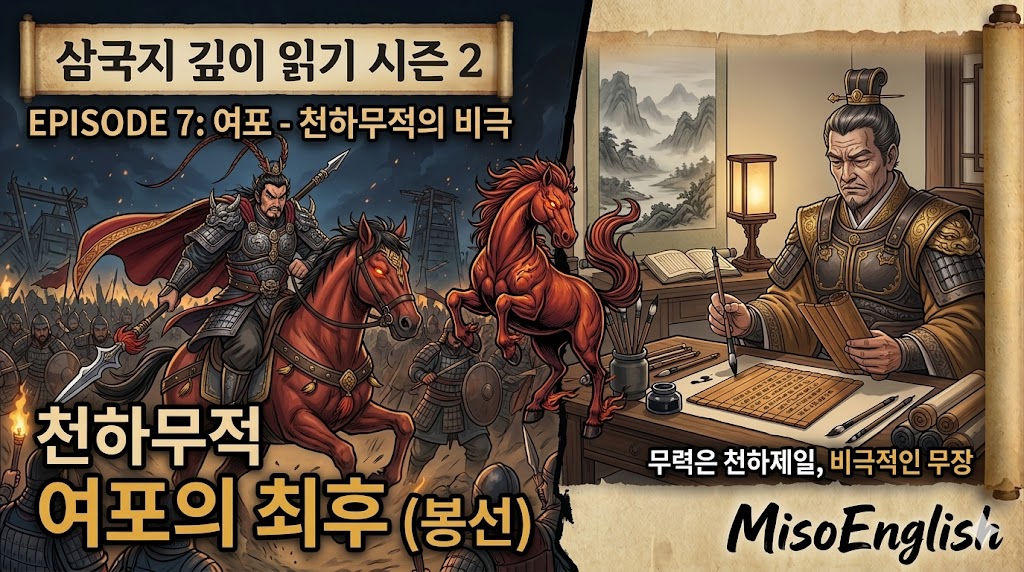
시즌 2 — 인물 심층편 7편. 여포, 천하제일 무장의 비극
삼국지에서 가장 강한 사람이 누구냐고 물으면, 답은 하나예요.
여포.
사람들은 여포를 이렇게 표현해요. 사람 중에 여포, 말 중에 적토마. 천하제일 무장이라는 말이 아깝지 않은 사람이었어요.
그런데 그 천하제일 무장의 최후는 너무나 허망했어요. 왜였을까요. 오늘은 그 이야기예요.
여포는 어떤 사람이었나
여포는 150년경 오원군에서 태어났어요.
타고난 체격과 힘, 말을 다루는 능력, 활 솜씨까지. 무장으로서 필요한 모든 걸 갖추고 태어난 사람이었어요.
정사 삼국지에서도 여포에 대한 평가는 분명해요. 진수는 여포를 "용맹이 뛰어나지만 지략이 없고, 이익을 보면 의리를 잊는 사람"이라고 평했어요. 칭찬과 비판이 동시에 담긴 평가예요.
삼국지연의에서 여포의 등장 장면은 언제나 압도적이에요. 호뢰관 전투. 유비, 관우, 장비 세 명이 동시에 여포를 상대했어요. 삼영전여포(三英戰呂布). 삼국지 최고의 명장면 중 하나예요.
셋이서 겨우 막아냈다는 이야기잖아요. 그 여포가 왜 비극으로 끝났을까요.
호뢰관 전투 — 정사와 연의 사이
삼영전여포는 삼국지연의에서 나온 장면이에요. 정사에는 이 장면이 없어요.
그렇다고 여포의 무용이 과장된 것만은 아니에요. 정사에도 여포가 원소의 군대를 거의 혼자 격파했다는 기록이 있어요. 조조도 여포와 직접 맞닥뜨렸다가 위기에 처한 적이 있었어요.
삼국지연의가 그 용맹을 극적으로 표현하기 위해 삼영전여포라는 장면을 만들어낸 거예요. 하지만 그 바탕에는 실제로 여포가 당대 최강의 무장이었다는 사실이 깔려있어요.
관우와 장비가 동시에 덤벼야 할 만큼 강했다는 표현은 허구지만, 그만큼 강했다는 건 사실이었어요.
첫 번째 배신 — 정원
여포의 인생을 이해하려면 배신의 역사를 따라가야 해요.
여포의 첫 주군은 정원이었어요. 정원은 여포를 아들처럼 아꼈어요. 여포도 정원을 아버지처럼 따랐어요. 적어도 처음에는요.
동탁이 낙양에 입성했어요. 권력을 장악하려는 동탁은 여포에게 접근했어요. 당근은 적토마와 금은보화였어요.
여포는 정원을 죽이고 동탁에게 넘어갔어요. 첫 번째 배신이었어요.
그런데 여기서 한 가지 생각해볼 게 있어요.
여포는 왜 그랬을까요. 단순히 욕심 때문이었을까요.
당시 여포의 처지를 보면 조금 달리 읽힐 수 있어요. 여포는 변방 출신이었어요. 오원군은 지금의 내몽골 근처, 당시 기준으로는 거친 변경 지역이에요. 중원의 명문가 출신들이 권력을 나눠 갖던 시대에, 여포 같은 사람이 올라갈 수 있는 사다리는 매우 제한적이었어요.
정원 밑에서는 무장으로 쓰였을 뿐이에요. 동탁은 더 높은 자리와 더 큰 보상을 제시했어요. 야망이 있는 사람이라면 흔들릴 수 있는 상황이었어요.
그렇다고 배신을 정당화할 수는 없어요. 하지만 단순히 탐욕스러운 사람이라고만 보기도 어려워요.
두 번째 배신 — 동탁과 초선
동탁은 여포를 아들로 삼았어요. 여포도 동탁을 아버지라 불렀어요. 그런데 이 관계도 오래가지 않았어요.
여기서 초선 이야기가 나와요.
초선은 삼국지연의에서 왕윤의 양녀로 등장해요. 절세미인으로, 동탁과 여포 모두를 홀려 두 사람 사이를 갈라놓은 연환계의 핵심 인물이죠.
그런데 초선은 정사 삼국지에 나오지 않아요.
정사에는 그냥 "여포가 동탁의 시비(侍婢)와 사통했다"는 짧은 기록만 있어요. 이름도, 배경도 없어요. 왕윤의 연환계 이야기도 정사에는 없어요.
초선은 나관중이 만들어낸 인물일 가능성이 높아요. 또는 실제 인물이 있었지만 이름이 전해지지 않는 여성을 소설에서 극적으로 발전시킨 것일 수도 있어요.
그렇다면 실제 여포는 왜 동탁을 죽였을까요.
정사에 따르면 왕윤이 여포에게 접근해 동탁 제거를 제안했고, 여포가 망설이면서 "부자 사이인데 어찌 그런 일을 하겠느냐"고 했다는 기록이 있어요. 왕윤은 "장군의 성은 여씨이고, 동탁의 성은 동씨입니다. 진짜 부자가 아닙니다"라고 설득했어요.
동탁에 대한 두려움과 분노, 그리고 왕윤의 설득이 합쳐진 결과였어요. 초선이라는 여인이 있었다면 그건 불씨를 더한 것이었겠지만, 근본적인 이유는 다른 데 있었어요.
어쨌든 여포는 동탁을 죽였어요. 두 번째 배신이었어요.
배신자의 낙인
두 아버지를 죽인 여포에게는 평생 꼬리표가 따라붙었어요.
삼성가노(三姓家奴). 세 성씨의 집에서 종살이한 노예라는 뜻이에요. 장비가 여포를 향해 내뱉은 말이에요.
여포의 본성은 여씨, 정원의 성인 정씨를 따랐다가, 다시 동탁의 성인 동씨를 따랐다는 거예요.
이 말이 여포에게 얼마나 깊이 박혔을지 역사는 말해주지 않아요. 하지만 이 낙인은 단순한 모욕 이상이었어요. 당시 사회에서 의리와 충성은 사람의 가치를 판단하는 핵심 기준이었어요. 두 번의 배신은 여포를 그 기준에서 완전히 벗어난 사람으로 만들었어요.
아무리 강해도 따르고 싶지 않은 사람. 그게 여포였어요.
유비와 여포 — 가장 위험한 손님
동탁을 제거한 뒤 여포는 갈 곳을 잃었어요. 왕윤도 죽고, 장안도 무너지면서 여포는 천하를 떠돌았어요.
그러다 유비에게 몸을 의탁했어요. 유비는 여포를 받아들였어요. 사람을 쉽게 내치지 않는 유비다웠어요.
그런데 참모들은 걱정했어요. 진등이 유비에게 말했어요.
"여포는 늑대나 호랑이 같은 사람입니다. 길게 놔두면 반드시 화가 될 것입니다."
유비는 알면서도 받아들였어요. 그게 유비의 강점이기도 하고, 이번만큼은 약점이기도 했어요.
결국 여포는 유비의 뒤통수를 쳤어요. 유비가 조조와 싸우러 나간 틈에 서주를 빼앗았어요. 유비가 돌아왔을 때 자신의 근거지가 사라져 있었어요.
유비는 이를 갈면서도 여포와 손을 잡을 수밖에 없었어요. 현실이 그랬어요. 여포는 진심인지 아닌지 모를 말을 했어요.
"나는 당신을 해치려 한 게 아니오. 조조가 오면 함께 맞서 싸웁시다."
그 동거는 오래가지 않았어요.
여포와 유비의 관계는 삼국지 전체를 통틀어 가장 기묘한 동거 중 하나예요. 서로를 이용하면서, 서로를 경계하면서, 결국 서로에게 칼을 겨누게 되는 관계였어요.
하비성의 최후 — 무너지는 방식
조조가 대군을 이끌고 여포를 치러 왔어요. 여포는 하비성에서 버텼어요.
싸울 때는 여전히 누구보다 강했어요. 조조도 여포의 용맹을 직접 경험했기에 쉽게 공격하지 못했어요.
그런데 여포에게는 치명적인 약점이 있었어요. 술이었어요.
전투 중에도 술을 놓지 않았어요. 부하들의 사기는 떨어졌고, 판단력은 흐려졌어요.
모사 진궁이 여러 번 말렸어요.
"술을 끊으십시오. 지금 상황이 위급합니다."
여포는 듣지 않았어요.
진궁은 탈출 계획도 세웠어요. 성 안에서 버티는 것만으로는 한계가 있으니, 여포가 성 밖으로 나가 기습을 감행하는 동안 자신이 성을 지키겠다는 계획이었어요. 여포의 아내가 말렸어요. "진궁을 믿을 수 있겠습니까. 그가 성을 넘기면 어떻게 하실 거예요?"
그 말에 여포가 흔들렸어요. 계획은 없던 일이 됐어요.
결국 부하 후성, 송헌, 위속이 반기를 들었어요. 여포가 잠든 사이 성문을 열어 조조의 군대를 들였어요. 여포는 사로잡혔어요.
하비성의 함락은 조조의 군사적 승리이기도 했지만, 여포 스스로 자초한 면이 더 컸어요. 술, 의심, 그리고 사람을 믿지 못하는 성격. 그 모든 것이 한꺼번에 터졌어요.
여포의 마지막 말
조조 앞에 끌려온 여포는 고개를 숙이지 않았어요. 오히려 이렇게 말했어요.
"명공께서 보병을 맡으시고 제가 기병을 맡는다면 천하는 쉽게 평정될 것입니다."
자신을 살려서 함께 천하를 도모하자는 말이었어요.
조조가 흔들리는 기색을 보였어요. 조조도 여포의 능력을 알았어요. 그 힘을 자기 편으로 쓸 수 있다면 얼마나 좋겠냐는 생각이 스쳤을 거예요.
그때 유비가 말했어요.
"공께서는 정원과 동탁의 일을 잊으셨습니까."
조조는 고개를 끄덕였어요. 여포는 처형됐어요. 199년이었어요.
죽기 전 여포가 유비를 향해 말했다는 기록이 있어요.
"큰 귀를 가진 자가 가장 믿을 수 없는 놈이었구나."
유비의 귀가 크다는 건 삼국지의 유명한 묘사예요. 여포는 마지막 순간에도 자신을 저버린 유비를 원망했어요.
그런데 생각해보면 아이러니예요. 여포는 두 명의 아버지를 배신했어요. 유비를 배신했어요. 그런데 죽는 순간 자신을 배신한 유비를 원망했어요.
배신의 아픔은 누구보다 잘 알면서, 배신하지 않는 법은 끝내 배우지 못한 사람이었어요.
진궁 이야기 — 여포보다 깊었던 사람
진궁은 여포와 함께 처형됐어요.
진궁은 원래 조조 편이었어요. 조조가 어릴 적 아버지의 오랜 친구 여백사를 의심해서 죽인 사건이 있었어요. 그걸 목격한 진궁은 조조를 떠났어요. "이 사람은 내가 섬길 사람이 아니다"라고 판단하고서요.
그리고 여포 곁에 남았어요. 여포가 완벽한 주군이어서가 아니었어요. 조조에 대한 반감, 그리고 자신이 선택한 길에 대한 책임감 때문이었어요.
진궁은 여포의 한계를 누구보다 잘 알았어요. 그래도 떠나지 않았어요.
조조가 마지막으로 진궁에게 물었어요.
"공대(진궁의 자), 지금 어떤 마음이오?"
진궁이 답했어요.
"여포는 지략이 없어 패했습니다. 저는 그걸 알면서도 따랐으니 죽는 게 마땅합니다."
조조가 진궁의 어머니와 가족을 평생 돌보겠다고 약속했어요. 진궁은 고개를 끄덕이고 형장으로 걸어갔어요. 뒤돌아보지 않았어요.
조조가 눈물을 흘렸다는 기록이 있어요.
진궁은 여포보다 훨씬 더 깊은 인물이었어요. 어쩌면 여포의 비극은 진궁 같은 사람의 충성을 끝까지 받아낼 그릇이 되지 못했던 데 있는지도 몰라요. 진궁이 여포를 따른 건 여포를 믿어서가 아니라, 자신의 선택에 끝까지 책임을 지려 했기 때문이에요. 그 충성을 받을 자격이 여포에게 있었는지는 모르겠어요. 하지만 진궁은 그걸 끝까지 지켰어요.
여포는 왜 실패했을까
여포는 천하제일의 무장이었어요. 그런데 결국 천하를 얻지 못했어요. 아니, 얻으려 하지도 않았는지 몰라요.
여포에게는 큰 그림이 없었어요.
조조에게는 천하를 통일하겠다는 비전이 있었어요. 유비에게는 한나라를 되살리겠다는 명분이 있었어요. 손권에게는 강동을 지키겠다는 책임감이 있었어요.
여포에게는 그게 없었어요. 더 좋은 주군, 더 좋은 조건, 더 좋은 기회. 그것만 좇았어요.
사람들이 여포를 따르지 않은 건 그 때문이에요. 모사 진궁만이 끝까지 곁에 있었어요. 진궁조차도 여포를 믿어서가 아니라, 조조에 대한 개인적인 원한과 자신의 선택에 대한 책임감 때문이었어요.
힘은 방향이 없으면 결국 스스로를 망가뜨려요. 여포가 그걸 보여줬어요.
여포, 다시 보기
여포는 나쁜 사람이었을까요.
단순히 나쁘다고 하기는 어려워요.
배신은 했지만, 딸을 아꼈어요. 하비성에서 포위당했을 때 딸을 탈출시키려 한 기록도 있어요. 사랑하는 사람이 있었고, 지키고 싶은 것도 있었어요.
그냥 자신이 무엇을 원하는지, 어디로 가야 하는지 몰랐던 사람이에요. 천하제일의 힘을 가졌지만, 그 힘을 무엇을 위해 써야 할지 끝내 찾지 못했어요.
삼국지에서 가장 강한 사람이 가장 허망하게 끝난 이유가 거기 있어요.
그리고 어쩌면 그 허망함이, 여포를 지금도 가장 많이 이야기되는 인물 중 하나로 만드는 이유일 거예요. 완벽한 힘을 가지고도 길을 잃은 사람의 이야기는, 어느 시대에나 낯설지 않으니까요.
다음 편에서는 사마의 이야기예요. 조조, 유비, 제갈량이 모두 세상을 떠난 뒤에도 살아남아 결국 천하를 가져간 사람, 사마의의 이야기를 해볼게요.
시즌 2 — 8편: 사마의, 가장 오래 버틴 자
Season 2 — Character Deep Dive, Episode 7: Lü Bu, The Tragedy of the Mightiest Warrior
Ask anyone who the strongest person in Romance of the Three Kingdoms is, and the answer is always the same.
Lü Bu.
There's a saying that captures it: among people, Lü Bu; among horses, Red Hare. The title of greatest warrior under heaven fit him without exaggeration.
And yet that greatest warrior's end was shockingly hollow. Why? That's today's story.
Who Was Lü Bu?
Lü Bu was born around 150 AD in Wuyuan Commandery.
Natural build and strength, extraordinary horsemanship, mastery of the bow. He was born with everything a warrior needs.
Even the official Records of the Three Kingdoms doesn't deny his ability. The historian Chen Shou described him as "outstanding in courage but lacking in strategy, a man who abandons loyalty at the sight of profit." Praise and condemnation in the same breath.
In Romance of the Three Kingdoms, every scene featuring Lü Bu is overwhelming. The Battle of Hulao Pass — Liu Bei, Guan Yu, and Zhang Fei all attacking him at once. Three against one. San Ying Zhan Lü Bu. One of the most iconic scenes in the entire story.
Three of the greatest warriors of the age, barely holding him off.
So how did this man end so badly?
Hulao Pass — History and Legend
The scene of three warriors fighting Lü Bu simultaneously comes from the novel. It doesn't appear in the historical record.
But that doesn't mean Lü Bu's fighting ability was invented. Historical sources describe him routing Yuan Shao's forces nearly single-handedly. Cao Cao himself came dangerously close to being killed in direct confrontation with Lü Bu.
What the novel did was find the most dramatic possible way to express what the historical record already suggested — that Lü Bu was in a category of his own.
The scene may be fiction. The underlying truth was not.
The First Betrayal — Ding Yuan
To understand Lü Bu's life, you have to follow the trail of betrayals.
His first lord was Ding Yuan. Ding Yuan treated Lü Bu like a son. Lü Bu followed Ding Yuan like a father. At least at first.
Then Dong Zhuo entered Luoyang and moved to seize power. He approached Lü Bu with an offer: the legendary warhorse Red Hare, and gold and treasures beyond measure.
Lü Bu killed Ding Yuan and went over to Dong Zhuo. The first betrayal.
But here it's worth pausing to ask: why?
Lü Bu came from the frontier — Wuyuan Commandery, near what is now Inner Mongolia. In a world where power flowed through aristocratic bloodlines and established networks, a man from the borderlands had almost no path to advancement through loyalty alone. Under Ding Yuan, he was used as a weapon. Dong Zhuo offered something more.
That doesn't justify what he did. But it makes it harder to reduce him to simple greed. He was a man with ambition and no legitimate road to walk it down.
The Second Betrayal — Dong Zhuo and Diaochan
Dong Zhuo adopted Lü Bu as his son. Lü Bu called him father.
Then came Diaochan.
In Romance of the Three Kingdoms, Diaochan is one of the great beauties of Chinese literature — the adopted daughter of the strategist Wang Yun, used as the centerpiece of an elaborate double scheme. Wang Yun promised her to both Dong Zhuo and Lü Bu, playing them against each other until Lü Bu's jealousy became an instrument of assassination.
Here's what the historical record actually says.
Diaochan doesn't appear in it.
The official Records of the Three Kingdoms contains only a brief note: "Lü Bu had a secret affair with one of Dong Zhuo's servant women." No name. No background. No elaborate scheme.
Diaochan was almost certainly Luo Guanzhong's creation — or at most, a nameless historical figure transformed into a fully realized character by the novel. The romantic betrayal that drives the story may be largely fiction.
What the historical record does show is Wang Yun approaching Lü Bu directly and proposing that they remove Dong Zhuo together. Lü Bu hesitated, saying "but we are as father and son." Wang Yun replied: "Your surname is Lü. His is Dong. You share no blood." Combined with Lü Bu's fear of Dong Zhuo's volatile temper and his own frustrated ambitions, the argument was enough.
Whether a woman was involved or not, the second betrayal happened. And this time it cost him everything — because the world would never forget.
The Branded Man
Two adoptive fathers, both dead at Lü Bu's hand. From that point forward, a label followed him everywhere.
San xing jia nu — slave of three surnames. The insult Zhang Fei hurled at him. His birth name was Lü. He took Ding Yuan's name, then Dong Zhuo's. Three families, three surnames, three betrayals.
This wasn't just an insult. In the moral world of the Three Kingdoms era, loyalty was the measure of a person's worth. Two betrayals didn't just damage Lü Bu's reputation — they made him someone people could not trust, no matter how powerful he was.
The strongest man in the world, and no one wanted to follow him.
Liu Bei and Lü Bu — The Most Dangerous Guest
After Dong Zhuo's death, Lü Bu had nowhere to go. Wang Yun was killed in the chaos that followed, Changan fell apart, and Lü Bu drifted.
Eventually he sought refuge with Liu Bei. Liu Bei took him in — consistent with his character, his reluctance to turn people away.
His advisors warned him. Chen Deng said directly: "Lü Bu is like a wolf or a tiger. Keep him long and disaster will follow."
Liu Bei knew. He accepted anyway. It was one of his strengths and, in this case, a costly misjudgment.
Lü Bu repaid the hospitality by seizing Xu Province while Liu Bei was away fighting Yuan Shu. When Liu Bei returned, his base was gone.
Liu Bei swallowed his rage and negotiated. He had no choice. Lü Bu offered words that may or may not have been sincere.
"I never meant you harm. When Cao Cao comes, let us fight him together."
The arrangement didn't last.
The relationship between Liu Bei and Lü Bu is one of the strangest in the whole story — two men using each other, wary of each other, each knowing the other couldn't be trusted, neither willing to make the first clean break until circumstances forced it.
The Fall of Xiapi — How a Fortress Crumbles From Within
Cao Cao came with his full army to destroy Lü Bu. Lü Bu retreated into Xiapi and held it.
In battle, he was still peerless. Cao Cao, who had faced him directly before, moved cautiously.
But Lü Bu had a weakness that no fortress wall could compensate for. Drink.
He kept drinking through the siege. His judgment clouded. His men's morale eroded.
His strategist Chen Gong urged him repeatedly: "Stop drinking. The situation is critical."
Lü Bu wouldn't listen.
Chen Gong also proposed a plan — Lü Bu would break out of the city and strike Cao Cao's forces from outside while Chen Gong held the walls within. It was their best option.
Lü Bu's wife intervened. "Can you really trust Chen Gong with the city while you're gone?" she asked.
Lü Bu hesitated. The plan was abandoned.
In the end, three of his own subordinates — Hou Cheng, Song Xian, and Wei Xu — turned against him. While Lü Bu slept, they opened the gates and let Cao Cao's army in.
Xiapi fell not because Cao Cao was too strong. It fell because Lü Bu had made himself impossible to follow.
The Last Words
When Lü Bu was brought before Cao Cao in chains, he didn't lower his head.
He made his case.
"If you take command of the infantry and let me lead the cavalry, we can pacify the realm with ease."
He was offering an alliance. He believed it might work. And Cao Cao wavered — because he knew what Lü Bu was worth in battle, and because a part of him wanted to believe it too.
Then Liu Bei spoke.
"My lord — have you forgotten what happened to Ding Yuan and Dong Zhuo?"
Cao Cao nodded. Lü Bu was executed. It was 199 AD.
Before he died, there is a recorded exchange in which Lü Bu looked at Liu Bei and said:
"The man with the big ears — he was the least trustworthy of all."
Liu Bei's unusually large ears are one of the famous physical details in the story. In his final moment, Lü Bu's bitterness fell on the man whose warning had sealed his fate.
The irony is hard to miss. Lü Bu had betrayed two father figures. He had betrayed Liu Bei. And in the last moments of his life, he was consumed by the feeling of being betrayed.
He knew the pain of it better than most. He never learned how to stop causing it.
Chen Gong — The Man Who Deserved Better
Chen Gong was executed alongside Lü Bu.
He had started as one of Cao Cao's men. But when Cao Cao killed the family of an old friend out of paranoid suspicion — cutting down innocent people to protect himself — Chen Gong walked away. "This is not a man I can serve," he decided.
He ended up with Lü Bu. Not because Lü Bu was admirable, but because Chen Gong had made his choice and intended to see it through. He knew Lü Bu's limitations better than anyone. He stayed anyway.
Before the execution, Cao Cao asked him: "Gongda — what is in your heart now?"
Chen Gong answered: "Lü Bu lacked the wisdom to succeed. I knew it and followed him regardless. I deserve to die."
Cao Cao promised to provide for Chen Gong's mother and family for the rest of their lives.
Chen Gong nodded. Then he walked to the execution ground without looking back.
Cao Cao wept, by some accounts.
Chen Gong was a far deeper man than Lü Bu. Perhaps the real tragedy of Lü Bu is that he was given the loyalty of someone like Chen Gong — and never became the kind of person worthy of it. Chen Gong followed not out of belief in Lü Bu, but out of commitment to his own choices. The loyalty was real. Whether Lü Bu deserved it is another question.
Why Lü Bu Failed
Lü Bu was the greatest warrior of his age. And he never came close to winning.
He had no larger vision.
Cao Cao had a picture of a unified realm. Liu Bei had the restoration of Han. Sun Quan had the stewardship of Jiangdong. Each of them had something they were working toward — something that gave their actions direction and meaning, something that made people want to follow them.
Lü Bu had none of that. He moved toward better conditions, stronger positions, more favorable arrangements. He followed advantage rather than principle.
That is why people didn't follow him. Chen Gong was at his side until the end — but Chen Gong stayed out of personal conviction, not loyalty to Lü Bu. When a man's only devoted follower is there for reasons unrelated to the man himself, that tells you something.
Strength without direction destroys itself. Lü Bu was the proof.
Lü Bu, Reconsidered
Was Lü Bu simply a bad person?
It's not that simple.
He betrayed two father figures. That is undeniable. But he also loved his daughter — there are records of him trying to get her out of Xiapi during the siege. He had people he wanted to protect. He had feelings that were real.
He was, at bottom, a man who never figured out what he wanted or where he was going. He had the greatest physical gifts of his generation and never found a purpose worthy of them.
The strongest person in the Three Kingdoms ended the most hollowly. That's the lesson people have been drawing from Lü Bu for eighteen hundred years.
And maybe that's why he's still one of the most talked-about figures in the story. A man with everything and no direction — that's not a story that belongs only to ancient China.
Next episode: Sima Yi — the man who outlasted Cao Cao, Liu Bei, and Zhuge Liang, and in the end took everything. That story is next.
Season 2 — Episode 8: Sima Yi, The Last Man Standing
'The Language Beyond Grammar' 카테고리의 다른 글
| 시즌 2 — 인물 심층편 9편. 주유, 하늘이 아낀 천재 (0) | 2026.03.09 |
|---|---|
| 시즌 2 — 인물 심층편 8편. 사마의, 가장 오래 버틴 자 (0) | 2026.03.09 |
| 시즌 2 — 인물 심층편 6편. 조자룡, 평생 충성의 의미 (0) | 2026.03.09 |
| 시즌 2 — 인물 심층편 5편. 장비, 가장 오해받는 영웅 (0) | 2026.03.08 |
| 시즌 2 — 인물 심층편 4편. 관우, 신이 된 사나이 (1) | 2026.03.08 |


