
- 분류 전체보기 (1053)

- Linguistics (고급 영어학) (10)
- Stylistics (6)
- Etymology & Word Building (15)
- Philosophy Meets Grammar (6)
- Collection of Famous Quotes (22)
- English Mechanism (276)
- The Language Beyond Grammar (274)
- Living English (81)
- Miso’s Life Notes (18)
- My English Journey and Refl.. (16)
- Philosophy (132)
- Video Clip (16)
- Airline English (항공 영어) (47)
- Creative Corner (35)
- Sally & Sia (1)
| 일 | 월 | 화 | 수 | 목 | 금 | 토 |
|---|---|---|---|---|---|---|
| 1 | 2 | 3 | 4 | |||
| 5 | 6 | 7 | 8 | 9 | 10 | 11 |
| 12 | 13 | 14 | 15 | 16 | 17 | 18 |
| 19 | 20 | 21 | 22 | 23 | 24 | 25 |
| 26 | 27 | 28 | 29 | 30 |
- MisoEnglish#불교철학 #BuddhismPhilosophy #사성제 #FourNobleTruths #공사상 #Emptiness #명상 #Mindfulness #열반 #EasternWisdom
- AirlineOpsEnglish
- 영어접속사
- 감성영어
- MisoEnglish#철학입문 #Philosophy #심리철학 #PhilosophyOfMind #철학공부 #의식 #마음 #PhilosophyForBeginners #교육콘텐츠 #철학시리즈
- Basic English Verbs
- pnr
- 🌿 English with Heart
- MisoEnglish#도교철학 #Taoism #도덕경 #TaoTeChing #무위자연 #WuWei #노자 #Laozi #장자 #YinYang
- MisoEnglish#철학입문 #Philosophy #형이상학 #Metaphysics #철학공부 #존재론 #실재론 #PhilosophyForBeginners #교육콘텐츠 #철학시리즈
- English Speaking Practice
- misoenglish
- 영문법
- MisoEnglish#철학입문 #Philosophy #종교철학 #PhilosophyOfReligion #철학공부 #신존재증명 #악의문제 #PhilosophyForBeginners #교육콘텐츠 #철학시리즈
- MisoEnglish#철학입문 #Philosophy #정치철학 #PoliticalPhilosophy #철학공부 #정의론 #자유주의 #PhilosophyForBeginners #교육콘텐츠 #철학시리즈
- English for Korean Learners
- ticketing
- 영어회화
- 영국사 #영국역사 #세계사 #역사연재 #브리튼에서영국까지
- EnglishWriting #AcademicWriting #Grammar #EnglishLanguage #EssayWriting #ParagraphStructure #SentenceStructure #BusinessEnglish #EnglishTips #WritingSkills #Linguistics #ESL
- everyday English
- MisoEnglish#철학입문 #Philosophy #윤리학 #Ethics #도덕철학 #철학공부 #칸트 #공리주의 #교육콘텐츠 #철학시리즈
- MisoEnglish#철학입문 #Philosophy #과학철학 #PhilosophyOfScience #철학공부 #포퓨퍼 #쿠hn #과학방법론 #교육콘텐츠 #철학시리즈
- 인도철학 #동양철학 #인문학 #요가 #명상 #힌두교 #불교 #간디 #타고르 #정통6파 #철학공부 #마음공부 #MisoEnglish #인문학영어
- English in English
- 영어공부
- 동양정치철학 #시리즈완결 #아시아적가치 #동서양비교 #유교 #민주주의 #정치사상 #인문학 #비교철학 #글로벌정치 #문화다양성 #2500년철학사
- MisoEnglish#유교철학 #Confucianism #성리학 #NeoConfucianism #인의예지 #Virtue #맹자 #Mencius #실학 #KoreanScholarship
- MisoEnglish#한국철학 #KoreanPhilosophy #홍익인간 #Hongik #화랑도 #Hwarang #단군 #Dangun #풍류도 #ThreeKingdoms#동양철학
- 영어문법
- Today
- Total
MisoEnglish
Episode 26 — 관계사: 두 문장을 하나로 잇는 다리 본문
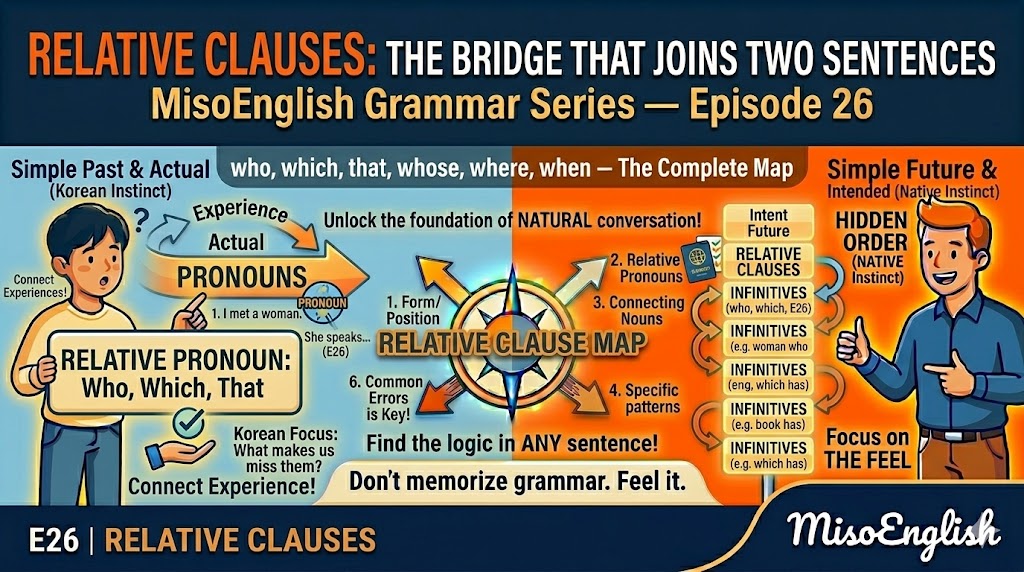
MisoEnglish Grammar Series
Episode 26 — 관계사
두 문장을 하나로 잇는 다리
"문법을 외우지 말고, 느껴라" Don't memorize grammar. Feel it.
🧭 들어가며 | Introduction
두 개의 문장이 있다.
Two sentences exist.
I met a woman. She speaks five languages.
나는 한 여자를 만났다. 그녀는 다섯 개의 언어를 한다.
이 두 문장을 하나로 합치면?
Join them into one?
I met a woman who speaks five languages.
나는 다섯 개의 언어를 하는 여자를 만났다.
who가 두 문장 사이의 다리가 됐다. 이것이 관계사의 핵심이다.
who became the bridge between two sentences. That's the core of relative clauses.
관계사를 잘 쓰면 문장이 길어지고 정밀해진다. 영어 표현의 수준이 한 단계 올라가는 지점이다.
Mastering relative clauses makes sentences longer and more precise. This is the moment your English takes a real step up.
1. 관계대명사의 종류 | Types of Relative Pronouns
관계사는 **선행사(앞의 명사)**의 종류에 따라 달라진다.
The relative pronoun changes depending on the antecedent (the noun before it).
선행사 Antecedent 주격 Subject 목적격 Object 소유격 Possessive
| 사람 Person | who | who(m) | whose |
| 사물·동물 Thing/Animal | which | which | whose / of which |
| 사람·사물 둘 다 | that | that | — |
2. who — 사람을 수식할 때 | Modifying People
주격 who | Subject who
관계사절 안에서 주어 역할을 한다.
Functions as the subject inside the relative clause.
The man who called you is my brother.
너에게 전화한 그 남자는 내 오빠야.
I have a friend who lives in Paris.
나는 파리에 사는 친구가 있다.
She is the teacher who changed my life.
그녀는 내 인생을 바꾼 선생님이다.
목적격 whom / who | Object whom / who
관계사절 안에서 목적어 역할을 한다. 구어에서는 who를, 격식체에서는 whom을 쓴다.
Functions as the object inside the relative clause. Informal: who. Formal: whom.
The person who(m) I met yesterday was very kind.
어제 내가 만난 사람은 매우 친절했다.
The teacher who(m) everyone loves retired last year.
모두가 좋아하는 그 선생님은 작년에 퇴임했다.
3. which — 사물·동물을 수식할 때 | Modifying Things and Animals
The book which I bought last week is fascinating.
내가 지난주에 산 책은 매력적이다.
She lives in a house which was built in 1920.
그녀는 1920년에 지어진 집에 산다.
The dog which bit him was my neighbor's.
그를 문 개는 내 이웃의 개였다.
4. that — 사람·사물 모두 | Both People and Things
that은 who와 which를 대신해서 사람과 사물 모두에 쓸 수 있다. 특히 구어에서 자주 쓰인다.
that can replace both who and which for people and things. Especially common in spoken English.
The man that called you is my brother. (= who)
The book that I bought is fascinating. (= which)
that을 반드시 써야 하는 경우 | When "that" Is Preferred
the only thing that matters 중요한 유일한 것
the first person that arrived 도착한 첫 번째 사람
the best movie that I've ever seen 내가 본 최고의 영화
all the things that I need 내게 필요한 모든 것
something / anything / nothing that ~하는 것
5. whose — 소유격 관계사 | Possessive Relative
whose는 "~의"를 표현하며, 사람과 사물 모두에 쓰인다.
whose expresses "of whom/which" — used for both people and things.
I know a girl whose mother is a famous actress.
나는 어머니가 유명한 여배우인 소녀를 안다.
He lives in a house whose roof was damaged in the storm.
그는 폭풍에 지붕이 손상된 집에 산다.
This is the company whose products I use every day.
이것은 내가 매일 그 제품을 사용하는 회사다.
6. where / when / why — 관계부사 | Relative Adverbs
관계부사는 장소, 시간, 이유를 나타내는 선행사를 수식한다.
Relative adverbs modify antecedents of place, time, or reason.
where — 장소 | Place
This is the city where I was born.
이것이 내가 태어난 도시다.
(= This is the city in which I was born.)
I remember the house where we used to live.
우리가 살았던 그 집이 기억난다.
when — 시간 | Time
I'll never forget the day when we met.
우리가 만난 그날을 절대 잊지 못할 것이다.
(= the day on which we met)
Summer is the season when I feel most alive.
여름은 내가 가장 살아있다고 느끼는 계절이다.
why — 이유 | Reason
That's the reason why I left.
그것이 내가 떠난 이유다.
(= the reason for which I left)
7. 제한적 vs 비제한적 관계사절 | Restrictive vs Non-Restrictive
이 구분이 매우 중요하다.
This distinction is very important.
제한적 관계사절 — 쉼표 없음 | Restrictive — No Comma
선행사를 특정하는 데 꼭 필요한 정보. 없으면 문장 의미가 달라진다.
Information essential to identify the antecedent. Without it, the sentence means something different.
The students who study hard will pass.
열심히 공부하는 학생들이 합격할 것이다.
(모든 학생이 아니라 열심히 하는 학생들)
비제한적 관계사절 — 쉼표 있음 | Non-Restrictive — With Comma
선행사에 대한 추가 정보. 없어도 의미가 달라지지 않는다. that은 비제한적 용법에 쓸 수 없다.
Additional, non-essential information. The sentence still makes sense without it. *"that" cannot be used in non-restrictive clauses.
My sister, who lives in London, is a doctor.
나의 언니는, 런던에 사는데, 의사다.
(언니가 한 명임을 전제. 런던에 산다는 건 추가 정보)
비교:
The book which I lost was very expensive.
내가 잃어버린 책은 매우 비쌌다.
(어느 책인지 특정 — 제한적)
This book, which I found in a used bookstore, is fascinating.
이 책은, 중고 서점에서 찾았는데, 매력적이다.
(추가 정보 — 비제한적)
8. 관계대명사 생략 | Omitting Relative Pronouns
목적격 관계대명사(who(m), which, that)는 생략 가능하다. 주격 관계대명사는 생략할 수 없다.
Object relative pronouns can be omitted. Subject relative pronouns cannot be omitted.
The book (that) I bought is on the table.✅ (목적격 — 생략 가능)
The man who called you is here. ❌ (주격 — 생략 불가)
The woman (whom) I met yesterday was very kind. ✅
She is the teacher who changed my life. ← who 생략 불가 ❌
📌 이번 편 요약 | Episode Summary
- who — 사람 / 주격·목적격 / whom은 격식체 who — people / subject and object / whom is formal.
- which — 사물·동물 / 주격·목적격 which — things and animals / subject and object.
- that — 사람·사물 모두 / only, first, best, all 뒤에 선호 that — people and things / preferred after only, first, best, all.
- whose — 소유격 / 사람·사물 모두 whose — possessive / people and things.
- where/when/why — 장소·시간·이유의 선행사 where/when/why — place, time, reason antecedents.
- 제한적(쉼표 없음) vs 비제한적(쉼표 있음) — that은 비제한적 불가 Restrictive (no comma) vs non-restrictive (comma) — that can't be non-restrictive.
- 목적격 관계대명사는 생략 가능 — 주격은 불가 Object relative pronouns can be omitted — subject ones cannot.
🔜 다음 편 예고 | Coming Up Next
Episode 27 — 접속사 : 문장과 문장을 연결하는 법 Conjunctions: How to Connect Sentences and Ideas
and, but, or, so, because, although, when, if
— 이 단어들이 문장과 문장을, 아이디어와 아이디어를 연결한다.
등위접속사와 종속접속사, 그 차이와 쓰임을 완전히 정리한다.and, but, or, so, because, although, when, if
— these words connect sentences and ideas.
Coordinating vs subordinating conjunctions — all mapped out.
© MisoEnglish Grammar Series | Level 4 — Episode 26 "문법을 외우지 말고, 느껴라" | "Don't memorize grammar. Feel it."
Relative Clauses: The Bridge That Joins Two Sentences
who, which, that, whose, where, when — The Complete Map
MisoEnglish Grammar Series — Episode 26
"Don't memorize grammar. Feel it."
Introduction
Every relative clause starts with the same need: two sentences that share a noun.
I met a woman.
She speaks five languages.
Join them with a relative pronoun, and one sentence does the work of two:
I met a woman who speaks five languages.
"Who" is the bridge. It replaces "she," connects the two thoughts, and adds precision — all at once. This is what relative clauses do. And once you feel how they work, your sentences become longer, richer, and more exact.
1. The Relative Pronouns
Antecedent Subject Object Possessive
| Person | who | who(m) | whose |
| Thing / Animal | which | which | whose / of which |
| Either | that | that | — |
2. who — For People
Subject:
The man who called you is my brother.
I have a friend who lives in Paris.
She is the teacher who changed my life.
Object (whom in formal, who in informal):
The person who(m) I met yesterday was very kind.
The teacher who(m) everyone loves retired last year.
3. which — For Things and Animals
The book which I bought last week is fascinating.
She lives in a house which was built in 1920.
The dog which bit him was my neighbor's.
4. that — For People and Things
"That" can replace both "who" and "which."
The man that called you is my brother. (= who)
The book that I bought is fascinating. (= which)
Prefer "that" after:
the only thing that matters the first person that arrived the best movie that I've ever seen all the things that I need something / anything / nothing that
5. whose — Possessive
"Whose" expresses "of whom/which" — works for both people and things.
I know a girl whose mother is a famous actress.
He lives in a house whose roof was damaged in the storm.
This is the company whose products I use every day.
6. where / when / why — Relative Adverbs
where — place:
This is the city where I was born. (= in which)
I remember the house where we used to live.
when — time:
I'll never forget the day when we met. (= on which)
Summer is the season when I feel most alive.
why — reason:
That's the reason why I left. (= for which)
7. Restrictive vs. Non-Restrictive
Restrictive — no comma: Essential information. Without it, the meaning changes.
The students who study hard will pass.
(Not all students — only the ones who study hard.)
Non-Restrictive — with comma: Additional information. The sentence makes sense without it. "that" cannot be used here.
My sister, who lives in London, is a doctor.
(I have one sister. The London detail is extra.)
The difference in meaning:
The book which I lost was expensive.
(Identifying which book — restrictive)
This book, which I found in a used bookstore, is fascinating.
(Adding extra info — non-restrictive)
8. Omitting Relative Pronouns
Object relative pronouns (who(m), which, that) can be omitted. Subject relative pronouns cannot.
The book (that) I bought is on the table. ✅ (object — omissible)
The man who called you is here. (subject — cannot omit)
The woman (whom) I met yesterday was very kind. ✅
She is the teacher who changed my life. (cannot drop "who")
Episode Summary
- who — people / subject and object / whom is formal.
- which — things and animals / subject and object.
- that — people and things / preferred after only, first, best, all.
- whose — possessive / people and things.
- where/when/why — place, time, reason antecedents.
- Restrictive vs non-restrictive — comma marks non-essential info.
- Object pronouns can be omitted — subject pronouns cannot.
Coming Up Next
Episode 27 — Conjunctions: How to Connect Sentences and Ideas
and, but, or, so, because, although, when, if — coordinating and subordinating conjunctions, mapped out completely. The tools that turn simple sentences into complex ones.
© MisoEnglish Grammar Series | Level 4 — Episode 26 "Don't memorize grammar. Feel it."
⚠️ 저작권 안내
본 블로그(MisoEnglish · slowblooms.tistory.com)의 모든 콘텐츠는 저작권법의 보호를 받습니다. 글, 예시 문장, 분석 내용 등 블로그에 게시된 모든 창작물은 저작자의 동의 없이 무단으로 복사, 복제, 배포, 2차 가공하는 행위를 금지합니다. 출처를 밝히지 않은 전재, SNS·커뮤니티·타 블로그 등에의 무단 게시, 상업적 이용은 모두 금지되며, 무단 불펌 적발 시 저작권법에 따라 법적 조치가 취해질 수 있습니다. 콘텐츠 사용 문의는 slowblooms.tistory.com으로 연락 주세요.
© MisoEnglish · slowblooms.tistory.com. All rights reserved.
━━━━━━━━━━━━━━━━━━━━━━━━━━━━━━━━
⚠️ Copyright Notice
All content published on this blog (MisoEnglish · slowblooms.tistory.com) is protected by copyright law. Copying, reproducing, distributing, or adapting any written posts, example sentences, or analyses without the explicit consent of the author is strictly prohibited. Unauthorised reposting on other blogs, social media, online communities, or any public platform — with or without modification — is not permitted, and may result in legal action under applicable copyright law. For content licensing enquiries, please contact us via slowblooms.tistory.com.
© MisoEnglish · slowblooms.tistory.com. All rights reserved.
'English Mechanism' 카테고리의 다른 글
| Episode 28 — 가정법: 현실이 아닌 세계를 말하는 법 (0) | 2026.03.02 |
|---|---|
| Episode 27 — 접속사: 문장과 문장을 연결하는 법 (0) | 2026.03.02 |
| Episode 25 — 동명사: 동사를 명사로 만드는 또 다른 방법 (0) | 2026.03.01 |
| Episode 24 — to부정사: 동사를 명사·형용사·부사로 만드는 법 (0) | 2026.03.01 |
| Episode 23 — 수동태: 당하는 입장에서 말할 때 (0) | 2026.03.01 |


