
- 분류 전체보기 (1238)

- Linguistics (고급 영어학) (10)
- Stylistics (6)
- Etymology & Word Building (15)
- Philosophy Meets Grammar (6)
- Collection of Famous Quotes (23)
- TOEIC & TOEFL English (0)
- English Mechanism (344)
- The Language Beyond Grammar (86)
- Living English (211)
- Video Clip (16)
- Miso’s Life Notes (30)
- My English Journey and Refl.. (8)
- Philosophy (258)
- Philosophy of Language (12)
- Ethics (8)
- Epistemology (7)
- Metaphysics (7)
- Philosophy of Mind (8)
- Philosophy of Religion (8)
- Christian Philosophy (44)
- Political Philosophy (11)
- Philosophy of Science (8)
- Eastern Philosophy (56)
- Comparative Philosophy (6)
- Ancient Philosophy (26)
- Contemporary Philosophy (56)
- World History & Culture (41)
- Airline English (항공 영어) (47)
- AI & Digital Life (21)
- Books & Insights (79)
- Creative Corner (35)
- Sally & Sia (1)
| 일 | 월 | 화 | 수 | 목 | 금 | 토 |
|---|---|---|---|---|---|---|
| 1 | 2 | |||||
| 3 | 4 | 5 | 6 | 7 | 8 | 9 |
| 10 | 11 | 12 | 13 | 14 | 15 | 16 |
| 17 | 18 | 19 | 20 | 21 | 22 | 23 |
| 24 | 25 | 26 | 27 | 28 | 29 | 30 |
| 31 |
- 영문법
- MisoEnglish#철학입문 #Philosophy #과학철학 #PhilosophyOfScience #철학공부 #포퓨퍼 #쿠hn #과학방법론 #교육콘텐츠 #철학시리즈
- AirlineOpsEnglish
- Basic English Verbs
- 감성영어
- English Speaking Practice
- English in English
- ticketing
- everyday English
- 영어회화
- MisoEnglish#불교철학 #BuddhismPhilosophy #사성제 #FourNobleTruths #공사상 #Emptiness #명상 #Mindfulness #열반 #EasternWisdom
- MisoEnglish#철학입문 #Philosophy #정치철학 #PoliticalPhilosophy #철학공부 #정의론 #자유주의 #PhilosophyForBeginners #교육콘텐츠 #철학시리즈
- English for Korean Learners
- pnr
- MisoEnglish#유교철학 #Confucianism #성리학 #NeoConfucianism #인의예지 #Virtue #맹자 #Mencius #실학 #KoreanScholarship
- 🌿 English with Heart
- MisoEnglish#도교철학 #Taoism #도덕경 #TaoTeChing #무위자연 #WuWei #노자 #Laozi #장자 #YinYang
- 인도철학 #동양철학 #인문학 #요가 #명상 #힌두교 #불교 #간디 #타고르 #정통6파 #철학공부 #마음공부 #MisoEnglish #인문학영어
- MisoEnglish#한국철학 #KoreanPhilosophy #홍익인간 #Hongik #화랑도 #Hwarang #단군 #Dangun #풍류도 #ThreeKingdoms#동양철학
- MisoEnglish#철학입문 #Philosophy #심리철학 #PhilosophyOfMind #철학공부 #의식 #마음 #PhilosophyForBeginners #교육콘텐츠 #철학시리즈
- MisoEnglish#철학입문 #Philosophy #종교철학 #PhilosophyOfReligion #철학공부 #신존재증명 #악의문제 #PhilosophyForBeginners #교육콘텐츠 #철학시리즈
- 영어문법
- EnglishWriting #AcademicWriting #Grammar #EnglishLanguage #EssayWriting #ParagraphStructure #SentenceStructure #BusinessEnglish #EnglishTips #WritingSkills #Linguistics #ESL
- MisoEnglish#철학입문 #Philosophy #윤리학 #Ethics #도덕철학 #철학공부 #칸트 #공리주의 #교육콘텐츠 #철학시리즈
- 동양정치철학 #시리즈완결 #아시아적가치 #동서양비교 #유교 #민주주의 #정치사상 #인문학 #비교철학 #글로벌정치 #문화다양성 #2500년철학사
- 영국사 #영국역사 #세계사 #역사연재 #브리튼에서영국까지
- MisoEnglish#철학입문 #Philosophy #형이상학 #Metaphysics #철학공부 #존재론 #실재론 #PhilosophyForBeginners #교육콘텐츠 #철학시리즈
- 영어접속사
- 영어공부
- misoenglish
- Today
- Total
MisoEnglish
오피니언 에세이 처음부터 끝까지 쓰기 : 논제에서 결론까지 단계별 가이드 본문
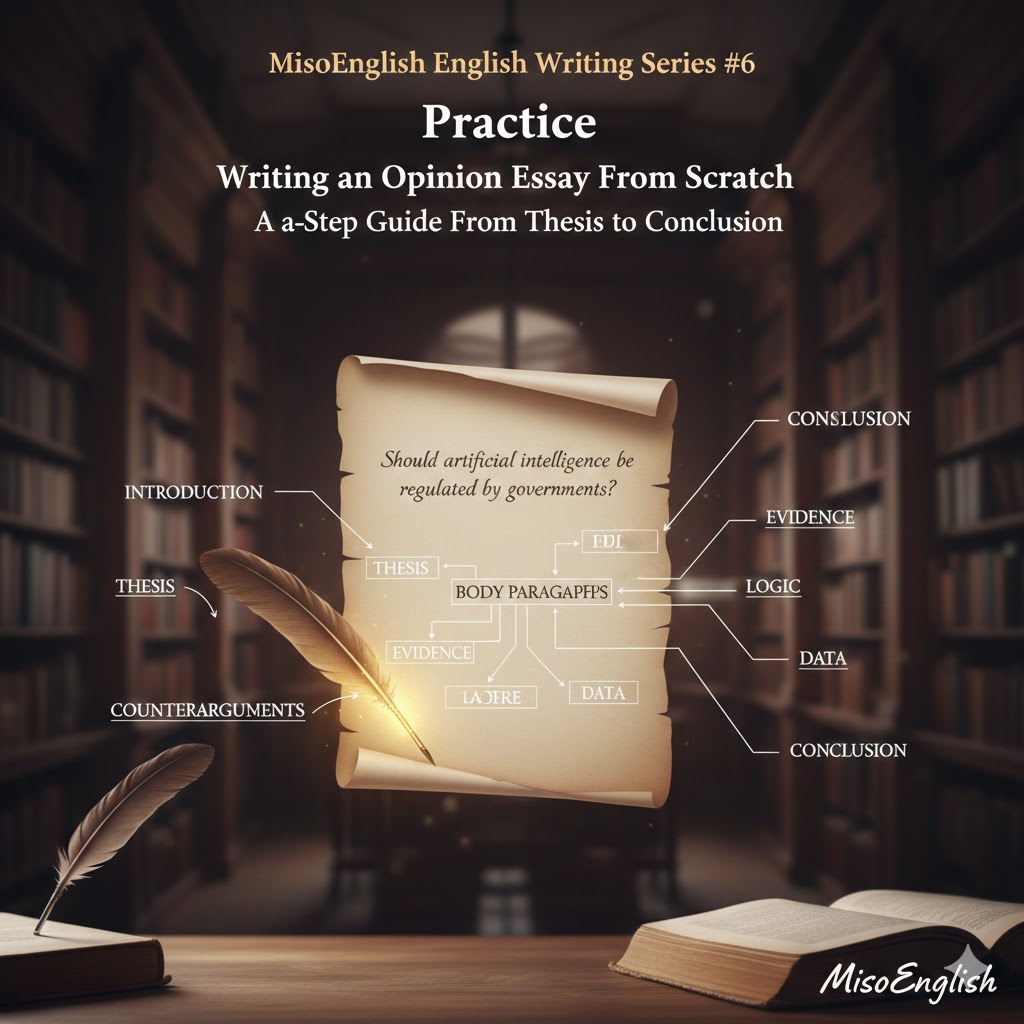
[MisoEnglish 영어 글쓰기 시리즈 #6 — 실전]
오피니언 에세이 처음부터 끝까지 쓰기 : -----논제에서 결론까지 단계별 가이드
안녕하세요, MisoEnglish입니다. 지난 편에서 우리는 논증의 구조를 살펴봤습니다. 논제를 어떻게 세우는지, 근거를 어떻게 사용하는지, 반론을 어떻게 다루는지를요. 이제 그 원칙들을 실전에 투입할 시간이에요 — 완전한 오피니언 에세이를 처음부터 끝까지, 단계별로 써볼 거예요.
이번 편은 워크숍이에요. 모든 결정을 눈에 보이게 만들 것입니다 — 에세이가 무엇을 말하는지만이 아니라, 각 선택이 왜 이루어졌는지를 보여드릴게요. 마지막에는 영어의 모든 에세이 주제에 적용할 수 있는 완전한 모델을 갖추게 될 거예요.
주제: 정부가 인공지능을 규제해야 하는가? 이 주제는 진정으로 논쟁적이고, 광범위하게 관련 있으며, 근거가 풍부합니다 — 논증적 글쓰기의 원칙을 보여주기에 이상적이에요.
- 1단계: 쓰기 전에 입장을 결정하라
에세이 쓰기에서 가장 흔한 실수는 명확한 입장 없이 시작하는 거예요. 필자들이 주제에 대한 막연한 감각으로 시작해서, 견해를 향해 써나가다가, 여러 방향으로 논증하는 에세이로 끝나버립니다.
단 하나의 문장도 쓰기 전에, 이 질문에 답하세요: 나는 실제로 무엇을 생각하는가?
우리 주제에 대해, 세 가지 광범위한 입장이 가능해요. A. AI는 규제되어야 한다 — 위험이 너무 커서 시장 힘에만 맡길 수 없다. B. AI는 규제되어서는 안 된다 — 규제는 혁신을 억누르고 정부는 효과적으로 규제할 전문성이 없다. C. AI는 규제되어야 한다 — 하지만 전반적으로가 아닌 특정 고위험 영역에서만.
입장 C가 가장 미묘하며 — 종종 가장 방어 가능합니다. 양측의 정당한 우려를 인정하고 구체적이고 실용적인 답을 제시해요. 우리는 입장 C를 논증할 거예요.
- 2단계: 논제 쓰기
입장이 결정됐으니, 논제를 씁니다.
첫 번째 시도: "AI should be regulated, but only in high-risk areas."
이것은 시작이지만 — 너무 모호해요. 무엇이 "고위험"인가? 왜 그 영역에서만? 규제는 어떤 모습이어야 하는가?
수정된 논제: "Governments should regulate artificial intelligence in domains where algorithmic decisions directly affect human welfare — healthcare, criminal justice, and financial services — while allowing broader innovation to proceed with lighter oversight."
이 논제는 구체적이고, 논증 가능하며, 에세이의 구조를 명확하게 설정합니다. 독자는 즉각적으로 무엇이 논증될 것인지, 어떤 종류의 근거와 예시가 따를 것인지를 알게 돼요.
- 3단계: 구조 계획하기
논제가 쓰여졌으니, 에세이의 구조를 계획합니다. 진정으로 논쟁적인 주제에 대해 가장 설득력 있는 결과를 내기 때문에, 양보 먼저 모델을 사용할 거예요 — 우리의 주장을 펼치기 전에 규제에 반대하는 가장 강한 논증을 인정하면서요.
계획된 구조: · 서론: 무엇이 걸려 있는지 확립; 논제 진술 · 양보: 규제에 반대하는 가장 강한 논증 인정 · 요점 1: 고위험 영역에서의 규제 주장 (의료) · 요점 2: 고위험 영역에서의 규제 주장 (형사 사법) · 요점 3: 고위험 영역에서의 규제 주장 (금융 서비스) · 반론과 반박: 왜 전면적 규제가 답이 아닌가 · 결론: 의미와 함의
세 가지 일반적인 논증이 아닌 — 각 영역당 하나씩 — 세 가지 본문 요점을 갖고 있다는 것을 알아채세요. 이것이 각 단락에 구체적인 예시를 제공하며, 추상적 추론만보다 더 설득력 있어요.
- 4단계: 서론 쓰기
서론은 무엇이 걸려 있는지를 확립하고, 필요한 맥락을 제공하며, 논제로 끝나야 합니다.
초안 서론: "Artificial intelligence is advancing faster than the institutions designed to govern it. In the past five years alone, AI systems have been used to diagnose cancer, determine bail conditions, approve or reject loan applications, and generate content indistinguishable from human writing. Each of these applications raises profound questions about accountability, fairness, and the distribution of power. Yet the debate about how — or whether — to regulate AI remains largely unresolved. Critics of regulation warn that heavy-handed government intervention will stifle innovation and cede competitive advantage to less regulated rivals. Proponents argue that the risks of inaction are too great. Both sides are partly right. Governments should regulate artificial intelligence in domains where algorithmic decisions directly affect human welfare — healthcare, criminal justice, and financial services — while allowing broader innovation to proceed with lighter oversight."
(인공지능은 그것을 거버넌스하기 위해 설계된 기관들보다 빠르게 발전하고 있다. 지난 5년만 보더라도, AI 시스템은 암을 진단하고, 보석 조건을 결정하고, 대출 신청을 승인하거나 거부하고, 인간의 글과 구분할 수 없는 콘텐츠를 생성하는 데 사용됐다. 이러한 각각의 응용은 책임, 공정성, 권력의 분배에 대한 심오한 질문을 제기한다. 하지만 AI를 어떻게 — 또는 규제할지 여부에 관한 논쟁은 대체로 해결되지 않은 채로 있다. 규제 비판자들은 강경한 정부 개입이 혁신을 억누르고 덜 규제된 경쟁자들에게 경쟁 우위를 넘겨줄 것이라고 경고한다. 지지자들은 무행동의 위험이 너무 크다고 주장한다. 양측 모두 부분적으로 옳다. 정부는 알고리즘 결정이 인간의 복지에 직접 영향을 미치는 영역 — 의료, 형사 사법, 금융 서비스 — 에서 인공지능을 규제해야 하며, 더 광범위한 혁신은 가벼운 감독으로 진행되도록 허용해야 한다.)
왜 이것이 작동하는가: · 첫 문장은 과장 없이 긴박감을 확립합니다 · 두 번째 문장은 문제를 실감 나게 만드는 구체적인 예시를 제공해요 · 세 번째 문장은 무엇이 걸려 있는지를 진술합니다 · 네 번째 문장은 논쟁을 프레이밍해요 · 다섯 번째와 여섯 번째 문장은 양측을 간략하게 제시합니다 — 양보 먼저 구조를 설정하면서 · 마지막 문장이 논제입니다 — 구체적이고, 입장을 가지며, 논증 가능한
- 5단계: 양보 쓰기
우리의 입장에 반대하는 가장 강한 논증으로 본문을 시작합니다. 이것은 지적 정직함을 보여주고 주장을 펼치기 전에 신뢰성을 높여요.
초안 양보 단락: "The case against regulation is not trivial. Governments have a poor track record of regulating technologies they do not fully understand, and artificial intelligence is arguably the most complex technology ever deployed at scale. Premature or poorly designed regulation risks locking in the assumptions of today's limited understanding, creating compliance burdens that favour large incumbents over nimble start-ups, and slowing the development of AI applications that could genuinely improve lives. The European Union's AI Act, ambitious as it is, has already been criticised by researchers and technologists for its blunt categorisation of risk, which may inadvertently restrict beneficial uses of AI while doing little to address the most serious dangers."
(규제에 반대하는 주장은 사소하지 않다. 정부들은 완전히 이해하지 못하는 기술을 규제하는 데 좋지 않은 실적을 갖고 있으며, 인공지능은 틀림없이 지금까지 대규모로 배포된 가장 복잡한 기술이다. 성급하거나 잘못 설계된 규제는 오늘날의 제한된 이해의 가정들을 고착화하고, 민첩한 스타트업보다 대형 기존 업체들에게 유리한 규정 준수 부담을 만들며, 진정으로 삶을 개선할 수 있는 AI 응용의 개발을 늦출 위험이 있다. 야심찬 유럽연합의 AI법은 이미 연구자들과 기술자들로부터 위험의 둔한 분류로 비판받고 있으며, 이는 가장 심각한 위험을 거의 다루지 않으면서 AI의 유익한 사용을 의도치 않게 제한할 수 있다.)
왜 이것이 작동하는가: · 가장 강한 형태로 반론을 진술합니다 — 풍자가 아닌 · 구체적인 예시(EU AI법)를 사용해 이의 제기에 구체적인 근거를 제공해요 · 주요 요점을 양보하지 않습니다 — 어려움을 인정하며 반박을 설정해요
- 6단계: 본문 단락 쓰기
각 본문 단락은 3편에서 세운 구조를 따릅니다: 주제문 → 본문(근거 + 설명 + 예시) → 마무리 움직임.
본문 단락 1: 의료
"In healthcare, the case for targeted regulation is strongest. AI diagnostic tools are already being used to screen for cancer, predict patient deterioration, and recommend treatment pathways — decisions that carry life-or-death consequences. Yet a 2021 study published in The Lancet found that the majority of AI medical devices approved in the United States had been validated on datasets that were not representative of the patients who would ultimately use them, raising serious concerns about bias and accuracy. When an algorithm makes a wrong call in a low-stakes commercial application, the consequence is inconvenience. When it does so in a clinical setting, the consequence may be a missed diagnosis, a delayed treatment, or a death. The principle should be proportionality: the degree of regulatory oversight should match the severity of potential harm."
(의료에서, 표적 규제를 위한 주장이 가장 강하다. AI 진단 도구는 이미 암 검진, 환자 악화 예측, 치료 경로 추천에 사용되고 있습니다 — 생사가 걸린 결과를 수반하는 결정들. 하지만 The Lancet에 발표된 2021년 연구는 미국에서 승인된 AI 의료 기기의 대다수가 궁극적으로 그것들을 사용할 환자들을 대표하지 않는 데이터셋에서 검증됐다는 것을 발견했으며, 편향과 정확성에 대한 심각한 우려를 제기했다. 알고리즘이 저위험 상업 응용에서 잘못된 판단을 내릴 때, 결과는 불편함이다. 임상 환경에서 그렇게 할 때, 결과는 놓친 진단, 지연된 치료, 또는 사망일 수 있다. 원칙은 비례성이어야 한다: 규제 감독의 정도는 잠재적 피해의 심각성과 일치해야 한다.)
본문 단락 2: 형사 사법
"The argument for regulation is equally compelling in criminal justice. Predictive policing tools and algorithmic risk-assessment instruments — used in several US states to inform bail and sentencing decisions — have been found to exhibit significant racial bias. A landmark 2016 investigation by ProPublica found that one widely used risk-assessment tool was nearly twice as likely to falsely flag Black defendants as future criminals compared with white defendants. Decisions about liberty should not be delegated to systems whose outputs cannot be fully explained, scrutinised, or appealed. Requiring transparency, auditability, and human oversight in this domain is not an obstacle to innovation — it is a basic condition of justice."
(형사 사법에서도 규제를 위한 논증은 동등하게 설득력이 있다. 예측적 치안 도구와 알고리즘 위험 평가 도구 — 보석 및 선고 결정을 알리는 데 미국 여러 주에서 사용되는 — 는 심각한 인종 편향을 보이는 것으로 밝혀졌다. ProPublica의 2016년 획기적인 조사는 널리 사용되는 한 위험 평가 도구가 백인 피고인과 비교해 흑인 피고인을 미래 범죄자로 잘못 표시할 가능성이 거의 두 배임을 발견했다. 자유에 관한 결정은 출력이 완전히 설명되거나, 조사되거나, 항소될 수 없는 시스템에 위임되어서는 안 된다. 이 영역에서 투명성, 감사 가능성, 인간 감독을 요구하는 것은 혁신의 장애물이 아닙니다 — 그것은 정의의 기본 조건이에요.)
본문 단락 3: 금융 서비스
"Financial services present a third domain where the case for oversight is clear. AI systems now make or influence decisions about credit, insurance, and investment at enormous scale and speed. The 2010 Flash Crash — in which algorithmic trading caused the Dow Jones to lose nearly 1,000 points in minutes before recovering — demonstrated the systemic risks of automated financial decision-making operating without adequate safeguards. More recently, concerns have been raised about AI-driven credit scoring systems that may discriminate against protected groups without their operators being aware of or able to explain why. Financial regulators already impose significant requirements on human decision-makers in these domains; there is no principled reason why algorithmic ones should be exempt."
(금융 서비스는 감독을 위한 주장이 명확한 세 번째 영역을 제시한다. AI 시스템은 이제 엄청난 규모와 속도로 신용, 보험, 투자에 관한 결정을 내리거나 영향을 미친다. 2010년 플래시 크래시 — 알고리즘 거래가 회복 전 수 분 만에 다우 존스가 거의 1,000 포인트 하락하게 만든 — 는 적절한 안전장치 없이 작동하는 자동화된 금융 의사 결정의 시스템적 위험을 보여줬다. 더 최근에는, 운영자들이 왜인지를 알거나 설명할 수 없는 채로 보호 집단에 차별할 수 있는 AI 주도 신용 점수 시스템에 대한 우려가 제기됐다. 금융 규제 당국은 이미 이 영역에서 인간 의사 결정자들에게 상당한 요건을 부과하고 있습니다; 알고리즘 결정자들이 면제되어야 할 원칙적 이유가 없어요.)
왜 이 단락들이 작동하는가: · 각각은 논제와 연결되는 명확한 주제문으로 열립니다 · 각각은 근거 샌드위치를 사용합니다: 소개 → 제시 → 설명 · 각각은 의미를 진술하고 더 큰 논증과 연결되는 마무리 움직임으로 끝납니다 · 각각은 모호한 일반화 대신 구체적이고 이름 있는 예시를 사용해요
- 7단계: 전면적 규제에 대한 반박
표적 규제를 위한 주장을 했으니, 양보에서 제기된 우려를 다룹니다 — 규제가 전반적으로 적용되어서는 안 된다는.
초안 반박 단락: "None of this requires — or justifies — blanket regulation of all AI applications. A risk-based approach, which calibrates oversight to the severity and reversibility of potential harm, avoids the worst pitfalls of the anti-regulation argument. A start-up building a better recipe recommendation algorithm does not need the same compliance infrastructure as a company deploying AI to assess mortgage applications. Proportionality is not a compromise — it is the correct analytical framework. The question is not whether to regulate, but where, and how much. In high-risk domains, the answer is clear. In lower-stakes applications, innovation should be encouraged to proceed, with the expectation that regulatory frameworks will evolve as our understanding of risk matures."
(이것 중 어느 것도 모든 AI 응용의 전면적인 규제를 요구하거나 정당화하지 않는다. 잠재적 피해의 심각성과 가역성에 따라 감독을 조정하는 위험 기반 접근 방식은 반규제 논증의 최악의 함정을 피한다. 더 나은 레시피 추천 알고리즘을 만드는 스타트업은 모기지 신청을 평가하기 위해 AI를 배포하는 회사와 같은 규정 준수 인프라가 필요하지 않다. 비례성은 타협이 아닙니다 — 그것은 올바른 분석 프레임워크예요. 질문은 규제할지 여부가 아니라, 어디서, 얼마나. 고위험 영역에서, 답은 명확하다. 저위험 응용에서, 위험에 대한 이해가 성숙해짐에 따라 규제 프레임워크가 발전할 것이라는 기대와 함께 혁신이 진행되도록 장려되어야 한다.)
- 8단계: 결론 쓰기
결론은 요약하지 않습니다. 논증의 의미를 성찰하고 더 넓은 함의를 향해 나아가요.
초안 결론: "The debate about AI regulation is, at its core, a debate about accountability — about who bears responsibility when automated systems cause harm, and how that responsibility can be enforced. The answer cannot be 'no one,' and it cannot be 'the algorithm.' It must be the humans and institutions that design, deploy, and profit from these systems. Targeted regulation in high-risk domains is not a constraint on technological progress. It is a condition for technological progress that can be trusted. An AI-driven future that is both innovative and accountable is possible — but only if the institutions responsible for governing it act before the harms become irreversible."
(AI 규제에 관한 논쟁은 그 핵심에서, 책임에 관한 논쟁입니다 — 자동화된 시스템이 피해를 야기할 때 누가 책임을 지는가, 그리고 그 책임이 어떻게 집행될 수 있는가에 관한. 답은 "아무도 아닌"이 될 수 없고, "알고리즘"이 될 수도 없습니다. 그것은 이 시스템들을 설계하고, 배포하고, 이익을 얻는 인간과 기관이어야 합니다. 고위험 영역에서의 표적 규제는 기술적 발전에 대한 제약이 아니에요. 그것은 신뢰받을 수 있는 기술적 발전을 위한 조건입니다. 혁신적이면서 책임 있는 AI 주도 미래는 가능합니다 — 하지만 오직 그것을 거버넌스하는 책임이 있는 기관들이 피해가 돌이킬 수 없어지기 전에 행동한다면요.)
왜 이것이 작동하는가: · 더 높은 수준의 추상에서 전체 논증을 재프레이밍합니다 — 책임 · 논제를 그대로 반복하지 않습니다 — 심화시켜요 · 수사 없이 긴박감을 만드는 조건문으로 끝납니다 · 요약이 아닌 도착처럼 느껴져요
- 고급 영어 학습자가 가져갈 것들
· 쓰기 전에 입장을 결정하세요. 목적의 명확성이 산문의 명확성을 만들어냅니다. · 논쟁적 주제에는 양보 먼저 구조를 사용하세요. 반대 논증을 인정하는 것은 약함이 아닌 강함의 표시예요. · 각 본문 단락에 하나의 역할을 주세요. 두 가지를 하려는 단락은 어느 것도 잘 하지 못해요. · 모든 본문 단락에서 근거 샌드위치를 사용하세요. 근거를 소개하고, 제시하고, 의미를 설명하세요. · 결론에서 요약하지 마세요 — 어딘가에 도착하세요. 결론은 논증이 완전한 의미를 얻는 곳이에요. · 제출 전에 처음부터 끝까지 에세이를 소리 내어 읽으세요. 눈이 놓치는 약점을 귀가 들을 거예요.
다음 편 예고
다음 편에서는 학술적 글쓰기로 넘어갑니다 — 영어 산문의 가장 격식 있는 레지스터예요. 학술적 문체의 특정 관례들을 살펴볼 거예요: 분석적 힘을 잃지 않고 어떻게 객관적으로 쓰는지, 인용을 어떻게 효과적으로 사용하는지, 정밀성을 잃지 않고 주장을 어떻게 헷지하는지, 단순히 올바른 학술적 글쓰기와 진정으로 탁월한 학술적 글쓰기를 무엇이 구분하는지를요.
참고 문헌 (References)
· Graff, G. & Birkenstein, C. (2018). They Say / I Say. W.W. Norton. · Toulmin, S. (2003). The Uses of Argument. Cambridge University Press. · Williams, J.M. & Bizup, J. (2017). Style: Lessons in Clarity and Grace. Pearson.
출처: MisoEnglish · slowblooms.tistory.com
[MisoEnglish English Writing Series #6 — Practice]
Writing an Opinion Essay From Scratch :
-----A Step-by-Step Guide From Thesis to Conclusion
Hello, this is MisoEnglish. In our last post, we examined the architecture of argument: how to build a thesis, how to use evidence, and how to handle counterarguments. Now we put those principles into practice — writing a complete opinion essay, step by step, from the first decision to the final sentence.
This post is a workshop. We will make every decision visible — showing not just what the essay says, but why each choice was made. By the end, you will have a complete model you can apply to any essay topic in English.
The topic: Should artificial intelligence be regulated by governments? This topic is genuinely contested, widely relevant, and rich in evidence — which makes it ideal for demonstrating the principles of argumentative writing.
- Step One: Decide Your Position Before You Write
The most common mistake in essay writing is beginning without a clear position. Writers start with a vague sense of the topic, write their way toward a view, and end up with an essay that argues in several directions at once.
Before writing a single sentence, answer this question: what do I actually think?
For our topic, three broad positions are possible: A. AI should be regulated — the risks are too great to leave to market forces alone. B. AI should not be regulated — regulation stifles innovation and governments lack the expertise to regulate effectively. C. AI should be regulated — but only in specific, high-risk domains, not across the board.
Position C is the most nuanced — and often the most defensible. It acknowledges the legitimate concerns on both sides and offers a specific, practical answer. We will argue Position C.
- Step Two: Write the Thesis
With our position decided, we write the thesis.
First attempt: "AI should be regulated, but only in high-risk areas."
This is a start — but it is too vague. What counts as "high-risk"? Why only those areas? What should regulation look like?
Revised thesis: "Governments should regulate artificial intelligence in domains where algorithmic decisions directly affect human welfare — healthcare, criminal justice, and financial services — while allowing broader innovation to proceed with lighter oversight."
This thesis is specific, arguable, and sets up the essay's structure clearly. The reader knows immediately what will be argued and what kinds of evidence and examples will follow.
- Step Three: Plan the Structure
With the thesis written, we plan the essay's structure. We will use the concession-first model — acknowledging the strongest argument against regulation before presenting our case — because it produces the most persuasive result for a genuinely contested topic.
Planned structure: · Introduction: establish what is at stake; state the thesis · Concession: acknowledge the strongest argument against regulation · Point 1: the case for regulation in high-risk domains (healthcare) · Point 2: the case for regulation in high-risk domains (criminal justice) · Point 3: the case for regulation in high-risk domains (financial services) · Counterargument and rebuttal: why blanket regulation is not the answer · Conclusion: significance and implications
Notice that we have three body points — one for each domain — rather than three general arguments. This gives the essay concrete examples in each paragraph, which is more persuasive than abstract reasoning alone.
- Step Four: Write the Introduction
The introduction must establish what is at stake, provide necessary context, and end with the thesis.
Draft introduction: "Artificial intelligence is advancing faster than the institutions designed to govern it. In the past five years alone, AI systems have been used to diagnose cancer, determine bail conditions, approve or reject loan applications, and generate content indistinguishable from human writing. Each of these applications raises profound questions about accountability, fairness, and the distribution of power. Yet the debate about how — or whether — to regulate AI remains largely unresolved. Critics of regulation warn that heavy-handed government intervention will stifle innovation and cede competitive advantage to less regulated rivals. Proponents argue that the risks of inaction are too great. Both sides are partly right. Governments should regulate artificial intelligence in domains where algorithmic decisions directly affect human welfare — healthcare, criminal justice, and financial services — while allowing broader innovation to proceed with lighter oversight."
Why this works: · The first sentence establishes urgency without exaggeration · The second sentence provides concrete examples that make the issue real · The third sentence states what is at stake (accountability, fairness, power) · The fourth sentence frames the debate · The fifth and sixth sentences present both sides briefly — setting up the concession-first structure · The final sentence is the thesis — specific, positioned, and arguable
- Step Five: Write the Concession
We begin the body with the strongest argument against our position. This demonstrates intellectual honesty and strengthens our credibility before we make our case.
Draft concession paragraph: "The case against regulation is not trivial. Governments have a poor track record of regulating technologies they do not fully understand, and artificial intelligence is arguably the most complex technology ever deployed at scale. Premature or poorly designed regulation risks locking in the assumptions of today's limited understanding, creating compliance burdens that favour large incumbents over nimble start-ups, and slowing the development of AI applications that could genuinely improve lives. The European Union's AI Act, ambitious as it is, has already been criticised by researchers and technologists for its blunt categorisation of risk, which may inadvertently restrict beneficial uses of AI while doing little to address the most serious dangers."
Why this works: · It states the counterargument in its strongest form — not a caricature · It uses a specific example (the EU AI Act) to give the objection concrete grounding · It does not concede the main point — it acknowledges the difficulty, setting up the rebuttal
- Step Six: Write the Body Paragraphs
Each body paragraph follows the structure we established in Post #3: topic sentence → body (evidence + explanation + example) → closing move.
Body paragraph 1: Healthcare
"In healthcare, the case for targeted regulation is strongest. AI diagnostic tools are already being used to screen for cancer, predict patient deterioration, and recommend treatment pathways — decisions that carry life-or-death consequences. Yet a 2021 study published in The Lancet found that the majority of AI medical devices approved in the United States had been validated on datasets that were not representative of the patients who would ultimately use them, raising serious concerns about bias and accuracy. When an algorithm makes a wrong call in a low-stakes commercial application, the consequence is inconvenience. When it does so in a clinical setting, the consequence may be a missed diagnosis, a delayed treatment, or a death. The principle should be proportionality: the degree of regulatory oversight should match the severity of potential harm."
Body paragraph 2: Criminal Justice
"The argument for regulation is equally compelling in criminal justice. Predictive policing tools and algorithmic risk-assessment instruments — used in several US states to inform bail and sentencing decisions — have been found to exhibit significant racial bias. A landmark 2016 investigation by ProPublica found that one widely used risk-assessment tool was nearly twice as likely to falsely flag Black defendants as future criminals compared with white defendants. Decisions about liberty should not be delegated to systems whose outputs cannot be fully explained, scrutinised, or appealed. Requiring transparency, auditability, and human oversight in this domain is not an obstacle to innovation — it is a basic condition of justice."
Body paragraph 3: Financial Services
"Financial services present a third domain where the case for oversight is clear. AI systems now make or influence decisions about credit, insurance, and investment at enormous scale and speed. The 2010 Flash Crash — in which algorithmic trading caused the Dow Jones to lose nearly 1,000 points in minutes before recovering — demonstrated the systemic risks of automated financial decision-making operating without adequate safeguards. More recently, concerns have been raised about AI-driven credit scoring systems that may discriminate against protected groups without their operators being aware of or able to explain why. Financial regulators already impose significant requirements on human decision-makers in these domains; there is no principled reason why algorithmic ones should be exempt."
Why these paragraphs work: · Each opens with a clear topic sentence that connects to the thesis · Each uses the evidence sandwich: introduce → present → explain · Each ends with a closing move that states significance and connects back to the larger argument · Each uses specific, named examples rather than vague generalisations
- Step Seven: Rebuttal of Blanket Regulation
Having made the case for targeted regulation, we address the concern raised in the concession — that regulation should not be applied across the board.
Draft rebuttal paragraph: "None of this requires — or justifies — blanket regulation of all AI applications. A risk-based approach, which calibrates oversight to the severity and reversibility of potential harm, avoids the worst pitfalls of the anti-regulation argument. A start-up building a better recipe recommendation algorithm does not need the same compliance infrastructure as a company deploying AI to assess mortgage applications. Proportionality is not a compromise — it is the correct analytical framework. The question is not whether to regulate, but where, and how much. In high-risk domains, the answer is clear. In lower-stakes applications, innovation should be encouraged to proceed, with the expectation that regulatory frameworks will evolve as our understanding of risk matures."
- Step Eight: Write the Conclusion
The conclusion does not summarise. It reflects on the significance of the argument and points toward its broader implications.
Draft conclusion: "The debate about AI regulation is, at its core, a debate about accountability — about who bears responsibility when automated systems cause harm, and how that responsibility can be enforced. The answer cannot be 'no one,' and it cannot be 'the algorithm.' It must be the humans and institutions that design, deploy, and profit from these systems. Targeted regulation in high-risk domains is not a constraint on technological progress. It is a condition for technological progress that can be trusted. An AI-driven future that is both innovative and accountable is possible — but only if the institutions responsible for governing it act before the harms become irreversible."
Why this works: · It reframes the entire argument at a higher level of abstraction — accountability · It does not repeat the thesis word-for-word — it deepens it · It ends with a conditional statement that creates urgency without rhetoric · It feels like arrival, not summary
- The Complete Essay: Read It Whole
Read the complete essay from introduction to conclusion — paying attention to how each paragraph connects to the thesis and how the argument builds.
Introduction → Concession → Healthcare → Criminal Justice → Financial Services → Rebuttal → Conclusion.
Notice: every paragraph advances the argument one step. None drifts. None repeats. Each earns its place by doing something the others do not.
That is what a well-built argument looks like.
- What Advanced Learners Can Take Away
· Decide your position before you write. Clarity of purpose produces clarity of prose. · Use the concession-first structure for contested topics. Acknowledging the opposing argument is a sign of strength, not weakness. · Give each body paragraph one job. A paragraph that tries to do two things does neither well. · Use the evidence sandwich in every body paragraph. Introduce the evidence, present it, explain its significance. · Do not summarise in the conclusion — arrive somewhere. The conclusion is where the argument earns its full significance. · Read your essay aloud from beginning to end before submitting. You will hear the weaknesses that your eye misses.
Coming Up Next
In the next post, we turn to academic writing — the most formal register of English prose. We'll examine the specific conventions of academic style: how to write objectively without losing analytical force, how to use citations effectively, how to hedge claims without losing precision, and what separates academic writing that is merely correct from academic writing that is genuinely excellent.
References & Further Reading
· Graff, G. & Birkenstein, C. (2018). They Say / I Say. W.W. Norton. · Toulmin, S. (2003). The Uses of Argument. Cambridge University Press. · Williams, J.M. & Bizup, J. (2017). Style: Lessons in Clarity and Grace. Pearson.
Source: MisoEnglish · slowblooms.tistory.com
⚠️ 저작권 안내
본 블로그(MisoEnglish · slowblooms.tistory.com)의 모든 콘텐츠는 저작권법의 보호를 받습니다. 글, 예시 문장, 분석 내용 등 블로그에 게시된 모든 창작물은 저작자의 동의 없이 무단으로 복사, 복제, 배포, 2차 가공하는 행위를 금지합니다. 출처를 밝히지 않은 전재, SNS·커뮤니티·타 블로그 등에의 무단 게시, 상업적 이용은 모두 금지되며, 무단 불펌 적발 시 저작권법에 따라 법적 조치가 취해질 수 있습니다. 콘텐츠 사용 문의는 slowblooms.tistory.com으로 연락 주세요.
© MisoEnglish · slowblooms.tistory.com. All rights reserved.
━━━━━━━━━━━━━━━━━━━━━━━━━━━━━━━━
⚠️ Copyright Notice
All content published on this blog (MisoEnglish · slowblooms.tistory.com) is protected by copyright law. Copying, reproducing, distributing, or adapting any written posts, example sentences, or analyses without the explicit consent of the author is strictly prohibited. Unauthorised reposting on other blogs, social media, online communities, or any public platform — with or without modification — is not permitted, and may result in legal action under applicable copyright law. For content licensing enquiries, please contact us via slowblooms.tistory.com.
© MisoEnglish · slowblooms.tistory.com. All rights reserved.
'English Mechanism > Writing' 카테고리의 다른 글
| 처음부터 끝까지 완전한 글 쓰기 : 일곱 가지 원칙의 통합 (0) | 2026.02.23 |
|---|---|
| 학술적 글쓰기의 언어 : 객관성, 정밀성, 그리고 헷지의 기술 (0) | 2026.02.22 |
| 논증의 구조 : 논리적이면서 설득력 있는 주장을 만드는 방법 (1) | 2026.02.22 |
| 비즈니스 이메일 : 결과를 만드는 영어 이메일 쓰는 법 (0) | 2026.02.22 |
| 단락의 해부학 : 주제문, 본문, 그리고 마무리 움직임 (0) | 2026.02.22 |


