
- 분류 전체보기 (1263)

- Linguistics (고급 영어학) (10)
- Stylistics (6)
- Etymology & Word Building (15)
- Philosophy Meets Grammar (6)
- Collection of Famous Quotes (23)
- TOEIC & TOEFL English (0)
- English Mechanism (344)
- The Language Beyond Grammar (86)
- Living English (211)
- Video Clip (16)
- Miso’s Life Notes (30)
- My English Journey and Refl.. (8)
- Philosophy (283)
- Philosophy of Language (12)
- Ethics (8)
- Epistemology (7)
- Metaphysics (7)
- Philosophy of Mind (8)
- Philosophy of Religion (8)
- Christian Philosophy (44)
- Political Philosophy (11)
- Philosophy of Science (8)
- Eastern Philosophy (56)
- Comparative Philosophy (6)
- Ancient Philosophy (38)
- Medieval Philosophy (11)
- Modern Philosophy (2)
- Postmodern philosophy (0)
- Contemporary Philosophy (56)
- World History & Culture (41)
- Airline English (항공 영어) (47)
- AI & Digital Life (21)
- Books & Insights (79)
- Creative Corner (35)
- Sally & Sia (1)
| 일 | 월 | 화 | 수 | 목 | 금 | 토 |
|---|---|---|---|---|---|---|
| 1 | 2 | |||||
| 3 | 4 | 5 | 6 | 7 | 8 | 9 |
| 10 | 11 | 12 | 13 | 14 | 15 | 16 |
| 17 | 18 | 19 | 20 | 21 | 22 | 23 |
| 24 | 25 | 26 | 27 | 28 | 29 | 30 |
| 31 |
- misoenglish
- 동양정치철학 #시리즈완결 #아시아적가치 #동서양비교 #유교 #민주주의 #정치사상 #인문학 #비교철학 #글로벌정치 #문화다양성 #2500년철학사
- pnr
- 🌿 English with Heart
- AirlineOpsEnglish
- MisoEnglish#불교철학 #BuddhismPhilosophy #사성제 #FourNobleTruths #공사상 #Emptiness #명상 #Mindfulness #열반 #EasternWisdom
- MisoEnglish#철학입문 #Philosophy #형이상학 #Metaphysics #철학공부 #존재론 #실재론 #PhilosophyForBeginners #교육콘텐츠 #철학시리즈
- MisoEnglish#철학입문 #Philosophy #과학철학 #PhilosophyOfScience #철학공부 #포퓨퍼 #쿠hn #과학방법론 #교육콘텐츠 #철학시리즈
- MisoEnglish#철학입문 #Philosophy #종교철학 #PhilosophyOfReligion #철학공부 #신존재증명 #악의문제 #PhilosophyForBeginners #교육콘텐츠 #철학시리즈
- Basic English Verbs
- MisoEnglish#철학입문 #Philosophy #윤리학 #Ethics #도덕철학 #철학공부 #칸트 #공리주의 #교육콘텐츠 #철학시리즈
- 영문법
- 영어접속사
- 영어공부
- MisoEnglish#철학입문 #Philosophy #정치철학 #PoliticalPhilosophy #철학공부 #정의론 #자유주의 #PhilosophyForBeginners #교육콘텐츠 #철학시리즈
- ticketing
- 영어회화
- MisoEnglish#도교철학 #Taoism #도덕경 #TaoTeChing #무위자연 #WuWei #노자 #Laozi #장자 #YinYang
- everyday English
- English for Korean Learners
- 영국사 #영국역사 #세계사 #역사연재 #브리튼에서영국까지
- 감성영어
- MisoEnglish#한국철학 #KoreanPhilosophy #홍익인간 #Hongik #화랑도 #Hwarang #단군 #Dangun #풍류도 #ThreeKingdoms#동양철학
- 인도철학 #동양철학 #인문학 #요가 #명상 #힌두교 #불교 #간디 #타고르 #정통6파 #철학공부 #마음공부 #MisoEnglish #인문학영어
- English in English
- English Speaking Practice
- MisoEnglish#철학입문 #Philosophy #심리철학 #PhilosophyOfMind #철학공부 #의식 #마음 #PhilosophyForBeginners #교육콘텐츠 #철학시리즈
- MisoEnglish#유교철학 #Confucianism #성리학 #NeoConfucianism #인의예지 #Virtue #맹자 #Mencius #실학 #KoreanScholarship
- 영어문법
- EnglishWriting #AcademicWriting #Grammar #EnglishLanguage #EssayWriting #ParagraphStructure #SentenceStructure #BusinessEnglish #EnglishTips #WritingSkills #Linguistics #ESL
- Today
- Total
MisoEnglish
헷갈리는 영문법 1:1 비교 — In the End vs At the End 본문
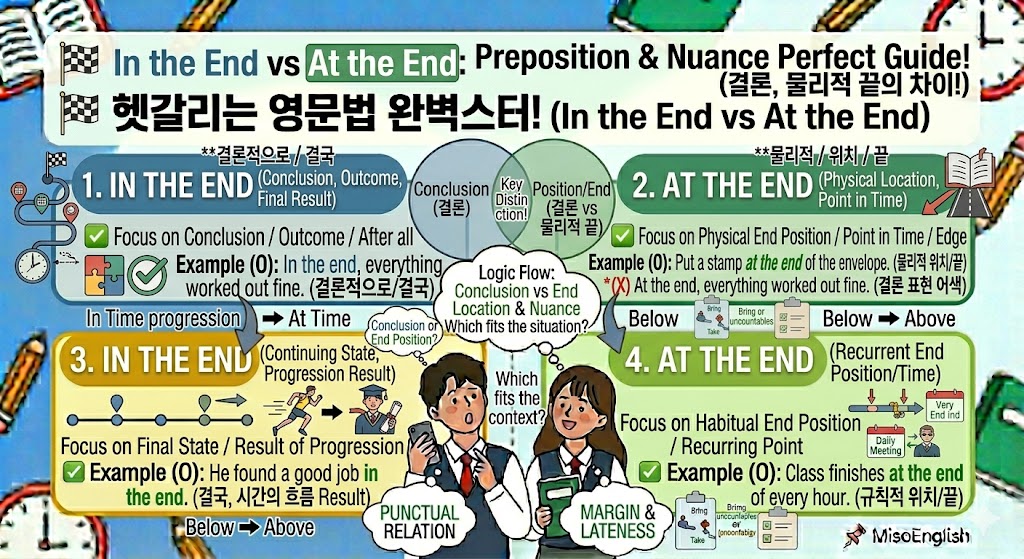
🏁 In the End vs At the End — 둘 다 "끝에"인데, 하나는 결론이고 하나는 물리적 끝입니다
헷갈리는 영문법 1:1 비교 | 📌 MisoEnglish
💡 "At the end, everything worked out fine." 이 문장, 원어민 귀에는 어색합니다. 그리고 "In the end, everything worked out fine." 은 자연스럽습니다. 단 두 글자 차이인데 왜 이렇게 다를까요? 오늘 이 결정적인 차이를 완전히 정리합니다.
1. 핵심 개념 — 뭐가 다른가?
in the end at the end
| 의미 | 결국, 마침내 (결론/결과) | ~의 끝에 (물리적/시간적 끝 지점) |
| 초점 | 과정을 거친 최종 결과 | 특정 지점, 끝 부분 |
| 뒤에 오는 것 | 단독 사용 | at the end + of + 명사 |
| 성격 | 추상적, 결론적 | 구체적, 물리적/시간적 |
📌 MisoEnglish의 핵심 포인트:
in the end = "결국" — 과정 끝에 내린 결론이나 최종 결과 at the end = "~의 끝 지점에" — 물리적이거나 시간적인 끝 부분
이 차이가 전부입니다. 하나는 추상적 결론, 하나는 구체적 위치나 시점입니다.
2. 언어학적 배경 — 왜 이런 구분이 생겼을까?
in the end의 기원
in은 "~안에, ~내부에"라는 의미로, 어떤 과정이나 상황의 내부를 거쳐 나온 결과를 나타냅니다. in the end는 "모든 과정이 끝난 지점 안에서"라는 의미에서 출발하여, "모든 것을 고려했을 때, 결국"이라는 추상적 결론의 표현으로 발전했습니다.
이는 단순히 시간적으로 마지막이 아니라, 다양한 요소들을 거쳐 도달한 최종 판단이라는 뉘앙스를 담고 있습니다.
at the end의 기원
at은 고대 영어 æt에서 왔으며, "~에, ~에서"라는 특정 지점을 가리키는 전치사입니다. at the end는 "끝이라는 지점에서"라는 의미로, 공간적이거나 시간적으로 구체적이고 명확한 끝 지점을 가리킵니다.
📌 MisoEnglish 포인트:
in = 과정 속에서, 내부를 통해 → 추상적 결론 at = 특정 지점에서 → 구체적 끝 지점
이 전치사의 본질적 차이가 두 표현의 의미를 갈라놓습니다.
3. IN THE END — 결국, 마침내
✅ 핵심 개념
in the end는 어떤 과정이나 상황을 거쳐 나온 최종 결론을 표현합니다. finally, ultimately, after everything 과 비슷한 의미입니다. 단독으로 쓰이며, of 뒤에 명사가 오지 않습니다.
In the end, she decided to quit her job.
→ 결국 그녀는 직장을 그만두기로 했다. (많은 고민 끝의 결론)

We argued for hours, but in the end, we agreed.
→ 우리는 몇 시간 동안 논쟁했지만 결국 동의했다.

In the end, it doesn't even matter.
→ 결국 그게 중요한 게 아니야. (모든 것을 고려한 결론)

In the end, hard work always pays off.
→ 결국 노력은 항상 보상받는다. (진리, 결론적 교훈)
📌 in the end = finally? ultimately?
비슷하지만 뉘앙스 차이가 있습니다.
표현 뉘앙스
| in the end | 과정을 거친 최종 결과, 철학적/결론적 |
| finally | 오랜 기다림 끝에, 안도감 포함 |
| ultimately | 가장 근본적인 결론, 격식체 |
| eventually | 시간이 지나 결국, 예상된 결과 |
In the end, love is all that matters.
→ 결국 사랑이 전부야. (철학적 결론)

Finally, the package arrived!
→ 드디어 택배가 왔다! (기다림 끝의 안도)

Ultimately, the decision is yours.
→ 궁극적으로 결정은 당신의 몫입니다. (격식체)

Eventually, he came around to our way of thinking.
→ 결국 시간이 지나 그는 우리 생각에 동의하게 됐다.
4. AT THE END — ~의 끝 지점에
✅ 핵심 개념
at the end는 물리적이거나 시간적으로 구체적인 끝 지점을 가리킵니다. 거의 항상 at the end + of + 명사 형태로 씁니다.
There's a café at the end of the street.
→ 길 끝에 카페가 있어. (물리적 끝 지점)

At the end of the movie, the hero dies.
→ 영화 끝에 영웅이 죽는다. (시간적 끝 지점)

Please save your work at the end of each session.
→ 각 세션이 끝날 때마다 작업물을 저장해 주세요.

At the end of the day, we'll review everything together.
→ 오늘 하루가 끝날 때 모든 것을 함께 검토하겠습니다.
5. "At the end of the day" — 특별한 관용구
at the end of the day는 물리적으로 "하루가 끝날 때"를 뜻하기도 하지만, 원어민들은 이것을 "결국, 어쨌든" 이라는 관용적 표현으로 훨씬 더 자주 씁니다.
At the end of the day, you have to do what's right for you.
→ 결국엔, 자신에게 옳은 것을 해야 해.

At the end of the day, results are all that matter in business.
→ 결국엔, 비즈니스에서 중요한 건 결과뿐이야.
📌 MisoEnglish 포인트:
at the end of the day (관용구) ≈ in the end 이 경우에는 두 표현이 비슷한 의미로 쓰입니다. 하지만 at the end of the day는 구어에서 훨씬 더 자주 쓰이며, 때로는 남용되어 진부하게 들리기도 합니다.
6. 실전 비교 — 같은 상황, 다른 표현
📌 MisoEnglish 포인트
상황 1: 영화/책
At the end of the book, the mystery is finally solved.
→ 책 끝에서 마침내 미스터리가 풀린다. (책의 끝 부분 — 구체적 지점)

In the end, the protagonist learns to forgive.
→ 결국 주인공은 용서하는 법을 배운다. (이야기 전체의 결론적 교훈)
상황 2: 프로젝트/업무
At the end of the project, we'll have a review meeting.
→ 프로젝트가 끝날 때 검토 회의를 할 것입니다. (시간적 끝 지점)

In the end, the project was a great success.
→ 결국 그 프로젝트는 큰 성공이었다. (과정을 거친 최종 평가)
상황 3: 인생/철학적 맥락
At the end of his life, he had no regrets.
→ 그의 삶이 끝날 무렵, 그에게는 후회가 없었다. (삶의 끝 지점)

In the end, what matters most is how we treated others.
→ 결국 가장 중요한 것은 우리가 다른 사람들을 어떻게 대했느냐다.
  (철학적 결론)
7. 실전 예문 — 상황별로 완전 정복
📌 MisoEnglish 포인트
🗣️ 일상 대화
A: Did you end up going to the party?
B: In the end, I decided to stay home. I was too tired.
→ 결국 집에 있기로 했어. 너무 피곤했거든.

A: How was the trip?
B: There were some rough patches, but in the end, it was amazing.
→ 힘든 부분도 있었지만 결국 정말 좋았어.

A: Where's the post office?
B: It's at the end of this road, turn left.
→ 이 길 끝에서 왼쪽으로 꺾으면 있어.
📧 이메일/비즈니스 영어
At the end of the quarter, we will assess the team's performance.
→ 분기 말에 팀의 성과를 평가할 것입니다.

In the end, we chose the more cost-effective solution.
→ 결국 우리는 더 비용 효율적인 솔루션을 선택했습니다.

Please submit your final report at the end of the fiscal year.
→ 회계연도 말에 최종 보고서를 제출해 주세요.

In the end, client satisfaction remains our top priority.
→ 결국 고객 만족이 우리의 최우선 과제입니다.
📝 에세이/글쓰기
At the end of the 20th century, the internet transformed
the way people communicated.
→ 20세기 말, 인터넷은 사람들의 의사소통 방식을 변화시켰다.

In the end, the evidence suggests that environmental policy
must be a global effort, not a national one.
→ 결국 증거는 환경 정책이 국가적이 아닌 전 지구적 노력이어야
   함을 시사한다.

At the end of his administration, the president's approval rating
had fallen significantly.
→ 임기 말에 대통령의 지지율은 크게 떨어졌다.

In the end, history judges leaders not by their intentions
but by their actions.
→ 결국 역사는 지도자들을 그들의 의도가 아닌 행동으로 평가한다.
8. 한국인이 특히 많이 틀리는 패턴 🚨
📌 MisoEnglish 오류 분석
❌ 오류 패턴 1: 결론 표현에 at the end를 쓰는 경우
❌ At the end, I decided to apologize.
✅ In the end, I decided to apologize.
   (많은 고민 끝의 결론 → in the end)

❌ At the end, love conquers all.
✅ In the end, love conquers all.
   (철학적 결론 → in the end)
가장 흔한 오류입니다. "끝에" = "at the end"로 직역하면 틀립니다.
❌ 오류 패턴 2: 물리적/시간적 끝에 in the end를 쓰는 경우
❌ There's a park in the end of the road.
✅ There's a park at the end of the road.
   (길의 끝 지점 → at the end of)

❌ In the end of the film, the credits roll.
✅ At the end of the film, the credits roll.
   (영화의 끝 부분 → at the end of)
❌ 오류 패턴 3: at the end 뒤에 of를 빠뜨리는 경우
❌ At the end the meeting, please submit your feedback.
✅ At the end of the meeting, please submit your feedback.

※ at the end는 거의 항상 at the end + of + 명사 형태로 씁니다.
❌ 오류 패턴 4: in the end와 at the end of the day 혼동
두 표현 모두 "결국"의 의미로 쓸 수 있지만:

In the end, the truth will come out. (격식적, 글쓰기)
At the end of the day, the truth will come out. (구어적)

※ 에세이나 격식 있는 글에서는 in the end가 더 자연스럽습니다.
※ at the end of the day는 구어에서 남용되어 진부하게 들릴 수 있습니다.
9. 원어민이 실제로 쓰는 표현 — 교과서 밖의 in the end & at the end
📌 MisoEnglish 포인트
💬 "In the end, it is what it is."
We tried everything, but in the end, it is what it is.
→ 모든 걸 해봤지만, 결국 어쩔 수 없는 거야.
it is what it is는 "어쩔 수 없다, 받아들여야 한다"는 諦念(체념)과 수용을 표현하는 원어민의 매우 흔한 표현입니다.
💬 "At the end of the tunnel" — 어려움 끝에 보이는 희망
It's been a tough year, but I can finally see the light at the end of the tunnel.
→ 힘든 한 해였지만 이제 드디어 터널 끝에 빛이 보여.
light at the end of the tunnel은 긴 어려움 끝에 보이는 희망을 표현하는 관용구입니다.
💬 "To the very end" — 끝까지
She fought to the very end.
→ 그녀는 끝까지 싸웠다.

I'll support you to the very end.
→ 끝까지 응원할게.
💬 "Ends meet" — 겨우 살아가다
With two jobs, she barely makes ends meet.
→ 두 가지 일을 해도 겨우 먹고 살 수 있을 정도야.
10. 최종 요약 — 한눈에 보기
📌 MisoEnglish 요약표
구분 in the end at the end
| 의미 | 결국, 마침내 (결론) | ~의 끝 지점에 |
| 성격 | 추상적, 결론적 | 구체적, 물리적/시간적 |
| 뒤에 오는 것 | 단독 사용 | + of + 명사 |
| 비슷한 표현 | finally, ultimately | at the bottom/top of |
| 글쓰기 사용 | ✅ 결론 문단에 | ✅ 시간/위치 표현에 |
| 관용구 | ❌ | ✅ at the end of the day |
마치며
in the end와 at the end — 전치사 하나의 차이가 만드는 뉘앙스의 차이입니다.
in the end는 "과정 속을 거쳐 나온 결론", at the end는 "끝이라는 구체적 지점에서" 입니다.
결론을 말할 때는 in the end, 구체적인 끝 지점을 가리킬 때는 at the end of, 이 두 가지 원칙만 기억하면 다시는 헷갈리지 않습니다.
📌 이 포스팅은 MisoEnglish 오리지널 콘텐츠입니다. 무단 복제 및 재배포를 금합니다. ⓒ MisoEnglish
🔜 다음 포스팅 예고 by vs until — 둘 다 시간 기한을 표현하지만, "그때까지 한 번" vs "그때까지 계속"이 핵심입니다. 드디어 시리즈 1 마지막 포스팅입니다!
'English Mechanism > Grammar' 카테고리의 다른 글
| 헷갈리는 영문법 1:1 비교 시리즈 완결편 — By vs Until (0) | 2026.04.20 |
|---|---|
| 헷갈리는 영문법 1:1 비교 — In Time vs On Time (1) | 2026.04.20 |
| 헷갈리는 영문법 1:1 비교 — Below vs Under / Above vs Over (0) | 2026.04.20 |
| 헷갈리는 영문법 1:1 비교 — Bring vs Take (0) | 2026.04.19 |
| 헷갈리는 영문법 1:1 비교 — Say vs Tell vs Speak vs Talk (0) | 2026.04.19 |


