
- 분류 전체보기 (1053)

- Linguistics (고급 영어학) (10)
- Stylistics (6)
- Etymology & Word Building (15)
- Philosophy Meets Grammar (6)
- Collection of Famous Quotes (22)
- English Mechanism (276)
- The Language Beyond Grammar (274)
- Living English (81)
- Miso’s Life Notes (18)
- My English Journey and Refl.. (16)
- Philosophy (132)
- Video Clip (16)
- Airline English (항공 영어) (47)
- Creative Corner (35)
- Sally & Sia (1)
| 일 | 월 | 화 | 수 | 목 | 금 | 토 |
|---|---|---|---|---|---|---|
| 1 | 2 | 3 | 4 | |||
| 5 | 6 | 7 | 8 | 9 | 10 | 11 |
| 12 | 13 | 14 | 15 | 16 | 17 | 18 |
| 19 | 20 | 21 | 22 | 23 | 24 | 25 |
| 26 | 27 | 28 | 29 | 30 |
- English in English
- MisoEnglish#도교철학 #Taoism #도덕경 #TaoTeChing #무위자연 #WuWei #노자 #Laozi #장자 #YinYang
- MisoEnglish#철학입문 #Philosophy #과학철학 #PhilosophyOfScience #철학공부 #포퓨퍼 #쿠hn #과학방법론 #교육콘텐츠 #철학시리즈
- ticketing
- Basic English Verbs
- MisoEnglish#철학입문 #Philosophy #형이상학 #Metaphysics #철학공부 #존재론 #실재론 #PhilosophyForBeginners #교육콘텐츠 #철학시리즈
- 🌿 English with Heart
- 인도철학 #동양철학 #인문학 #요가 #명상 #힌두교 #불교 #간디 #타고르 #정통6파 #철학공부 #마음공부 #MisoEnglish #인문학영어
- English Speaking Practice
- EnglishWriting #AcademicWriting #Grammar #EnglishLanguage #EssayWriting #ParagraphStructure #SentenceStructure #BusinessEnglish #EnglishTips #WritingSkills #Linguistics #ESL
- 감성영어
- 영국사 #영국역사 #세계사 #역사연재 #브리튼에서영국까지
- MisoEnglish#철학입문 #Philosophy #심리철학 #PhilosophyOfMind #철학공부 #의식 #마음 #PhilosophyForBeginners #교육콘텐츠 #철학시리즈
- MisoEnglish#철학입문 #Philosophy #정치철학 #PoliticalPhilosophy #철학공부 #정의론 #자유주의 #PhilosophyForBeginners #교육콘텐츠 #철학시리즈
- 영어문법
- MisoEnglish#유교철학 #Confucianism #성리학 #NeoConfucianism #인의예지 #Virtue #맹자 #Mencius #실학 #KoreanScholarship
- AirlineOpsEnglish
- 영문법
- English for Korean Learners
- MisoEnglish#불교철학 #BuddhismPhilosophy #사성제 #FourNobleTruths #공사상 #Emptiness #명상 #Mindfulness #열반 #EasternWisdom
- 영어접속사
- 영어공부
- 영어회화
- MisoEnglish#철학입문 #Philosophy #윤리학 #Ethics #도덕철학 #철학공부 #칸트 #공리주의 #교육콘텐츠 #철학시리즈
- MisoEnglish#철학입문 #Philosophy #종교철학 #PhilosophyOfReligion #철학공부 #신존재증명 #악의문제 #PhilosophyForBeginners #교육콘텐츠 #철학시리즈
- MisoEnglish#한국철학 #KoreanPhilosophy #홍익인간 #Hongik #화랑도 #Hwarang #단군 #Dangun #풍류도 #ThreeKingdoms#동양철학
- pnr
- 동양정치철학 #시리즈완결 #아시아적가치 #동서양비교 #유교 #민주주의 #정치사상 #인문학 #비교철학 #글로벌정치 #문화다양성 #2500년철학사
- everyday English
- misoenglish
- Today
- Total
MisoEnglish
이성으로 현대를 해부한다 — 시리즈를 시작하며 본문
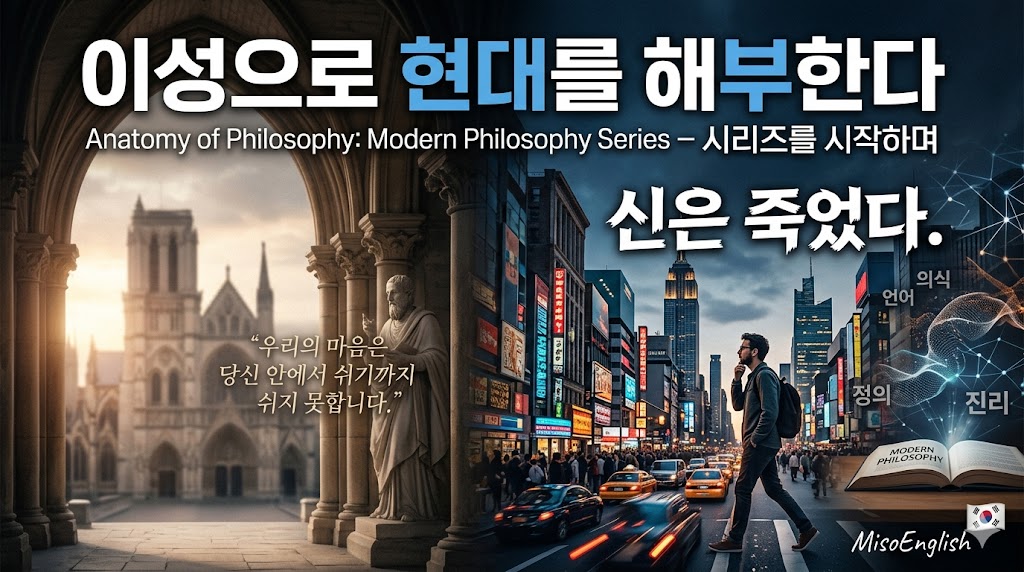
이성으로 현대를 해부한다 — 시리즈를 시작하며
Anatomy of Philosophy: Modern Philosophy Series
기독교 철학 시리즈의 마지막 문장은 아우구스티누스였다.
"우리의 마음은 당신 안에서 쉬기까지 쉬지 못합니다."
1000년의 철학자들이 신을 향해 이성을 갈고닦았다. 안셀무스는 개념에서, 아퀴나스는 세계에서, 플랜팅가는 양상논리에서, 크레이그는 빅뱅에서 — 같은 방향을 향해 걸었다.
그런데 19세기 말, 누군가 이렇게 외쳤다.
"신은 죽었다."
이 선언 하나가 철학의 지형을 완전히 바꿨다. 신이 사라진 자리에서 철학자들은 새로운 질문들을 들고 나왔다.
"신 없는 세계에서 인간은 무엇인가?" "언어는 세계를 담을 수 있는가?" "의식이란 무엇인가?" "정의로운 사회는 어떻게 가능한가?" "진리는 존재하는가, 아니면 권력만 있는가?"
이 시리즈는 그 질문들을 정면으로 다룬다.
이 시리즈는 무엇인가
19세기 말부터 20세기까지 — 현대 철학의 핵심 텍스트들을 원전 중심으로, 논증 구조를 해부하며 읽어나가는 시리즈다.
입문서가 아니다. 철학자들이 "인간이란 무엇인가", "이성의 한계는 어디인가", "우리는 어떻게 살아야 하는가"를 두고 벌인 지적 격투기를 따라가는 것이다.
읽고 나면 이런 것들이 달라진다.
- 니체가 "신은 죽었다"고 했을 때, 이것이 단순한 무신론 선언이 아니라 서양 문명 전체에 대한 진단임을 알게 된다
- 하이데거가 "존재"를 물을 때, 그것이 왜 2000년 철학이 잊어버린 질문인지 이해하게 된다
- 비트겐슈타인이 "말할 수 없는 것에 대해서는 침묵해야 한다"고 했을 때, 그 배후의 논리를 따라갈 수 있게 된다
- 롤스가 "무지의 베일" 뒤에서 정의를 설계할 때, 왜 그것이 혁명적인지 알게 된다
전체 로드맵
🔥 1부 — 실존주의
"신이 없다면 인간은 무엇인가"
순서 철학자 핵심 텍스트 핵심 주제
| 1 | 니체 | 『즐거운 학문』, 『차라투스트라』, 『도덕의 계보학』 | 신의 죽음, 권력의지, 위버멘쉬 |
| 2 | 하이데거 | 『존재와 시간』 | 현존재, 죽음을 향한 존재 |
| 3 | 사르트르 | 『존재와 무』, 『실존주의는 휴머니즘이다』 | 실존은 본질에 앞선다, 자유와 책임 |
🔬 2부 — 분석철학
"언어가 철학의 모든 문제를 만들었다"
순서 철학자 핵심 텍스트 핵심 주제
| 4 | 프레게 | 『산술의 기초』 | 논리주의, 뜻과 지시체 |
| 5 | 러셀 | 『논리원자론의 철학』 | 기술이론, 논리원자론 |
| 6 | 비트겐슈타인 (전기) | 『논리철학논고』 | 그림이론, 말할 수 없는 것 |
| 7 | 비트겐슈타인 (후기) | 『철학적 탐구』 | 언어게임, 사적 언어 논증 |
🌍 3부 — 대륙철학
"이성의 구조를 해체하다"
순서 철학자 핵심 텍스트 핵심 주제
| 8 | 후설 | 『논리 연구』, 『순수 현상학』 | 현상학, 지향성, 판단중지 |
| 9 | 하버마스 | 『의사소통 행위 이론』 | 공론장, 숙의민주주의 |
🧠 4부 — 마음철학
"의식이란 무엇인가"
순서 철학자 핵심 텍스트 핵심 주제
| 10 | 처칠런드 | 『물질과 의식』 | 제거적 유물론 |
| 11 | 챔머스 | 『의식하는 마음』 | 어려운 문제, 철학적 좀비 |
🌀 5부 — 포스트모던
"진리는 없다, 권력만 있다"
순서 철학자 핵심 텍스트 핵심 주제
| 12 | 푸코 | 『감시와 처벌』, 『광기의 역사』 | 권력-지식, 규율 |
| 13 | 데리다 | 『그라마톨로지』 | 해체주의, 차연 |
⚖️ 6부 — 정치철학
"정의로운 사회란 무엇인가"
순서 철학자 핵심 텍스트 핵심 주제
| 14 | 롤스 | 『정의론』 | 무지의 베일, 원초적 입장 |
| 15 | 노직 | 『무정부, 국가, 유토피아』 | 최소국가론, 소유권 이론 |
읽는 방법
각 편은 독립적으로 읽을 수 있지만, 순서대로 읽으면 철학자들이 서로 어떻게 대화하고 반박하는지가 보인다.
니체를 읽어야 하이데거가 왜 "존재망각"을 말하는지 알 수 있고, 비트겐슈타인을 읽어야 후기 분석철학이 왜 언어로 돌아서는지 이해된다. 롤스를 읽어야 노직의 반론이 얼마나 날카로운지 느껴진다.
텍스트는 가능한 한 원전을 직접 가져온다. 한국어, 영어, 그리고 가능한 경우 원어(독일어, 프랑스어)까지.
마지막으로
니체는 이렇게 말했다.
"철학자는 망치로 철학해야 한다."
이 시리즈는 그 망치를 함께 들어보는 시간이다.
→ 다음 글: [니체 1편] 역사적 맥락 — "신은 죽었다"의 탄생
🇺🇸 English
The last sentence of the Christian Philosophy series was Augustine.
"Our heart is restless, until it repose in Thee."
For a thousand years, philosophers sharpened their reason toward God. Anselm from concepts, Aquinas from the world, Plantinga from modal logic, Craig from the Big Bang — all walking in the same direction.
Then, at the end of the nineteenth century, someone cried out:
"God is dead."
This single declaration transformed the landscape of philosophy entirely. In the space left by God's absence, philosophers arrived with new questions.
"What is man in a world without God?" "Can language contain the world?" "What is consciousness?" "How is a just society possible?" "Does truth exist, or is there only power?"
This series confronts those questions directly.
What This Series Is
From the late nineteenth century to the twentieth — a series that reads the core texts of modern philosophy through primary sources, dissecting the structure of arguments.
This is not an introduction. It is a pursuit of the intellectual combat in which philosophers fought over "what is man," "where are the limits of reason," and "how should we live."
After reading, these things will change.
- When Nietzsche says "God is dead," you will understand that this is not a simple atheist declaration but a diagnosis of Western civilization as a whole
- When Heidegger asks about "Being," you will understand why this is the question that two thousand years of philosophy forgot
- When Wittgenstein says "Whereof one cannot speak, thereof one must be silent," you will be able to follow the logic behind it
- When Rawls designs justice behind a "veil of ignorance," you will understand why this is revolutionary
Full Roadmap
🔥 Part 1 — Existentialism
"What is man if God does not exist?"
Order Philosopher Key Texts Core Theme
| 1 | Nietzsche | The Gay Science, Thus Spoke Zarathustra, On the Genealogy of Morality | Death of God, Will to Power, Overman |
| 2 | Heidegger | Being and Time | Dasein, Being-toward-death |
| 3 | Sartre | Being and Nothingness, Existentialism is a Humanism | Existence precedes essence, freedom and responsibility |
🔬 Part 2 — Analytic Philosophy
"Language created all the problems of philosophy"
Order Philosopher Key Texts Core Theme
| 4 | Frege | The Foundations of Arithmetic | Logicism, sense and reference |
| 5 | Russell | The Philosophy of Logical Atomism | Theory of descriptions, logical atomism |
| 6 | Wittgenstein (early) | Tractatus Logico-Philosophicus | Picture theory, the unsayable |
| 7 | Wittgenstein (late) | Philosophical Investigations | Language games, private language argument |
🌍 Part 3 — Continental Philosophy
"Dismantling the structure of reason"
Order Philosopher Key Texts Core Theme
| 8 | Husserl | Logical Investigations, Ideas I | Phenomenology, intentionality, epoché |
| 9 | Habermas | The Theory of Communicative Action | Public sphere, deliberative democracy |
🧠 Part 4 — Philosophy of Mind
"What is consciousness?"
Order Philosopher Key Texts Core Theme
| 10 | Churchland | Matter and Consciousness | Eliminative materialism |
| 11 | Chalmers | The Conscious Mind | The hard problem, philosophical zombies |
🌀 Part 5 — Postmodern Philosophy
"There is no truth, only power"
Order Philosopher Key Texts Core Theme
| 12 | Foucault | Discipline and Punish, Madness and Civilization | Power-knowledge, discipline |
| 13 | Derrida | Of Grammatology | Deconstruction, différance |
⚖️ Part 6 — Political Philosophy
"What is a just society?"
Order Philosopher Key Texts Core Theme
| 14 | Rawls | A Theory of Justice | Veil of ignorance, original position |
| 15 | Nozick | Anarchy, State, and Utopia | Minimal state, entitlement theory |
How to Read
Each installment can be read independently, but reading in order reveals how philosophers dialogue with and challenge one another.
Reading Nietzsche illuminates why Heidegger speaks of "the forgetting of Being." Reading Wittgenstein clarifies why later analytic philosophy turns toward language. Reading Rawls makes Nozick's counterarguments feel all the more sharp.
Texts are drawn directly from primary sources wherever possible — in Korean, English, and where applicable, the original language (German, French).
Finally
Nietzsche said:
"Philosophizing with a hammer."
This series is an invitation to pick up that hammer together.
→ Next: [Nietzsche Part 1] Historical Context — The Birth of "God is Dead"
'The Language Beyond Grammar' 카테고리의 다른 글
| 현대철학 2편 - 원전 읽기: 신의 죽음과 위버멘쉬 (니체 2편) (0) | 2026.03.21 |
|---|---|
| 현대철학 1편 - "신은 죽었다" — 현대 철학의 출발점 (니체 1편) (0) | 2026.03.21 |
| 기독교 철학 42편 - 안셀무스부터 크레이그까지 — 1000년의 지적 여정 (0) | 2026.03.20 |
| 기독교 철학 41편 - 칼람 논증의 반론과 재반박 (크레이그 3편) (0) | 2026.03.20 |
| 기독교 철학 40편 - 칼람 논증 해부: 철학적·과학적 논거와 원인의 본성 (크레이그 2편) (0) | 2026.03.20 |


