
- 분류 전체보기 (1053)

- Linguistics (고급 영어학) (10)
- Stylistics (6)
- Etymology & Word Building (15)
- Philosophy Meets Grammar (6)
- Collection of Famous Quotes (22)
- English Mechanism (276)
- The Language Beyond Grammar (274)
- Living English (81)
- Miso’s Life Notes (18)
- My English Journey and Refl.. (16)
- Philosophy (132)
- Video Clip (16)
- Airline English (항공 영어) (47)
- Creative Corner (35)
- Sally & Sia (1)
| 일 | 월 | 화 | 수 | 목 | 금 | 토 |
|---|---|---|---|---|---|---|
| 1 | 2 | 3 | 4 | |||
| 5 | 6 | 7 | 8 | 9 | 10 | 11 |
| 12 | 13 | 14 | 15 | 16 | 17 | 18 |
| 19 | 20 | 21 | 22 | 23 | 24 | 25 |
| 26 | 27 | 28 | 29 | 30 |
- English Speaking Practice
- MisoEnglish#한국철학 #KoreanPhilosophy #홍익인간 #Hongik #화랑도 #Hwarang #단군 #Dangun #풍류도 #ThreeKingdoms#동양철학
- 영어공부
- 동양정치철학 #시리즈완결 #아시아적가치 #동서양비교 #유교 #민주주의 #정치사상 #인문학 #비교철학 #글로벌정치 #문화다양성 #2500년철학사
- 영국사 #영국역사 #세계사 #역사연재 #브리튼에서영국까지
- MisoEnglish#철학입문 #Philosophy #형이상학 #Metaphysics #철학공부 #존재론 #실재론 #PhilosophyForBeginners #교육콘텐츠 #철학시리즈
- ticketing
- MisoEnglish#철학입문 #Philosophy #과학철학 #PhilosophyOfScience #철학공부 #포퓨퍼 #쿠hn #과학방법론 #교육콘텐츠 #철학시리즈
- 영어회화
- MisoEnglish#철학입문 #Philosophy #윤리학 #Ethics #도덕철학 #철학공부 #칸트 #공리주의 #교육콘텐츠 #철학시리즈
- MisoEnglish#불교철학 #BuddhismPhilosophy #사성제 #FourNobleTruths #공사상 #Emptiness #명상 #Mindfulness #열반 #EasternWisdom
- MisoEnglish#철학입문 #Philosophy #심리철학 #PhilosophyOfMind #철학공부 #의식 #마음 #PhilosophyForBeginners #교육콘텐츠 #철학시리즈
- EnglishWriting #AcademicWriting #Grammar #EnglishLanguage #EssayWriting #ParagraphStructure #SentenceStructure #BusinessEnglish #EnglishTips #WritingSkills #Linguistics #ESL
- Basic English Verbs
- misoenglish
- 영어접속사
- 영문법
- pnr
- AirlineOpsEnglish
- MisoEnglish#철학입문 #Philosophy #종교철학 #PhilosophyOfReligion #철학공부 #신존재증명 #악의문제 #PhilosophyForBeginners #교육콘텐츠 #철학시리즈
- English in English
- everyday English
- 🌿 English with Heart
- MisoEnglish#철학입문 #Philosophy #정치철학 #PoliticalPhilosophy #철학공부 #정의론 #자유주의 #PhilosophyForBeginners #교육콘텐츠 #철학시리즈
- 인도철학 #동양철학 #인문학 #요가 #명상 #힌두교 #불교 #간디 #타고르 #정통6파 #철학공부 #마음공부 #MisoEnglish #인문학영어
- English for Korean Learners
- 감성영어
- MisoEnglish#도교철학 #Taoism #도덕경 #TaoTeChing #무위자연 #WuWei #노자 #Laozi #장자 #YinYang
- 영어문법
- MisoEnglish#유교철학 #Confucianism #성리학 #NeoConfucianism #인의예지 #Virtue #맹자 #Mencius #실학 #KoreanScholarship
- Today
- Total
MisoEnglish
시즌 4 — 인생 교훈편 2편. 실패, 원소와 여포와 마속이 알려주는 것 본문
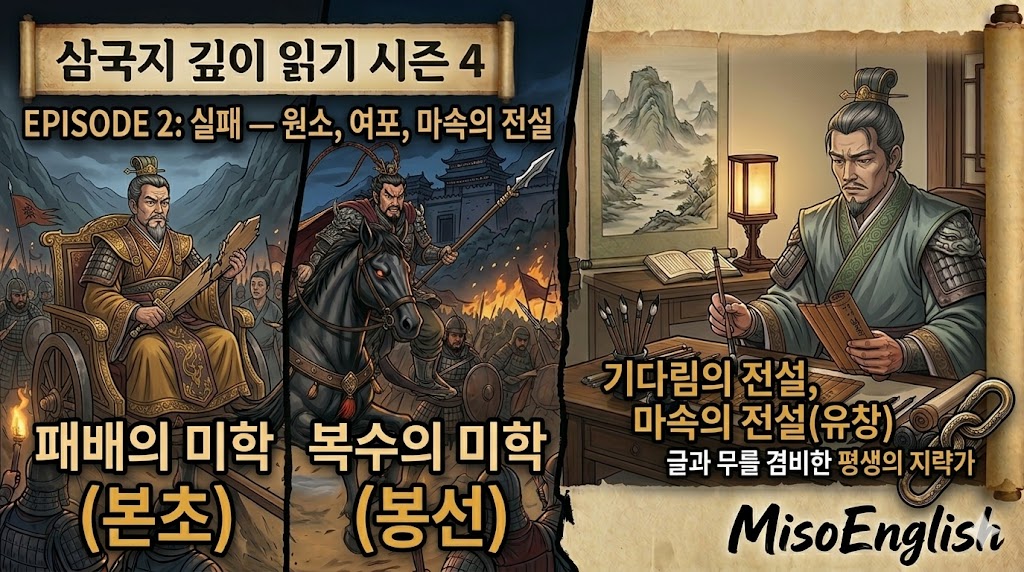
시즌 4 — 인생 교훈편 2편. 실패, 원소와 여포와 마속이 알려주는 것
실패한 사람 이야기는 불편해요.
보통 성공한 사람 이야기를 좋아하잖아요. 조조는 어떻게 천하를 잡았나, 제갈량은 어떻게 나라를 지탱했나.
근데 사실 실패한 사람 이야기가 더 많이 가르쳐 줘요.
왜 무너졌는지를 알면, 같은 방식으로 무너지지 않을 수 있으니까요.
오늘은 삼국지에서 가장 뼈아픈 실패 세 가지예요.
원소의 실패 — 가진 게 너무 많아서 진 사람
원소는 삼국지에서 가장 억울한 패배자예요.
가진 게 너무 많았어요.
북방 네 개 주. 조조의 열 배가 넘는 군대. 당대 최고의 참모들. 명문가 출신이라는 권위까지.
누가 봐도 원소가 이겨야 했어요.
근데 졌어요.
왜였을까요.
가진 게 너무 많아서 방심했어요.
참모 전풍이 말했어요. "지금 치면 안 됩니다." 감옥에 가뒀어요. 참모 저수가 말했어요. "기다려야 합니다." 무시했어요. 참모 허유가 뭔가 잘못됐다고 느끼자 적진으로 넘어갔어요.
원소는 뛰어난 사람들을 곁에 뒀어요. 근데 그 사람들의 말을 듣지 않았어요.
왜 안 들었을까요.
내가 옳다고 믿었어요. 이미 이긴다고 믿었어요. 숫자가 많으니까 이길 수밖에 없다고 믿었어요.
그 확신이 귀를 막았어요.
원소의 실패가 가르쳐 주는 것.
가진 게 많을수록 더 잘 들어야 해요.
성공 경험이 쌓일수록 오히려 더 조심해야 해요. 잘되고 있을 때 방심이 시작되거든요. 원소처럼 70만을 가지고도 질 수 있어요. 내가 옳다는 확신이 클수록 틀릴 가능성도 커져요.
여포의 실패 — 방향을 잃은 사람
여포는 삼국지에서 가장 강한 사람이었어요.
사람 중에 여포, 말 중에 적토마. 그 말이 괜히 나온 게 아니에요.
근데 그 천하제일 무장이 결국 부하들에게 목숨을 잃었어요.
왜였을까요.
강하기만 했어요. 강함을 어디에 써야 할지 몰랐어요.
조조에게는 천하통일이라는 목표가 있었어요. 유비에게는 한나라를 되살리겠다는 명분이 있었어요. 손권에게는 강동을 지키겠다는 책임감이 있었어요.
여포에게는 그게 없었어요.
더 좋은 주군, 더 좋은 조건, 더 좋은 기회. 그것만 좇았어요.
정원을 배신했어요. 동탁을 배신했어요. 유비를 배신했어요.
배신이 나빠서 망한 게 아니에요. 목표가 없으니까 기준이 없었어요. 기준이 없으니까 더 좋아 보이는 쪽으로 계속 움직였어요.
그러다 아무도 여포를 믿지 않았어요.
아무리 강해도 혼자서는 살 수 없었어요.
여포의 실패가 가르쳐 주는 것.
힘은 방향이 있어야 해요.
능력이 뛰어나도 그 능력을 왜 쓰는지 모르면 결국 표류해요. 더 좋은 조건을 찾아 옮겨 다니다 보면 어느새 아무도 나를 믿지 않아요. 여포처럼요.
내가 지금 무엇을 위해 이 일을 하고 있는지 모른다면, 그건 여포의 길 위에 서 있는 거예요.
마속의 실패 — 아는 것과 하는 것을 혼동한 사람
마속은 제갈량이 가장 아끼는 참모였어요.
머리가 좋았어요. 병법을 꿰뚫고 있었어요. 제갈량과 밤새 전략을 토론할 수 있는 사람이었어요.
그래서 제갈량이 중요한 자리를 맡겼어요. 가정.
마속이 가정에 도착했어요.
부장 왕평이 말했어요. "길목에 진을 치야 합니다."
마속이 고개를 저었어요. "높은 곳에서 내려치는 게 병법의 기본이오."
이론은 맞았어요. 높은 곳이 유리하다는 건 병법의 상식이에요.
근데 현실은 달랐어요.
그 산에는 물이 없었어요. 포위당하면 버틸 수 없었어요. 왕평이 걱정한 건 바로 그 부분이었어요.
마속은 이론으로 현실을 이겼어요.
책에서는 맞는 말이 현장에서는 틀릴 수 있어요. 마속은 그 차이를 몰랐어요.
아니, 알면서도 자기 판단을 믿었어요.
결과는 참혹했어요. 가정을 잃었고, 1차 북벌이 무너졌고, 마속은 처형됐어요.
유비가 죽기 전에 제갈량에게 했던 말이 있었어요.
"마속은 말이 실력보다 앞서는 사람이오. 중용하지 마시오."
제갈량은 그 말을 들었지만 믿지 않았어요.
아끼는 마음이 판단을 흐렸어요.
마속의 실패가 가르쳐 주는 것.
아는 것과 할 수 있는 것은 달라요.
이론을 많이 안다고 현장에서 잘하는 게 아니에요. 책으로 배운 것과 몸으로 겪은 것 사이에는 항상 간격이 있어요. 그 간격을 무시하면 마속처럼 돼요.
그리고 한 가지 더. 누군가 "저 사람 좀 더 지켜봐야 한다"고 말할 때, 아끼는 마음 때문에 그 말을 흘려듣는 건 결국 그 사람에게도, 나에게도 좋지 않아요.
세 실패의 공통점
원소, 여포, 마속.
셋이 다 달라 보이지만 공통점이 있어요.
자기가 보고 싶은 것만 봤어요.
원소는 자신의 숫자만 봤어요. 여포는 눈앞의 조건만 봤어요. 마속은 자신의 이론만 봤어요.
현실이 다른 말을 하고 있었어요. 곁에 있는 사람들이 다른 말을 하고 있었어요.
근데 듣지 않았어요.
실패는 대부분 갑자기 찾아오지 않아요.
미리 신호가 있어요. 누군가 말해줬어요. 뭔가 이상하다는 느낌이 있었어요.
그 신호를 무시했을 때 무너져요.
그럼 우리는
원소처럼 잘되고 있을 때, 주변의 말이 귀찮게 느껴질 때. 여포처럼 더 좋은 조건이 보일 때, 지금 내가 왜 이걸 하는지 모를 때. 마속처럼 내가 이론적으로는 맞다고 확신할 때.
그 순간이 가장 위험한 순간이에요.
삼국지의 실패한 사람들이 1,800년을 넘어 지금도 이야기되는 이유가 거기 있어요.
그 순간이 지금도 우리 앞에 똑같이 오거든요.
다음 편에서는 인간관계 이야기예요. 유비는 왜 그렇게 사람을 끌어당겼을까요. 그 비밀을 파헤쳐 볼게요.
시즌 4 — 3편: 인간관계, 유비는 왜 사람을 끌었나
Season 4 — Life Lessons
Episode 2: Failure — What Yuan Shao, Lü Bu, and Ma Su Tell Us
Stories about failure make people uncomfortable.
We'd rather hear about success. How Cao Cao took the realm. How Zhuge Liang held a kingdom together against impossible odds.
But the people who failed teach us more.
Because if you understand how someone collapsed, you have a chance to avoid collapsing the same way.
Today — the three most painful failures in the Three Kingdoms.
Yuan Shao's Failure — The Man Who Lost Because He Had Too Much
Yuan Shao is the most frustrating loser in all of Romance of the Three Kingdoms.
He had everything.
Four northern provinces. An army ten times the size of Cao Cao's. The finest advisors of the age. The prestige of the most powerful aristocratic family in the land.
By every reasonable calculation, Yuan Shao should have won.
He lost.
Why?
He had so much that he stopped paying attention.
Tian Feng said: "Don't attack yet." Yuan Shao threw him in prison. Ju Shou said: "We should wait." Yuan Shao ignored him. Xu You sensed something was wrong — and walked across to the enemy camp.
Yuan Shao surrounded himself with brilliant people. And refused to listen to any of them.
Why?
Because he already knew he was right. Already knew he would win. How could he possibly lose with an army this size?
That certainty closed his ears.
What Yuan Shao's failure teaches us:
The more you have, the more carefully you need to listen.
The more success you accumulate, the more dangerous your blind spots become. Complacency starts exactly when things are going well. Yuan Shao had 700,000 men and lost. The stronger your conviction that you're right, the higher the chance that you're not.
Lü Bu's Failure — The Man Who Lost His Direction
Lü Bu was the strongest person in the Three Kingdoms.
Among men, Lü Bu. Among horses, Red Hare. That saying didn't come from nowhere.
And yet the greatest warrior in the land was killed by his own subordinates in the night.
Why?
He was strong. But he never figured out what to do with that strength.
Cao Cao had the ambition to unify the empire. Liu Bei had the cause of restoring the Han. Sun Quan had the responsibility of protecting Jiangdong.
Lü Bu had none of that.
Better terms. Better conditions. Better opportunities. That was all he ever chased.
He betrayed Ding Yuan. He betrayed Dong Zhuo. He betrayed Liu Bei.
The problem wasn't the betrayal itself. It was that without a goal, he had no standard to hold himself to. Without a standard, every shinier option pulled him in a new direction.
And eventually, nobody trusted him anymore.
No matter how strong you are, you can't survive alone.
What Lü Bu's failure teaches us:
Strength needs direction.
No matter how capable you are, if you don't know why you're doing what you're doing, you'll drift. Keep chasing better conditions and at some point, nobody believes in you anymore. Just like Lü Bu.
If you can't answer the question of why you're doing what you're doing right now — you're already on Lü Bu's road.
Ma Su's Failure — The Man Who Confused Knowing With Doing
Ma Su was Zhuge Liang's most cherished advisor.
Brilliant. He knew military theory inside out. He could debate strategy with Zhuge Liang through the night and hold his own.
So Zhuge Liang gave him the most important assignment of the first northern campaign. Jieting.
Ma Su arrived at Jieting.
His deputy Wang Ping said: "We need to hold the road junction."
Ma Su shook his head. "Striking from high ground is the fundamental principle of warfare."
The theory was correct. High ground is an advantage — that's basic military knowledge.
But the reality was different.
There was no water source on that mountain. If they were surrounded, they couldn't hold. That's exactly what Wang Ping was worried about.
Ma Su let theory beat reality.
What's correct in a book can be wrong in the field. Ma Su didn't understand that gap.
Or maybe he understood it — but trusted his own judgment anyway.
The result was catastrophic. Jieting fell. The first northern campaign collapsed. Ma Su was executed.
Before Liu Bei died, he had said to Zhuge Liang:
"Ma Su's words always outrun his abilities. Do not place him in a position of importance."
Zhuge Liang heard it. And didn't believe it.
Affection clouded his judgment.
What Ma Su's failure teaches us:
Knowing something and being able to do it are different things.
Deep theoretical knowledge doesn't automatically translate into performance under pressure. There is always a gap between what you've learned from books and what you've earned through experience. Ignore that gap and you become Ma Su.
And one more thing. When someone says keep an eye on that person — and your affection for them makes you wave it off — that's not kindness. It's a mistake that costs both of you.
What All Three Failures Share
Yuan Shao, Lü Bu, Ma Su.
They look different on the surface. But there's a thread running through all three.
Each of them only saw what they wanted to see.
Yuan Shao saw his numbers. Lü Bu saw the next opportunity. Ma Su saw his own theory.
Reality was saying something different. The people around them were saying something different.
They didn't listen.
Failure rarely arrives out of nowhere.
There are signals first. Someone speaks up. Something feels off. A quiet voice says this isn't right.
The collapse comes when you ignore those signals.
So What About Us?
When things are going well and someone's feedback starts to feel like noise — that's Yuan Shao's moment. When a shinier option appears and you've lost track of why you started — that's Lü Bu's moment. When you're absolutely certain the theory is on your side — that's Ma Su's moment.
Those are the most dangerous moments.
That's why the people who failed in the Three Kingdoms are still being talked about 1,800 years later.
Because those same moments show up in front of us. Today. Unchanged.
Next episode: Relationships. Why did Liu Bei pull people toward him the way he did? We dig into that next.
Season 4 — Episode 3: Relationships — Why People Followed Liu Bei
'The Language Beyond Grammar' 카테고리의 다른 글
| 시즌 4 — 인생 교훈편 4편. 배신과 충성, 여포와 조자룡의 차이 (0) | 2026.03.11 |
|---|---|
| 시즌 4 — 인생 교훈편 3편. 인간관계, 유비는 왜 사람을 끌었나 (0) | 2026.03.11 |
| 시즌 4 — 인생 교훈편 1편. 리더십, 세 종류의 리더 (0) | 2026.03.11 |
| 시즌 3 — 전투 심층편 4편. 이릉대전, 복수가 부른 참사 (0) | 2026.03.10 |
| 시즌 3 — 전투 심층편 3편. 한중대전, 조조도 물러선 싸움 (0) | 2026.03.10 |


