동음이의어 · 이철이의어 · 동형이의어 정리
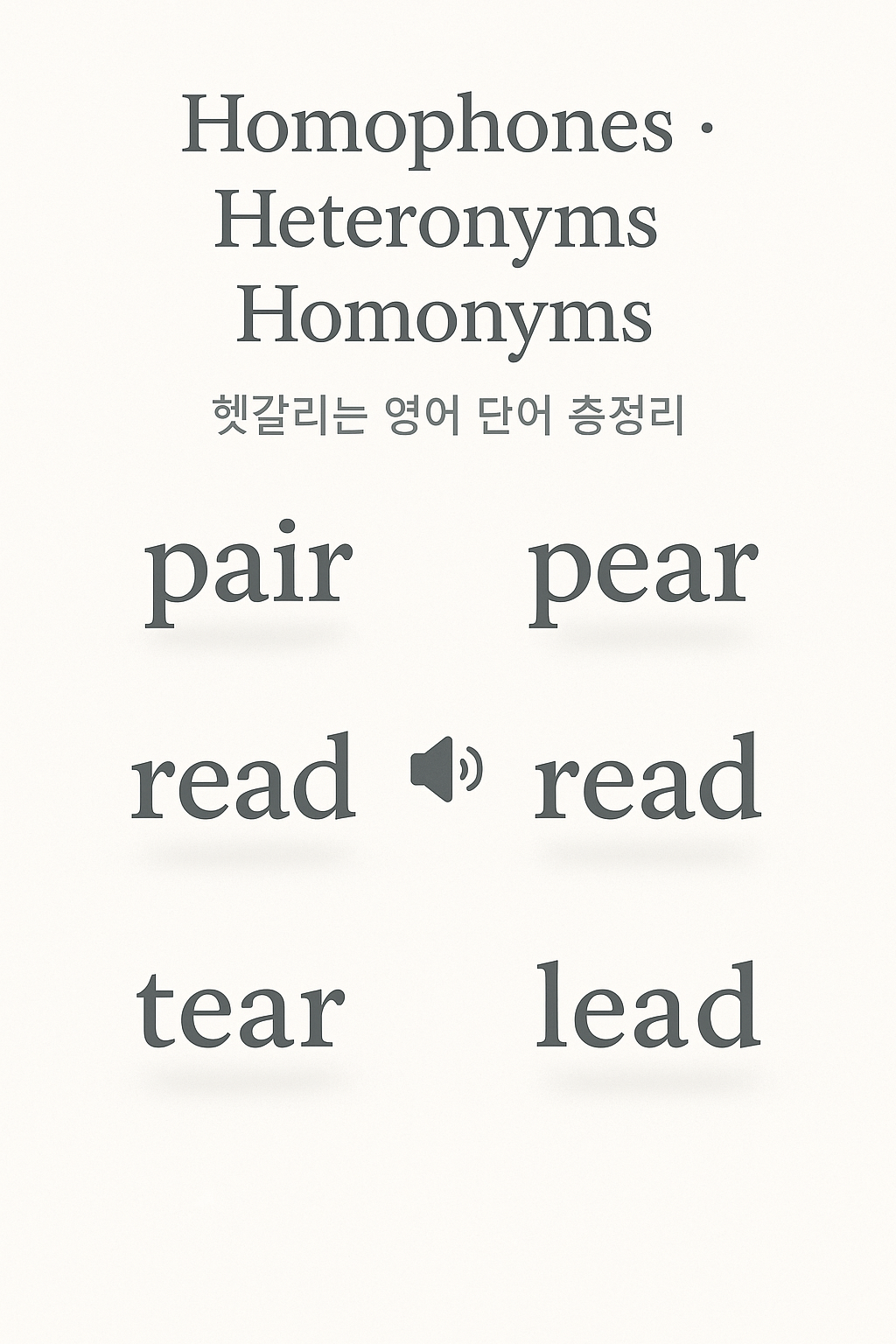
Homophones, Heteronyms, Homonyms
동음이의어 · 이철이의어 · 동형이의어 정리
영어에는 소리, 철자, 의미의 관계에 따라 재미있는 단어 그룹이 있습니다.
이 글에서는 Homophones(동음이의어), Heteronyms(이철이의어), Homonyms(동형이의어)를 한 번에 정리하고, 각 유형별 예문 30개를 살펴봅니다.
영어 학습자 입장에서는 헷갈리기 쉽지만, 한 번 정리해 두면
듣기, 읽기, 쓰기, 어휘 감각을 한꺼번에 키울 수 있는 좋은 소재입니다.
0. Overview | 개념 정리
- Homophones (동음이의어)
EN: Words that sound the same but have different spelling and meaning.
KR: 발음은 같지만, 철자와 뜻이 다른 단어. - Heteronyms (이철이의어 / 이음이의어)
EN: Words that are spelled the same but have different pronunciation and meaning.
KR: 철자는 같지만, 발음과 뜻이 다른 단어. - Homonyms (동형이의어)
EN: Words that are spelled and pronounced the same but have different meanings.
KR: 철자와 발음은 같지만, 문맥에 따라 뜻이 달라지는 단어.
💡 요약 한 줄
Homophones는 귀를 헷갈리게 하고 👂,
Heteronyms는 혀를 시험하고 👅,
Homonyms는 머리를 시험합니다 🧠.
1. Homophones | 동음이의어
Homophones는
발음은 같지만, 철자와 의미가 서로 다른 단어를 말합니다.
EN: They sound the same, but their spelling and meanings are different.
KR: 소리는 같지만, 철자와 뜻이 달라서 듣기·받아쓰기·스펠링에서 자주 혼동됩니다.
| Word Pair & IPA 단어 & 발음 기호 |
Example Sentences (EN / 설명) 예문 (영어 + 한국어 의미 설명) |
|---|---|
| 1. sea / see /siː/ sea: 바다, see: 보다 |
EN: The sea is very calm today. EN: I can see an island in the distance. |
| 2. sun / son /sʌn/ sun: 태양, son: 아들 |
EN: The sun is shining brightly. EN: Her son is only five years old. |
| 3. right / write /raɪt/ right: 오른쪽, 맞는 / write: 쓰다 |
EN: Turn right at the next corner. EN: Please write your name here. |
| 4. night / knight /naɪt/ night: 밤, knight: 기사(중세 전사) |
EN: It was a very quiet night. EN: The knight wore heavy armor. |
| 5. meat / meet /miːt/ meat: 고기, meet: 만나다 |
EN: I don’t eat much meat. EN: Let’s meet at three o’clock. |
| 6. flower / flour /ˈflaʊər/ flower: 꽃, flour: 밀가루 |
EN: She put the flower in a vase. EN: We need more flour for the cake. |
| 7. hear / here /hɪr/ hear: 듣다, here: 여기 |
EN: I can’t hear you very well. EN: Please come here for a moment. |
| 8. one / won /wʌn/ one: 숫자 1, won: 이겼다 |
EN: She has one younger brother. EN: Our team won the game. |
| 9. blue / blew /bluː/ blue: 파란, blew: blow의 과거 |
EN: He bought a blue jacket. EN: The wind blew all night long. |
| 10. knew / new /nuː/ 또는 /njuː/ knew: know의 과거, new: 새로운 |
EN: I knew the answer already. EN: She bought a new phone yesterday. |
| 11. buy / by / bye /baɪ/ buy: 사다, by: ~옆에, bye: 안녕(작별) |
EN: I want to buy this book today. EN: He sat by the window and said bye. |
| 12. pair / pear /pɛr/ pair: 한 쌍, pear: 배(과일) |
EN: I bought a new pair of shoes. EN: This pear is very sweet. |
| 13. brake / break /breɪk/ brake: 브레이크, break: 쉬다/깨다 |
EN: Step on the brake slowly. EN: Let’s take a short break. |
| 14. weather / whether /ˈwɛðər/ weather: 날씨, whether: ~인지 아닌지 |
EN: The weather is very cold today. EN: I don’t know whether he will come. |
| 15. hour / our /ˈaʊər/ hour: 한 시간, our: 우리의 |
EN: I will be there in an hour. EN: This is our favorite café. |
| 16. allowed / aloud /əˈlaʊd/ allowed: 허용된, aloud: 소리 내어 |
EN: Phones are not allowed in class. EN: Please read the story aloud. |
| 17. hole / whole /hoʊl/ hole: 구멍, whole: 전체 |
EN: There is a hole in my sock. EN: I ate the whole cake myself. |
| 18. steel / steal /stiːl/ steel: 강철, steal: 훔치다 |
EN: The bridge is made of steel. EN: It is wrong to steal money. |
| 19. mail / male /meɪl/ mail: 우편, male: 남성 |
EN: Did you get any mail today? EN: The doctor is a male. |
| 20. plain / plane /pleɪn/ plain: 수수한/평원, plane: 비행기 |
EN: She wore a plain white T-shirt. EN: The plane landed safely. |
| 21. so / sew /soʊ/ so: 그래서, sew: 바느질하다 |
EN: I was tired, so I went home early. EN: She can sew her own clothes. |
| 22. sail / sale /seɪl/ sail: 항해하다, sale: 세일/판매 |
EN: They went out to sail in the morning. EN: The store has a big sale today. |
| 23. weight / wait /weɪt/ weight: 몸무게, wait: 기다리다 |
EN: I gained some weight last year. EN: Please wait here for a minute. |
| 24. their / there /ðɛr/ their: 그들의, there: 거기에 |
EN: That is their new car. EN: Please put the box over there. |
| 25. road / rode /roʊd/ road: 도로, rode: ride의 과거 |
EN: The road is very narrow here. EN: She rode her bike to school. |
| 26. peace / piece /piːs/ peace: 평화, piece: 조각 |
EN: We all want peace in the world. EN: Can I have a piece of cake? |
| 27. eight / ate /eɪt/ eight: 숫자 8, ate: eat의 과거 |
EN: I got up at eight this morning. EN: I already ate breakfast. |
| 28. tail / tale /teɪl/ tail: 꼬리, tale: 이야기 |
EN: The dog wagged its tail. EN: It’s a very famous fairy tale. |
| 29. hair / hare /hɛr/ hair: 머리카락, hare: 산토끼 |
EN: She has long brown hair. EN: A hare ran across the road. |
| 30. bored / board /bɔːrd/ bored: 지루한, board: 판/칠판 |
EN: I felt bored during the meeting. EN: He wrote the answer on the board. |
2. Heteronyms | 이철이의어 (철자는 같고, 발음·뜻이 다른 단어)
Heteronyms는
철자는 같지만, 발음과 의미가 달라지는 단어입니다.
EN: Same spelling, but different pronunciation and different meaning.
KR: 스펠링이 똑같아서 헷갈리기 쉬우므로, 강세 위치와 발음 기호를 함께 외우면 좋습니다.
| Word & IPA 단어 & 발음 |
Meanings & Examples 의미 & 예문 (EN) |
|---|---|
| 1. lead /liːd/ vs. /lɛd/ 동사: 이끌다 / 명사: 납(금속) |
EN: She will lead the team to success. (/liːd/) EN: The old pipes were made of lead. (/lɛd/) |
| 2. tear /teər/ vs. /tɪər/ 찢다 / 눈물 |
EN: Don’t tear the paper. (/teər/) EN: A single tear rolled down her cheek. (/tɪər/) |
| 3. wind /wɪnd/ vs. /waɪnd/ 바람 / 감다, 감아올리다 |
EN: The wind is very strong today. (/wɪnd/) EN: Please wind the clock. (/waɪnd/) |
| 4. live /lɪv/ vs. /laɪv/ 살다 / 생방송의, 라이브 |
EN: They live in New York. (/lɪv/) EN: The show was broadcast live. (/laɪv/) |
| 5. read /riːd/ vs. /rɛd/ 현재형 / 과거형 |
EN: I read a book every night. (/riːd/) EN: I read three books last week. (/rɛd/) |
| 6. bass /beɪs/ vs. /bæs/ 베이스(저음, 악기) / 농어(물고기) |
EN: He plays the bass guitar. (/beɪs/) EN: He caught a huge bass. (/bæs/) |
| 7. close /kloʊz/ vs. /kloʊs/ 닫다 / 가까운 |
EN: Please close the window. (/kloʊz/) EN: We are very close friends. (/kloʊs/) |
| 8. use /juːz/ vs. /juːs/ 동사: 사용하다 / 명사: 사용, 용도 |
EN: How do you use this tool? (/juːz/) EN: This book is of great use. (/juːs/) |
| 9. excuse /ɪkˈskjuːz/ vs. /ɪkˈskjuːs/ 용서하다 / 변명, 핑계 |
EN: Please excuse my mistake. (/ɪkˈskjuːz/) EN: That’s just an excuse. (/ɪkˈskjuːs/) |
| 10. record /rɪˈkɔːrd/ vs. /ˈrɛkərd/ 기록하다 / 기록, 레코드 |
EN: We will record the meeting. (/rɪˈkɔːrd/) EN: He broke the world record. (/ˈrɛkərd/) |
| 11. present /prɪˈzɛnt/ vs. /ˈprɛzənt/ 발표하다 / 선물, 현재의 |
EN: I will present my idea tomorrow. (/prɪˈzɛnt/) EN: I got a birthday present. (/ˈprɛzənt/) |
| 12. object /əbˈdʒɛkt/ vs. /ˈɒbdʒɪkt/ 반대하다 / 물체, 목적어 |
EN: I object to that decision. (/əbˈdʒɛkt/) EN: This object is very heavy. (/ˈɒbdʒɪkt/) |
| 13. subject /səbˈdʒɛkt/ vs. /ˈsʌbdʒɪkt/ ~을 겪게 하다 / 과목, 주제 |
EN: They were subject to strict rules. (/səbˈdʒɛkt/) EN: English is my favorite subject. (/ˈsʌbdʒɪkt/) |
| 14. desert /ˈdɛzərt/ vs. /dɪˈzɜːrt/ 사막 / 버리다 |
EN: The desert is very dry. (/ˈdɛzərt/) EN: Don’t desert your friends. (/dɪˈzɜːrt/) |
| 15. project /prəˈdʒɛkt/ vs. /ˈprɒdʒɛkt/ 예상하다, 투사하다 / 프로젝트 |
EN: We project higher sales next year. (/prəˈdʒɛkt/) EN: This project is very important. (/ˈprɒdʒɛkt/) |
| 16. conduct /kənˈdʌkt/ vs. /ˈkɒndʌkt/ 실시하다 / 행동, 품행 |
EN: They will conduct a survey. (/kənˈdʌkt/) EN: His conduct was excellent. (/ˈkɒndʌkt/) |
| 17. contract /kənˈtrækt/ vs. /ˈkɒntrækt/ 수축하다/계약하다 / 계약서 |
EN: Muscles contract when you move. (/kənˈtrækt/) EN: She signed a new contract. (/ˈkɒntrækt/) |
| 18. contest /kənˈtɛst/ vs. /ˈkɒntɛst/ 이의를 제기하다 / 대회, 콘테스트 |
EN: They will contest the result. (/kənˈtɛst/) EN: She won the singing contest. (/ˈkɒntɛst/) |
| 19. rebel /rɪˈbɛl/ vs. /ˈrɛbəl/ 반란을 일으키다 / 반역자 |
EN: The people may rebel against the law. (/rɪˈbɛl/) EN: The rebel was arrested. (/ˈrɛbəl/) |
| 20. refuse /rɪˈfjuːz/ vs. /ˈrɛfjuːs/ 거절하다 / 쓰레기 |
EN: I must refuse the offer. (/rɪˈfjuːz/) EN: The truck collects refuse every week. (/ˈrɛfjuːs/) |
| 21. minute /ˈmɪnɪt/ vs. /maɪˈnjuːt/ 분(시간) / 아주 작은 |
EN: Wait a minute, please. (/ˈmɪnɪt/) EN: There was a minute difference. (/maɪˈnjuːt/) |
| 22. bow /baʊ/ vs. /boʊ/ 허리를 굽혀 인사하다 / 활, 리본 매듭 |
EN: They bow to the audience. (/baʊ/) EN: He shot an arrow from his bow. (/boʊ/) |
| 23. sow /soʊ/ vs. /saʊ/ 씨를 뿌리다 / 암퇘지 |
EN: Farmers sow seeds in spring. (/soʊ/) EN: The sow fed her piglets. (/saʊ/) |
| 24. does /dʌz/ vs. /doʊz/ do의 3인칭 단수 / 암사슴들 |
EN: She does her homework every day. (/dʌz/) EN: The does ran into the forest. (/doʊz/) |
| 25. invalid /ɪnˈvælɪd/ vs. /ˈɪnvəlɪd/ 무효인 / 병약자 |
EN: The ticket is invalid now. (/ɪnˈvælɪd/) EN: The hospital cares for many invalids. (/ˈɪnvəlɪd/) |
| 26. separate /ˈsɛpəreɪt/ vs. /ˈsɛprət/ 분리하다 / 분리된, 별개의 |
EN: Please separate the papers. (/ˈsɛpəreɪt/) EN: We sleep in separate rooms. (/ˈsɛprət/) |
| 27. alternate /ˈɔːltərneɪt/ vs. /ˈɔːltərnət/ 번갈아 하다 / 번갈아의, 대체의 |
EN: We alternate roles every week. (/ˈɔːltərneɪt/) EN: We meet on alternate Mondays. (/ˈɔːltərnət/) |
| 28. advocate /ˈædvəkeɪt/ vs. /ˈædvəkət/ 옹호하다 / 옹호자 |
EN: I advocate for equal rights. (/ˈædvəkeɪt/) EN: She is a strong advocate of education. (/ˈædvəkət/) |
| 29. attribute /əˈtrɪbjuːt/ vs. /ˈætrɪbjuːt/ ~의 탓으로 돌리다 / 특성 |
EN: They attribute his success to hard work. (/əˈtrɪbjuːt/) EN: Kindness is a great attribute. (/ˈætrɪbjuːt/) |
| 30. digest /daɪˈdʒɛst/ vs. /ˈdaɪdʒɛst/ 소화하다, 이해하다 / 요약본 |
EN: It’s hard to digest this news. (/daɪˈdʒɛst/) EN: I read a short digest of the report. (/ˈdaɪdʒɛst/) |
3. Homonyms | 동형이의어 (철자·발음 같고, 의미가 다른 단어)
Homonyms는
철자와 발음은 완전히 같지만, 뜻이 둘 이상인 단어입니다.
EN: Same spelling and same pronunciation, but different meanings depending on context.
KR: 문맥(context)에 따라 뜻이 달라지므로, 예문 속에서 함께 익히는 것이 중요합니다.
| Word & IPA 단어 & 발음 |
Meanings & Examples 의미 & 예문 (EN) |
|---|---|
| 1. bank /bæŋk/ 은행 / 강둑 |
EN: I went to the bank to open an account. EN: We had a picnic on the river bank. |
| 2. bat /bæt/ 야구 방망이 / 박쥐 |
EN: He hit the ball with a bat. EN: A bat flew out of the cave. |
| 3. watch /wɑːtʃ/ 지켜보다 / 손목시계 |
EN: Please watch the kids for a moment. EN: I got a new watch for my birthday. |
| 4. ring /rɪŋ/ (전화가) 울리다 / 반지 |
EN: My phone began to ring. EN: She wore a silver ring. |
| 5. light /laɪt/ 빛, 불 / 가벼운 |
EN: Please turn on the light. EN: This suitcase is very light. |
| 6. kind /kaɪnd/ 친절한 / 종류 |
EN: She is very kind to everyone. EN: What kind of music do you like? |
| 7. park /pɑːrk/ 공원 / 주차하다 |
EN: Let’s go to the park this afternoon. EN: You can park your car here. |
| 8. nail /neɪl/ 손톱 / 못 |
EN: She painted her nail red. EN: He hit the nail into the wall. |
| 9. right /raɪt/ 오른쪽 / 옳은, 권리 |
EN: Turn right at the next light. EN: You were right about the result. |
| 10. file /faɪl/ 파일, 서류철 / 줄(도구) |
EN: Please save the file on the computer. EN: He used a file to smooth the wood. |
| 11. spring /sprɪŋ/ 봄 / 솟아오르다, 튀어 오르다 |
EN: Spring is my favorite season. EN: The cat can spring onto the table. |
| 12. date /deɪt/ 날짜 / 데이트, 만남 |
EN: What’s today’s date? EN: She has a date tonight. |
| 13. letter /ˈlɛtər/ 편지 / 글자 |
EN: I wrote a letter to my friend. EN: “B” is the second letter of the alphabet. |
| 14. fair /fɛr/ 공정한 / 박람회, 축제 |
EN: That doesn’t seem fair to me. EN: We went to the city fair. |
| 15. glass /ɡlæs/ 유리 / 유리잔 |
EN: The window is made of glass. EN: I drank a glass of water. |
| 16. fly /flaɪ/ 날다 / 파리(곤충) |
EN: Birds can fly high in the sky. EN: There is a fly on the wall. |
| 17. match /mætʃ/ 경기, 시합 / 성냥 |
EN: The soccer match starts at seven. EN: He lit a match. |
| 18. seal /siːl/ 도장, 봉인 / 물개 |
EN: The envelope had a wax seal. EN: We saw a seal at the zoo. |
| 19. wave /weɪv/ 파도 / 손을 흔들다 |
EN: A big wave hit the boat. EN: She gave me a little wave. |
| 20. point /pɔɪnt/ 요점, 점수 / 가리키다 |
EN: That’s a good point. EN: Don’t point at people. |
| 21. can /kæn/ ~할 수 있다 / 깡통, 캔 |
EN: I can speak a little English. EN: He opened a can of soup. |
| 22. trip /trɪp/ 여행 / 발이 걸려 넘어지다 |
EN: We went on a trip to Paris. EN: Be careful not to trip over the cable. |
| 23. change /tʃeɪndʒ/ 변화, 잔돈 / 바꾸다 |
EN: Do you have any change? EN: I want to change my seat. |
| 24. book /bʊk/ 책 / 예약하다 |
EN: I am reading a good book. EN: Please book a table for two. |
| 25. head /hɛd/ 머리 / 우두머리, 장 |
EN: He hurt his head. EN: She is the head of the department. |
| 26. arm /ɑːrm/ 팔 / 의자 팔걸이, 무장시키다(동사) |
EN: He broke his left arm. EN: The chair has wooden arms. |
| 27. mind /maɪnd/ 마음, 정신 / 꺼리다 |
EN: My mind is full of ideas. EN: Do you mind if I sit here? |
| 28. face /feɪs/ 얼굴 / 직면하다 |
EN: She washed her face. EN: We must face the problem. |
| 29. rock /rɑːk/ 바위 / 흔들다 |
EN: He threw a rock into the lake. EN: The baby likes to rock in the chair. |
| 30. sound /saʊnd/ 소리 / ~처럼 들리다 |
EN: I heard a strange sound outside. EN: Your idea sounds great. |
4. Summary | 정리
EN: Homophones confuse your ears 👂, Heteronyms challenge your tongue 👅, and Homonyms test your brain 🧠.
KR: Homophones는 귀를, Heteronyms는 혀를, Homonyms는 머리를 헷갈리게 하지만,
이런 단어들을 한 번에 정리해 두면 영어의 구조와 어휘를 훨씬 깊게 이해할 수 있습니다.
© MisoEnglish / Michelle Kim. This is original content written by the author. Unauthorized reproduction or full reposting is prohibited. You may quote short parts only with clear credit and a link to the original post.
이 글은 작성자가 직접 집필한 오리지널 콘텐츠입니다. 전체 복제·무단 재게시를 금하며, 일부 인용 시에는 반드시 출처(MisoEnglish)와 링크를 남겨 주세요.