Ⅴ. 언어와 문화: 말의 배경에 깃든 세계
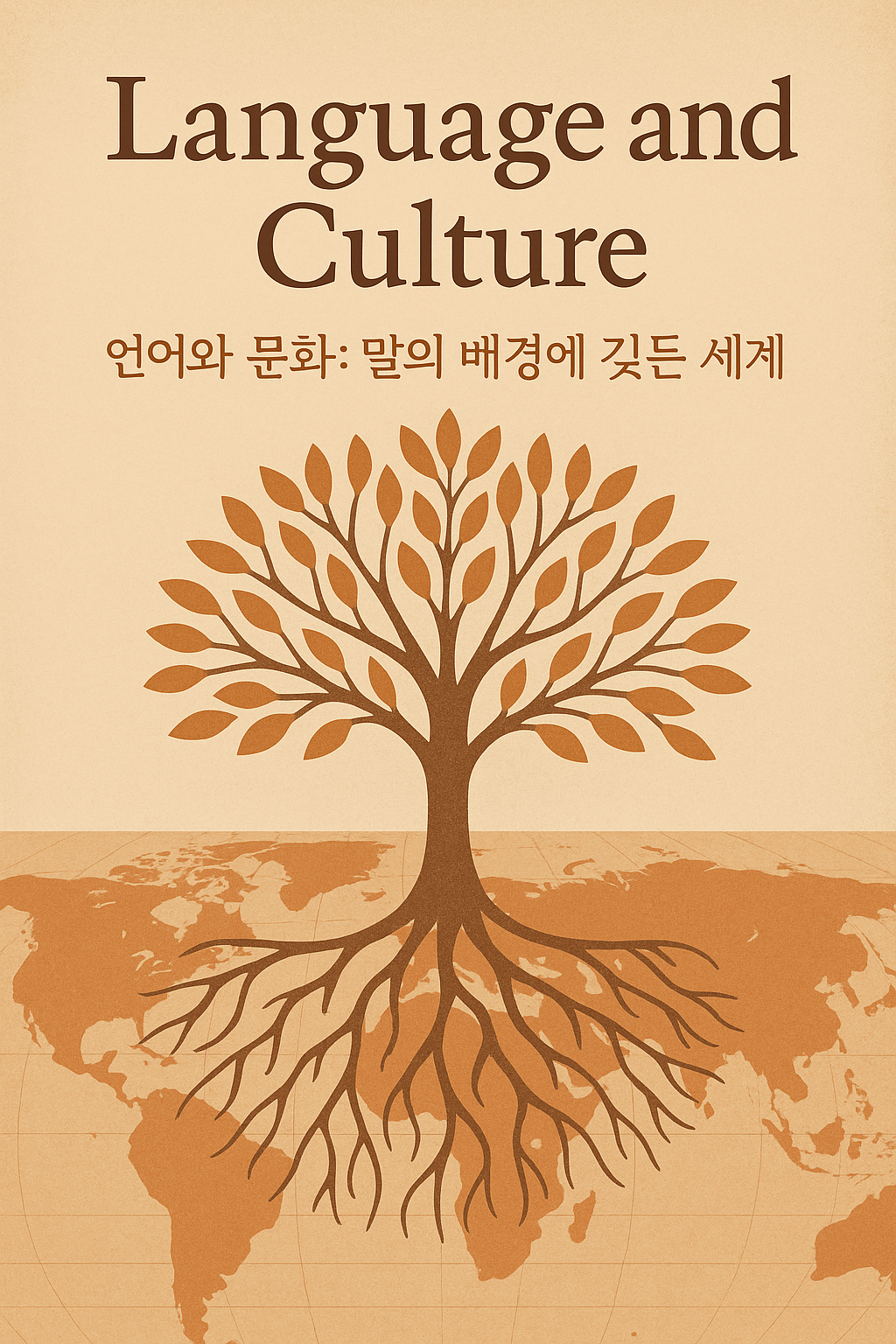
🌿 Language and Culture – 언어와 문화: 말의 배경에 깃든 세계
✨ Ⅰ. Introduction – The World Behind Words
Language is not born in isolation.
It grows from the soil of culture — nurtured by collective memory, shaped by tradition, and colored by values.
When we speak, we carry within our words the rhythm of a people —
their ways of seeing, feeling, and living.
To speak a language is to see the world through a specific lens.
Our grammar reflects our worldview, and our vocabulary carries centuries of shared experience.
Through language, we don’t just communicate — we participate in a culture’s way of being.
📘 Ⅱ. Theoretical Background – Linguistic Relativity and Cultural Patterns
1️⃣ The Sapir–Whorf Hypothesis: Language Shapes Thought
Edward Sapir and Benjamin Lee Whorf proposed that the structure of a language affects its speakers’ perception and cognition.
This idea, known as linguistic relativity, suggests that language is not merely a tool for communication — it is a framework for thought.
- English: emphasizes tense and agency (“I broke the vase”)
- Korean or Japanese: often omits the agent (“꽃병이 깨졌어요” – the vase broke)
→ Different grammatical focus, different perception of responsibility and causality.
Language doesn’t just reflect the world; it constructs it.
2️⃣ Politeness and Cultural Hierarchies
Linguistic politeness reveals cultural values.
In English, politeness is often expressed through tone and indirect phrasing (“Would you mind…”),
while in Korean, it is deeply embedded in grammar and honorific systems (–요, –(으)시–, 존댓말).
These linguistic habits reflect deeper cultural orientations:
- Western cultures → egalitarian and individualistic communication
- East Asian cultures → hierarchical and relational communication
Thus, every polite expression carries invisible layers of social awareness and shared norms.
3️⃣ Cultural Semantics: The Words That Can’t Be Translated
Certain words resist translation because they belong to the emotional DNA of a culture:
- Jeong (정) in Korean – affection rooted in long connection
- Wabi-sabi in Japanese – beauty of imperfection
- Serendipity in English – unexpected joy in discovery
Each word encodes an entire worldview.
To learn another language is to gain access to another emotional universe. 🌏
🌸 Ⅲ. Reflection – Language as the Mirror of Culture
When we learn a language, we don’t just memorize grammar;
we learn how another culture breathes.
We begin to notice what it values, what it omits, and what it celebrates.
Language becomes a mirror — reflecting not only the culture but also ourselves through contrast.
And as we switch between languages, we sometimes find that
the world itself changes shape — not because reality changed,
but because our lens did. 🌿
💫 Ⅳ. Conclusion – Becoming Citizens of Another World
To speak another language is to live another life.
Through the words of others, we learn empathy —
the ability to see through someone else’s eyes.
Language and culture are not separate domains;
they are two sides of the same human experience —
one shaping, and the other being shaped.
“When we learn a new language,
we inherit a new way of being.” 🌏
🌿 Language and Culture – 언어와 문화: 말의 배경에 깃든 세계
✨ Ⅰ. 서론 – 말 뒤에 숨은 세계
언어는 고립된 채 태어나지 않습니다.
그것은 문화라는 토양에서 자라며—공동의 기억에 의해 길러지고, 전통에 의해 형태를 얻으며, 가치에 의해 색을 입습니다.
우리가 말을 할 때, 우리는 그 말 속에 한 민족의 리듬—그들의 사고방식, 감정, 그리고 삶의 방식을 담아 전달합니다.
언어를 말한다는 것은 특정한 렌즈를 통해 세상을 바라보는 일입니다.
문법은 우리의 세계관을 반영하고, 어휘는 수백 년의 공동 경험을 품고 있습니다.
언어를 통해 우리는 단순히 소통하는 것이 아니라—그 문화의 삶의 방식에 참여하는 것입니다.
📘 Ⅱ. 이론적 배경 – 언어 상대성 이론과 문화적 패턴
1️⃣ 사피어–워프 가설: 언어가 사고를 형성한다
에드워드 사피어와 벤저민 리 워프는 언어 구조가 그 말을 사용하는 사람들의 인지와 지각에 영향을 미친다고 주장했습니다.
이 이론을 언어 상대성이라고 하며, 언어가 단순한 의사소통 도구가 아니라 사고의 틀임을 보여줍니다.
- 영어: 시제와 행위자를 명확히 드러냄 (“I broke the vase” — 내가 꽃병을 깼다)
- 한국어·일본어: 행위자를 생략하는 경우가 많음 (“꽃병이 깨졌어요”)
→ 문법적 초점이 다르면 책임과 인과 관계에 대한 인식도 달라집니다.
언어는 단지 세계를 반영하는 것이 아니라, 세계를 구성합니다.
2️⃣ 공손성 체계와 문화적 위계
언어 속 공손성은 그 문화의 가치관을 드러냅니다.
- 영어: 완곡한 표현과 어조가 핵심 (“Would you mind…” 등)
- 한국어: 문법에 깊이 내재된 높임법과 존댓말 체계 (–요, –(으)시– 등)
이러한 언어 습관은 더 깊은 문화적 지향을 반영합니다:
- 서구 문화: 평등주의·개인주의적 의사소통
- 동아시아 문화: 위계적·관계 중심적 의사소통
따라서 모든 공손한 표현에는 눈에 보이지 않는 사회적 감각과 공동 규범이 깃들어 있습니다.
3️⃣ 문화 의미론 – 번역되지 않는 단어들
일부 단어는 특정 문화의 감정적 DNA에 속해 있기 때문에 번역이 쉽지 않습니다:
- 정 (Jeong, 한국어) – 오랜 관계 속에서 생겨나는 깊은 애정
- 와비사비 (Wabi-sabi, 일본어) – 불완전함 속에서 찾는 아름다움
- Serendipity (영어) – 뜻밖의 발견에서 오는 기쁨
각 단어는 하나의 세계관을 담고 있습니다.
다른 언어를 배우는 것은 곧 또 하나의 감정 우주에 접근하는 일입니다. 🌏
🌸 Ⅲ. 성찰 – 문화의 거울로서의 언어
우리가 언어를 배울 때, 단순히 문법을 외우는 것이 아닙니다.
우리는 그 언어의 문화가 어떻게 숨 쉬는지를 배웁니다.
그들이 무엇을 중요하게 여기고, 무엇을 생략하며, 무엇을 기뻐하는지 깨닫게 됩니다.
언어는 거울이 됩니다—그 문화를 비출 뿐 아니라, 그와의 대비를 통해 우리 자신도 비춥니다.
그리고 언어를 바꾸어 사용할 때, 때때로 세상이 다른 모습으로 보이기도 합니다.
현실이 달라진 것이 아니라, 우리가 바라보는 렌즈가 달라졌기 때문입니다. 🌿
💫 Ⅳ. 결론 – 또 다른 세계의 시민이 되기 위하여
다른 언어를 말한다는 것은 또 다른 삶을 사는 것입니다.
타인의 언어를 통해 우리는 공감—남의 눈을 통해 세상을 보는 능력을 배우게 됩니다.
언어와 문화는 분리된 영역이 아니라
인간 경험의 두 면이며, 서로가 서로를 만들고 지탱합니다.
“새로운 언어를 배운다는 것은
새로운 존재 방식을 물려받는 것이다.” 🌏
© MisoEnglish / Michelle Kim. This is original content written by the author. Unauthorized reproduction or full reposting is prohibited. You may quote short parts only with clear credit and a link to the original post.
이 글은 작성자가 직접 집필한 오리지널 콘텐츠입니다. 전체 복제·무단 재게시를 금하며, 일부 인용 시에는 반드시 출처(MisoEnglish)와 링크를 남겨 주세요.