Pronunciation Pitfalls: 50 Sounds to Master for Clear English
Introduction:
Pronunciation is more than just speaking correctly; it's about being understood effortlessly. A single mispronounced vowel or consonant can change a word's meaning or force your listener to constantly re-interpret what you say.
This post targets the 50 most common and costly pronunciation pitfalls that prevent advanced learners from achieving native-like clarity. We’re not focusing on accents, but on articulation—the specific sounds that cause the most confusion, from the elusive 'th' to the subtle difference between ship and sheep.
Mastering these minimal pairs and tricky sounds is the final step in ensuring your English is not only grammatically perfect but also perfectly clear.
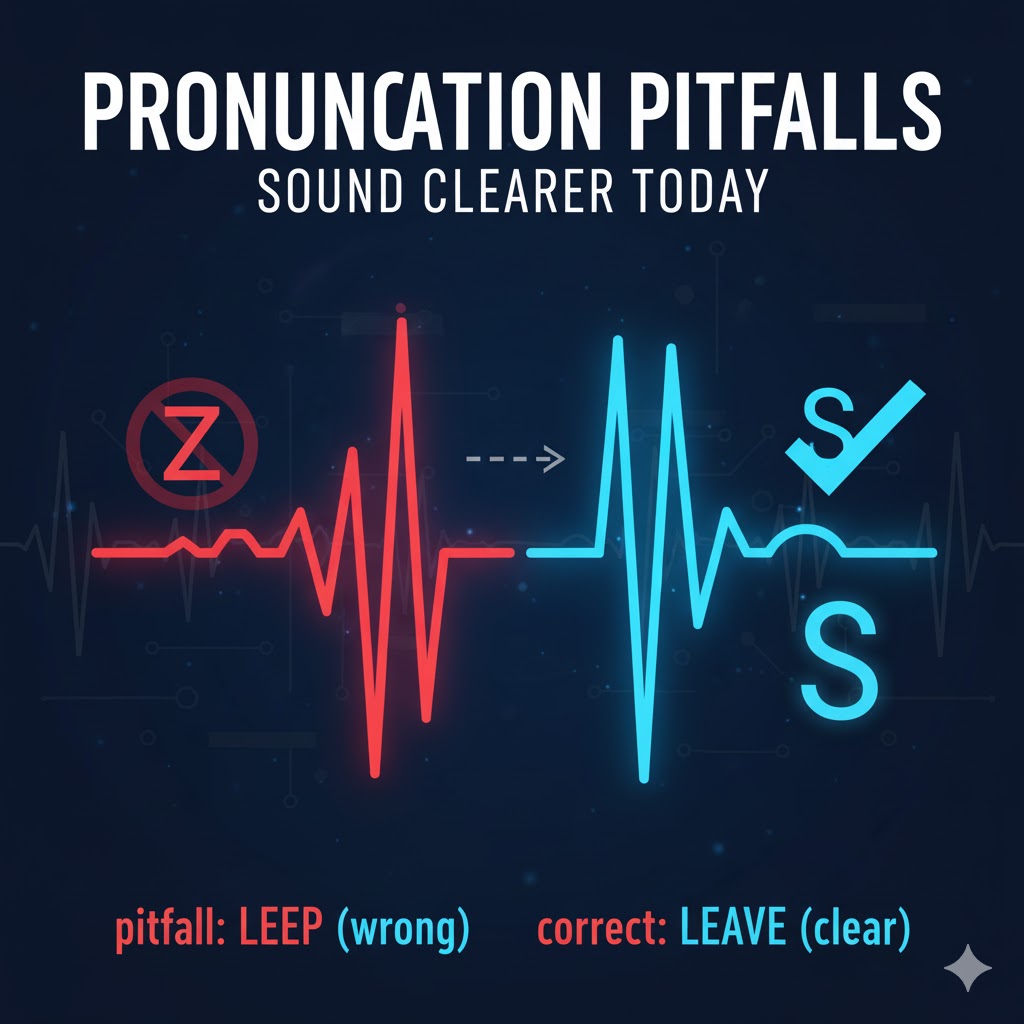
The 50 Pronunciation Pitfalls
Section 1: Vowels and Minimal Pairs (15 Sounds)
Focus on short vs. long vowels, which change meaning.
| # | Pitfall Pair | IPA | Pitfall Mistake | Correct Use |
| 1. | Long 'ee' vs. Short 'i' | /iː/ vs. /ɪ/ | Ship (long 'ee') | Sheep (long 'ee'), Ship (short 'i') |
| 2. | Short 'a' vs. Short 'e' | /æ/ vs. /ɛ/ | Man (like men) | Man (flat 'a'), Men (short 'e') |
| 3. | Long 'oh' vs. Short 'o' | /əʊ/ vs. /ɒ/ | Not (like note) | Note (long 'oh'), Not (short 'o') |
| 4. | 'U' (up) vs. 'A' (far) | /ʌ/ vs. /ɑː/ | Cut (like cart) | Cut (short 'u'), Cart (long 'a') |
| 5. | Long 'oo' vs. Short 'oo' | /uː/ vs. /ʊ/ | Pool (like pull) | Pool (long 'oo'), Pull (short 'oo') |
| 6. | 'Er' (bird) vs. 'E' (bed) | /ɜː/ vs. /e/ | World (like wild) | World ('er' sound), Bed (short 'e') |
| 7. | 'A' (made) vs. 'E' (bed) | /eɪ/ vs. /e/ | Name (like nem) | Name (long 'a'), Bed (short 'e') |
| 8. | 'O' (go) vs. 'A' (cat) | /əʊ/ vs. /æ/ | Show (like shat) | Show (long 'o'), Cat (flat 'a') |
| 9. | 'Ow' (now) vs. 'O' (no) | /aʊ/ vs. /əʊ/ | Down (like done) | Down ('ow' sound), Done (short 'u') |
| 10. | 'Ear' vs. 'Air' | /ɪə/ vs. /eə/ | Here (like hair) | Here ('ear' sound), Hair ('air' sound) |
| 11. | 'Ou' (thought) vs. 'U' (but) | /ɔː/ vs. /ʌ/ | Caught (like cut) | Caught (long 'o'), Cut (short 'u') |
| 12. | Short 'i' vs. Short 'e' | /ɪ/ vs. /e/ | Pin (like pen) | Pin (short 'i'), Pen (short 'e') |
| 13. | 'Ay' (say) vs. 'I' (sigh) | /eɪ/ vs. /aɪ/ | Pay (like pie) | Pay (long 'a'), Pie (long 'i') |
| 14. | The Schwa Sound (ə) | /ə/ | Over-stressing unstressed vowels (e.g., a**bout) | Use a quick, neutral sound (ə) in about |
| 15. | 'Oo' (boot) vs. 'Ew' (new) | /uː/ vs. /juː/ | Pronouncing tune as toon | Tune (starts with a 'y' sound), Toon (starts with 't') |
Section 2: Consonants and Difficult Sounds (20 Sounds)
These include common substitutions, silent letters, and voice differences.
| # | Pitfall Sound | Common Error | Correct Production | Example Words |
| 16. | Voiced 'th' | /ð/ (like dis) | Tongue between teeth, vibration | The, There, Mother |
| 17. | Unvoiced 'th' | /θ/ (like tink) | Tongue between teeth, air only | Thing, Thought, Bath |
| 18. | 'V' vs. 'W' | /v/ is often /w/ | V: Top teeth on bottom lip. W: Rounded lips. | Vest vs. West |
| 19. | 'R' (at end of word) | Rolled or over-articulated | Often a smooth, subtle sound (or silent in some accents) | Car, Faster |
| 20. | 'L' vs. 'R' | Substitution of one for the other | L: Tongue touches ridge behind teeth. R: Tongue curls back. | Light vs. Right |
| 21. | 'S' vs. 'Z' | Unvoiced 's' for voiced 'z' | S: Hissing air. Z: Buzzing vibration. | Sip vs. Zip |
| 22. | 'J' vs. 'Y' | /dʒ/ vs. /j/ | J: Starts with a 'd' sound. Y: Quick 'ee' sound. | Jump vs. Yes |
| 23. | Silent 'L' | Pronouncing the 'l' in certain words | Do not pronounce the 'l' | Could, Walk, Talk |
| 24. | Silent 'K' | Pronouncing the 'k' at the start of words | Do not pronounce the 'k' | Know, Knife, Knee |
| 25. | Silent 'B' | Pronouncing the 'b' at the end of words | Do not pronounce the 'b' | Climb, Dumb, Thumb |
| 26. | Soft 'G' | /dʒ/ (like gum) | Use the 'j' sound | Giant, Germ |
| 27. | Hard 'G' | /g/ (like gem) | Use the hard sound | Game, Get |
| 28. | 'Sh' vs. 'Ch' | /ʃ/ vs. /tʃ/ | Sh: Lips pushed out, smooth air. Ch: Air stopped then released. | Ship vs. Chip |
| 29. | 'P' vs. 'B' | Lack of voicing distinction | P: Voiceless puff of air. B: Voiced. | Park vs. Bark |
| 30. | Final Consonants | Dropping or softening them | Articulate the final sound clearly | Book, Grip, Lost |
| 31. | The 'Ng' sound | /ŋ/ (like think-g) | The sound is created at the back of the throat, no hard 'g' | Sing, Think, Going |
| 32. | 'Ed' endings (past tense) | Always pronouncing /ɪd/ | Only pronounce /ɪd/ after 't' or 'd' | Worked /t/, Needed /ɪd/ |
| 33. | Intrusive 'R' | Adding an 'r' sound where there is none | Avoid adding an 'r' | Idear, Africar |
| 34. | Plural 'Es' | Incorrectly voicing the 's' | Voiced /z/ after voiced consonants/vowels | Dogs /z/, Books /s/ |
| 35. | Stress in Record | Stressing the wrong syllable | Verb (re-CÓRD); Noun (RÉ-cord) | Re-CÓRD (verb), RÉ-cord (noun) |
Section 3: Word Stress, Syllable, and Linking (15 Mistakes)
Focus on how sound changes across words and sentences.
| # | Pitfall Area | The Mistake | The Correction | Example Word/Phrase |
| 36. | Word Stress (Verb/Noun) | Stressing the first syllable of a verb | Stress the second syllable for verbs | PREsent (noun), pre-SENT (verb) |
| 37. | Word Stress (Adjective/Noun) | Stressing the second syllable of an adjective | Stress the first syllable for most adjectives | PERfect (adjective), per-FECT (verb) |
| 38. | Linking (Consonant-Vowel) | Stopping the sound between words | Link the final consonant to the next vowel sound | Pick up becomes Pi-k-up |
| 39. | Contractions | Avoiding or over-articulating them | Use 've, 's, 'd naturally in speech | I've been working / She's going |
| 40. | Syllable Counting | Adding or dropping syllables | Ensure correct syllable count | Interesting (3 syllables) NOT in-ter-est-ing (4) |
| 41. | Auxiliary Verbs | Over-stressing weak words (is, was, do) | Reduce these to the schwa or a quick sound | The book is good (not IZ good) |
| 42. | Prepositions | Over-stressing to, of, for | Reduce these to weak forms (e.g., f'r, t') | Going to work / A lot of time |
| 43. | Question Intonation | Dropping tone at the end of a Yes/No Q | Raise the pitch on the last word | Are you ready? (↑) |
| 44. | List Intonation | Keeping a monotone while listing | Use a rising tone, then a falling tone on the last item | I need pens (↑), paper (↑), and books (↓). |
| 45. | Reduction of 'Going to' | Pronouncing all three words clearly | Reduce it to Gonna | I'm gonna see him later. |
| 46. | Reduction of 'Want to' | Pronouncing both words clearly | Reduce it to Wanna | I wanna get a coffee. |
| 47. | Unstressed 'Can' | Over-stressing 'can' in a statement | Use the weak, reduced form /kən/ | I can help you tomorrow. |
| 48. | Voiced 'S' in 'Is' | Pronouncing 'is' with a hard 's' | Pronounce 'is' with a 'z' sound | The book is here. /ɪz/ |
| 49. | Intonation on Emphatic Words | Speaking key words flatly | Use higher pitch and volume on the most important word | That's ABSOLUTELY right. |
| 50. | Elision (dropping sounds) | Articulating every sound | Drop the middle sound in common phrases | Nex' time, mos' time |