Social English: 50 Phrases for Natural Small Talk and Connecting
Introduction:
Moving from being fluent to being natural is often a matter of mastering Social English. This is the language of connection—the smooth transitions, the genuine reactions, and the polite maneuvers that make conversation feel effortless. It’s about being engaging, not just informative.
In formal settings, we use the textbook; in social settings, we need verbal shortcuts and emotive fillers.
This list of 50 phrases is designed to fill those conversational gaps, making your small talk feel less like an interview and more like a friendly chat. Learn these, and you'll find it easier to break the ice, keep the ball rolling, and make a real connection.
The 50 Essential Social English Phrases
Section 1: Breaking the Ice & Starting a Chat (10 Phrases)
Use these to initiate conversation naturally, moving beyond simple greetings.
| # | Phrase | Function | Example Use |
| 1. | What have you been up to lately? | Asks for general life updates (more casual than "How are you?"). | "Hey! It's great to see you. What have you been up to lately?" |
| 2. | How did your weekend pan out? | Casual way to ask about weekend plans/results. | "Hope you had a good one! How did your weekend pan out?" |
| 3. | Are you keeping busy? | A friendly, indirect way to ask about work/life. | "Things are hectic here. Are you keeping busy?" |
| 4. | I should introduce myself... | A polite, informal way to start an introduction. | "We haven't met. I should introduce myself. I'm Chris." |
| 5. | I hear you're the expert on... | A subtle compliment used to prompt a specific topic. | "I hear you're the expert on that new restaurant downtown." |
| 6. | How are you finding [situation]? | Asks for an opinion on a current shared situation. | "How are you finding the new office layout?" |
| 7. | That reminds me... | Natural transition to a new, related topic. | "Oh, you mentioned the city. That reminds me, I need to plan a trip." |
| 8. | I was just wondering... | A tentative, polite way to ask a question. | "I was just wondering if you've tried that new cafe yet." |
| 9. | Let me grab you a drink. | A common gesture to facilitate conversation flow. | "The line isn't too long. Let me grab you a drink." |
| 10. | It's a small world! | Used when you discover an unexpected connection. | "You know Sarah, too? It's a small world!" |
Section 2: Reacting & Showing Empathy (15 Phrases)
These phrases show genuine interest, shock, or support.
| # | Phrase | Function | Example Use |
| 11. | That sounds like a nightmare! | Expressing strong, empathetic negative reaction. | "I lost my phone and my wallet? That sounds like a nightmare!" |
| 12. | You're kidding me! | Expressing surprise or disbelief (in a friendly way). | "They gave her a raise? You're kidding me!" |
| 13. | I hear you. | Showing that you understand and validate their feeling. | "It's been tough this week. I hear you." |
| 14. | I couldn't agree more. | Strong, informal agreement. | "This weather is awful. I couldn't agree more." |
| 15. | That's a relief! | Expressing satisfaction or positive emotional change. | "The test results were negative? That's a relief!" |
| 16. | Tell me about it! | Expressing strong agreement, often with a complaint. | "This project is taking forever. Tell me about it!" |
| 17. | Oh, that's rough. | A simple, empathetic response to bad news. | "He got sick and missed the concert. Oh, that's rough." |
| 18. | I wouldn't worry too much. | Offering gentle reassurance. | "I wouldn't worry too much. You'll do great." |
| 19. | I’m so jealous! | Expressing envy over a positive experience. | "You went to Greece? I'm so jealous!" |
| 20. | No way! | An exclamation of surprise (used for good or bad news). | "She quit her job? No way!" |
| 21. | That's hilarious! | Expressing that something is very funny. | "He showed up in a costume? That's hilarious!" |
| 22. | Seriously? | Used to confirm surprising information. | "It only cost fifty dollars? Seriously?" |
| 23. | It's not the end of the world. | Minimizing the importance of a small failure. | "I forgot my keys, but it's not the end of the world." |
| 24. | I can only imagine. | Expressing understanding without having experienced it. | "The flight was 10 hours long. I can only imagine." |
| 25. | You nailed it. | Strong compliment meaning they did something perfectly. | "That presentation was perfect. You nailed it." |
Section 3: Smooth Conversational Maneuvers (15 Phrases)
These phrases help you stall, politely interrupt, change topic, or retrieve forgotten information.
| # | Phrase | Function | Example Use |
| 26. | Just a thought... | Introducing a suggestion tentatively. | "Just a thought, maybe we should leave early?" |
| 27. | It totally slipped my mind. | Admitting you forgot something (more natural than "I forgot"). | "I was supposed to call him, but it totally slipped my mind." |
| 28. | I'm drawing a blank. | Cannot recall a name or piece of information. | "What was that actor's name? I'm drawing a blank." |
| 29. | Where were we? | Asking to return to the main topic after an interruption. | "Sorry, I lost my train of thought. Where were we?" |
| 30. | If you'll excuse me for a second... | Polite phrase for a brief, necessary interruption. | "If you'll excuse me for a second, I need to take this call." |
| 31. | To make a long story short... | Signalling that you are summarizing a lengthy tale. | "To make a long story short, we missed the flight." |
| 32. | Speaking of which... | Introducing a new topic related to the previous one. | "You're getting coffee. Speaking of which, I need a refill." |
| 33. | Hold that thought. | Asking someone to pause their statement so you can say something. | "Hold that thought! I just got an important text." |
| 34. | I'll say. | Simple way to express strong agreement with an opinion. | "It was a difficult test." "I'll say." |
| 35. | I could use that! | Enthusiastic way to accept an offer. | "Want a coffee? I could use that!" |
| 36. | That’s beside the point. | Stating that something is irrelevant to the main discussion. | "The color doesn't matter; that's beside the point." |
| 37. | Let me rephrase that. | Used when you need to state something more clearly. | "Wait, let me rephrase that; I didn't mean to sound harsh." |
| 38. | As a matter of fact... | Introducing a piece of relevant, often surprising, information. | "Are you busy? As a matter of fact, I just finished my work." |
| 39. | I didn't quite catch that. | Polite way to ask someone to repeat what they said. | "The music is loud. I didn't quite catch that." |
| 40. | Don't get me wrong... | Used to clarify a preceding negative statement. | "Don't get me wrong, the food was good, but the service was slow." |
Section 4: Closing & Promises (10 Phrases)
Phrases for leaving a conversation politely and arranging future contact.
| # | Phrase | Function | Example Use |
| 41. | I should probably let you get back to it. | Polite way to signal you are ending the conversation. | "This was great, but I should probably let you get back to it." |
| 42. | I'm going to run. | Very casual way to say "I'm leaving." | "It's late, so I'm going to run." |
| 43. | It was great catching up. | A warm, common phrase to conclude a chat with someone you know. | "Talk soon! It was great catching up." |
| 44. | Let's catch up soon. | Informal phrase promising to talk again in the near future. | "I didn't get to hear about your trip. Let's catch up soon." |
| 45. | I'll give you a buzz. | Casual way to say "I'll call you." | "When you get back in town, I'll give you a buzz." |
| 46. | Keep me posted! | Asking for updates on a developing situation. | "Let me know what happens with the interview. Keep me posted!" |
| 47. | Say hi to [Name] for me. | Asking someone to pass on a greeting. | "I haven't seen your brother in a while. Say hi to him for me." |
| 48. | I've got to jet. | Informal, slightly playful way of saying "I have to leave quickly." | "Look at the time—I've got to jet!" |
| 49. | Have a good one. | A common, versatile farewell (means 'Have a good day/week'). | "See you on Monday! Have a good one." |
| 50. | I'll be in touch. | Professional or friendly promise to communicate soon. | "I'll review the notes and I'll be in touch." |
This video offers practical tips and key question types for learners to use when initiating and sustaining social small talk in everyday English situations.
English Small Talk for Social Situations

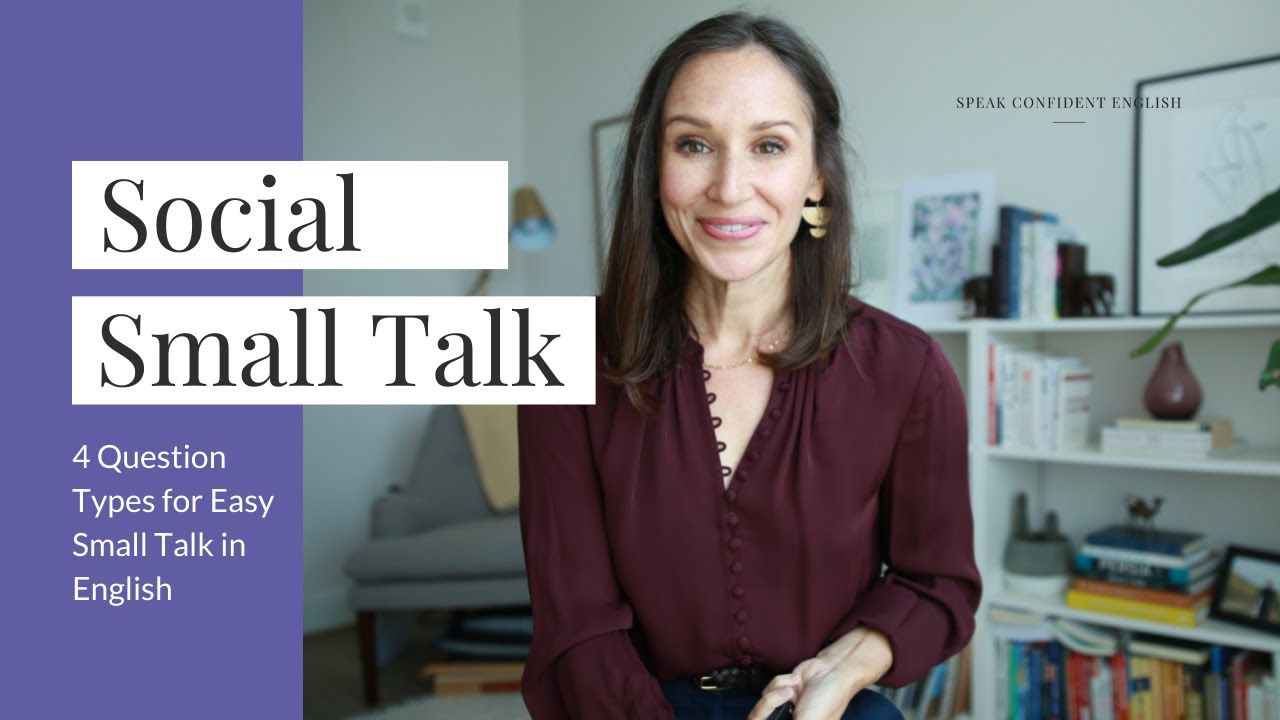
Transcript: English Small Talk for Social Situations
The transcript is from the video located here: http://www.youtube.com/watch?v=XA9ZZqrxSZk.
- Do you avoid opportunities to start conversations socially because you're just not sure what to say or ask in English? [00:00]
- For example, if you see your neighbor out watering her garden, or when you go to your yoga studio every Monday and Wednesday, and you see the same people there every time [00:14], maybe you even avoid things like joining a book club, because you're so nervous about that process of getting to know others. [00:22]
- Several months ago, I did a lesson on English, small talk for work, but what about small talk for social more informal situations? [00:27]
- Can you ask the same questions? How can you be sure that you're polite, but not too formal or too personal, too fast. [00:40]
- By the end of this lesson today, you'll have several open-ended questions that you can use to effectively start a conversation and make a connection to others. [01:08]
- Whether you're in a book club, going to a yoga studio, talking to your neighbor or any other social situation that you might be in. [01:19]
- Small talk plays a critical role in building relationships and forming friendships. We use it as a pathway to learn something new about someone. [01:50]
- On that path, we're able to establish connections, discover potential friendships, and have fun along the way. [02:06]
Strategy 1: Start with a Compliment
- Strategy Number one, start with a compliment. [02:18]
- When you meet someone new for the very first time, you don't have any initial common ground. You have to find a way to discover common interests or things to talk about. [02:30]
- The easiest way to take those first steps is to start with a compliment, something related to the situation that you're in. [02:46]
- Then add an open-ended question. For example, you're going to a party, you might say to someone, "Your dress is gorgeous. Where did you get that?" [02:59]
- Here's a second scenario: You want to strike up a conversation with a neighbor while you're taking a walk outside. You might say "Your garden is beautiful. What's your secret?" [03:52]
Strategy 2: Inquire About Wellbeing
- The second way to initiate small talk is to inquire about someone's day or their wellbeing. [04:03]
- You could use that opportunity to initiate some small talk and have a little conversation. [04:34] The best way to do that is simply ask about their day or their wellbeing. [04:42]
- Scenario (at the grocery store during a busy time): "It seems so busy today. How are you holding up?" [05:24]
- "How are you holding up?" is a casual way to ask how someone is doing during a particularly difficult or challenging time. [05:33]
- Scenario (in an Uber): "There's always a lot of traffic at this time of day. How are your trips going so far?" [06:10]
Strategy 3: Ask for an Opinion or Suggestion
- The third question type is to ask for someone's opinion or ask for someone's suggestion. [06:41]
- If you wanted to start a conversation with someone you see often at the gym, you could say "Building strength and getting fit has been such a long journey for me. I'd love to know how do you stay committed to your fitness goals?" [07:45]
- Scenario (in a book club): You could start with a comment on the current book, and then follow it up with a question that is asking for someone's opinion or suggestion. [08:16]
- Example: "I thought the author explored the theme of happiness in an unusual, surprising way. What did you think?" [08:29]
- Important Note: We have to be careful to not become too personal too soon. We are focused on asking their opinion about a common topic or a common area of interest. [08:56]
Strategy 4: Connect Through Hobbies or Interests
- The fourth type of question you can use for social small talk is connect through hobbies or interests. [09:40]
- I encourage my students to keep an ear out for common areas of interest or hobbies. What this means is to always be listening for those little details that people share. [10:08]
- Scenario (with your boss during an awkward silence): You could change the focus of conversation slightly by acknowledging an area of interest or hobby and asking for more details. For example, "I remember you mentioned reading Obama's autobiography. What did you think about it? Would you recommend it?" [10:59]
- Scenario (with parents at school pick-up): If you have no idea what someone's interests or hobbies are, you can simply ask after you have that basic greeting. You could say something like, "So what do you and your family love to do on the weekends?" [11:52]
- With that, you have four different kinds of questions you can use for appropriate, polite and interesting English small talk for social situations. [12:12]