C2 Proficiency: 50 Phrases for Near-Native Mastery
Introduction:
Congratulations! You've reached the summit of English learning. At the C2 level, communication isn't about being understood; it's about achieving precision, rhetorical flair, and absolute mastery in every setting—from writing complex reports to participating in philosophical debate.
This level demands more than just grammar; it demands collocations—words that naturally pair together like "stark contrast" or "unreservedly condemn." Using these phrases is the difference between writing an essay and writing a scholarly paper.
This list of 50 phrases is your final polish. It will elevate your English from fluent to impeccable, giving you the confidence to articulate subtle shades of meaning in any complex, challenging, or formal discussion.
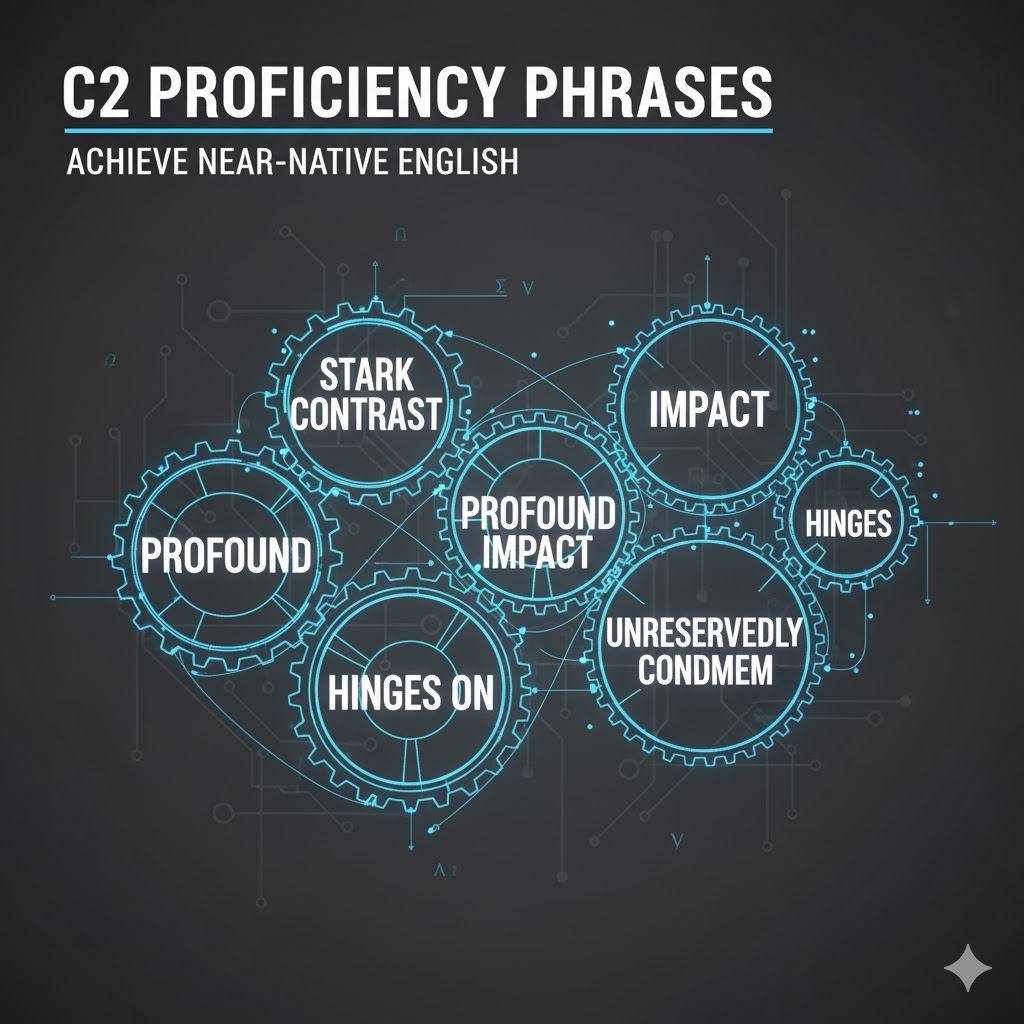
The 50 C2 Proficiency Phrases
Section 1: Collocations for Strong Statements & Intensity (15 Phrases)
These phrases pair an adjective or adverb with a noun or verb to achieve dramatic precision.
| # | Collocation / Phrase | Meaning | Example Use |
| 1. | Stark contrast | A very clear and obvious difference. | "There is a stark contrast between the two reports." |
| 2. | Profound impact | A deep or intense effect. | "The new policy had a profound impact on staff morale." |
| 3. | Fundamental difference | A basic, core difference. | "They have a fundamental difference in their approach to problem-solving." |
| 4. | To critically examine | To look at something in depth, identifying strengths and weaknesses. | "The committee must critically examine the evidence." |
| 5. | Widely acknowledged | Generally accepted or known by many people. | "It is widely acknowledged that technology is evolving rapidly." |
| 6. | To unequivocally state | To express an opinion clearly and without doubt. | "The CEO unequivocally stated his commitment to the changes." |
| 7. | Vast majority | The great portion of a group. | "The vast majority of researchers support the findings." |
| 8. | Crucial element | A central, essential part. | "Trust is a crucial element in any successful partnership." |
| 9. | Inherent flaws | Defects existing as a natural part of something. | "The system has several inherent flaws that need fixing." |
| 10. | Beyond dispute | So clearly true that no one can argue with it. | "The necessity of the reform is beyond dispute." |
| 11. | To render obsolete | To make something old-fashioned or irrelevant. | "New technology will soon render this model obsolete." |
| 12. | To harbor resentment | To keep feelings of bitterness or anger over time. | "Many employees still harbor resentment over the layoffs." |
| 13. | Deeply flawed | Having serious and significant defects. | "The initial assumption proved to be deeply flawed." |
| 14. | To garner support | To collect or gather approval or help. | "The campaign struggled to garner support from the public." |
| 15. | Unreservedly condemn | To express strong disapproval without holding back. | "The politician chose to unreservedly condemn the violence." |
Section 2: Formal Connectors & Structuring Argument (15 Phrases)
These phrases help you link complex ideas and transition smoothly in academic writing or formal speech.
| # | Formal Connector / Phrase | Function | Example Use |
| 16. | Be that as it may... | Conceding a point before presenting a counter-argument. | "Be that as it may, the long-term cost remains prohibitive." |
| 17. | In light of this evidence... | Introducing a conclusion based on a prior statement. | "In light of this evidence, we must revise our hypothesis." |
| 18. | Concurrently... | Stating that something is happening at the same time. | "The team is restructuring; concurrently, they are hiring new staff." |
| 19. | Insofar as... | To the extent that (used to qualify a statement). | "Insofar as the budget allows, we should hire more developers." |
| 20. | In essence... | Explaining the most important, fundamental nature of something. | "In essence, the entire strategy rests on one core assumption." |
| 21. | The prevailing wisdom is... | Introducing the current, accepted common belief. | "The prevailing wisdom is that remote work is more efficient." |
| 22. | To give credence to... | To lend authority or belief to an idea. | "The new data gives credence to the earlier, smaller study." |
| 23. | It is imperative that... | Stating that something is absolutely necessary. | "It is imperative that all teams adhere to the new security protocols." |
| 24. | Notwithstanding the data... | Despite the data (more formal than 'despite'). | "Notwithstanding the data, the client insists on the original design." |
| 25. | By the same token... | Introducing an idea that supports the previous one. | "The software is powerful; by the same token, it requires intensive training." |
| 26. | Suffice it to say... | Used to summarize briefly, implying the rest is understood. | "Suffice it to say, the meeting did not go well." |
| 27. | The dichotomy between... | Highlighting a contrast or division between two ideas. | "The dichotomy between public opinion and official policy is clear." |
| 28. | There is a propensity for... | There is a natural tendency or inclination for something. | "There is a propensity for new businesses to overestimate their initial revenue." |
| 29. | To extrapolate from this... | To infer or estimate based on existing information. | "To extrapolate from this, we can predict a 15% growth next quarter." |
| 30. | To be contingent upon... | To depend on another condition. | "The project launch is contingent upon final legal approval." |
Section 3: High-Level Phrasal Verbs & Expressions (20 Phrases)
These idioms and verbs are common in formal speech and highly skilled writing.
| # | Phrasal Verb / Expression | Meaning | Example Use |
| 31. | To grapple with | To struggle to deal with a difficult problem. | "Researchers are still grappling with the ethical implications of AI." |
| 32. | To flesh out | To add more detail and substance to an idea. | "We need to flesh out the core concepts before the next meeting." |
| 33. | To hinge on | To depend entirely on one thing. | "The entire success of the venture hinges on securing that patent." |
| 34. | To gloss over | To treat a serious subject lightly or quickly, often avoiding detail. | "The report glossed over the department's biggest failures." |
| 35. | To factor in | To include a circumstance or influence when making a plan. | "Did you factor in the possibility of a supply chain delay?" |
| 36. | To set the stage for | To prepare for what will happen next. | "The CEO's announcement set the stage for a major company overhaul." |
| 37. | To square up to | To confront or deal with a problem directly. | "The management finally decided to square up to the crisis." |
| 38. | To fall short of | To fail to meet an expectation or requirement. | "The final revenue figures fell short of the ambitious targets." |
| 39. | To call into question | To cause doubts about whether something is true or valid. | "The leaked emails call into question the company's integrity." |
| 40. | To come to terms with | To gradually accept a difficult situation. | "The market is slowly coming to terms with the new regulations." |
| 41. | To stand at a crossroad | To be at a point where a crucial decision must be made. | "The industry now stands at a crossroad regarding fossil fuels." |
| 42. | To take precedence | To be considered more important than something else. | "Safety must always take precedence over speed." |
| 43. | To be under no illusion | To know the truth about a difficult situation, despite appearances. | "We are under no illusion that this transition will be easy." |
| 44. | To steer clear of | To avoid or stay away from. | "During the negotiation, we must steer clear of political commentary." |
| 45. | To lend weight to | To make an argument or idea more credible or convincing. | "The historical data lends weight to the theory of a market correction." |
| 46. | To shed light on | To help to explain a situation. | "The new document helps shed light on the firm's past practices." |
| 47. | To champion the cause | To publicly support and defend a belief or movement. | "The manager championed the cause of flexible working hours." |
| 48. | To face a barrage of | To be confronted with a continuous, heavy stream of something (questions, criticism). | "The spokesperson faced a barrage of questions from the press." |
| 49. | To wrestle with | To struggle to find a solution (similar to 'grapple with'). | "The scientists wrestled with the complex equation for weeks." |
| 50. | To pave the way for | To create the conditions for something to happen. | "The successful pilot program paved the way for a national rollout." |